
May 7, 2024 - PBS NewsHour full episode
5/7/2024 | 57m 46sVideo has Closed Captions
May 7, 2024 - PBS NewsHour full episode
May 7, 2024 - PBS NewsHour full episode
Problems playing video? | Closed Captioning Feedback
Problems playing video? | Closed Captioning Feedback
Major corporate funding for the PBS News Hour is provided by BDO, BNSF, Consumer Cellular, American Cruise Lines, and Raymond James. Funding for the PBS NewsHour Weekend is provided by...
May 7, 2024 - PBS NewsHour full episode
5/7/2024 | 57m 46sVideo has Closed Captions
May 7, 2024 - PBS NewsHour full episode
Problems playing video? | Closed Captioning Feedback
How to Watch PBS News Hour
PBS News Hour is available to stream on pbs.org and the free PBS App, available on iPhone, Apple TV, Android TV, Android smartphones, Amazon Fire TV, Amazon Fire Tablet, Roku, Samsung Smart TV, and Vizio.
Providing Support for PBS.org
Learn Moreabout PBS online sponsorshipAMNA NAWAZ: Good evening.
I'm Amna Nawaz.
Geoff Bennett is on assignment.
On the "NewsHour" tonight: Israel seizes control of a Gaza border crossing, as a cease-fire and hostage deal hangs in the balance.
Adult film star Stormy Daniels takes the stand in the hush money trial of former President Donald Trump.
And basketball star Brittney Griner talks about her release from Russian prison and readjusting to life back in the United States.
BRITTNEY GRINER, WNBA Player: Once I'm on the soil and we pulled up to that hangar, and I saw my wife and I saw that U.S. flag hanging in that hangar, Then I finally could relax.
(BREAK) AMNA NAWAZ: Welcome to the "NewsHour."
Delegations from Israel and Hamas returned to Cairo to resume fraught negotiations over a potential cease-fire and hostage deal.
In the meantime, Israeli tanks and troops seized the Rafah border crossing with Egypt, delaying aid shipments, as 1.2 million Palestinians shelter in the city.
Following it all is our Nick Schifrin, reporting tonight from Jacksonville, North Carolina.
So, Nick, let's begin in Rafah.
Tell us what kind of operation Israel has launched there and why.
NICK SCHIFRIN: Well, Amna, as you just said, Israel sees the border crossing that separates Gaza from Egypt.
Israel called it a -- quote - - "precise operation" to tackle some of the smuggling that goes from Egypt into Gaza, as well as the Hamas militants who operate there.
This is actually the first time that Israeli troops have controlled that border crossing since 2005, when Israel withdrew settlers and soldiers from Gaza back then.
And in this war, Israel has long argued that it needs to enter nearby Rafah City.
And, today, Israeli Prime Minister Benjamin Netanyahu said that operation was next.
BENJAMIN NETANYAHU, Israeli Prime Minister (through translator): Seizing the passage in Rafah today is a very important step, an important step on the way to destroying the remaining military capabilities of Hamas, including the elimination of the four terrorist battalions in Rafah, and an important step to damage the governmental capabilities of Hamas, because, as of this morning, we denied Hamas a passage that was essential for establishing its reign of terror in the strip.
NICK SCHIFRIN: But Rafah is also the main crossing of humanitarian aid from Egypt into Gaza.
And, today, hundreds of trucks are backed up at the border because the crossing is shut, as is the nearby crossing of Kerem Shalom, which Israel promised to open by tomorrow.
And the U.N. warned today that food and fuel to Southern Gaza will run out by the end of the week.
And, of course, Amna, as you and I have talked about so often, the U.N. is warning that famine is imminent.
AMNA NAWAZ: Nick, help us understand now.
Both sides are -- also seem to be making clear today that this operation is intertwined with the fate of those hostage negotiations as well.
Is that right?
NICK SCHIFRIN: It's certainly what Israel has said, Amna, absolutely, that Israel has said that this military operation must continue in order to keep the pressure on Hamas, so that Hamas agrees to the latest version of the hostage negotiation deal.
But the fact is right now that the ball is in Israel's court.
Hamas submitted a new to the latest version of the hostage negotiation deal.
Israeli officials said that Hamas had actually created new versions or new aspects of that deal.
And a senior U.S. official today confirmed to me that the Hamas changes were significant.
But, still, the U.S. is hoping that progress can be made.
John Kirby, the National Security Council spokesman, saying today that the two sides should be able to -- quote -- "close the gaps."
But, today, Hamas, spokesman Osama Hamdan warned that a major Rafah operation means no deal over hostages.
OSAMA HAMDAN, Hamas Spokesperson (through translator): If the aggression continues, there will be no cease-fire, because Israelis are the ones attacking and shooting.
It is normal for the resistance to respond to this aggression, to respond in defense, and to respond in order to defeat the occupation.
NICK SCHIFRIN: Now, this is all part of the diplomacy that CIA Director Bill Burns has been leading, and his trip to the region continues today.
The U.S. is pressuring Netanyahu to make the deal, as are the families of hostages being kept in Gaza.
And the U.S. has also pushed Qatar to threaten Hamas with expulsion from Doha, where the political leadership of Hamas is based if Hamas rejects this deal.
It's not clear, Amna, if this deal can be made.
But the U.S. knows it is urgent.
U.S. officials tell me that Israel has imposed a deadline by the end of the week and then, if this deal is not set by then, it will launch that major operation into Rafah, defense Minister Yoav Gallant making that explicit today.
He said, if there's no deal, Israel will -- quote -- "go deeper into Rafah."
AMNA NAWAZ: That is Nick Schifrin reporting tonight from Jacksonville, North Carolina.
Nick, thank you.
In the day's other headlines: TikTok sued to overturn a new law that could ban the video-sharing platform inside the U.S.
The statute says that TikTok has to end American operations unless its Chinese parent company, ByteDance, sells it within nine months.
The lawsuit says that mandate is -- quote -- "simply not possible, not commercially, not technologically, not legally," and that it violates the First Amendment.
In Ukraine, the state security service says it foiled a Russian plot to assassinate President Volodymyr Zelenskyy and others.
Investigators arrested two colonels in the guard unit that protects high-ranking Ukrainian figures.
Investigators say they planned to kidnap and kill Zelenskyy before Russian President Vladimir Putin's inauguration.
That inauguration took place today, as Putin was sworn in for his fifth term after almost 25 years in office.
At an elaborate Kremlin ceremony, Putin vowed to defend the Russian Constitution.
He said he was open to working with the West, despite bitter divisions over Russia's war in Ukraine.
VLADIMIR PUTIN, Russian President (through translator): We have been and will be open to strengthening good relations with all countries who see Russia as a reliable and honest partner.
And this really is the global majority.
We do not reject dialogue with Western states.
The choice is theirs.
AMNA NAWAZ: Putin now begins a six-year term that will keep him in office through 2030, when he will be eligible to run again.
It turns out a U.S. army soldier arrested in Russia last week was not authorized to be there.
The Army says that Staff Sergeant Gordon Black was on leave and was supposed to be returning to Texas.
Instead, he flew from South Korea through China to Vladivostok.
But Pentagon officials say he never got permission.
SABRINA SINGH, Pentagon Deputy Press Secretary: Official or any leave to Russia is strictly prohibited.
And that's pursuant to the DOD foreign clearance guide, which, of course, is also informed by the State Department guidelines, which, right now, I believe that is at -- I believe it's category four, which is do not travel to Russia.
AMNA NAWAZ: Russian officials say Black went to Russia to see a girlfriend, but the couple argued and he was arrested for stealing money from her.
Separately, Moscow's court system says a U.S. civilian is being held there after he was spotted in public drunk with no clothes on.
Officials in London say the British military's payroll system was hacked, exposing names, banking details and even home addresses.
As many as 272,000 soldiers, sailors and Air Force members were affected, both current and former.
Reports swirled today that China was involved, but British officials would not confirm that publicly.
Rescuers in South Africa worked today to free 11 people trapped under a collapsed building.
The five-story apartment complex in the city of George was under construction when it gave way on Monday.
Six workers were confirmed dead.
Crews have been combing through the wreckage, searching for bodies and survivors.
Nearly 40 people are still unaccounted for.
Here at home, a federal judge in Florida has indefinitely delayed former President Trump's classified documents trial.
Judge Aileen Cannon, a Trump appointee, canceled the trial date of May 20, but she gave no new date, saying she has yet to rule on several key legal issues.
Mr. Trump has pleaded not guilty to 40 federal counts.
A tornado ripped through a small Oklahoma town last night, killing at least one person.
It happened in Barnsdall, north of Tulsa.
The town had already been hit by an earlier tornado last month.
This time, the damage was far worse.
Debris littered lot after lot where homes once stood.
The mayor said the crews are still sifting through the wreckage.
JOHNNY KELLEY, Mayor of Barnsdall, Oklahoma: We have got drones.
We have got dogs.
We have got infrared stuff.
We're going through the debris very thoroughly.
All the search-and-rescue teams are going through with a fine-teeth comb because nobody wants to miss anything.
AMNA NAWAZ: The National Weather Service had reports of 16 other tornadoes across a swathe of neighboring states.
A scathing new independent report has found rampant sexual harassment, racial bias, and other misconduct at the Federal Deposit Insurance Corporation, or FDIC.
The report said that leaders at the banking regulator, including its chair, Martin Gruenberg, ignored the problems and that those who complained face retaliation.
Gruenberg called the findings sobering and pledged to make changes.
After more than a century, the Boy Scouts of America will change its name to simply Scouting America.
The rebrand reflects the organization's shift towards inclusivity, namely, allowing girls to join the ranks.
In an interview, President and CEO Roger Krone said -- quote -- "In the next 100 years, we want any youth in America to feel very, very welcome to come into our program."
And on Wall Street, stocks mostly drifted in lackluster trading today.
The Dow Jones industrial average gained 32 points to close at 38884.
The Nasdaq fell 16 points.
The S&P 500 added seven.
Still to come on the "NewsHour": President Biden denounces the rise in antisemitism in a speech marking Holocaust Remembrance Day; a look at whether campus protests against the war in Gaza qualify as civil disobedience; and Anita Hill on the overturning of Harvey Weinstein's rape conviction and what it means for the MeToo movement.
Stormy Daniels, the adult film actress at the center of the criminal hush money trial against former President Donald Trump, took the stand in New York City today.
William Brangham has more on the volatile day in court.
WILLIAM BRANGHAM: That's right, Amna.
In sometimes graphic detail, Stormy Daniels described the one sexual encounter she alleges she had with Trump and the six-figure payment she received from Trump's lawyer to buy her silence before the 2016 election.
Trump denies any sexual relationship with her.
Daniels was forcefully cross-examined by Trump's legal team, who questioned her financial motives and her shifting stories about her encounter with the former president.
Andrea Bernstein is covering the trial for NPR, and she joins us again now.
Andrea, what did we learn from Stormy Daniels today?
ANDREA BERNSTEIN, NPR Contributor: So it was quite a scene, because this is a trial where we have heard now testimony from David Pecker, the former publisher of "The National Enquirer," from Stormy Daniels' lawyer Keith Davidson about this deal that they set up.
And, obviously, the defendant is male.
We have heard about Michael Cohen.
Here was the woman at the center of it all coming forward for the first time in the courtroom to tell her story of this encounter with President Trump at a celebrity golf tournament in 2006.
And she -- as you said, it was quite graphic, but she walked the jury through what happened.
Trump invited her up to his suite.
They were speaking.
She went to use the restroom.
He came in -- when she came out, he was lying on the bed in his underwear, she says, and then she says they had sex.
And that is what is at the heart of all of this, hush money deals, trying to silence it, and, only now, here we are in 2024, with her testifying about something that happened in 2006.
WILLIAM BRANGHAM: I know that Trump's lawyers at one point, citing some of those graphic details, saying that they were prejudicial to the jury, pushed for a mistrial.
How did the judge respond to that?
ANDREA BERNSTEIN: So Trump was about as agitated as I have seen him in this case, leaning over, talking to his lawyers, clearly very upset during all of Stormy Daniels' testimony.
Of course, he has denied having any kind of relationship with her.
After lunch, his lawyers came back and said to the judge, this is so prejudicial, all of these details.
This is a case about business records.
And the prosecution said, no, no, no, this is necessary to complete the narrative.
This is a story about what happened.
The jury needs to hear it.
In fact, it's the story that Trump and Michael Cohen tried to keep silent.
And the judge said, well, he was not going to declare a mistrial, but that he wishes that there were details that had not come out.
And in the afternoon testimony, there was a close rain kept on Stormy Daniels, although then, of course, it was the defense's turn to cross-examine her, with the prosecution objecting.
And it was a very agitated day of testimony in the courthouse in Lower Manhattan.
WILLIAM BRANGHAM: Tell us a little bit more about that, that cross-examination, because my understanding is that Susan Necheles, Trump's lawyer, really went at her and tried to exploit some holes in her story.
ANDREA BERNSTEIN: Right.
Right.
That's right.
I mean, the details of the encounter that Stormy Daniels laid out did sync up with what other witnesses have testified, down from sort of Trump calling her honey bunch, to the contact that she made through his executive assistant, Rhona Graff.
We had heard from Rhona Graff.
She had acknowledged that she'd seen Stormy Daniels in Trump Tower, entered a contact for her.
But what the defense wanted to lean into is all of the contradictory accounts that Stormy Daniels has given since this happened.
And those are out there.
She obviously denied the story for a long time, put a toe in the water about selling it in 2011, drew back, then made this NDA with Trump, or with Cohen, on behalf of Trump, as she understood it, in 2016, during the campaign.
She testified how anxious she was that he would never pay her and she'd have essentially no leverage after the campaign.
But the defense just wanted to dwell on all of the contradictory accounts, that she'd, in fact, hated Trump, that she owed him money from an unsuccessful defamation suit she tried to bring against him.
And this all came up.
And it's going to be for the jury to sort out whether all of those contradictory counts overwhelm the other testimony corroborated about what she says happened in 2006 and then how she made this deal with the Trump campaign or with Trump through Michael Cohen in late - - in -- late in the campaign in 2016.
WILLIAM BRANGHAM: So how did Daniels respond to all of that?
Because, as you were saying, her story has shifted over time.
I mean, in one case, certainly, she was paid to change her story from what she alleges is the truth.
How else did she defend herself to say, no, in fact, this is why my story makes sense in its totality?
ANDREA BERNSTEIN: Well, so this cross-examination is going to consider -- continue on Thursday.
There's no testimony tomorrow.
And it wasn't -- she didn't exactly have the opportunity to say, believe what I have to believe, but she stood by the heart of her story, which is that she had a sexual encounter with Donald Trump in 2006, and then decided to sell it in 2016.
And, of course, that's all the prosecution needs.
Nevertheless, the jury was treated to many statements that she had given denying that there had been an encounter.
And that exists.
And that is something that the prosecution will likely try to clean up when they get to redirect.
But it still exists.
And it's something that the jury will just have to consider when they go over all the evidence.
WILLIAM BRANGHAM: All right, Andrea Bernstein, thank you so much from NPR for getting us through all this.
ANDREA BERNSTEIN: Thank you.
AMNA NAWAZ: As reported earlier, an Israeli delegation has arrived in Cairo for crucial cease-fire talks a day after Hamas said it had accepted an Egyptian-Qatari proposal.
To explore what could happen next, we turn now to Hussein Ibish, senior resident scholar at the Arab Gulf States Institute.
That's a think tank here in Washington.
Hussein, good to see you.
HUSSEIN IBISH, Senior Resident Scholar, Arab Gulf States Institute: Thank you very much.
AMNA NAWAZ: So let's begin with the Israeli troops seizing that critical Rafah border crossing today.
What does that say to you, that there's some larger incursion imminent or a different kind of strategy?
HUSSEIN IBISH: No, it doesn't say that.
What it says to me is that the Israelis are going ahead with key parts of their original war aim.
At the beginning of the war, they definitely wanted to seize the Philadelphi Corridor, which is the parcel of land between the Egyptian border and Rafah and the urban areas most south of -- in Gaza.
And this is a crucial, strategically crucial area, which the Israelis agreed not to occupy in the peace treaty with Egypt and then again in 2005, when they redeployed their troops out of Gaza, and then again after 2007, when Hamas took over.
They have agreed many times with the Egyptians not to take it.
But I think they're determined after October 7 to reoccupy it, to create a buffer zone in the south that will mimic the buffer zone that they are going to beef up and greatly strengthen in the north, the one that Hamas and the others breached on October 7.
And, lastly, I think they're thinking about maintaining troops in a buffer zone in the center of Gaza, dividing Gaza in half between north and south.
And this sets up a potential set of targets for a long-term insurgency against Israeli troops.
So it's the kind of long-term plan that Hamas likes to hear about, frankly.
AMNA NAWAZ: Well, at a time when we have the head of the World Food Program saying there's already a full-blown famine in Northern Gaza moving south, what does the seizing of this border crossing mean in terms of its impact on the ground?
HUSSEIN IBISH: Well, it's dire, because every parcel of food that goes through is crucial, because people are living on the brink of starvation.
And in the north, they are starving.
And there have been trucks going through the Rafah crossing, the crossing that is now blocked off by Israeli troops, through Egypt.
And the Israelis have been very restrictive through the crossings they controlling, including Kerem Shalom, which is the one that could really handle large amounts.
And that's why the United States has been trying to build this maritime pier and other countries have done airdrops.
But it is a potentially huge problem, adding to the famine conditions in Gaza.
AMNA NAWAZ: What about the negotiations over a potential cease-fire and hostage release?
We heard the U.S. national security spokesperson, John Kirby, today say they believe the text is close.
HUSSEIN IBISH: Yes.
AMNA NAWAZ: Do you share that optimism?
You think both sides are incentivized to make a deal right now?
HUSSEIN IBISH: I think that both the Netanyahu government, especially Netanyahu, and also Yahya Sinwar, the head of Hamas in Gaza, believe they profited politically off of the war.
And they would both like to keep it going.
But Hamas is under so much pressure from their own leaders outside of Gaza, from the people of Gaza, from other Palestinians, and from Arab countries, that they have had to shift their policies very greatly.
They were calling for a total cease-fire.
They're now apparently willing to accept a series of short-term cease-fires.
And they have shifted a lot.
So it's possible there could be an agreement.
But Netanyahu keeps talking about a rough operation with or without a cease-fire.
He's really kind of sabotaging the talks.
And the Israeli delegation is a mid-level delegation, meeting -- meaning they don't have any authority.
They're just there to be there.
They really are there for show.
And that's a big problem.
So we will see.
Netanyahu is under a lot of pressure to get hostages out if he can.
But if he can avoid this cease-fire, he's going to do it.
And I think we can see how the Israelis are going to do their Rafah operation without confronting the Biden administration, piecemeal little bit here, a little bit there, rather than a giant, smashing attack, like they did in Khan Yunis, reducing the place to a moonscape in a few days.
They will just salami-slice it off bit by bit.
The problem for Biden is, that may take the war into the summer.
And that's bad news for his campaign.
AMNA NAWAZ: Hussein, what about the Saudi influence here?
We heard the foreign minister just refer to the war and use the word genocide for the first time... HUSSEIN IBISH: Yes.
AMNA NAWAZ: ... in an English-language press release, we should say, so it's for outside consumption.
How do you read that?
Why now?
HUSSEIN IBISH: Well, it's also going to be consumed inside Saudi Arabia.
And I think the Saudis are trying to exercise their influence.
They're -- they have made a lot of progress with the United States on bilateral issues that could contribute to a triangular agreement with the U.S. and Israel that would involve them normalizing with Israel, which would be a huge win for the U.S., a huge win for Israel, and good for Saudi Arabia as well.
But they need the Israelis to recognize the Palestinian right to a state, which Israel has never done, and agree to enter into a process for the eventual creation of some sort of Palestinian state.
And this Israeli government is dead set against anything like that.
So Biden is pressuring them on that.
The Saudis are pressuring them on that.
The world is pressuring them on that.
But they appear to be more addicted to seizing the land of the West Bank than for peace and stability and security and strengthening their own strategic position.
That's the ideological extremism of this Israeli government.
AMNA NAWAZ: That's Hussein Ibish, senior resident scholar at the Arab Gulf States Institute.
Good to see you.
Thank you for being here.
HUSSEIN IBISH: Thank you very much.
AMNA NAWAZ: President Joe Biden marked the 75th anniversary of the Holocaust today remembering the six million Jewish people who were killed.
In his speech, Biden affirmed America's support for Jewish people and for Israel and condemned antisemitism.
JOE BIDEN, President of the United States: We have seen a ferocious surge of antisemitism in America and around the world, on college campuses, Jewish students blocked, harassed, attacked while walking to class, antisemitism, antisemitic posters, slogans calling for the annihilation of Israel, the world's only Jewish state, too many people denying, downplaying, rationalizing, ignoring the horrors of the Holocaust and October 7.
AMNA NAWAZ: And White House correspondent Laura Barron-Lopez joins me now.
So, Laura, tell us, why did President Biden decide to deliver this speech now?
LAURA BARRON-LOPEZ: The White House sources that I talked to today told me that the president views the increase in antisemitism and hate speech as something that is at crisis levels right now.
This is a wider trend, Amna, that started well before the Hamas attack on October 7.
And for the president, this is ultimately a continuation of why he ran in 2020, when he saw neo-Nazis marching in Charlottesville chanting -- quote -- "Jews will not replace us."
And so this is something that he wanted to confront head on.
AMNA NAWAZ: We know you were at the president's campaign headquarters today talking to your sources.
He's spoken about the ongoing protests against the war in Gaza and his speech condemning all of the hate speech, but saying Americans have a right to protest.
How is the campaign viewing this moment politically right now?
LAURA BARRON-LOPEZ: The campaign really stresses that the president's policy is not driven by the politics of the moment.
This isn't -- he's not responding to criticisms, even those from within his own party.
And campaign aides told me that they don't actually think that the president's position and his policies towards Israel, Gaza are costing him as many votes as those college protests may suggest.
And they pointed to recent polls from Harvard, from The Economist, and they show that young voters are ranking the economy and abortion and other issues at higher levels than they are the Israel-Hamas war.
AMNA NAWAZ: Meanwhile, on policy, we know, as we follow the war in Gaza, and Gazans tell us they feel there is no safe space there, the administration is considering some new measures related to this?
Tell us about that.
LAURA BARRON-LOPEZ: That's right.
Three sources familiar with the administration's thinking told me that the White House is considering allowing certain Palestinians with U.S. ties refugee status.
That would be Palestinians that have family members that are either U.S. citizens or have permanent resident status.
Now, Amna, it's important to say that this is in the very early stages of consideration, and it was something that was first reported by CBS News, but we have confirmed it.
AMNA NAWAZ: It's -- to be clear here, it's not something they have officially announced yet from the White House, right?
LAURA BARRON-LOPEZ: That's right.
So the White House officially has just said from the podium that they're constantly evaluating policy proposals that would further support Palestinians who have U.S. family members that are citizens and who may want to join them in the United States, but that they have nothing to announce on this front at this moment.
Something else that a White House aide told me is that, since the start of the Israel-Hamas war, the U.S. has helped more than 1,800 American citizens and their families leave Gaza and come to the United States.
They have also helped some children who need dire medical care get care at hospitals in the region.
AMNA NAWAZ: I know you have been looking into this more deeply too.
What obstacles stand in their way if they were to move forward with something like this, and where does it fit into the larger administration efforts on refugees?
LAURA BARRON-LOPEZ: I spoke to Krish O'Mara Vignarajah, who's the president of Global Refuge.
That's a refugee resettlement organization, Amna.
And she said that the biggest obstacle, she thinks, to carrying out a plan like this would be more political than they are logistical.
KRISH O'MARA VIGNARAJAH, President and CEO, Lutheran Immigration and Refugee Service: I think it's important to understand that program applicants who come through the refugee resettlement program are some of the most extremely vetted of any immigrants seeking to come to the U.S.
This is a program that has a longstanding history.
It has had bipartisan support.
And, unfortunately, the fear-mongering that we are seeing today resembles what we saw in 2015 when it came to Syrian refugees, which we saw was thoroughly unfounded and unnecessary.
LAURA BARRON-LOPEZ: Now, Vignarajah said that what's important distinction here is that, if Palestinians are allowed in through the refugee program, that could take years, Amna.
It's not something that is quick.
It would allow them, though, some type of more permanent protected status in the U.S., versus humanitarian parole, which is what we have seen the administration use and allow Afghans and Ukrainians come -- use that program to come to the United States, those that are fleeing conflicts.
And humanitarian parole is a faster process, but it only allows for temporary protected status in the United States.
So, they could very well end up considering humanitarian parole, as something that would be much more expeditious for allowing Palestinians in.
Another point on this, though, is that it would require close coordination with Egypt.
And, of course, there are some fears amongst Egyptian officials, Vignarajah said, as well as amongst Palestinians, that if they were to ultimately evacuate, if more were to evacuate Gaza, that they may not be let back in by the Israeli government.
AMNA NAWAZ: And we know, when news of this proposal came out, former President Trump did attack it.
Walk us through the policy differences on here.
What do we know about how he approaches this versus how President Biden approaches it?
LAURA BARRON-LOPEZ: There's a stark contrast here between former President Trump and President Biden.
And during a recent campaign rally, Trump demonized Palestinian refugees.
DONALD TRUMP, Former President of the United States (R) and Current U.S. Presidential Candidate: Your towns and villages will now be accepting people from Gaza, lots of people from Gaza, because, under chain migration, they can bring everybody they ever touched.
Under no circumstances should we bring thousands of refugees from Hamas-controlled terrorist epicenters like Gaza to America.
We just can't do it.
LAURA BARRON-LOPEZ: As you heard there, Amna, the former president has vowed to ban Gaza refugees, would not allow them to come in if they do want to.
He's also vowed to reinstate the Muslim ban, and he's proposed ideological screenings for immigrants.
I think it's also important to point out a key distinction between Trump and President Biden when it comes to the matter of resettlement of refugees as a whole, Amna.
Under Trump, he cut the refugee resettlement cap to a record low during his last year to 15,000 in his final year in office, and ended up admitting even less than 15,000.
And then, by contrast, President Biden, when he came in, raised the refugee cap to roughly 62,000 during his first year, and now the target is 125,000.
So, overall, President Biden has tried to rebuild the refugee resettlement program.
AMNA NAWAZ: All right, our White House correspondent, Laura Barron-Lopez.
Laura, thank you.
LAURA BARRON-LOPEZ: Thank you.
AMNA NAWAZ: Protests against the war in Gaza continue on a number of campuses across the country.
As part of our ongoing coverage, Lisa Desjardins has a conversation tonight about the wave of crackdowns at some colleges and universities and how they are being justified.
LISA DESJARDINS: Amna, the past day shows more action and reaction.
Police made dozens of arrests as they broke up an encampment at the University of California, San Diego.
At the University of Chicago, police disbanded another encampment.
But, at MIT, pro-Palestinian protesters refused to move, despite the threat of academic suspension.
Today, in his own speech recognizing Holocaust Remembrance Day, House Speaker Mike Johnson charged that many schools are hostile places for Jewish people and have -- quote -- "succumbed to an antisemitic virus."
Last night, we looked at the idea that colleges have themselves fomented these protests.
Our guest tonight says colleges are not doing enough to crack down on them.
David French is an opinion columnist for The New York Times.
And, David, what do you think universities are getting wrong here?
DAVID FRENCH, Opinion Columnist, The New York Times: Yes, what they're getting wrong is, they're ignoring their own reasonable time, place and manner restrictions that should allow all parties to have equal access to campus facilities.
This is something that universities who have tens of thousands of students often, but not -- they don't have the public spaces big enough to encompass everybody who might want to engage in free expression.
So, when you have a time, place and manner restriction, what that does is, it says everyone's going to have equal access to the campus, and also that place and manner restriction means that people can't disrupt the actual educational process of the school.
And so what's happening is that many of these protests, particularly encampments, are occupying space on the quad.
They're, by necessity, excluding others who might want to use it.
And then, with the nature of the protests, they're interfering with the students' ability to study, to learn, sometimes even to sleep.
And some of these Jewish students are finding that their access to campus is limited by the protests as well.
And so by blowing through these time, place and manner restrictions, the protesters are actually violating the rights of other students.
And in that circumstance, the university has to step in.
LISA DESJARDINS: Some of these protests, as you say, have raised a lot of concerns, but so has the idea of calling in police.
Police have more power than students.
How do you see the idea that perhaps how do you make sure that a get-tough approach doesn't go too far?
DAVID FRENCH: Well, the bottom line is that these universities have a legal obligation to protect the rights of all of the students and also to protect the Jewish students on campus from antisemitic harassment.
So, when these encampments violate the rights of others and they refuse to leave, then, sometimes, there's no option but to bring in law enforcement.
Now, that doesn't mean that law enforcement can do whatever it wants.
It should be disciplined.
It should be restrained in its use of force.
But when a group of students is violating the rights of other students, there are legal obligations that attach to the university to defend the rights of others.
And so if these students won't move, the university is, in many ways, their hands are tied, because they cannot continue to consent to the violation of other students' rights.
LISA DESJARDINS: Let me get at this idea of what is civil disobedience and what is actually problematic, unlawful conduct, as you're saying.
For example, if there was a sit-in at a diner... DAVID FRENCH: Right.
LISA DESJARDINS: ... and those conducting the sit-in were preventing the business from conducting its own business and preventing other patrons from entering, is that something that you see in the same kind of light?
And is it civil disobedience or not?
DAVID FRENCH: Well, when we saw the civil rights movement, what you saw was protesters violating unjust laws, like prohibiting Black Americans from eating in the same diners as white Americans.
That's violating an unjust law and then accepting the consequences.
So you accept the consequences of your legal violation, which upholds the rule of law.
But that's the key.
There's an unjust law that you violate, and then you accept the consequences, and you do it all peacefully.
Here, in many ways, what they're doing is, they're violating just laws.
In other words, they're actually in violation of laws that protect the rights of others, and then they're refusing to accept the consequences.
They're covering their faces to avoid detection.
They're often in outright defiance of the police when the police try to move them.
And that's when you're moving from civil disobedience, which is honorable and respects the rule of law, to outright lawlessness, where they're violating just laws and refusing to accept the consequences.
LISA DESJARDINS: Protesters do say they see an injustice overseas and America tied to that injustice some -- they say, through its support of Israel.
They see this as a life-and-death cause.
They're talking about nothing less than starvation, violent deaths of civilians.
What should protesters be doing when they see injustice like that, in your view?
DAVID FRENCH: Well, they should absolutely lift up their voices in protest, and the schools should absolutely provide an avenue and a place for people to protest.
They can engage in their own boycotts.
They can engage in all kinds of constitutionally protected activities to lift up this issue.
But they do not have the ability, under American law, to violate the rights of others because they think it's for a good cause.
That is not the way this works.
You cannot -- my First Amendment rights and my rights to study, to sleep, to receive the benefit of an education do not depend on whether or not another group of students consider that a cause is important enough to disrupt my rights.
That's not how this works.
Students have ample opportunity to express their views, and they also have opportunity to engage in true, genuine, peaceful civil disobedience.
But what we're seeing on many campuses, not all, but many campuses is something an order of magnitude beyond that.
LISA DESJARDINS: As you know, there's not the same kind of right to free speech on private college campuses as there is on public, but many embrace that ideal.
But I also don't know that there is an espoused right to sleep or right to have the most convenient path to the library.
All of this is sort of weighing with something you pay attention to, our founders.
You're an originalist.
You pay attention to their intention here.
The founders themselves espoused rebellion, not just their own.
How do you weigh that idea of this sort of American tension between, yes, speak up, even do rebellious acts for something you believe in, but also perhaps follow the law?
DAVID FRENCH: In many of these campuses, if you're talking about people in their own dorms, in the comfort of their own dorms, there is a right to some peace and safety and security here.
And it is in fact violation of federal law, anti-harassment law, in particular, when, in particular, Jewish students can't have full access to campus, can't have -- can't sleep, can't rest.
These things actually violate federal law when it rises to that level.
And in that circumstances, these universities have to do something to protect the rights of other students.
The right to rebellion, I would say that that was seriously diminished after the loss in the Civil War by the Confederacy.
I don't think there's any real concept of a right to rebellion.
In this circumstance, if you have an actual rebellion against authority on campus, where people move beyond these reasonable time, place, and manner restrictions, they're violating the rights of others.
And I'm sorry, the law protects all of us.
It doesn't just protect a small cohort of people who decide to occupy part of a campus.
LISA DESJARDINS: David French, part of a national conversation here, we appreciate your time.
DAVID FRENCH: Thanks so much.
AMNA NAWAZ: The recent ruling by New York's highest court to overturn Harvey Weinstein's 2020 rape conviction has sent a wave of shock and disappointment through advocates of the MeToo movement.
The 72-year-old former movie mogul remains in prison on a 16-year sentence for another rape conviction in Los Angeles.
But the New York ruling still raises questions about justice for sexual assault survivors.
For some perspective on all of this, I'm joined now by Anita Hill, chair and president of the Hollywood Commission, founded in 2017 to handle abuse in the entertainment industry.
She's a professor of law and social policy at Brandeis University.
Professor Hill, welcome.
Thanks for joining us.
ANITA HILL, Brandeis University: Thank you for having me.
AMNA NAWAZ: So, as you know, that New York court ruling cited errors in allowing testimony about sexual assault allegations that weren't actually part of the criminal case.
But what was your reaction when you heard that initial ruling?
ANITA HILL: Well, the initial ruling, for me, was shocking and, of course, disappointing.
I think the prosecutors have done a great job of trying to bring context into the conversation and to the processes and the understanding of criminal terms like intent and reasonable doubt.
And I'm disappointed, but I also know that this is not the last case that we will be hearing.
And I'm really excited that the prosecutors are saying that -- telling the public that they will retry this case.
Just how they do that, I don't know what the strategy is going to be.
I don't know.
I'm not a prosecutor.
But since there was evidence that was excluded, I think that they must have a strategy about additional evidence that will give context to jurors and inform jurors about how to interpret the law on sexual assault, whether that evidence is coming from other victims who are not complainants or whether that's coming from experts.
We do need that evidence.
AMNA NAWAZ: Mm-hmm.
This may not be the last case, as you noted, but it was really a milestone case.
I mean, Harvey Weinstein was among the most famous, most powerful men in the industry to be credibly accused and then convicted during what we're calling this MeToo movement.
Do you worry that the overturning of that ruling sets back the movement in some way?
ANITA HILL: I do think it may set back the movement in some way.
But I would like to focus right now on the individuals who may not come forward, who might, in fact, be too vulnerable to come forward.
And what we don't -- we have to realize is, is that there is a level of vulnerability that any victim will face when they have to address a criminal court.
I don't know -- I don't know where the movement will head after this.
But I'm encouraged because of the fact I do see that there is advocacy out there.
I think there's outrage.
And from that outrage can come new energy into the movement.
As opposed to setting it back, it may push us and push us even further than we have been in the last six years.
AMNA NAWAZ: Let's talk about those last six years.
As you know, a lot of the focus has been on some of the more famous celebrities who have been wrapped up in the movement.
More broadly, though, as we know, women who experience sexual harassment or assault aren't necessarily doing so at the hands of some of the most famous or powerful people in America.
It's happening in their everyday lives.
As you know, the statistics speak for themselves.
One out of every five women in their lifetime, according to the National Sexual Violence Resource Center, experience an attempted or a completed rape in their lifetime.
Over 80 percent of women report being sexually harassed or assaulted in their lifetimes.
You talked about the vulnerability of women coming forward.
Do you think there could be a chilling impact, that women would be less likely to come forward if someone like Harvey Weinstein can't even be held accountable in this case?
ANITA HILL: Well, I'm absolutely sure that some women may decide that it's just not worth the risk to come forward.
But I do think that we have gone through these periods before.
And we have seen that they do -- people step up, they come forward, despite the odds being against them.
I think we -- as a society, though, we have to think about the fact that this trial happened.
And on one level, it was won, and it may be retried again -- retired, and there may be a verdict against Harvey Weinstein again.
But also remember that it took scores and scores of women coming forward in order to have -- get us this far.
And I just don't think that they're going to just turn around and stop coming forward after having come as far as we have.
AMNA NAWAZ: How do you look at that MeToo movement today?
I mean, is there any metric you can look at that tells you how far we have come or how much of a difference has been made?
ANITA HILL: Well, absolutely.
You know, you mentioned that I chair the Hollywood Commission, and am president and chair of the Hollywood Commission.
We have done surveys, now three surveys, since we have been in existence over the past six years.
And what we have found is that people wanted to know more about this problem.
They wanted to acknowledge it.
People in our entertainment workplaces wanted information about how they could press complaints in some instances.
But, in more -- more often, they wanted to know how they could change their workplaces.
They wanted training, bystander training, to help them to be able to become part of the solution to the problem in the workplace.
And so I think that where we're headed is this increased awareness that can ultimately lead to greater accountability.
And so there has been movement.
There needs to be more, because we do need to change our processes to keep up with this awareness.
And some employers are providing more information to their employees and the workers that are in their work force.
But, again, we are just not there yet.
And I don't think it would be fair to even think that we could overcome a problem that is centuries perhaps, certainly generations in this industry in the making in six years.
So, we will continue to do the work.
And I think, at this point, I can say with some confidence that we can rely on workers in our industries to step up and make the change, because that's the kind of workplace they want.
They want the kind of workplace where people do not sexually harass and abuse.
And they want the kind of workplace where they can be part of a solution to make sure that that doesn't happen.
AMNA NAWAZ: That is Anita Hill, chair of the Hollywood Commission, professor of law and social policy at Brandeis University.
Professor Hill, thank you for joining us.
ANITA HILL: Thank you.
AMNA NAWAZ: Yesterday, we brought you part one of our interview with basketball star Brittney Griner, who's detailing for the first time what it was like being detained by Russian authorities for 10 months in 2022.
Her crime, carrying less than a gram of hashish oil for extreme pain from years of pounding on the courts.
She had a medical prescription in the U.S., but the substance is illegal in Russia.
Tonight, Griner shares more from her book out today called "Coming Home."
I met up with her recently at the YMCA of Greater New York.
Brittney Griner had been detained in Russia for six months, when a court sentenced her to nine years in prison.
You're told that if a guard stops you, you have to be able to tell them your crime and your release date in Russian at any point.
Do you still remember how to say that?
BRITTNEY GRINER, WNBA Player: (SPEAKING IN FOREIGN LANGUAGE) I forgot the last one.
It was like 22 -- it was my crime in their penal code.
But you had to say that, and a lot of other words too.
But I struggled on it.
I struggled on it big time.
AMNA NAWAZ: Across the globe, an effort was under way, led by her wife, Cherelle, to rally support behind the #WeAreBG hashtag and apply pressure on the Biden administration to bring her home.
But thousands of miles away, Griner admits there were times she lost all hope.
You write about your life in your cell in Russia and you say: "I wanted to take my life more than once in those first few weeks.
I wanted it to be over.
Suicide would have been easy.
I could have broken off a piece of rusty metal, sliced it on my wrist.
I could have found a loose screw.
Nothing was bolted down well."
In the detail in that sentence, were you really looking around the cell and thinking about that?
BRITTNEY GRINER: Yes.
Yes, definitely.
I definitely thought about it, made a plan.
I knew some places where there was some loose metal.
But in the end, if I would have did that, I would have thought about my mom, my dad, my sister, my brother, my wife.
Who knows?
They wouldn't -- maybe they -- maybe they didn't let go of my body.
Maybe they held onto my body.
It's already hard.
AMNA NAWAZ: You were held there for 10 months.
BRITTNEY GRINER: Mm-hmm.
AMNA NAWAZ: And in an interview, your coach at the time at the Phoenix Mercury said, if it was LeBron, he'd be home.
Do you agree with that?
BRITTNEY GRINER: I mean, I definitely think -- and we have seen it before.
When female athletes fight for their rights or fight for equality, we're chirpy, we're being catty, but when the men -- and I'm not going to say just one sport, just men across the board -- it's showing their toughness.
It's showing how strong they are, how they fight for themselves, the brotherhood.
So I just -- I hate the inequity of the two, and I definitely felt it.
AMNA NAWAZ: In December of 2022, a breakthrough in negotiations between the U.S. and Russia.
Griner is to be traded for Viktor Bout, a prolific arms dealer and ally of Russian President Vladimir Putin, held in a U.S. prison since 2012.
Griner is told to pack her things.
At what point, though, do you really allow yourself to say, OK, I am going home?
BRITTNEY GRINER: Once I was on the plane, I felt good, because, at any moment, it could have fell through.
AMNA NAWAZ: So literally not until you're on the plane?
BRITTNEY GRINER: Oh, not until I'm on the plane.
And then once I'm on the soil and we pull it up to that hangar, and I saw my wife and I saw that U.S. flag hanging in that hangar, then I finally could relax.
AMNA NAWAZ: That first hug.
BRITTNEY GRINER: Oh, man.
AMNA NAWAZ: That first hug, what did that feel like?
BRITTNEY GRINER: It felt so good just seeing her.
Oh, my God.
She's going to kill me for this, but... (LAUGHTER) BRITTNEY GRINER: She's going to kill me, but I just remember I was whispering in her ear, because I just wrapped my arms around her.
My hand may have went a little low.
And I was just like: "You're going to kill me, but I'm so sorry."
(LAUGHTER) BRITTNEY GRINER: "I missed you so much."
(LAUGHTER) BRITTNEY GRINER: And she was like: "Oh, my God."
(LAUGHTER) BRITTNEY GRINER: We're -- she's very private.
And I was just like: "I hadn't seen you for 10 months.
I just want to just touch you everywhere."
(LAUGHTER) AMNA NAWAZ: I mean, you're just -- you light up when you talk about her.
BRITTNEY GRINER: Yes, I do.
AMNA NAWAZ: I can't -- after 10 months away, to be back together, what does that feel like?
BRITTNEY GRINER: She's my person.
She's my person.
I have said it before.
She saved my life.
She saved my life in the past.
She was there for me always.
AMNA NAWAZ: Safely back on U.S. soil, Griner was welcomed home by legions of fans as she made her return to the WNBA court in May of 2023.
But even back home, criticism and threats found her online from those who opposed the trade that freed her.
BRITTNEY GRINER: I had letters go to the gym and to my old home.
It was hard to read.
It was even more hard to read when they included my wife in it.
That was pretty hard as well.
AMNA NAWAZ: You know, Relle says at one point in the book, you quote her as saying, there's no normal to go back to.
What does your normal look like now?
BRITTNEY GRINER: We had to find a new normal.
Your whole life changes up.
At first, it was such a shock having security with us and just how we move about our lives.
Like, so it's more quiet, which has given us, honestly, more peace, too because it's just us.
I like your stance.
You're getting low right there.
AMNA NAWAZ: It's just them, for now, but B.G.
and Cherelle are preparing to become a family of three.
Their first baby is due in June.
BRITTNEY GRINER: You start here and just go side to side.
Yes, yes, yes.
There it is.
AMNA NAWAZ: Are you ready to be a mom?
BRITTNEY GRINER: I am so ready.
I am so ready.
(LAUGHTER) BRITTNEY GRINER: I am so ready.
I cannot wait.
It's going to be the most pinnacle part of my life.
AMNA NAWAZ: Do you know what you want to be called?
BRITTNEY GRINER: Yes.
I call my dad Pops, so I'm going to go by Pops.
AMNA NAWAZ: The one thing you write about that goes on a real journey in the book is your faith.
BRITTNEY GRINER: Mm-hmm.
There were just so many nights where I just did not feel good and I could rely on my Bible and rely on my faith.
And he got me through all that.
I'm here because of him.
He made me the way I am for a reason, and I'm glad he did.
AMNA NAWAZ: At the same time, I know you do a lot of work now with the Bring Our Families Home Campaign.
BRITTNEY GRINER: Mm-hmm.
AMNA NAWAZ: There are still Americans detained in Russia today.
Paul Whelan remains there, Evan Gershkovich, The Wall Street Journal reporter, and many others around the world, right, in different countries.
You know better than most what they have been through.
Gosh, if you could send one message to them, what would you want them to hear right now?
BRITTNEY GRINER: Don't give up.
Don't give up.
We're going to keep doing everything we can.
We're going to make as much noise as we can, and we're going to use our platforms as much as we can to bring you home.
And I will promise you that.
AMNA NAWAZ: Remember, there's a lot more online, including a story about how law enforcement in Oklahoma will have broader authority to arrest people living in the U.S. illegally.
That's at PBS.org/NewsHour.
And that is the "NewsHour" for tonight.
I'm Amna Nawaz.
On behalf of the entire "NewsHour" team, thank you for joining us.
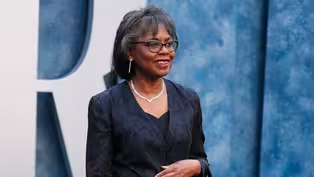
Anita Hill discusses overturn of Weinstein's rape conviction
Video has Closed Captions
Anita Hill discusses overturn of Weinstein's rape conviction and what it means for #MeToo (7m 56s)

Biden condemns antisemitism in Holocaust remembrance speech
Video has Closed Captions
Biden condemns antisemitism, affirms support for Israel in Holocaust remembrance speech (7m 32s)
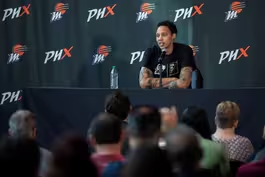
Brittney Griner discusses day she was released from Russia
Video has Closed Captions
Brittney Griner describes release from Russia and readjusting to life at home (6m 47s)

How Israel's operation in Rafah affects aid for Palestinians
Video has Closed Captions
How Israel's operation in Rafah affects aid for Palestinians and cease-fire talks (5m 40s)
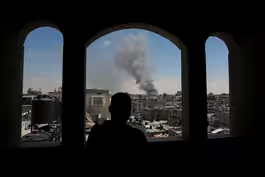
Israel seizes Gaza crossing as cease-fire hangs in balance
Video has Closed Captions
Israel seizes Gaza border crossing as cease-fire and hostage deal hangs in the balance (4m 25s)
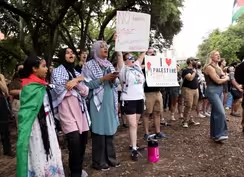
Protests violate rights of other students, commentator says
Video has Closed Captions
Campus protesters are violating rights of other students, argues legal commentator (7m 43s)
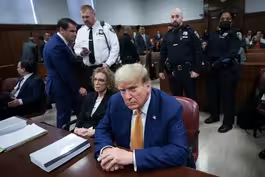
What Stormy Daniels revealed on the stand in Trump's trial
Video has Closed Captions
What Stormy Daniels revealed on the stand in Trump's hush money trial (6m 10s)
Providing Support for PBS.org
Learn Moreabout PBS online sponsorship
- News and Public Affairs

FRONTLINE is investigative journalism that questions, explains and changes our world.

- News and Public Affairs

Today's top journalists discuss Washington's current political events and public affairs.












Support for PBS provided by:
Major corporate funding for the PBS News Hour is provided by BDO, BNSF, Consumer Cellular, American Cruise Lines, and Raymond James. Funding for the PBS NewsHour Weekend is provided by...