
May 7, 2026 - Full Show
5/7/2026 | 26m 50sVideo has Closed Captions
Watch the May 7, 2026, full episode of "Chicago Tonight."
Reports of immigration agents at Cook County courthouses. And a CTA groundbreaking, decades in the making.
Problems playing video? | Closed Captioning Feedback
Problems playing video? | Closed Captioning Feedback
Chicago Tonight is a local public television program presented by WTTW
WTTW video streaming support provided by members and sponsors.
May 7, 2026 - Full Show
5/7/2026 | 26m 50sVideo has Closed Captions
Reports of immigration agents at Cook County courthouses. And a CTA groundbreaking, decades in the making.
Problems playing video? | Closed Captioning Feedback
How to Watch Chicago Tonight
Chicago Tonight is available to stream on pbs.org and the free PBS App, available on iPhone, Apple TV, Android TV, Android smartphones, Amazon Fire TV, Amazon Fire Tablet, Roku, Samsung Smart TV, LG TV, and Vizio.

WTTW News Explains
In this Emmy Award-winning series, WTTW News tackles your questions — big and small — about life in the Chicago area. Our video animations guide you through local government, city history, public utilities and everything in between.Providing Support for PBS.org
Learn Moreabout PBS online sponsorship>> Hello and thanks for joining us on Chicago tonight on Brandis Friedman.
Here's what we're looking at.
>> This is not behavior intended to keep anyone safe.
It's intended to intimidate and harassed.
>> And kids are sounding the alarm saying federal immigration agents have been spotted at multiple Cook County Courthouse is.
>> Is project doesn't just make history.
>> It's been decades in the making.
The CTA finally breaks ground on the Red Line Extension project.
A look at the potential impact for Southside residents.
>> Much faster to get a on that and get a little help appoint.
>> There's a crisis with black youth and suicide.
We talk with Chicagoans taking action.
And it's open Mike night on Chicago's rooftops as acoustic devices are listening for migrating birds.
First off tonight, federal immigration agents are reportedly spotted at for Cook County Courthouse.
Is this morning.
>> Immigrant advocates are calling it a significant ramp-up of enforcement in and around Chicago.
>> Just seeing ice at one may not be so significant in itself, but seeing ice presents at 4 courthouses all in the same morning.
Looks like an escalation.
>> The Illinois Coalition for immigrant and refugee Rights said say ICE agents were at the domestic violence courthouse downtown as well as in other courts.
And at 100 11th street grand in central and in Maywood last fall, then Chief Judge Tim Evans signed an order banning federal agents from arresting people in or around local courthouse without a warrant.
And in December, Governor JB Pritzker signed a law barring the civil arrest of anyone in or around court houses who are attending certain court proceedings.
The Department of Homeland Security, which oversees ICE did not immediately respond to a request for comment.
Mourners paid their respects today to slain police Officer John Bartholomew visitation continues through 8 tonight at Saint Andrews, Greek Orthodox Church in Edgewater.
Funeral Services are scheduled for tomorrow morning at 10 at the same church the 10 year police force veteran was shot and killed April 25th inside Endeavor Health Swedish hospital on the north side while escorting a man suspected of armed robbery to the hospital for treatment.
With all of you is survived by his wife and 3 children.
Advocates are calling on the Trump administration to restore crisis services for LGBTQ+ youth through the 9, 8, 8 suicide and crisis lifeline.
People in crisis could receive help by dialing 9.88 in using the press 3 option.
That is until the Department of Health and Human Services discontinued that option last summer.
>> That out palms of LGBTQ young people who are seeking support.
And some of their most Stark east.
If you're for hours.
A life could be saved based off of the individual who ashes.
On the other >> The National Alliance on Mental Illness or NAMI.
Chicago gave a tour of its 9.88 call center today to Congressman Raja Krishnamoorthi.
The organization says it's fielded more than 53,000 calls since opening in January 2024. advocates argue the sudden termination impacted more than 1.5 million young people nationwide.
>> They're calling on Congress to pass the 9, 8, 8, LGBTQ+ Youth Access Act to restore the service at the time the Trump administration said it was canceling the option to, quote, focus on serving all help seekers, including those previously served through the press.
3 option.
Plans to extend the CTA.
Red line are now in motion.
More on the multibillion-dollar project right after this.
>> Chicago tonight is made possible in part why the Alexandra and John Nichols family.
The Pope Brothers Foundation.
And the support of these donors.
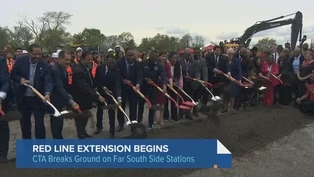
>> Plans to extend the CTA red line to the far South side of Chicago are finally on track.
The Red Line Extension Project broke ground last month after years of planning and months of federal funding, uncertainty, the project would add over 5 and a half miles of tracks and 4 new stations planned stations would be at 100 and 3rd Street, 100 11th Street, Michigan Avenue at 115 100 and 30th Street.
Joining us, our Tony Xia Marshall Bct vice president of the Red Line Extension Project.
Get on your AB vice president of planning at the far South Community Development Corporation and chair of the CTA Citizens Advisory Board and Alderman Anthony Beale whose 9th Ward includes 2 of the future Red Line stations.
Thanks to all of you for joining Congrats on on on getting this far.
But sure it has been a long Tony Xia, let's start with you.
How long has it been in the works?
So this started with CTA over 20 years ago, we started our planning and development in 2006.
>> But even it predates that because in 2004, actually the community rallied around and did a referendum to even get to make this even possible.
So this project has been in the works for nearly 60 years.
So we're super excited to be at this place today.
Yeah.
Tell us about that community referendum in 2004 and how it got us to this point because of the community and also legislative support.
They were able to get enough signatures in order to get in on the books for the CTA to take notice and also be able to start to plan for that work.
So in 2006, that's when we started planning forward.
We started our nepo, which is National Environmental Protection Agency.
And we also started coordination with the federal government in order to start this process.
And then there's been some concerns over federal funding over the last few years.
Remind us what's been going on there.
So if you remember in January of 2025, we've gotten executed full funding grant agreement, longtime common.
We finally got it.
Super excited about that.
And then later in the year there was a federal pause on that funding.
But just recently when it was actually lifted, so the money is back flowing and that's how we were able to have a great and fantastic groundbreaking, right?
That federal pause was because of the Trump administration's concerns about some of the contracting.
But recently a judge has said, no, you got to give the money.
Absolutely.
Policies yes.
Yeah.
And then there's the timeline for completing the What does that look like?
So because we just did break ground, you'll see them digging some infrastructure there.
You also see some cases and foundation work because basically we're building from the ground up.
>> And from there, you'll see the case ons and the structures then we'll have track systems allow buses along the way.
Then you'll see the stations that will start up in about 27 28.
And then we will go into testing commission in 2030 and that's when we'll open of revenue service in new tracks.
A new stations 2034, short years.
but it's all new new construction.
Yeah.
Yeah.
There's a lot to because I knew you were at this the groundbreaking ceremony.
We're looking at a little bit of it now.
What was it like finally being there for that is amazing.
Absolutely beautiful.
The energy just everyone in the community come in out.
>> So much of our community leaders have just, you know, you know, elected officials, just everyone in that overjoyed by having this momentous occasion being celebrated.
We're so excited.
>> And Bill, what is this extension mean for residents in your ward?
>> Well, when you look at everything that we've done over the last 25 years, you know, we've been fighting for the red line extension, even when I was chairman of Transportation Committee Transportation, Meet Me Alderman Austin at the time and also aldermen Brookens approach Mayor Daley and asked him to put this on the federal agenda and it was it was because of those actions, you know, working with the community you know, the mayor, Mayor Daley, for field, his father's promise put to the far South his father is the one.
It actually made the promise 50 years ago that we would extend the red line extension.
So we approached him and say, look, your father promise us this.
And so we need because of the pressure that the community put on and the pressure that we put on him.
He is the one that basically put it on the forefront of the federal agenda for the city of Chicago.
And so it's finally getting done and this means your residents will have access to.
>> There's that's at well, access to get to those jobs downtown to be able to get from the far south side of the city Chicago to downtown in 30 minutes is you know, nothing short of amazing because we've been locked down.
It would take You know, sometimes I want to have 2 hours to get from 138 street just to get downtown.
And, you know, time is money.
And so that to be able to get on a train, get downtown in 30 minutes.
>> You know, that's that's more time spend with our family more time weakens, you know, go to dinner and do different things that really of families take for granted, other you know, being on public transportation.
It's always going to have a huge impact.
And then all the dollars that come along with it to actually have 4 stops on South side is going to bring more transit oriented development.
We're going to bring some more stores and shops to its around a lot of these stations.
And if it's going to have a ripple effect, you know, we can talk about what's happening in Rosen.
Well, you can see what's happening in a row the largest infrastructure project the CTA has ever.
>> Undertaking.
>> can tell you know, there's you know, as we just heard from the aldermen is the ability to get downtown.
Forget the jobs that are downtown more easily.
But what can CTA connectivity bring to the neighborhood?
There's we're so excited for south CDC in partnership with other local organizations, including Chicago neighborhood Initiatives were.
>> You know, pushing development at 100 15th in Michigan, which is we lovingly call one 15, Michigan, which is adjacent to the station there.
And at that particular site, we are looking to bring grocery.
We're looking to bring its multi family housing development where looking to bring other types of retail.
So we expect that at that station along with other stations, there will be variety of different shops and restaurants other kinds of places that residents can pop into and then also attract people from other areas of the city to come and visit the farce outside in ways that they had before How has the CTA involved community members in the project?
>> So we started week actually created I pack, which is the project Advisory Council.
We started with them back in 2019.
>> We have key players like Charles Johnson, Andrea Reed and Deborah Trusts.
And it's a about a group of 20 people that live breathe a whole neighborhood, the community, and they're able to bring back information from the community make sure that we are aligned to make sure that we are providing with the community really wants out there.
All bill, for for anyone who visits your ward for the first time because they will have this access via the red line.
>> What can they expect and what do you want them to know?
>> Well, first of all, you know, what I expect for them to see a different 9th Ward, a different roles full in the community which they already see right now.
When you drive down the Bishop Ford Expressway, you can see board is already being transformed before our eyes.
And so now they've been asking, what are we doing on the west side of of Pullman will now you'll see, you know, we're working with roles in the hospital medical district.
This is going to help that this is going to help us bring more resources and more jobs and opportunity into the area as well.
And so we've already invested over 2 billion dollars, a public-private investment and created over 2000 jobs.
You know, it's far as what you see today and having a red line extension ring in 5.7 billion additional dollars.
And, you know, the term thousands and thousands of more jobs, we need some place all those workers to eat, have large bring their families and then don't.
Let's not forget we have pool a national monument.
We have historic fights that people can come and see.
We just broke ground on a hotel for where we make into a new boutique We have another hotel breaking ground this summer.
So we have a lot of great things going to happen in the far South Side is on the move.
And if you haven't seen it, you need to pay attention because it's the fastest growing African-American ward in the city Chicago.
>> It's an issue the anticipated This project have risen from 3.6 billion in 2024 to 5.7 billion.
What is driving that?
>> So if you remember, we had an unprecedented effort here during what the COVID heard about endemic.
Right.
So in 2020, that's when pandemic hit.
So back then when it was 3.6 billion that predates the whole pandemic episode that we all went through.
So after that, everything increase from labor to material to equipment.
And so we had to adjust with those numbers.
Even today we're still living off of, you know, what happened during that pandemic.
Okay.
Could Tanya, most of this project covers Roseland as we've discussed.
It also extends to all gardens wise.
That connection important, deeply important >> out Guild has been a community as Adam and Bill mention, that has been very much disconnected from the rest of the city its entire existence times of transit access.
And so >> being able to really make sure that this community, you not only is feels like they're fully embraced, connected to the rest of the CDU.
Chicago.
It's important to make sure that they have access essentially to the rest of the world through the Chicagoans have the benefit of being able to connect to anywhere in the world.
We can get to hear.
We can get some and so now the residents about gardens will be able to do this.
I'm all right.
That's where we're going to.
I think that's a good place to leave it.
Alderman Anthony Beale Contining Radiant Marshall, thanks to all of you for joining us.
Thank you for having us.
Thank you.
Up next, how local community members are helping fix the mental health crisis among black youth.
>> Suicide is the second-leading cause of death among children and young adults in the U.S.
That's according to the CDC and in Chicago.
Suicide rates among black youth are rising faster than any other racial or ethnic group.
As part of Mental Health Awareness Month.
And in partnership with students from Northwestern University's Medill School of Journalism, We take a look at what's happening in Chicago and how to organizations are working to address this.
>> I know the most key up on the lot.
When I was in crime novel and ruled I thought about suicide.
And on the look at me over.
So that's that's my role to kids.
I know what helped me.
>> I am a social worker, but I'm the founder of Soul.
So by visiting Chicago.
It's a nonprofit organization dedicated to suicide prevention and mental health awareness.
I lost my son by way of suicide.
His name was tomorrow.
He was 19 years old.
It was the worst day of my life.
>> Amendment Foundation's House of Hope Foundation.
No cause them is more of a platform that we live about.
We have to educate not program every device that was the 40 50 kids.
This is a What we have video We feed the kids, get a haircut.
We also teach with the current law, comes down the troubled banks and like that, he I wanted to take what everybody says who get this pain?
>> And turn it into something that doctor that's about purpose.
That's about spreading the message because my son died and even have to them.
>> And Chicago, what we've seen is there's been a big increase in suicide deaths since 2018 for black youth.
The the percentage who are attempting is much higher compared to other folks when the main reason kids and he's going commit suicide is the environment.
They have nothing to look for many acts.
you know, I can't focus in school.
>> He's saying, you know, I just saw somebody killed or have 82 days.
What a great love on hospice I you got to look at like far, the Russell Senate is more broader than what people think.
a kid 15 years-old, he's doing 67% today.
That's like social side.
a 15 year-old young man get a gun, put on a mask.
And when the police come, he shoots at the police back in 4 in his mind.
know there's a 99% chance is going to die.
So what does what does a lot?
>> This is a gun law.
So if you know somebody with a I please take one our take to, you know, 2 people would line and also take.
still, my has some of the most restrictive gun laws.
But at the same time, we're learning that persons who are backed by way suicides, especially males more likely to die behind them.
weapon like a is.
>> Much faster to get a guy on news to get a mental health.
A point.
>> They know what a neighborhood people had to go community.
Then you got a thing on top of itself.
That's not safely.
Got to walk on is not in the case of black Historically for understandable reasons.
Do not trust the mental health care system historically white mental health care system to have a resource.
That something that is dependable accessible.
>> Something that's unknown.
It's something that reachable is everything.
Just just like water.
Just like fresh air.
>> Are we providing culturally relevant services where people are and in a format that makes sense to them.
>> Being in the community brings the message you don't have to travel far to get the support that you need We can come and we can be right here with walk away.
>> One of the most important parts of suicide prevention.
Is hoping.
People build lives worth living and communities to make sure that they're creating a world that kids want to live I felt the need for at-risk young black kids.
need to help but needed the The right guidance and the right positive motivation from people look like them.
>> We do what's called a circle.
Well, have all the key is put out some governor and we just talk about every life they met strong what they want, ups and downs.
Then we'll at something called when it come over here.
Grab out.
>> at all with the the Granite State, but I been and then we bring about.
A kid can either be in DC was in games, the party.
What will that do?
we have the kids come because the lies that a key seize a clean commuting makes a clean heart and clean slow and a positive mind.
There's this myth.
>> That if you ask somebody if they're having thoughts of suicide, you can put the idea into their head and what we know from research and just general clinical experiences.
That's not true.
>> Most of our children speak about the anxieties.
They the stresses going to the next level in their lives, making sure that they can connect with you and that you are one point in your time in your life.
You felt that Conway and you're going through so you can normalize that conversation.
You can judge him.
>> You can't talk against them yet.
Hopeful if you care for these kids, they can change.
takes a while.
But if you care, you want to say somebody because love, you know, love.
>> Since this story was produced, new data has been released.
That information provided at the end of April by the CDC shows that nationally suicide rates for youth and young adults aged 15 to 34 decreased by 4% from 2023 to 2024. the latest year statistics are available.
We're back with more right after this.
>> Reflecting the people and perspectives that make up our communities.
This story is part of Chicago tonight.
Black voices.
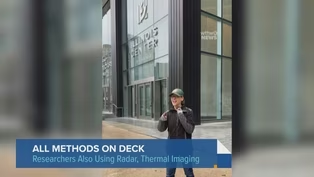
>> Hundreds of millions of birds migrate over Chicago every spring and fall.
But most of that activity happens at night, making it nearly impossible for researchers to eyeball which bird species are passing through and how they're using the city's airspace.
So scientists from the University of Illinois are partnering with Chicago's Windy City Bird lab to track and identify the birds by their sounds.
Instead.
Our Patty wet Lee joins us now to tell us more.
Patty.
So these researchers they put around 45 to 50 acoustic monitors across the city, even in the burbs.
You tell us about their broad on the 111 for Tower Are tell us about that project?
And one of the questions are trying to answer, right?
So like you mentioned, they can't see the birds because most of them are nocturnal migrating at night.
They can hear them and they've used machine learning to be able to identify those sounds down to the species.
So what they want to know are what species are passing through Chicago, not necessarily landing here, but they're using our air space and they have discovered some rarities that we don't really see around here.
>> But there are actually flying over and then it's really like where are they are?
Are they using certain corridors more than others?
But really the acoustic monitoring helps them get that species level detail that they're not able to with other technology.
That's impressive because they've also been using other methods like thermal imagery to study these birds.
that works.
Yeah.
They're also able to use radar, which gives you kind of a larger landscape view like when birds are moving.
Thermal imagery will give them a picture of like the altitude that they're flying at in the direction that they're doing in more of their behavior.
So they can tell our birds like flying in unusual patterns that might indicate that they're disoriented.
Maybe they're circling, you know, our bright lights in the city are is when driving them toward the Laker or toward more toward inland, they can put all of this information together into a more complete picture, like you said of using the airspace.
If you think of the air space as a habitat, just as much as the ground is.
So how are they using that habitat and then how do they want to use all the that they're gathering?
Will you could be able to tell are there changes over time of when they're arriving?
Are they flying low or are they flying higher if they're using certain corridors?
that's where we were planning on putting an airport, maybe not they're suddenly over here where we happened a habitat restoration shows that it's working.
It just gives them, you know, migration it.
There's still so much mystery surrounding it and it will help them answer so many of the questions that we have and also how to make the city safer for these birds as they're flying through because as we now, Chicago is quite dangerous for migrating birds.
It an architectural exhibit.
Those set to open on June first that will highlight the dangers birds face in urban in urban Chicago.
Tell us about the will be at the Chicago Architecture Center, which is on the ground floor, Illinois Center, which is where I went up to the roof where they were installing one of these monitors.
And Jeanne GANG's architecture practice studio gang is curating one of 2 exhibits and it's really out.
Here's the problem that our built environment has.
We have this buffet of solutions that we can use that maybe we're not using in here some the materials that you can use all the way from architects like Jeanne Yang, designing skyscrapers to you and I at home to make our windows safer for birds as they fly through.
Right.
I have the window clings on my windows all right now.
wet thank you so much.
Thank And course, and you can read patties full story on our website or check out our Instagram at W T Tw Chicago.
>> And that's our show for this Thursday night.
Join us tomorrow night at 5.37, for the weekend review.
Now for all of us here at Chicago tonight, I'm Brandis Friedman, thank you for watching.
Stay healthy and safe and have a good night.
>> A closed captioning is made possible by Robert a cliff and Clifford law offices, Chicago, personal injury and wrongful death that serves the needs of
Acoustic Devices Will Listen for Migrating Birds on Chicago Rooftops
Video has Closed Captions
Hundreds of millions of birds migrate over Chicago every spring and fall. (3m 52s)
Chicago Organizations Work to Address Suicide Rates Among Black Young People
Video has Closed Captions
Suicide is the second leading cause of death among children and young adults in the United States. (6m 8s)
How the CTA Red Line Extension Could Impact South Side Residents
Video has Closed Captions
The project is expected to add more than 5.5 miles of tracks and four new stations. (10m 7s)
Providing Support for PBS.org
Learn Moreabout PBS online sponsorship New Episode
- News and Public Affairs

Top journalists deliver compelling original analysis of the hour's headlines.
 New Episode
- News and Public Affairs

Today's top journalists discuss Washington's current political events and public affairs.


 New Episode
 New Episode
 New Episode
 New Episode

 New Episode
 New Episode
 New Episode
Support for PBS provided by:
Chicago Tonight is a local public television program presented by WTTW
WTTW video streaming support provided by members and sponsors.