
May 8, 2024
5/8/2024 | 55m 53sVideo has Closed Captions
Volodymyr Zelensky; Jens Stoltenberg, Kaja Kallas and Pete Ricketts; Alejandro Mayorkas
Volodymyr Zelensky discusses Alexey Navalny's death and the state of the war on his country. Christiane speaks onstage in Munich with NATO’s Secretary General Jens Stoltenberg, Estonia’s Prime Minister Kaja Kallas, and Republican Senator Pete Ricketts. The first Cabinet Secretary to be impeached since 1876, Christiane spoke with Mayorkas in Munich, his first interview since the vote.
Problems playing video? | Closed Captioning Feedback
Problems playing video? | Closed Captioning Feedback
May 8, 2024
5/8/2024 | 55m 53sVideo has Closed Captions
Volodymyr Zelensky discusses Alexey Navalny's death and the state of the war on his country. Christiane speaks onstage in Munich with NATO’s Secretary General Jens Stoltenberg, Estonia’s Prime Minister Kaja Kallas, and Republican Senator Pete Ricketts. The first Cabinet Secretary to be impeached since 1876, Christiane spoke with Mayorkas in Munich, his first interview since the vote.
Problems playing video? | Closed Captioning Feedback
How to Watch Amanpour and Company
Amanpour and Company is available to stream on pbs.org and the free PBS App, available on iPhone, Apple TV, Android TV, Android smartphones, Amazon Fire TV, Amazon Fire Tablet, Roku, Samsung Smart TV, and Vizio.
Watch Amanpour and Company on PBS
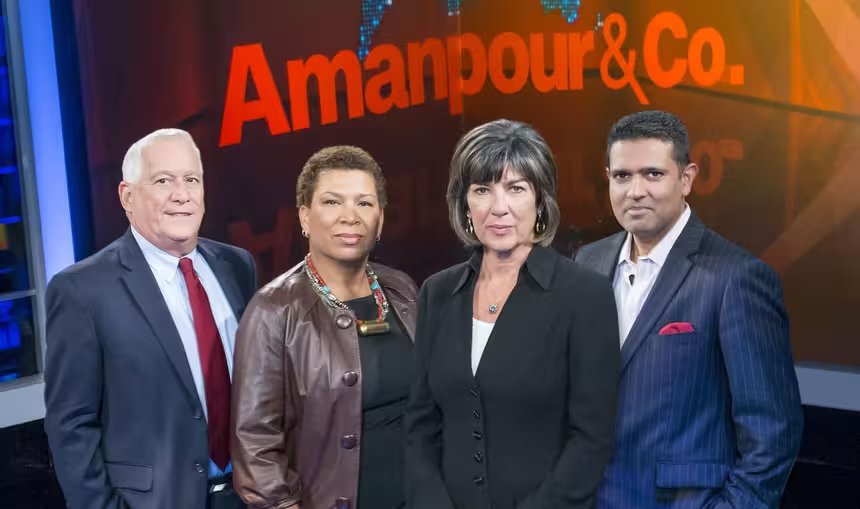
PBS and WNET, in collaboration with CNN, launched Amanpour and Company in September 2018. The series features wide-ranging, in-depth conversations with global thought leaders and cultural influencers on issues impacting the world each day, from politics, business, technology and arts, to science and sports.Providing Support for PBS.org
Learn Moreabout PBS online sponsorship[dramatic music] - Hello, everyone, and welcome to "Amanpour & Company."
Here's what's coming up.
- Senators have to understand, only in unity, we can win in Russia, and they have to understand that we will win with them or not.
- [Amanpour] The urgency of now from President Zelenskyy amid allied anxiety as Putin's forces pressure Ukraine.
Will the US deliver aid as promised on the eve of the war's second anniversary?
My conversations with President Zelenskyy at the Munich Security Conference and with a panel of NATO leaders and Republican Senator Pete Ricketts, then... - It is a matter of unanimity that our system in the United States, our immigration system is broken.
- [Amanpour] My conversation with Homeland Security Secretary Alejandro Mayorkas, caught in the crosshairs as Congress slow walks America's critical priorities.
[dramatic instrumental music] [dramatic instrumental music continues] - [Announcer] Amanpour & Company is made possible by the Anderson Family Endowment, Jim Attwood and Leslie Williams, Candace King Weir, the Family Foundation of Leila & Mickey Straus, Mark J. Blechner, the Filomen M. D'agostino Foundation, Seton J. Melvin, Charles Rosenblum, Koo and Patricia Yuen, committed to bridging cultural differences in our communities.
Barbara Hope Zuckerberg.
Additional support provided by these funders and by contributions to your PBS station from viewers like you.
Thank you.
- Welcome to the program, everyone.
I'm Christiane Amanpour in Ukraine, where days away from the second anniversary of this war, there are feelings of urgency and of frustration as American support dries up just as Ukraine needs it most.
Probing NATO's staying power, Russia delivered a frontline defeat.
Its flags are now flying over Avdiivka in Eastern Ukraine.
Still, Kyiv battles on with fewer weapons, less ammunition, and troops staggering from two years of war.
Amid this gloom, the death of preeminent Putin critic, Alexei Navalny, hit Europe and Ukraine like a bolt of lightning.
Speaking on her husband's social media channels, Navalny's widow Yulia fired a shot across Washington's bow.
[Yulia speaking in foreign language] - [Interpreter] I ask you to share your rage, rage, anger, and hatred with me towards those who were daring enough to kill our future.
And I address you with Alexei's words, which I believe it is not a shame to do.
"It's not a shame to do little, but it's a shame not to do anything.
It's a shame to make yourself intimidated."
- Senate Majority Leader Chuck Schumer said what many here in Europe are thinking, that Navalny's death sounds an urgent alarm.
And President Joe Biden says Congress's quote, "Failure to support Ukraine at this critical moment will never be forgotten."
This weekend, I spoke to President Zelenskyy on stage at the Munich Security Conference, his first in-person appearance there since before Russia's full-scale invasion.
And in Munich, he invited Donald Trump, the leading Republican candidate for president and the obstacle to Ukraine aid to come to the front and see the need for himself.
Firstly, Mr. President, thank you for being here, and I would like to ask you first about the decision of your commanders to pull back.
Your commander said, "In a situation where the enemy is advancing on the corpses of their own soldiers, with a 10-to-one shell advantage under constant bombardment, this is the only correct solution."
What do you expect to happen now?
- [Interpreter] Thank you very much for your question.
It's a very logical and a fair one.
It's important for us to save the lives of our people.
That's our main objective.
We're saving our lives, our soldiers because that's our defense.
We are very grateful to our partners for any weapons, but clearly weapons can only help to bring back justice and peace in the territory of Ukraine.
But first and foremost, as we all know, it's the man.
It's the military man who has it in his arms.
The military people, they liberate territories, they protect people, families, and that's a correct decision in order not to be surrounded.
The decision has been made to move back to other lines.
Russia has not seized anything.
We have to understand that.
After those two years of war, Russia has tried in the east of the country to do something.
And what does it mean, do?
They just destroyed several small villages and towns.
But the most thing that they did, they destroyed our life.
Then since October, they have been attacking this poor Avdiivka with all the armaments, with all the power that they had with thousands of their soldiers who died, thousands, tens of dozens of thousands.
That's what Russia has achieved.
It's a depletion of their army.
We are just waiting for more weapons that we're short of.
We are short of it.
I'm telling you frankly.
We don't have long-range weapons.
Russia has it and we have too little of that.
That's true.
That's why our main weapon today is our soldiers, our people, and we hope to have the support of our partners.
- So, a senior NATO official told the "FT" that it is a desperate situation for you on the front lines, far worse than you are actually admitting.
Your commander said that one of the reasons that they pulled back was in just the last 24 hours, there was some 20 airstrikes, 150 different shells.
He said they're trying to erase Avdiivka from the face of the, from the Earth.
Do you think this will lead to a snowball of other towns and cities on the front lines collapsing?
Or what do you expect for the next months and year?
[Zelenskyy speaking in foreign language] - [Interpreter] What we expect, we expect to see what has been promised, what we have agreed upon that we will be able to unblock the skies wherever Russians have an advantage.
As soon as we can do that, when they no longer control the sky, I think this is what I started at the Munich Conference two years ago when I said that we need to work a little bit faster and to pay attention to the messages of Ukraine that has a lot of practice in this war, and that's why it is very important.
I've been emphasizing this since the very first days of the war to unblock the sky.
We have started receiving.
We're grateful to our partners.
We have started receive the air defense systems, Patriot, NASAMS, and others, and we have too few of them.
I'm not criticizing now, but we have too few of them in order to quickly move ahead, but the decision is very simple.
Where we had our air defense systems where we, at that time, people would come back.
They would bring back the economy of a certain town or city, but where we had such systems of air defense, immediately, Russia would move back because it would lose its aircraft.
So, you ask me what we are expecting if we have those systems and long-range weapons because it's all an unfair war.
It's unfair in general, but it's unfair in terms of the advantages.
If you have artillery with a range of up to 20 kilometers and the Russians' artillery has the range of up to 40 kilometers, that's the answer.
A human being is fighting artillery.
That's unfair and it's not modern war ideology.
We have to develop technology.
We've started doing that.
We have to develop to start building drones.
I'm sure that what is positive for us and negative for Russia, we will be able to surprise them this year with our drone systems, with our radio electronic warfare systems.
That's our domestic technologies, but that's just a parallel road that we're taking while we're expecting for assistance from our partners.
- Mr. President, you said that with the will and with all the gear, you could win.
I've been speaking to American generals, others who said you can win, but it depends on the will of politicians in your allied nations in the United States and everywhere else.
As you know, there is a stalling in the United States Congress.
The Republican-led House will not address the huge weapons bill that the President's trying to get to you.
Some of them may be here.
What would you say to your Republican colleagues in the United States, anybody who's blocking that bill?
- Yeah, I will have a meeting with senators today.
We have, I think, we will have detail, speech with detail.
They have to understand what's going on.
And I think that's it's, I don't want to push such message to United States because they did a lot for us, did a lot.
I see Nancy Pelosi.
Thank you so much.
We did together a lot.
Thank you from our people, from all our hearts.
Thank you so much.
[audience applauding] Just yes, we have to work in one joint team.
That is the answer.
If Ukraine will be alone, you have to understand what will be.
Russia will destroy us, destroy Baltic, destroy Poland, and they can do it.
Yesterday, I had very interesting, very useful, I think, dialogues with German government and also with France partners.
And I said very clearly and very honestly, if you will remind that what was going on in Ukraine in 2014.
Our people were not ready for the war, for the quick occupation of Crimea, part of Donbas.
And then during almost, say, eight years, people began to be ready for such aggression, not only with a weapon, It's not a question of weapon.
You are ready psychologically.
That's why, that's why.
Senators have to understand, only in unity we can win in Russia, and they have to understand that we will win with them or not.
We don't have any other way.
We have only one land, our Ukraine.
Yeah.
[audience applauding] [audience continues applauding] - Mr. President, you are outmanned, and you always say this, there are a huge, huge advantage in terms of numbers of Russian forces.
There is a question of, potentially you signing a law or changing the draft and the conscription and lowering the age from 27 to 25.
Are you going to do that?
[Zelenskyy speaking in foreign language] - [Interpreter] It's a comprehensive and complicated question.
It's the question about how fair recruitment should be.
And the most important issue is rotation of the people who are very tired at the frontline.
Physically, any person, not only Ukraine, it doesn't really matter what nation you belong to.
If you are tired, you have to go back.
You have to be restored and somebody else would replace you, another professional soldier who has been trained during a certain period of time.
And mobilization recruitment depends on that, also.
How many people you have on the front, how many reserves you have and why you need that.
- For defending operation, some number of brigades for...
They began to translate me.
Yeah, it's difficult.
So, for counteroffensive, you need another, another number of brigades.
So the question of mobilization, it's a complicated thing.
Yes, but I can't share with you the number of victims and casualties.
Yeah, but for example, if you will, when we speak that they have too much people, yeah, and you have to know, for example, in Avdiivka, just comparing the number, one to seven.
It's a pity that I'm...
But for one death of Ukrainians, seven deaths of Russians, one to seven.
So I'm not comparing this war and I don't want, and it's a tragedy even to lose one person, but we didn't begin it.
So that, but you have to know, have to understand what was going on in this small city.
- But still, they are outgunned.
They desperately need that ammunition.
And Zelenskyy offered this candid response to the death of Alexei Navalny.
- Putin kills whoever he wants, be it an opposition leader or anyone else who seems as the target exactly to him.
After the murder of Alexei Navalny, it's absolute to perceive Putin as a supposedly legitimate head of a Russian state.
- Now, behind the scenes in Munich amidst shock at Navalny's death, the Republican congressional delegation were winning no popularity contests, although some tried to say they would eventually do the right thing and pass the Ukraine aid bill.
To discuss all of this, I spoke with NATO Secretary General Jens Stoltenberg, Estonia's Prime Minister, Kaja Kallas, and Republican Senator Pete Ricketts.
You heard President Zelenskyy talk about the death of Alexei Navalny and how this has been a warning or a sign to all of you sitting here as this very important conference opens.
Can I just get you, Senator, to comment on the death of Navalny, and what signal do you think Russia is sending the world?
- Well, first of all, our thoughts and prayers go out to the family.
And it just reemphasizes that Vladimir Putin's a dictator, that dictators don't know any rules.
And that is why it's important that we remember that NATO is here to protect our collective security against dictators like Vladimir Putin.
- And just before I go to the Prime Minister, does it sharpen your intent to do more to support Ukraine, as President Zelenskyy said, you know, "It's Navalny one day.
It's Ukraine and the rest of Europe the next day."
- Well, I think Putin's invasion of Ukraine demonstrated what his intentions are.
I don't know that this changes our perception of Putin.
We always knew he's a bad guy, and this just reinforces what we already knew.
- I'll get back to the, you know, the bill for aid in a moment.
Prime Minister Kallas, you are literally on the front line.
You have been very strong in, you know, needing to maintain a credible defense and deterrence.
What is your reaction to the death of Navalny and what it might mean in a bigger way?
- Well, it shows that Putin's playbook hasn't changed.
I mean, this is the way he operates.
This is the dictator's handbook in real life, so we should be all aware of this.
And like President Zelenskyy said, let's not discuss to do something.
We have to do everything to stop him because history rhymes.
We have seen this already in 1930s, the same thing.
I mean, Americanism isolation, I mean, on the one side, you know, this not stopping aggressor when we have the chance to stop him and then seeing aggression spread all over the world.
Let's do the right thing.
Let's learn something from the history.
- And just to frame it a little differently for you, Secretary General, NATO has said, and actually key defense ministers from the frontline countries have said that you are concerned for the first time, this wasn't the case last year, that within three to five years, even, Putin could test the resolve of a NATO country.
- We can never take peace for granted, but I think it is important to convey that we don't see any imminent threat against any NATO ally.
The world has become more dangerous, but NATO has become stronger.
And the purpose of NATO is to prevent war, is to ensure that there's no room in Moscow for any miscalculation about NATOs readiness and resolve to protect all ally and to make it clear that an attack on one ally will trigger the response from the whole alliance.
And as long as we convey that message clearly to Moscow, no ally will be attacked.
So our deterrence remains credible and therefore we don't see any military threat against any NATO ally.
- Just, I mean, our focus should not drift from helping Ukraine militarily because we don't have to talk about any NATO country if we stop Putin in Ukraine, and that's why we should concentrate our efforts that he stop there.
- Senator Ricketts, this is now depending on the United States.
Europe has done its bit.
When everybody said "We're not going to, you know, pass this bill," Europe stepped up $50 billion worth of other material to Ukraine.
When is the United States going to do what the United States pledged to do at the beginning of this war, that is, defend democracy, make sure tyranny and dictatorship doesn't win?
- Yeah, well first of all, I'm gonna respectfully disagree with you.
Europe still needs to do more, right?
So as of last summer, only 11 of the NATO allies were reaching the 2% GDP spending, so that still needs to be done, and I certainly applaud what Germany's doing to get there, hopefully this year, right, to get to that 2%.
But there's still many of the European allies who need to get that done.
With regard to the United States, look, we're democracies.
Democracy is messy, and it takes time and a process to get there.
Every country has their own thing.
So for example, I just mentioned, you know, the Europeans haven't gotten to the 2% yet.
But that's probably because of the internal politics to each of those different countries, right?
So it takes time to bring democracies along, and the same thing is gonna happen in the United States.
We will get there with regard to making the investments in our defense industrial base, supply the weapons to Ukraine, but it's gonna take time to get there.
There may be different paths to get there.
I'm reminded of Winston Churchill's quote, "Americans will do the right thing after exhausting all other possibilities."
- Just a thought about your migration worry.
It just, in comparison, we have 6% of our population now Ukrainian refugees.
That would be, calculating into America, that would be 20 million people.
So we survive.
You will, I guess, survive as well.
- And then I'd be interested to hear from the two Europeans here what Senator Angus King told me the other day on my program, that actually the United States is 15th in terms of defense spending for its GDP, and other European countries are spending more, relatively frankly.
Do you have an answer to the consequence of Russia winning, of Putin winning?
- Well, I absolutely believe, just as the Prime Minister was saying, that if Putin wins in Ukraine, he won't stop there.
He's a dictator.
Dictators behave the same way, which is, they tell you what they're gonna do.
And he's talked about a greater Russia.
He's talked about Russians living outside of Russia.
There's no doubt that the Baltic states are gonna be at risk or Poland if we don't stop him in Ukraine.
And the other thing we should also remember is the geography is not gonna change.
When he loses in Ukraine, he's still gonna be a threat and a danger.
And that's why we are gonna have to continue to bolster our eastern flank, and NATO's doing that right now.
So I think that's part of what we have to do is make sure that we stop him here in Ukraine.
And part of also what we do, not just in the United States, but in all of our countries, is make sure we're reminding our publics, 'cause we've seen decreasing support in the United States for Ukraine, reminding 'em how important it is that we stop Putin here and really getting that message out, building that support to be able to get the weapons that Ukraine's gonna need to continue to fight.
- Can I just ask you to pick up on the progress that NATO nations are making in what you are all demanding for more defense spending?
- In 2014, NATO made the very important decisions triggered by Russia's illegal annexation of Crimea.
The reality is that a lot has happened because since then, all NATO allies have increased defense spending.
This year we expect 18 allies to meet the 2% guideline, spend 2% of GDP on defense.
And that's up from three in 2014.
That's a significant increase.
And NATO has implemented the biggest reinforcements of collected defense in generations, with battle groups, combat troops in eastern border lines for the first time in our history with higher readiness, more forces, and now total a new defense plan.
So I'm not saying everything is fine.
I agree that Europeans have to do even more, but they're really on track to something which is demonstrating a commitment of all allies that they need to stand together.
- Prime Minister Kallas, you heard the senator say that America will eventually do the right thing in this case.
The CIA Director has said, "For the United States to walk away from the conflict in Ukraine at this crucial moment and cutoff support to Ukraine would be an own goal of historic proportions."
Do you feel, as the atmosphere has been around the beginning of this conference, that there's a worry about America continuing to lead the alliance, wanting to be the leader, particularly if the administration changes after the elections?
Is that a real anxiety or not?
- I mean, first of all, I want to just correct one thing that I hear everywhere.
It is mentioning separately Baltics and Poland.
I mean, it is like we are second-class NATO members.
There are all equal NATO members.
When Russia is gonna attack, NATO is gonna attack all of us, not Poland, not the Baltics.
So let's not make that distinction there.
[audience applauding] Then second, I think that, of course, we are all democracies.
And democracies, we don't get to choose the leaders for our allies and we have to work with all the allies.
What we have to understand is to learn from the mistakes from the history.
And so it is true that we have to ramp up our defense spending and do it not only political pledges, but actually in real life.
So in Estonia, we have invested, or are investing over 3% of our GDP to defense, and we encourage everybody to do so.
But there's also one thing that I've thought about, and this is that, you know, when I came up with the proposal or the 1 million rounds artillery initiative for Ukraine, then it turned out that, you know, our defense industry is not capable and we don't have enough.
But we have in Estonia, for example, a very, you know, vibrant tech sector.
So why don't we put those tech sector and defense industries together to make, you know, a really big progress not producing what, you know, was there for the 20th century, but actually what should be in the 21st century so that we could make advantage by this technological part also in the defense industry.
So I think there is so much we can do all together, and together with the big allies, the small ones, everybody brings something to the table.
That is what the alliance is all about.
- Can you today be certain that NATO can defeat Russia if it comes to that?
'Cause all we're hearing is that you're not ramped up enough, you don't have enough to do what you need to do in Ukraine, much less if you were to confront Russia.
And you've said that if he'd stepped on your territory, every single inch will be defended.
- NATO is the strongest military power in the world today.
We represent 50%, roughly, of the world's total military might.
And militarily, we are stronger than Russia.
But at the same time, I think the war in Ukraine has demonstrated that there are some serious gaps.
For instance, when it comes to sustainment, one of the things is to have all the advanced weapon systems, but they need spare parts, they need maintenance, and at least they need ammunition.
And in the beginning of the War in Ukraine, we depleted our stocks, but now they are running quite low.
So now we are focusing extremely, also very much, on how to ramp up production.
We have some good news.
There are new factories being set up.
Production has increased, but it's urgent need to do more.
So yes, I think we all have learned some serious lessons about warfare, also for NATO, from the War in Ukraine.
Then of course, I was speaking about burden sharing.
European allies have more to do when it comes to total defense spending.
But actually, when you look at support for Ukraine, European allies and Canada have provided more support to Ukraine in total than United States.
And of course, the United States have done a lot, particularly when it comes to military support to Ukraine.
But the problem now is of course the lack of decision in the US Congress means that the flow from the US has gone down, and that has a direct impact on the frontline in Ukraine.
So of course, this is not only about making the right decision, but it's about making the right decision early as quickly as possible because it's urgent.
Every week we wait means that there will be more people killed on the front line in Ukraine.
So it's not for me to give advice on how to pass legislation to the US Congress, but what I can say is the vital and urgent need for the US to decide on a package for Ukraine because they need that support, and we have a burden sharing between Europe and Canada and United States.
So now it's for the US to deliver what they have promised.
- And you just [audience applauding] took that message to Washington last week.
And Chancellor Scholz went, and you know, he's just broken ground on a new ammunition factory.
So let me turn to you again, then, Senator Ricketts.
You voted against the Senate plan.
I wonder whether anything you've heard today may maybe stiffen your resolve to go and convince your colleagues, not just in the Senate but in the House.
And particularly what President Zelenskyy said, that he would even invite former President Donald Trump to the front line so he could see the danger and see what's going on.
Does anything you hear today stiffen your resolve, change your mind?
- Well, I think, again, it goes back to, democracies are messy, and every country has its priorities.
So for example, in the United States right now we have a pressing national security issue at our southern border.
Over the course of the last three years, eight and a half million people have either entered our country illegally or attempted to enter our country illegally.
Put in that perspective, that's more than four times the population of my state.
And that's the number-one consideration for people in my state and frankly, across the United States is what's going on at our southern border.
And so that's what my colleagues and I were attempting to do when we were trying to pass this bill, is to get a package that would secure the border, force President Biden to change his policy to secure the border.
Ultimately, we were not successful.
It doesn't mean I don't support what we're doing to support Ukraine.
But again, it gets back to, every country's got its own policies and its priorities.
- Do you accept though, Senator, that actually the administration came to a very conservative and very conservative and strict immigration proposal based on what the Congress wanted, and it's Congress who torpedoed it.
And we know that the American people, by a considerable poll margin, support NATO.
The Polish Prime Minister Donald Tusk tweeted, "Dear Republican Senators of America, Ronald Reagan, who helped millions of us to win back our freedom and independence must be turning in his grave today."
I'm sorry to add, he said, "Shame on you."
So I wonder what you think about that and whether you are prepared to see a world in which America doesn't lead anymore, or one, I asked you before, in which Russia wins?
- Yeah, so first of all, I'm actually gonna say what the administration came forward with on the border was not adequate, didn't get the job done.
With regard to, you know, again, I understand people are anxious to get this done.
It is a democracy, it does take time, and we have other issues that we gotta deal with as well.
So as I mentioned, we're gonna get there.
It's gonna take time.
Democracy is a process.
And we just have to continue to work to be able to get to the answer for how we're gonna invest in our defense industrial base, how we're gonna supply Ukraine, the weapons they need to be able to do it, but I'm confident the United States will get there.
- So they're gonna get there.
- Yeah, but it is, the time is working in favor of Putin, of course, so... And against the rules-based order really so of course everybody's looking at United States, also, to speed up the process.
I understand, you know, democracy takes time.
You have debates, but at the same time, there is a lot at stake, I think, in the world.
Again, I turn back to history, and I think three things we learned from the 1930s and the Second World war was that first, everything spreads very fast in Europe.
The second is that if America isolates itself, it eventually is going to cost you more.
And the third is that if aggression pays off somewhere, it serves as an invitation to use it elsewhere, which is a threat to the global security.
[audience applauding] - Senator Ricketts, Prime Minister Kallas, Secretary General Stoltenberg, thank you very much.
And everybody there was very aware that actually Russia's defense industry has really ramped up and its economy is ramped up because of it.
And it's producing a huge number of tanks, huge number of ammunition and rounds.
And this is what's also causing unbalance and worry amongst not just people here in Ukraine, but obviously, the NATO allies.
Now, as we mentioned earlier, Alexei Navalny's death dominated many of the discussions in Munich over the weekend.
But despite it being the lead story in news outlets around the world, inside Russia, it's barely mentioned.
This as at least 366 people were detained across the country while attending vigils and rallies to express their grief for the late opposition leader.
A reminder that an act as simple as laying flowers can land people in jail in Putin's Russia today.
Meanwhile, a spokesperson for Navalny says that his mother and lawyers were denied access to the morgue where his body is allegedly being held.
They accuse Russian authorities of quote, "Stalling for time," and claimed on Twitter, X, that the body will not be returned to them, not be returned to the family for at least another 14 days.
The Kremlin says, "An investigation into the circumstances around Navalny's death is underway."
Despite the urgency felt around Navalny's death, House Speaker Mike Johnson in Washington has signaled that he won't be bringing the bill to help Ukraine to the House floor.
Instead, the House has gone on a two-week winter break, a decision that President Biden called "Bizarre."
What House Republicans apparently did have time for these past few weeks was the impeachment of the Homeland Security Secretary, Alejandro Mayorkas, the first cabinet secretary to be impeached since 1876.
And I spoke with Mayorkas in Munich.
It was his first interview since that vote.
And just to note, with world leaders gathering and security being tight, you may occasionally hear the sound of helicopters overhead as we spoke.
Secretary Mayorkas, welcome to the program.
- Thank you.
So glad to be here.
- Let me just ask you first to react, you know, to the death of Alexei Navalny, the last remaining opposition leader in Russia.
- Tragic news for the world, but it speaks to the depravity of Vladimir Putin and our need as a world to have resolve against authoritarianism and the invasion of another country that is just yearning for its sovereignty.
- Do you see any kind of mood that Putin might have or what he might be thinking now emboldened by the gridlock in Congress over the aid to Ukraine?
- Two years ago, you and I were here in Munich for the security conference.
You interviewed President Zelenskyy.
The United States led and drew its allies forward in a united front against Vladimir Putin.
The inability to continue, with emphasis, that leadership on the part of the United States, the uncertainty that we are bringing only can empower Vladimir Putin, and we have to continue our leadership.
- The Vice President has spoken here, other senior American officials will.
Can they convince a very anxious alliance that the United States remains all-in as a leader of NATO and as a nation that's going to continue its traditional and historic role.
- The short answer is yes.
President Biden has spoken so powerfully about this.
The Vice President, just a short while ago, put an exclamation point on that, yes.
- So you have no doubt.
- I have no doubt.
Regrettably, we're going through a period of uncertainty, but I have optimism that we will come together to meet the imperative.
- You have just been impeached by the House.
It's the first time in 150 years that this has happened to a cabinet secretary.
The White House has obviously, you know, called it, you know, a political disgrace, and it was all about politics.
The MAGA republicans who wanted to do this say it was the right thing to do because they say you did not perform your duty as the Secretary over immigration.
What is your response?
- It's what I've said previously.
Baseless allegations.
No basis in fact, no basis in law, and I continue my work.
And my work brings me to the Munich Security Conference to meet with public officials from different countries, to meet with private sector leaders to address the challenges that we in the United States are facing and that are global in nature.
- And do you think people over here understand when you have these incredibly important discussions on policy, and immigration is something that the whole world, you know, goes through and is having this crisis.
Do they understand or do you feel that your position has been compromised?
- Oh, not at all.
Not at all.
They very well understand the politics of the moment, not only in the United States, but in their respective countries as well.
And the leaders with whom I am meeting, the great majority of which I have met before, they know me.
They know the seriousness of my purpose and the fact that I am focused on mission.
The politics are an aside.
- What about immigration?
Because the Republicans, the very same Republicans that impeached you, they had insisted that the administration of which you are a cabinet secretary add a tough immigration bill to any foreign aid bill for Ukraine and the other countries.
And then they sabotaged that.
What's your analysis of that?
You know, how much has that set back the cause of proper immigration reform?
- So, it is a matter of unanimity that our system in the United States, our immigration system is broken.
I was very privileged and honored to sit with a bipartisan group of senators to fashion legislative fixes that are overdue now for decades.
It is in fact what the Republicans insisted upon.
The bipartisan group of senators delivered.
The question that everyone is asking is, "Was a solution actually desired or do people want the problem as a tool for politics?"
And regrettably, what we are seeing now is that the latter seems to carry the day more than the former.
- And what will that mean, actually, on the border?
You've been down there, the President has been down there.
You know, it's such a huge thing, particularly in an election year.
What does that mean for actually trying to tackle what even you all admit is, you know, just too many people coming across?
- What it does is it's a serious constraint on our ability to manage it, as it has been for some time.
We can only do so much within a broken immigration system, a system that is fundamentally broken.
And when we act, our actions, our executive actions are invariably challenged in the courts, depending on what we do.
What we do drives who's litigating, but not whether or not it is litigated.
We rely on other countries as well.
And what's very important to understand is that the challenge that we are confronting is not unique to the United States.
- No.
- It is hemispheric and global in scope.
- Is it unique to the United States that it just never gets fixed?
Or are many of your allies facing the same issue?
You keep saying it's a broken immigration system.
Why doesn't it get fixed?
- I think that it is potentially unique that we haven't been able to do anything legislative since 1996.
That's a long time.
- Yes.
- And the world has changed and the dynamics of migration have changed.
The demographics of the individuals whom we are encountering at the border are very different than they were 10 years ago.
And so unfortunately, politics are an impediment to a solution.
- What other issues is top of mind for you in your position here?
What other major global issues that affect the United States are you going to be discussing with your counterparts?
- So we are very focused on a number of different types of threats as well as opportunities.
Uppermost in my mind right now is what we are doing with respect to the potential as well as the risks of artificial intelligence to advance our mission as well as to protect against adverse nation states.
I have a very important meeting with my counterpart from the People's Republic of China in Vienna following the Munich Security Conference.
And so we have a number of different mission sets within our portfolio that I am addressing with world leaders.
- Do you feel, 'cause China's obviously, you know, in the bigger picture, America seems to think its biggest threat comes from China.
I mean, it's trying to deal with Russia and Ukraine, it's trying to deal with an explosive Middle East, but they all say that we need to pivot to China.
What do you think your counterpart is going to be thinking in terms of the seriousness of the United States after all these shenanigans in Congress, after, you know, questioning aid to Ukraine?
I mean, they must all be watching very closely.
- I'm sure they are.
The world watches the United States because the United States is a leader.
My counterpart is very focused on some of the challenges that we share, and one of them is fentanyl.
The scourge of fentanyl that is not exclusive to the United States, but is predominant in the United States.
We want to tackle that challenge, and we want to tackle it together.
The President, our President Biden, met with President Xi and really opened up the aperture of a dialogue between the United States and China, and other cabinet members have brought their respective portfolios to the table with their Chinese counterparts, and I am doing the same.
- And given that this is a election year, not just in the United States, but in many, many countries around the world, do you think that there can be any progress made on the US immigrations front or not?
Or is it gonna wait till after the election?
- I am an unrelenting optimist, especially when one confronts a legislative imperative.
A bipartisan group of senators reached an agreement.
I am hoping that that crosses the finish line.
And if not in its current form, that modifications are made that don't cause disrepair to really the fundamental principles of it, which is to make that asylum system more workable to meet the dynamics of today.
- Do you have a personal reaction to what happened in Congress, last week, being impeached?
- I will say this, Christiane.
I don't let it distract me from the work.
Would I have preferred that correctness had prevailed?
Of course so.
The fact that it did not does not slow me down in doing the work that I'm tasked to do by the President of the United States.
- I don't know whether you want to or can answer this, but you know, a huge amount of focus on President Biden's age.
And I just wanna know what you think about that given what's at stake, essentially.
And are you sure and confident that let's say, I don't know, Congress hauls in the Special Prosecutor and he, you know, is able to sort of talk more in detail about his questioning of President Biden?
- Two responses.
One, the attention's misplaced.
I've interacted with the President countless times.
I've said publicly, the most difficult part about a meeting with President Biden is preparing for it because he is probing, exacting, and quite detail-oriented and focused, number one.
Number two, I was a federal prosecutor for 12 years.
And so the responsibility of a prosecutor, including a special counsel, is to learn the facts, determine the facts, and apply the law to those facts.
That was done, and the conclusion is that no case was there and therefore the case is closed.
To make gratuitous personal remarks is inappropriate and is a deviation from the Department of Justice norms.
To add the fact that those gratuitous personal remarks were terribly inaccurate only makes it more inappropriate.
- Interesting you say that because even the former Republican Speaker of the House said, "No, no, no, the President is super sharp."
That was Kevin McCarthy.
- Oh, I've been before the President.
And the sharpness of the questioning and the probing into the details is something I know very well.
- Really interesting.
Alejandro Mayorkas, thank you so much.
- Thank you, Christiane.
- Next, we want to hear from the late Alexei Navalny.
Back in December, 2020, I spoke to him from Germany where he was treated after being poisoned with a nerve agent.
A Bellingcat-CNN investigation exposed an FSB assassin team had trailed him for more than three years.
But even with this knowledge, Navalny decided to go back to Russia to continue his pro-democracy, anti-corruption work.
This conversation was just a month before he returned home and one of his last ever TV interviews.
You want to go back to Russia.
You know that this situation hasn't been, you know, there's no criminal investigation, there's no acceptance, that obviously they deny, certainly Putin denies that any such thing happened.
Why do you want to go back?
And I guess, do you think you'll be safe when you go back?
- Well, I don't think that I can have such a privilege being safe in Russia, but I have to go back because I don't want these, you know, groups of killer exist in Russia.
I don't want Putin be ruling of Russia.
I don't him being president.
I don't want him being czar of Russia because, well, he's killing people.
He is the reason why the whole country is degrading.
He is the reason why people are so poor.
We have 25 million people living below the poverty line, and the whole degradation of system, unfortunately for me, including system of assassination of people.
He's the reason of that, and I want to go back and try to change it.
- You know, "The Wall Street Journal" has said in the past that the man Vladimir Putin fears most is Alexei Navalny.
And he doesn't talk about you.
He doesn't say your name.
How much longer do you think that they can keep this up?
Because, you know, even before the report came out yesterday, CNN and Bellingcat, you had the German authorities who immediately investigated from the elements that were taken from your hotel to Germany with you in that plane.
And they said that it was, you know, highly possible and probable that it was, you know, Kremlin-orchestrated, or at least by the intelligence services there.
- Well, what do you expect from him?
His confession, his public confession?
Like in the movies, like, "Guys, I did it.
I'm very sorry.
I would never do it again."
Definitely, I'm not the first one and unfortunately I will be not the last one who was poisoned or killed because they are practicing it.
Putin consider these opportunity to murder people as his, as a sort of, you know, soft power, and the situation where they are keeping silence right now, it's kind of speaking very well about what's going on because even Putin's press secretary, he canceled his daily briefings because they have nothing to say so far.
Right now they are developing their own story.
And I think Putin tomorrow, maybe, in a couple of days, he will publicly say something about it.
Also, of course, try not to mention my name, but it's a failure.
It's his personal failure.
That's why it's so painful for him.
And they will continue to deny despite all evidence against them because they don't have- - But I wonder if- - other chances.
- I wonder if you hope that this really public reporting now that is, you know, trying to connect the dots, and has done to an extent, will lead to further international reaction.
Of course, we know that the EU in August when you were first poisoned, put sanctions on key members of the FSB, and wonder what you hope that because the US didn't, and I wonder what you hope a Biden administration will do.
President-elect Biden has said, "The mode of attack leaves no doubt as to where the responsibility lies, the Russian state.
As president, I will do what Donald Trump refuses to do, work with our allies and partners to hold the Putin regime accountable for its crimes."
What do you think needs to be done?
- Well, first of all, I need a very clear message from the President of United States.
Not just me.
I think it's not about me.
It's about using chemical weapon against civilians for killing political opponents.
And honestly, a reaction from Donald Trump was very disappointing because the only thought, only word he said it was, "Let's talk about this later."
And I think it's actually not enough because this later never came.
And I think the President of United States should say something very clear and his message was supposed to be very clear about that it's absolutely impossible and unaffordable for the whole world to have someone who's using chemical weapon and developing chemical weapon and using it in a such, you know, reckless and very dangerous way.
Because well, if you stand on this way, killing people, it's very difficult to get away because it's a very powerful tool and very seductive tool.
And I think this situation with me will continue with their following investigation and we will see that actually quite a lot of people were killed in Russia and maybe abroad in this way.
- So let me ask about, you know, the changes you want to see in Russia, and I think you're looking at 2024 as the next election, and President Putin has managed to extend his mandate beyond 2024.
I'm just wondering, what plan do you have to be any more successful than you've been already?
I mean, they just blank you out.
They don't let, you know, they don't give you access to a level playing field in elections.
You're one of the leading anti-corruption campaigners.
You're very visible on social media and all over the place inside Russia, but they don't allow you to have, you know, a normal opposition role.
How do you think the 2024 election is gonna play out?
- Well, you are correct.
I cannot participate in the 2024 election because I'm banned from participating.
And this is a strategy which Kremlin and Putin, they are applying and so they're just banning people from participating, but still, well, election is not a tool.
It's not the only political tool because we do everything.
We do rallies and we are making investigations.
And so I'm going to go back to Russia, and I think our role in the forthcoming, goes Duma election, our parliamentary election, would be significant, and we ready to have a fight with the ruling party, United Russia.
And we have our special strategy named Smart Voting.
So we are going to use so-called system political parties to fight the ruling party, United Russia.
So, well, anyway, you know, despite the, it's all the time kind of game of catch me if you can.
They are inventing more and more tools to oppress us.
It's our country.
We have a million people who are supporting the idea of European way of development of country.
We have millions of people who are very, tens of millions of people who are very unhappy and angry with Putin, and these people exist.
So despite they are kind of pushed out of their legal political field, they still exist.
And we will use their energy and their passion and their power to fight this regime.
- So spooky to hear Alexei Navalny three years ago call for accountability and talk about those elections that are happening next month.
And Putin now has absolutely no domestic opposition.
And finally tonight, Russia's agony that is being inflicted on Ukraine was recognized at the BAFTA Awards in London last night as "20 Days in Mariupol" won for best documentary where journalist Mstyslav Chernov and his small team risked their lives to stay and report from that besieged city.
- Story of Mariupol is a symbol of everything that happened and the symbol of struggle, symbol of faith.
And thank you for empowering our voice.
Let's just keep fighting.
Thank you.
[audience applauding] - And when I spoke to him a few months ago, he explained the crucial importance of staying with the story and documenting the people's experiences.
- If we don't report everything as it is, if we don't show to people across the world, to our viewers, to our audience the reality of war, it becomes acceptable.
It's a big danger in not exposing the war for all its brutality, for all its absurd.
And if it's polished, if it's sanitized, then it's acceptable, and that shouldn't be the case.
- A reminder of the vital power of journalism and bearing witness.
And that's it for our program tonight.
If you want to find out what's coming up on the program every night, sign up for our newsletter at PBS.org/Amanpour.
Thanks for watching and join us all this week for our reports for Ukraine.

- News and Public Affairs

Top journalists deliver compelling original analysis of the hour's headlines.

- News and Public Affairs

FRONTLINE is investigative journalism that questions, explains and changes our world.












Support for PBS provided by: