Vermont This Week
May 8, 2026
5/8/2026 | 26m 46sVideo has Closed Captions
Overdose deaths fell in Vt. for the 3rd year in a row | Funding Vermont’s Ethics Commission
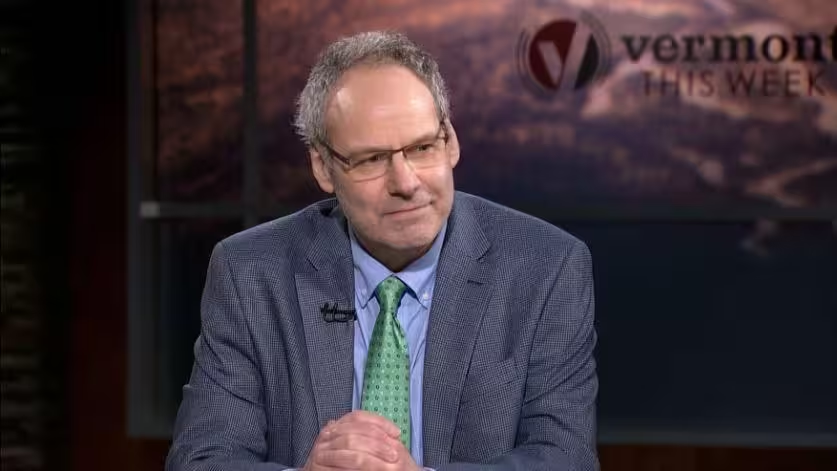
Overdose deaths fell in Vt. for the 3rd year in a row | Funding Vermont’s Ethics Commission | Banning guns in bars | Moderator - Mitch Wertlieb; Mark Johnson - WCAX; Alicia Freese - Vermont Public; Calvin Cutler - WCAX.
Problems playing video? | Closed Captioning Feedback
Problems playing video? | Closed Captioning Feedback
Vermont This Week is a local public television program presented by Vermont Public
Sponsored in part by Lintilhac Foundation and Milne Travel.
Support provided by:


Vermont This Week
May 8, 2026
5/8/2026 | 26m 46sVideo has Closed Captions
Overdose deaths fell in Vt. for the 3rd year in a row | Funding Vermont’s Ethics Commission | Banning guns in bars | Moderator - Mitch Wertlieb; Mark Johnson - WCAX; Alicia Freese - Vermont Public; Calvin Cutler - WCAX.
Problems playing video? | Closed Captioning Feedback
Where to Watch Vermont This Week
Vermont This Week is available to stream on pbs.org and the PBS app.
Support the crew
Help Mitch keep the conversations going as a member of Vermont Public. Join us today and support independent journalism.Providing Support for PBS.org
Learn Moreabout PBS online sponsorshipOverdose deaths in Vermont drop for the third consecutive year in a row.
Plus, Vermont's Ethics Commission grapples with funding and capacity questions.
When we're, you know, getting additional responsibilities each and every year, but not being given the staff to do it, it almost looks like somebody wants to the Ethics Commission to fail.
And the Senate advances a statewide ban on guns in bars.
All that and more ahead on Vermont this week.
From the Vermont public studio in Winooski.
This is Vermont this week, made possible in part by the Lintilhac Foundation and Milne travel.
Here's moderator Mitch Wertlieb.
Thanks so much for joining us.
I'm Mitch Wertlieb.
It's Friday, May 8th, and with us on the panel today, we have Mark Johnson from Wcax.
Calvin Cutler from Wcax and Alicia Freese from Vermont Public.
And thank you all so much for being here.
We're going to dive right into a story that actually has a little bit of good news element to it, Alicia Freese and this has to do with overdose deaths in Vermont falling now for the third year in a row.
Now we don't want to paint too rosy a picture.
We'll get into some of the data here, but this is pretty good news so far.
What do we know?
Yeah, I think it's hard to deny that it's good news.
As you said, third year in a row, we've seen a decline.
It's a 25% decline from 2024 to 2025.
And this is something we're seeing across the country, too.
We should note that Vermont is not alone in this respect.
And the biggest question is why?
Why?
What's this all about?
And I think we can't say with complete confidence.
I think there are multiple factors involved here.
If you ask the state health commissioner, he'll say, I think it's pretty clear that this stems, at least in part, from the state's efforts to ramp up treatment, ramp up harm reduction efforts, prevention efforts.
And that has been, you know, many year long endeavor.
There are there are other potential explanations, too.
I mean, we've seen the fentanyl supply from China decrease.
There's been some studies showing that there are fewer younger, people, people in their teens taking up, taking up these drugs.
But there are also, if you dig into the data, there are reasons to continue to be concerned.
One of them is an increase in, the amount of cocaine and methamphetamine that are showing up in these overdose deaths.
Instead of like, fentanyl, as you were saying.
Right, instead of the opioids.
And our system is really not designed to treat, those drugs like naloxone, the overdose reversing drug that has been, I think, hugely influential probably in bringing these overall numbers down.
Doesn't work on cocaine, doesn't work on meth.
So I think there yeah, there are more challenges ahead.
It's interesting because the last conversation I had with Chief Burke in Burlington, the police chief there, you know, he talked about this switch from the old days of heroin addiction to now that's amphetamine was really the drug of choice.
And also, EMTs talk about this, how, you know, Narcan just doesn't work on it.
And they were really concerned because, you know, heroin also is a drug that users can take early in the day.
It's a sort of once a day drug, and you're high for the rest of the day.
But methamphetamine requires you to, get, you know, more drugs sort of as the day goes along, which, of course, is increasing the amount of street crime and robberies and house break ins and car break ins as well, too.
And from a policy perspective, you know, this is also raising questions about what is the best way to tackle this.
I mean, Alicia talked about our hub and spoke model, which has been pretty effective in battling heroin.
But as we're seeing more stimulants, I'm thinking, you know, the legislature and the city of Burlington have sort of greenlit preliminarily this safe injection site.
And there was sort of a preliminary report out earlier this week that showed, that they're still trying to find a place to put it.
There's still community outreach.
They're still, you know, looking to staff this thing up.
And the future of it is really unclear because, I mean, this is a very specific policy intervention that's designed to keep people alive from deadly fentanyl.
And so the question is, now, if we're dealing with more stimulants, is this still the best course of action?
Senator Jenny Lyons I actually spoke with her earlier today, and she was one of the biggest supporters of the safe injection site bill.
When it was going through her committee, there they were going they are going to be voting on a bill to funnel another million dollars to this proposal.
But she raised some deep questions and deep concerns about, is this the best use of our money?
Should we be putting it towards treatment or recovery or other things as opposed to this specific piece of harm reduction?
So, yeah, you mixed in with the declining opioid, fatal opioid overdoses, the changing drug supply, just how tough it is to cite some of these things.
Just thinking with the needle exchange in Burlington, there's a lawsuit over that.
Yeah.
So, the future of the safe injection sites still very remains in the air.
That million dollar ask, though.
That's kind of a bold ask on top of the money that they've already asked for for these injection sites.
Right.
Yeah.
So, what I'm wondering here is, you know, when Alicia's talking about this drop that we've seen, and again, that's good news.
But if you look over the last decade, this year, 170, just from over opioid overdoses, but back in 2016, 111.
So there is still an issue here.
It the numbers have gotten incrementally better, but this is still a very big issue.
I'm just wondering how much political will there is to get that money out there for these injection sites.
It's it's a really good question.
And they've already allocated about $2 million to this.
They've spent about 300,000.
The folks that are sort of behind the safe Vermonters for Criminal Justice Reform, who's sort of administering this project, they say that as this gets closer to to reality, they're going to need to renovate a space and hire staff, and there's going to be more costs are going to ramp up.
But in terms of the political will, which I think you bring up a really good point.
We've seen other models like the work that they're doing at Jenna's Promise, for instance, or other sort of models of recovery and, rehabilitation that I think lawmakers are also really interested in looking at as well.
Plus, given some of just the systemic issues that we've seen in Burlington, you know, I don't know on the state level how much of a political appetite there was is for this.
Given also, the governor vetoed this and they overrode the veto, too.
Right.
And you can certainly expect local opposition wherever they cited.
And then there's also a hostile attitude towards these centers federally.
So yeah, lots of lots of hurdles.
Yeah.
So a lot to to watch out for that.
But again let's please take away some good news for those groups.
And yes, we have to.
We love reporting good news on the show whenever we can.
Funding always an issue.
It's an issue as well with Vermont's Ethics Commission.
Now this was something that was created in 2017.
Mark Johnson.
There are now it's becoming a bit of a problem at the state House.
What to do about the Ethics Commission, what the Ethics Commission should be doing, as opposed to, say, the Secretary of State's office on a number of things.
What are some of the issues folks are grappling with?
Well, you know, let's go back to the cut that you ran at the top of the show where you've got, this idea that Roy, the attitude in the legislature, they want it to fail.
You know, I was sitting in Jeanette White's committee who is the chair of the Senate Government Operations Committee back in 2017 when they were making this.
And, you know, it was like watching somebody sitting in a dental chair.
I mean, that legislature just really didn't want to deal with this.
And, you know, there was this attitude that, you know, we're all Vermonters, of course, were honest.
And we really don't even need this.
We know each other.
It's a small state.
Yeah.
And it was like pulling teeth to get, to continue the analogy, to try to get the legislature to even do this and the hostility that they showed in doing it was just palpable.
And the number of years that it took for them to actually come up.
They passed in 2017, went into effect in 2018, but then the number of years it took for them to actually establish what the ethical standards were was like another 4 or 5 years.
Then they added on the not only state officials but municipal officials on to this.
So they've just been loading this thing up with more and more to do and not really funding it.
You know, it just really, you know, I hate to be cynical about it, but it really just smacks of just pure, intellectual dishonesty.
And the latest controversy is that candidates, statewide candidates and legislative candidates are supposed to file a form which discloses what their potential conflicts of interest are, where they work, what their financial holdings are.
And now we're at a point where the Ethics Commission says we don't have enough staff and personnel to enforce if you don't file this form.
I mean, this is not asking an awful lot there.
The Ethics Commission has a budget of about 250,000 people.
They're asking for another 350,000 people.
And I know, you.
Know, dollars.
You're talking about other people.
Create for $50,000.
And yes, times are tight.
But, you know, just the the lack of will that the legislature has shown in wanting to do this just has become more and more apparent with this lack of enforcement, lack of funding.
And, you know, it's just it's it's embarrassing.
This is something that a lot of constituents, a lot of Vermonters are asking for this.
I mean, we see what happens at the federal level.
We're thinking about, you know, Congress is talking about banning stock trading and banning betting on poly market and prediction markets, you know, all sorts of ethical and moral questions that politicians are wading through.
I mean, Vermonters want this, right?
But it's one of those questions is the legislature going to hold themselves accountable?
And you know, to Mark's point, they did have, you know, they were giving guidance to to municipalities, local select boards, city councils, and they were just inundated.
I mean, they were swamped and they had to discontinue those services because they just they couldn't.
So but these municipalities wanted those services.
Cuzthat's they were saying, look, we need help with these issues.
Yeah, totally.
And I mean, this all plays out at the local level, the state level, you know, the the House, as Mark mentioned, you know, they requested the Ethics Commission, wanted two positions.
The House gave them one.
The Senate's version of the budget strips all of those positions.
We'll see what comes out in the conference committee.
But yeah, I mean, it's one of these we're going to have more responsibilities for the Ethics Commission to enforce this law that the legislature decided to pass.
But yet, it's an unfunded mandate in some ways.
Well, you know, and I'm glad you raised the federal issue, because I think an awful lot of people these days are looking at the federal government, and our federal officials in are saying, you know, this is outrageous what's going on.
We've had oil prices going up and down, and you see people that are profiting just in huge amounts of money betting on what the president will tweet out next.
So, you know, you can say to yourself, this is small potatoes, what's happening here in Vermont.
But, you know, we ranked Vermont ranked the lowest in the country in terms of ethical standards.
When this started to be taken up in 2017.
And just the slow work that has been done to get to where we are today, I mean, we're now almost we are almost like in ten years ago now that this, this effort began.
And, you know, you can say, well, you know, why is this Secretary of State do this?
Well, the Secretary of State's office is a is a state constitutional office.
And you really want to have this independent group looking at it.
And, you know, I liken it to we have, speed limits out on the roads.
And if there are no consequences to speeding, you know, we all try to not speed.
But if there's no consequence, potential consequence, then what's the point?
So, you know, maybe the legislature needs to really look at themselves in the mirror and say, if we don't want this, let's just gut it instead of having it do this sort of, you know, slow death.
It's going to be really interesting, too, because, as you say, the Secretary of State's office now is in direct conflict with the Ethics Commission, saying we don't want to do this work.
This is what you were designed to do, checking for financial deficiency.
I mean, it's it's not appropriate for them as a state constitutional office that they're enforcing this any more than, you know, one of the other problems that comes up is that the House and the Senate each have their own ethics committees, and there's a lot of controversy about that to where somebody will file a complaint, and then the House will look into their own membership.
And, you know, that just is a setup for a conflict right there.
Talk about conflict.
You want to talk about guns in bars.
Let's talk about that.
This is a this is a fascinating to me.
This has been now, I guess, moved out of the Senate, a bill that has, said, look, you can't bring Vermont has a Second Amendment right, like every state in the country does.
But you cannot bring a gun into a bar.
An establishment.
Calvin Cutler, it's it's not just like bars, like Red Square in Burlington, though.
It's restaurants too.
Right.
That's what this bill.
Would do, correct?
Yeah.
This would ban people bringing firearms into any establishment that has a class one liquor license.
That's everything from Red Square in Burlington to the 99 in Williston.
You know, that serves a beer and food.
So it's really a pretty broad gamut.
And, you know, as we've talked about, this is based off of that Burlington charter change.
I think it was ten years ago.
It was first, introduced.
The legislature never took it up because of concerns about a patchwork of the sportsman's bill of rights.
And so now, there was the latest, charter change that came from Burlington.
The house declined.
The House of ops Committee really didn't take it up.
So what Senator Bruce did is basically took, S-3 29, this vehicle, which has a number of other gun provisions in it as well.
And said, hey, let's take this bill, skip crossover.
And now it is passed the Senate on a party line vote.
But still, the path forward for this bill is anything but, but certain.
I mean, as I mentioned, it's a very broad swath of, you know, establishments that this would now say this is like bringing a gun into a hospital or a courthouse or a school, a sensitive zone, which I believe it's the Fifth Circuit, if I'm not mistaken.
Yeah.
The Fifth Circuit, has said that this is allowable.
Texas even has a similar, law on the books.
But, you know, when, like, when we talk about any gun law in the second, year of a biennium at the very end, it's going to be very controversial.
And we'll see what what the governor does with this, what Ruth wanted to do with this, of saying let's ban guns and bars statewide, was to sort of get over that concern of of the a patchwork.
But there's still, you know, the governor has also in the past questioned how do you enforce it?
So we'll see where it goes.
But it's not clear.
And, you know, this is actually I think the second there are two attempts by Burlington voters charter change to bring it down to the legislature.
This is really Senator Bruce kind of farewell attempt to make this happen.
And, you know, we have other fundamental constitutional rights.
We have, you know, the First Amendment, which, of course, we all are very interested in.
But, you know, you can't scream fire in a crowded theater.
I mean, there are restrictions on it.
And the idea that it is somehow controversial to have guns in an establishment that is serving alcohol.
We've seen it play out in Burlington, you know, and we've had a number of deaths, and there are people that are on bars who say, you know, this is really problematic when you have the emotionality of what happens when people are drinking alcohol and they have access to weapons.
Well, Alicia Freese.
We were talking about this before the show started, actually.
And to Mark's point, this does feel like something that Senate Senate Pro Tem Barrett, who is, who is retiring, would like to get done before he leaves.
Is this feel like it's something that personal for him in a way.
I mean, definitely, I mean, he has been probably the staunchest proponent of gun control measures in the legislature during his time there.
I think it's a really interesting move on his part because, as Calvin said, he's kind of trying to call the governor.
And perhaps some opponents in, in the House on, potentially a bluff here, you know, if, if the concern, if the primary concern was that this would lead to a patchwork of regulations, they're saying, all right, let's do it.
Let's do it everywhere.
Now we are seeing other concerns come to the fore, and I think it does face a real uphill battle.
But I think it's an interesting move on both Firth's part.
And I think it does have a bit of momentum because, as Mark alluded to, it, there was a fatal shooting at a bar on Church Street in Burlington and I believe 2024 Red square.
Yeah, yeah.
Which was the impetus for the second, attempt, to, to get this through at the, at the local level in Burlington.
Well, again, to put it in perspective to Calvin's reporting on this, the fact that this kind of blows my mind, it just because we know about the state of Texas, if the state of Texas does not allow guns in bars, it's a little surprising to me that Governor Phil Scott, to be clear, he says he would veto this bill, right.
If it does reach his desk.
He hasn't said the V word.
I mean, it did pass on a party line vote.
It was at 1713 in the Senate.
And he has raised concerns about the enforcement.
I would not be surprised.
I'd say a potential veto.
But but certainly, I mean, it's it's a real deep issue.
I mean, bring up the Texas piece of this.
I mean, Vermont has some of the highest, per capita or some of the highest rates of gun ownership per capita in the country.
You know, you get outside of Burlington and, you know, people really identify with the Second Amendment.
And, you know, I mean, it's a practical it's a safety measure.
But a lot of people really take the Second Amendment very seriously.
So we'll see.
And there's a lot of history here with the governor to remember the 2018 gun bills that the governor got a lot of flack for from from Republicans.
But yet he got a lot of credit for, from from Democrats.
So the politics here can't be ignored too.
Well.
It does not forget Peter Smith too.
You know, the the he lost his congressional seat to Bernie Sanders by going back on a gun pledge to.
So it's a real hot button.
It's a tough one for politicians.
Yeah.
It's a fascinating issue and one we're going to have to follow now that that bill has advanced, out of the Senate.
Really interesting thing happened last week where the, replacement for Kristi Noem at the head of Homeland security, Tom Homan, came to Vermont.
People started buzzing about Air Force four, I guess, was on the tarmac at the Burlington airport.
So he was here to talk with some officials.
But.
And he met with the governor.
But nobody really knows what was talked about in this meeting.
Here's what, Representative Becca Ballard had to say about that.
It should not be a secret when these things are happening, we should know what's happening, and we ought to be able to be in attendance to ask questions.
That's our job.
Yeah.
My my apologies.
Tom Homan is the Cfpb had and not replacing Kristi Noem.
But again you know, meeting with folks here in Vermont, as you heard Becca Ballance say there, nobody really knows what happened in this meeting.
What do we think they may have been talking about?
Well, this comes on the heels of the South Burlington, ice raid, where Vermont officials, including the public safety commissioner, Jennifer Morrison, made very clear that they were displeased with how, Ice operated on that day.
So I think it's a very high public interest to know.
And I'm not sure if the governor was involved in the conversation.
But at least Morrison was his legal.
Team was for sure.
Yeah.
Right.
And members of the state police and I think a couple of other local agencies.
So, yeah, pretty frustrating to have, you know, no idea what assurances state officials may have gotten out of that meeting or may not have gotten out of that meeting.
And pretty striking to, see it happen, with no announcement other, as you were mentioning before the show.
Not unprecedented.
Not at all.
What is it?
Last year, it was after the fatal shooting at the border, with the citizens.
And we can get into that by Friday.
Their, then secretary, Kristi Noem came a very unannounced met with Border patrol, met with local law enforcement and and left.
So again, not unheard of.
But, certainly, you know, it's significant that that, you know, the borders are is coming to Vermont and engaging in local with local officials in this way in a blue state.
You know, if they were going to Texas or going to, you know, we've seen them in other states at a much more let's get out the cameras and let's have the press conference.
But it was very much under the radar.
And we still, to Alicia's point, don't know a lot about it.
Yeah.
What alarmed me about it was some of the comments that Tom Homan was making after that visit on a broader level, saying, look, we are doing these mass deportations.
They are coming.
Get ready.
Given the chaotic nature of what happened in South Burlington, and again, there's we're still sifting through tape and body camera footage of all of that.
It's just it's very disquieting to to think that nobody really knows what was mentioned in that particular meeting.
I will say, though, you know, even as we sit here in tape on Friday, there is a protest that is being planned and is going on in Saint Albans.
And, you know, from a lot of people that are sort of in the sort of protesting atmosphere from the law enforcement, space of this, a lot of folks are looking at what happened in South Burlington on the on March 11th, and they're saying, what can we learn here?
How can we better communicate with law enforcement ahead of time?
Granted, that was an Ice raid, and that was a very dynamic, unique, active situation.
But a lot of people, you know, from the law enforcement side and the, the sort of anti ice protester side are very cognizant of what can we learn from that going forward.
What what did the feds take away?
I don't know, but here locally there's been a lot of reflection on.
It no question about it.
Want to update you on some, political happenings.
We've got some election news for you.
Vermont's lone U.S.
representative back about who we just heard from before, is announced this week.
She is running for reelection for a third term.
It appears unlikely she will face a challenger in the Democratic primary for 2024.
Republican challenger Mark Castor announced his candidacy last week, and Vermont Attorney General Charity Clark announces she is running for a third term, following some widespread speculation that she might throw her hat into the ring for governor.
But she is running for attorney general again, telling Vtdigger that this week, surprise at all Mark Johnson that perhaps Charity Clark wasn't seeking, the nomination for that.
Well, I think, you know, she's coming to the same conclusion that many others are.
I'm not totally convinced that Phil Scott runs again, but everybody else seems to think so.
And I think, you know, her feeling is she's in a very high profile position right now.
She is the main state official opposing the Trump policies.
Might be wise for her to stay right where she is.
She's getting a lot of, headlines, a lot of news out there, maybe setting herself up for two years.
And now and there are two very good candidates right now that are running on the Democratic side.
And you spoke with one of the at length, right, Ali Richards.
Yeah.
Yes, I did podcast and you know, she ran let's go kids, Vermont, is certainly a much more serious candidate, I think, than the last opponents that Phil Scott has had.
Amanda Joannou, who's an economist, is also running.
So I you know, I think there's some credible candidates.
If Phil Scott runs again, you know, of course they're both either one of them, are going to run into the problem of, the popularity of Phil Scott's 70% approval rating.
And I think really the big issue within that is that Vermonters really seem to like to have divided government.
They want to have somebody as a check on the Democratic legislature and not let them go too far.
Before we head out, we need to make an announcement about, it's kind of hits home.
We're a little navel gazing here, but Vermont Public Chief Operating Officer Brendan Kinney has been hired as the new CEO of Vtdigger, his parent organization, the Vermont Journalism Trust.
Now, Kinney is among Vermont public's most experienced leaders.
He spent 16 years at the merged Vermont public and one of its predecessors, Vermont Public Radio, most of that time spent supervising the organization's development efforts, as well as a one year stint as interim CEO.
And just on a personal level, I've known Brendan for many years.
He and I have been through the wars of many a, pledge drive together.
And it has just been a delight for me personally to, to have worked with Brendan.
And, certainly this is good news for Vtdigger.
Alicia, this is an organization.
You have worked at yourself, so you.
This has to be good news for them.
Yeah, it's a loss for Vermont public.
And I think a great a great gain for for Vtdigger.
And Vtdigger has seen a lot of leadership transitions recently.
So I think having somebody who has worked in the Vermont media ecosystem for so long is, is just going to be a huge well.
What he really brings to the table is, you know, he's he's got fundraising skills.
And if there's anything right now that for my needs is somebody who has the ability to go out and raise money.
They've had some pretty significant financial challenges.
And, you know, he's also from Vermont.
He's he's got a Rolodex.
But I think one of the other real issues is who's going to come in next is the news director, Sue Allen, who's worked with many of us in the past, is going to run the news division for a while.
But, you know, they really need to up their game on the news side in order for Brendan and the rest of the crew to have somebody, a product to really sell to the public as well too.
Well, we appreciate all thoughts on Brendan.
Best of luck to him.
And that does it for Vermont this week.
Thank you to our panel.
Mark Johnson from Wcax Calvin Cutler from Wcax.
And Alicia Freese from Vermont Public.
Im Mitch Wertlieb, thank you so much for watching.
Join us next Friday for Vermont this week.
 New Episode
- News and Public Affairs

Top journalists deliver compelling original analysis of the hour's headlines.
 New Episode
- News and Public Affairs

Today's top journalists discuss Washington's current political events and public affairs.
 New Season


 New Episode
 New Episode
 New Episode

 New Episode
 New Episode
Support for PBS provided by:
Vermont This Week is a local public television program presented by Vermont Public
Sponsored in part by Lintilhac Foundation and Milne Travel.