
May 9, 2024 - PBS NewsHour full episode
5/9/2024 | 57m 46sVideo has Closed Captions
May 9, 2024 - PBS NewsHour full episode
Thursday on the NewsHour, Israel bombards Rafah as its leaders respond with defiance to President Biden freezing some weapons deliveries. Stormy Daniels clashes with Donald Trump's legal team as she takes the stand for a second day in the former president's hush money trial. Plus, a look at a battery-powered aircraft that could lead the transition away from fossil-fueled flight.
Problems playing video? | Closed Captioning Feedback
Problems playing video? | Closed Captioning Feedback
Major corporate funding for the PBS News Hour is provided by BDO, BNSF, Consumer Cellular, American Cruise Lines, and Raymond James. Funding for the PBS NewsHour Weekend is provided by...
Support provided by:

May 9, 2024 - PBS NewsHour full episode
5/9/2024 | 57m 46sVideo has Closed Captions
Thursday on the NewsHour, Israel bombards Rafah as its leaders respond with defiance to President Biden freezing some weapons deliveries. Stormy Daniels clashes with Donald Trump's legal team as she takes the stand for a second day in the former president's hush money trial. Plus, a look at a battery-powered aircraft that could lead the transition away from fossil-fueled flight.
Problems playing video? | Closed Captioning Feedback
How to Watch PBS News Hour
PBS News Hour is available to stream on pbs.org and the free PBS App, available on iPhone, Apple TV, Android TV, Android smartphones, Amazon Fire TV, Amazon Fire Tablet, Roku, Samsung Smart TV, and Vizio.
Providing Support for PBS.org
Learn Moreabout PBS online sponsorshipAMNA NAWAZ: Good evening.
I'm Amna# Nawaz.
Geoff Bennett is on assignment.
On the "NewsHour" tonight: Israel bombards Rafah,## as its leaders respond with defiance to# President Biden freezing some weapons deliveries.
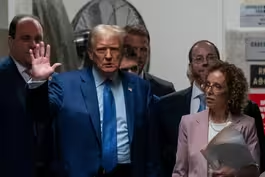
Stormy Daniels clashes with# Donald Trump's legal team,## as she takes the stand for a second day# in the former presidents hush money trial.
And a look at a battery-powered aircraft## that could lead the transition# away from fossil-fueled flight.
EMMA DAVIS, Beta Technologies: You can get in# it, you can fly in it, you can carry cargo in## it.
This aircraft isn't a gimmick.
It is# a real-world aircraft.
It is reliable.
(BREAK) AMNA NAWAZ: Welcome to the "NewsHour."
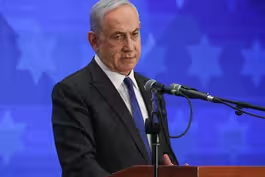
Today, Israeli Prime Minister Benjamin Netanyahu# said his country.. if necessary," a response# to President Biden's recent## move to pause deliveries of some bombs to Israel.
That decision has created a possible turning# point in the U.S.-Israel relationship and## the war in Gaza, with the fate of# hostage negotiations in the balance.
Israel is now poised to# expand its operation in Rafah,## a step the U.S. is warning Netanyahu not to take.
Nick Schifrin begins our coverage.
NICK SCHIFRIN: In Southern Israel, tanks# are massed and nearly ready for an assault.## They fire at Rafah, where ongoing airstrikes# ripped the roofs off homes, toppled minarets,## and killed victims who are so easy to# carry, the burden becomes all the heavier.
And President Biden is concerned an# expanded military operation would## kill more Gazans, like Yazan Hassan Mohana (ph).
JOE BIDEN, President of the United States:# Civilians have been killed in Gaza as a## consequence of those bombs and other ways# in which they go after population centers.
And I made it clear that, if they go into Rafah# -- they haven't gone into Rafah yet.
If they go## into Rafah, I'm not supplying the weapons that# have been used historically to deal with Rafah.
NICK SCHIFRIN: But Hamas fights from# Rafah, including with mortars that## last weekend killed four Israeli soldiers# and blocked humanitarian aid.
Israel is## determined to eliminate Hamas' final four# battalions no matter what the U.S. says,## Prime Minister Benjamin Netanyahu said today.
BENJAMIN NETANYAHU, Israeli Prime Minister# (through translator): If we need to stand## alone, we will stand alone.
I# have said that.. we will fight with fingernails.
But# we have much more than fingernails.## And with that same strength of spirit,# with God's help, together, we will win.
NICK SCHIFRIN: The fighting has forced# some 80,000 Gazans, many already displaced,## to flee Rafah.
The main hospital# is closed, its rooms abandoned.
Humanitarian aid shelves are nearly bare.
And# fuel trucks are stuck in Egypt.
There's only## one to two days of fuel left since Israel seized# and closed the border, the U.N. said this week.
DR. MICHAEL J. RYAN, World Health Organization:# The first act is to stop the fuel, stop the food,## stop the medicine at source, at the border.# I don't call that limited, and I don't call## that restricted.
I call that a reimposition of# total blockade on nearly 2.5 million civilians.
NICK SCHIFRIN: The fate of# Rafah is connected to the## fate of Israeli hostages.
Every night# their families march through Tel Aviv,## demanding the government accept a deal that# would pause the war to release their loved ones.
Today, National Security Communications# Adviser John Kirby said the U.S. shares## Israel's strategic goal of an enduring# defeat of Hamas, but said it disagreed with## how to achieve it.
Smashing into Rafah,# Kirby said, will not get Israel there.
And, Amna, he also said it's unacceptable# that the Rafah Crossing is not open.
AMNA NAWAZ: Nick, you mentioned there in your# report how the fate of Rafah is intertwined## with the fate of those hostages still held in# Gaza.
What's the status of those negotiations?
NICK SCHIFRIN: CIA Director Bill Burns,## who has been leading these# negotiations, has left the region.
But U.S. officials tell me that that does# not mean the negotiations have stopped.
But## there's clearly a difference between the U.S.# and Israel on how those negotiations should## proceed.
Israel has argued that President Biden's# decision about pausing some weapons deliveries## and making that decision public actually# strengthens Hamas' negotiating position.
But Kirby today argued that a major operation# by Israel in Rafah would actually strengthen## Hamas' negotiation position, because he said that# operation would show that Israel is not interested## in actually achieving a cease-fire-for-hostage# deal, and it would cause more civilian casualties,## therefore putting more diplomatic# and international pressure on Israel.
But it's all coming to a head.
Israel said# the end of this week is the deadline.
They## will launch that major operation in# Rafah if there is not a hostage deal.
AMNA NAWAZ: Nick Schifrin# beginning our coverage tonight.
Nick, thank you.
NICK SCHIFRIN: Thank you.
AMNA NAWAZ:## In the day's other headlines: Large# stretches of the Deep South faced## a new wave of severe storms,# including possible tornadoes.
Dangerous conditions delayed flights in Atlanta# and Charlotte and closed schools in some places.## A day earlier, Tennessee reported multiple# tornadoes and saw barrages of massive hail.## The storms also left widespread destruction and# hundreds of thousands of people without power.## In all, four people have died this# week from the extreme weather.
Puerto Rico has declared a state of emergency# and activated the National Guard amid unrelenting## rain and flooding.
The U.S. territory has had# more than 10 inches of rain in just two days,## turning streets into rivers and triggering# landslides.
Officials say one person is missing,## several people have been rescued from# rooftops and crops have been badly damaged.
In Ukraine, President Volodymyr Zelenskyy warned## today his country faces a -- quote --# "really difficult situation" in the east,## as Russian forces gain ground.
Zelenskyy# spoke in Kyiv with the president of the## European Parliament.
He said new military aid# from the United States needs to arrive soon.
VOLODYMYR ZELENSKYY, Ukrainian President# (through translator): With an increase in## the supply of weapons, we will be a.. they seized the initiative there.
This is# no secret.
We need to stop them, take the## initiative into our own hands.
This is possible# only when you have something strong in your hands.
AMNA NAWAZ: Zelenskyy's comments followed a# week of heavy Russian bombardments.
Today,## officials confirmed that two hydropower# plants were knocked out in the assault.
In the meantime, a Ukrainian drone attack# today damaged an energy plant more than 900## miles inside Russian territory.
That is# the deepest strike yet by Kyiv's forces.
Russia focused on a different conflict today,# its defeat of Nazi Germany in World War II.## Victory Day brought parades and pageantry# orchestrated by President Vladimir Putin.## On a cold, snowy day in Moscow, military# regiments marched and tanks rolled through## Red Square.
Putin thanked those fighting# in Ukraine and said the country is united.
VLADIMIR PUTIN, Russian President (through# translator): We celebrate Victory Day in the## context of the special military operation.# All its participants, those who are .. front line, on the line of combat contact,# are our heroes.
All of Russia is with you.
AMNA NAWAZ: Putin has used World War# II to justify his invasion of Ukraine,## claiming without evidence that the# goal is to root out a neo-Nazi regime.
Back in this country, 25 Republican# attorneys general sued the Environmental## Protection Agency over carbon emissions.# They're challenging a rule that would cut## those emissions from coal-fired power# plants by 90 percent over eight years.
West Virginia's attorney general said the mandate# is -- quote -- "setting up the plants to fail,## and therefore shutter, altering the# nation's already stretched grid."
On Wall Street, stocks managed to gain some# ground today.
The Dow Jones industrial average## was up 331 points to close at 39387.
The# Nasdaq rose 43 points.
The S&P 500 added 26.
And the World Video Game Hall# of Fame in Rochester, New York,## has five new honorees.
The class of 2024 includes# "Asteroids," which debuted in arcades in 1979,## plus "Ultima," Resident Evil," "Myst," and# "SimCity."
The Hall of Fame recognizes all## types of electronic games, including arcade,# counsel, computer, handheld, and mobile.
Still to come on the "NewsHour": the# Biden administration proposes changes## to the asylum system that would speed# up deportations for certain migrants;## a middle school's unique and successful approach# to keeping students off their cell phones;## and a new book takes a look at the women# who shaped President Theodore Roosevelt.
More now on the Biden administration's decision# to suspend some weapons deliveries to Israel## to pressure it against a large-scale# invasion of the Gazan city of Rafah.
Nick Schifrin is back here in studio now.
And, Nick, as you have been reporting, President# Biden wants the Netanyahu government to do more## to limit civilian deaths in Rafah, where more# than a million people are now sheltering -- Nick.
NICK SCHIFRIN: Amna, the decision# pauses the delivery of 3,500 bombs,## about half of them 2,000-pound bombs# that the U.S. police have caused the## most civilian casualties in Gaza.# President Biden also warned that## more weapons deliveries could be paused if# Israel launches that full invasion of Rafah.
So, will the decision have the desired effect?
For that, we get two views.
Ambassador Dennis# Ross played leading roles in the Middle East## peace process for more than 12 years.
He is# now a counselor and a distinguished fellow## at the Washington Institute for Near# East Policy, a Washington think tank.
And Tom Malinowski was assistant# secretary of state for democracy,## human rights and labor during the Obama# administration, and is a former member## of Congress.
He's now a nonresident# senior fellow at the McCain Institute.
Thanks very much to both of you.# Welcome back to the "NewsHour."
Ambassador Ross, let me start with you.
Will the Israeli government now take more into# account Biden administration over Rafah than## it would have had this decision not# been made and not been made public?
DENNIS ROSS, Former U.S.
Envoy to Middle# East: Look, it's an excellent question.
My sense is, from a political standpoint, it# will be harder for Prime Minister Netanyahu## to look like he's responding to President# Biden, not in terms of the body politic## of Israel as a whole, but in terms of# the right-wing of his own coalition.
So how he manages that, I think, remains## to be seen.
Now, having said that, I# don't see him wanting to put Israel in## a position where suddenly it's losing access# to some of the munitions it's likely to need,## not so much for Rafah, but because it still faces# very real threats from Hezbollah in the north.
It's not in Israel's interest# to create an image of a gap,## a division with the United States.
That could# make a conflict in the north with Hezbollah## more likely.
And, frankly, it's also not# in Israel's interest, because I think## it probably also increases the Hamas sense, or# at least Yahya Sinwar, the Hamas leader in Gaza,## increases his sense that he really doesn't# need to make any decisions at all right now.
He's going to play upon the divisions# between the United States and Israel.## So I think both Israel and the# United States have an interest## in finding a way to change that# image that there's a division.
NICK SCHIFRIN: Tom Malinowski, same question.# Is Bibi Netanyahu more likely to take U.S.## warnings seriously today than he# was before this was made public?
FMR.
REP. TOM MALINOWSKI (D-NJ): Well,# he wasn't taking them seriously before.
And that's why the president# made this decision.
Look,## this is the most pro-Israel president in# American history, who's just reached his## limit after months and months of trying to# break through to this government in Israel.
We're still supporting Israel.
He's also# the first president just last month to put## American armed forces on the line defending# Israel against attacks, shooting down... NICK SCHIFRIN: This is the Iranian attack, right.
FMR.
REP. TOM MALINOWSKI: Exactly,## shooting down hundreds of..
He's just decided something that I think should# be noncontroversial, that we shouldn't be arming## a foreign country to do something that the# United States thinks should not be done.
NICK SCHIFRIN: Dennis Ross, take on# that last point.
Should the United## States be arming a country, Israel in this case,## to do something that it doesn't want# done, namely the invasion of Rafah?
DENNIS ROSS: It's pretty# hard to quarrel with that,## because the fact is, Israel has# its set of interests, but so do we.
And if we to do something that# is wrong or crossed the line or,## in fact, is counterproductive, which is# the real reason that the president has## adopted the position he has -- yes,# there's a moral dimension to this,## but he actually thinks this is self-defeating,# if Israel goes into Rafah on the ground.
Now, having said that, again, the# administration's position is actually## not different from Israel's that Hamas# should not be in control, not only of Gaza,## but they shouldn't be in control of Rafah.
There# ought to be a way for the administration and## Israel to reach an understanding on what# is a way to deal with the Hamas presence## in Rafah without putting at risk 1.3 million# people who are crammed into a very small area.
NICK SCHIFRIN: Well, that is certainly# what the U.S. wants.
Netanyahu has said,## at least publicly, that he needs to go into Rafah.
The impact on the hostage negotiations is the real# divide here.
Israel has accused President Biden,## essentially, of relieving pressure on Sinwar,# as Ambassador Ross said.
John Kirby made the## opposite case, that an invasion of Rafah would# actually hurt Israel in the negotiations.
Tom Malinowski, what do you think?
FMR.
REP. TOM MALINOWSKI: I agree with John Kirby.
But, also, I think that, for Prime Minister# Netanyahu to make that argument doesn't make## a lot of sense to me, because it was Prime# Minister Netanyahu who said repeatedly over## the last several days that he would go into# Rafah whether there's a hostage deal or not.
He took away his own leverage by# making those statements and put## the United States and our allies in the# region in a -- our other allies in the## region in the difficult position of trying# to convince Hamas, you have to give up the## hostages anyway and we will somehow try# to restrain the Israelis from doing this.
So, I don't think he can have it both ways.
NICK SCHIFRIN: Ambassador# Ross, take on that point,## that Netanyahu took away his own leverage by# arguing he was going into Rafah regardle.. DENNIS ROSS: Yes, I think it was a mistake for him# to say that.
I think he was saying it because he## was trying to appease his ministers on the far# right, meaning Ministers Smotrich and Ben-Gvir.
The most important leverage Israel# has with Sinwar -- and, again, Sinwar,## I think, is different than the political# leadership of Hamas.
The key to, I think,## putting pressure under him is him feeling that# there's a noose that's tightening around his neck.
But, from that standpoint, the# threat of going into Rafah is## far more impressive than actually doing it,# number one.
Number two, if you were saying,## we won't go into Rafah if there's a hostage# release, that too increases the leverage.
I am concerned that, if it looks like we're# doing everything we can to prevent a threat## against Rafah, that that gives Sinwar a certain# degree of comfort.
So I think there is a great## value in the U.S. and the Israelis reaching an# agreement on, A, we share the same strategic## objective as it relates to Hamas in Gaza --# I mean, in Rafah and Gaza more generally,## but, B, we have reached an understanding about how# to contend with how to remove Hamas from Rafah.
I think that is something that can be achievable.# I do think the issue with Netanyahu relates much## more to the politics of his coalition# than to the reality of what it will take## to succeed in Rafah and to do it in a way that# is consistent with what the U.S. can live with.
NICK SCHIFRIN: Well, when it comes# to the politics of the coalition,## we have got a few graphics to show here.
We have got a tweet from a member of the# coalition who is National Security Minister## Itamar Ben-Gvir right there in response to# the decision, tweeting: "Hamas loves Biden."
And a Jerusalem Post editorial,# there you go, "Betrayal of Allies."
So, Tom Malinowski, in the minute we# have left, is some of the responses,## especially within Netanyahu's# coalition, is that posturing or## is that genuine anger ahead of Israeli# Independence Day, and does it matter?
FMR.
REP. TOM MALINOWSKI: I think they're amping# up the drama.
I think they're hoping to affect## the American political debate on this, hoping# that somehow they can go around Biden and have## others pressure the administration# to change course, which won't work.
I -- those statements, particularly from ministers## who have been convicted by Israeli courts# of support for terrorism themselves,## are not going to have a lot of impact on the# Biden administration's calculus, nor should they.
I think, when the drama subsides, I agree with# Ambassador Ross that, at the end of the day,## Israel and the United States need each# other.
Israel needs the United States## and the supply of weapons that we provide# and the political support that we provide.
And I think the understanding, the common# understanding that Ambassador Ross rightly## says is necessary, about how to actually# defeat Hamas will be where we end up.
NICK SCHIFRIN: Tom Malinowski, Ambassador# Dennis Ross, thank you very much to you both.
DENNIS ROSS: Thank you.
AMNA NAWAZ:## The adult film actress at the center of# former President Trump's criminal hush## money trial finished her testimony today# after more than seven hours on the stand.
Stormy Daniels spent the morning being# questioned by Trump's defense attorney## in a tense cross-examination that tried# to paint her as an opportunist.
She was## just one of several witnesses# who appeared in court today.
Our William Brangham has been covering# this.
He joins us now from New York.
So, New York, Ms. Daniels -- rather, William,# Ms. Daniels finished her second and her last## day on the stand today.
We're saying she's at# the center of this trial, but she's not really## involved in any of the hush money repayments that# Mr. Trump is accused of trying to conceal here.
So tell us a little bit about# what she did testify to today.
WILLIAM BRANGHAM: No, that's exactly right, Amna.
She has testified that she has no direct# knowledge of the charges.. center of this falsifying business# records case, but yet, as you said,## she is also at the very center of this case.# And her testimony continued today with her## finishing telling the story of this alleged# one-time sexual encounter she had with Donald## Trump at a celebrity golf tournament years# ago in Lake Tahoe, and the then $130,000## that she negotiated to get paid to silence# that story and make sure it never came out.
And Trump's legal team# today, led by Susan Necheles,## tried to poke holes in inconsistencies# that she has given over the years,## trying to say that she's not told a consistent# story.
There were lots of little examples of this.
Like, one example, they spent# a good deal of time trying to## parse out whether Stormy Daniels# ever said that she ate dinner,## literally ate a meal with him in that# room that night of this alleged affair.
Necheles also tried to# paint her, as you mentioned,## as solely being out for money and said,# how much money were you making on the## documentary and the book and the interviews# that you have given over the years?
I mean, it was very testive -- testy,# very combative.
And there were times## where Daniels seemed extremely defiant,# and there were times where she seemed## to actually enjoy the jousting back and# forth.
In contrast to how she was Tuesday,## where she seemed much more nervous, today,# she seemed much more eager for the fight.
In fact, there was one point at which Necheles# was trying to show all the merchandise that she## sells on her Web site and through her# Instagram page, where she is promoting## appearances at strip clubs, where she makes# some mention of her relationship with Trump.
And Necheles was saying, you know, you're# trying to capitalize on this.
And Daniels said,## in essence, yes, that's my job, merchandising# myself and selling things with my name on it,## not too dissimilar from what Trump does, she said.
So, a very, very combative day today.
AMNA NAWAZ: (AUDIO GAP) for a moment.
There# were some witnesses who did have a more direct## relationship to those repayments at the center# of this trial.
What did they have to testify to?
WILLIAM BRANGHAM: That's right.
There wa.. test -- who told basically about how checks# were cut from the Trump Organization and sent## to Washington, D.C., to the White House for Trump# to sign them and then send them back to New York.
Some of these checks are at the core of this case# of the alleged repayment to Michael Cohen.
Another## former executive assistant from the White House,# a woman named Madeleine Westerhout, testified## about receiving some of those checks and seeing# Donald Trump sign some of them in the Oval Office.
She also detailed scheduling a very# crucial meeting where Michael Cohen## came to meet Donald Trump at the White# House while he was president, and,## allegedly, they discussed the White House -- this# repayment scheme that's the center of this case.
So those were the other# witnesses we heard from today.
AMNA NAWAZ: And, William, we know Mr.# Trump's lawyers took issue with some of## the details that Stormy Daniels# testified to.
They again asked## for a mistrial and for a change to Mr.# Trump's gag order.
What happened there?
WILLIAM BRANGHAM: That's right, the -- two things.
Modifying the gag order, trump's lawyers argued# that all of these details that .. now that Daniels is off the witness# stand, that Trump should be freed## from his gag order and be able to directly# try to rebut her publicly on social media.
The second one is, they argued for this mistrial,# as you mentioned.
And they were alleging,## Trump's lawyers were alleging that Daniels# was somehow telling a different story about## this alleged sexual encounter, implying that# she was saying that there was some level of## coercion going on there, and that Trump --# that this is completely unfair, that this## is a new story they had never heard before, and# that all of these details that she testified to## over seven hours are prejudicial to the jury,# and they need to have the trial thrown out.
The judge in both of these cases said --# denied the motions by Trump's lawyers.
And## Trump was quite, seemingly, visibly angry# towards the end of the day today.
And at## the end of the day's proceedings, he went out# into the hallway, as he often does and today,## in a particularly angry way,# lashed out at the judge.
Let's hear what he had to say.
DONALD TRUMP, Former President of#the United States (R) ... Everybody saw what happened today.
He's a# corrupt judge, and he's totally conflicted.
WILLIAM BRANGHAM: Both of those# motions were denied by his team.
Testimony resumes tomorrow.
And,# again, as is always the case,## we don't know who will be on# the witness stand tomorrow.
AMNA NAWAZ: All right, that is William# Brangham covering the legal cases around## former President Donald Trump# joining us in New York tonight.
William, thank you.
WILLIAM BRANGHAM: Thanks, Amna.
AMNA NAWAZ:##The Biden administration proposed a cha... the U.S. asylum system today that would expedite## the removal of certain migrants.
The regulation# under consideration would apply to migrants with## criminal histories or deemed as national security# risks who would be unlikely to receive asylum.
Following all of this is our White# House correspondent, Laura Barron-Lopez.
Laura, you spoke with some Homeland# Security Department officials earlier## today who briefed you on this change.
What# did they share with you about the plan?
LAURA BARRON-LOPEZ: So, a senior DHS# official essentially said that this## change allows asylum officers to take# into consideration if they think that## a migrant may be a threat to public# safety, a threat to national security## at an earlier stage of that asylum process# than is previously allowed under the law.
Currently, under the law, asylum --# currently, in the asylum process,## those potential threats are taken into# consideration when they're deciding -- when## the government is deciding whether or not# a migrant can be granted asylum.
But it's## typically when they're in court facing# a judge, have a lawyer by their side.
This makes it so that would be possible# during the credible fear interview stage,## which happens within the first one to two days of## a migrant arriving.
So that's the big# change here, Amna, is to the timeline.
AMNA NAWAZ: So, do any of the measures# or proposals announced today, do they## have any impact on the southern border right now?
LAURA BARRON-LOPEZ: So, that proposed rule won't# have an immediate impact, because it's a proposal.
And so, of course, it has to go through# the process that all regulations have## to go through.
But the DHS official who# spoke to reporters today said that the## administration believes that they will# go through this regulation, the process,## expeditiously, that it could very well be# finalized before the November election.
And one other thing, though, that the Homeland## Security Department announced today# that would take effect immediately, Amna, is new guidance that was issued to asylum# officers, a revised guidance that says that,## during, again, that credible fear interview,# which happens within the first few days of a## migrant arriving and whether or not they're# determining if they are granted asylum,## during that interview, asylum officers can now# try to figure out whether or not those migrants## can be relocated internally to the country# that they came from safely, and if they can## safely return to the country that they're from and# live there and not fear violence or retribution.
And that's something that initially was# not something that asylum officers did## that early in the stage.
So that's something# that is going to have an immediate effect.
One thing I want to say, though, about that# proposed regulation, Amna, and when it does## take effect, is that the experts that I spoke# to said that it may only impact a small number## of migrants.
The DHS official did not want to tell# us an exact estimate of how many migrants it would## impact, but the legal immigration experts that I# spoke to said that it would be a small percentage.
AMNA NAWAZ: So what about the timing of all of# this, Laura?
What does your reporting show you## about why the Biden administration# would propose these changes now?
LAURA BARRON-LOPEZ: As we both reported,# Amna, President Biden has been considering## unilateral actions because of the fact that# his efforts to negotiate with Congress,## to seek out a bipartisan border# agreement totally failed because## Republicans killed it, despite# the fact that he was trying to## sign on to one of the most conservative# bills that they have considered in decades.
And so the DHS senior official told us today that# they're clear-eyed about executive actions.
They## know that they don't solve all the problems, but# because there has been no action in Congress,## they felt that they needed to take this# step.
And they are also consistently## reviewing other steps that they could# potentially take in the coming months.
Now, of course, Amna, another factor# here is that it is an election year.## And President Biden has been facing a lot# of pressure, not just from Republicans,## but from also Democrats within his own# party, to take more actions on the border.
AMNA NAWAZ: So what is the reality# on the ground at the U.S. southern## border right now?
What are the# facts on the ground we know?
LAURA BARRON-LOPEZ: So, what we have seen actually# in recent months, there was an increase at the end## of last year in terms of the number of migrants# encountered between ports of entry at the border.
But there has been a decline in# apprehensions at the Southwest## border.
So, when you start in December,# there was more than 200,000 apprehensions## at the southern border.
January, that dropped# to more than 124,000, and then, in February,## 140,000, a slight increase there from January.# But again it dipped in March, which is the## month that we have the most recent data for from# Customs and Border Protection to 137,000, Amna.
And the administration largely# credits actions taken by allies,## taken by the Mexican government to crack down# on immigration as well, for that dip in numbers.
AMNA NAWAZ: All right, our White House# correspondent, Laura Barron-Lopez,## reporting on an issue still top# of mind for many voters this year.
Laura, thank you.
LAURA BARRON-LOPEZ: Thank you.
AMNA NAWAZ: As schools nationwide grapple with# how to keep students off their cell phones,## one Connecticut school took a blunt approach.
In Manchester, Illing Middle School banned# all cell phone use, requiring students to## lock phones in a pouch until the end of the# school day.
The backlash from students and some## parents was swift.
Illing even offered to have# administrators unlock a student's phone if needed.
But, within weeks, school staff said that wasn't# even necessary.
This comes as lawmakers in at## least a half-a-dozen states are pushing# their schools to curb cell phone use.
Illing Middle School's assistant# principal, Raymond Dolphin, joins me now.
Welcome, and thanks for joining us.
So tell us a little bit about what the problem was## that you were trying to fix in# the first place.
Why the ban?
RAYMOND DOLPHIN, Assistant Principal, Illing# Middle School: The number one problem was that## the cell phones were interfering with the student# -- the learning of our students in the classrooms.
As we administrators were visiting classrooms,# as well as listening to other teachers,## we would regularly hear or witness# ourselves, when the teacher was## providing instruction, students were# being distracted on their cell phones.
AMNA NAWAZ: So you spearheaded this# move.
And we should note this wasn't## about limiting use during the school day or# giving teachers the power to take phones away## if there are problems.
You basically said# no phones all day, that's it, lock it away.
Why that approach?
RAYMOND DOLPHIN: We, as an administrative tea.. we found is that, for even adults, it's really# difficult for them to manage their cell phone use.
And, for students, it's even that much# more challenging, just, as age-appropriate,## for them to struggle even more so.
To just# tell them it's effective to use your phone## at this time and not that time, students weren't# able to handle that.
Any time their phone would## vibrate or an alert would come off or just# throughout the day because they were curious## about a friend's response, they would be -- they# would find themselves looking on their cell phone.
AMNA NAWAZ: What kind of reaction did# you get from students and from parents?
RAYMOND DOLPHIN: So, initially, of course,# our students, they had major resistance.## They thought it was -- they were a lot# -- a lot of them were very, very fearful.
What does it seem -- what does it look# like for me not to have access to my phone,## when this device is something that, for some# students, they would sleep with?
And so it was## a lot of fear there, a lot of frustration.
But# they soon adapted to it and responded very well.
For the majority of our parents, we have# a philosophy out here in Manchester Public## School where we don't just do things to our# community, we do them with them.
And so we## have already sent out surveys and asked a lot of# parents if they were on board and also thought## that there was something that we needed to do.# And they signed up on it as well overwhelmingly.
And so that just left a small minority of## parents that we had to kind of coach# through the process of resistance.
AMNA NAWAZ: There is an expectation, as I'm# sure you have seen in your school community too,## among some parents that they want to be able# to reach their kids during the school day.
They## want their kids to be able to reach them in an# emergency or for support or a similar situation.
Did you see any of that?
And how# do you respond to those concerns?
RAYMOND DOLPHIN: Those concerns are legitimate,# but we already have solutions already built in.
Every single classroom that we have# in this building has at least one## phone in it, and most of them have two phones.
So,## if something comes up where a student# actually needs to reach their parent,## they can just simply ask for permission, and# they have the opportunity to call their parent.
If the parent wants to reach their student, they# can call the main office and we can get messages## to them.
So you have access to your students.# And the only change is that that immediate,## like this-second reaction to send a text# or send multiple texts is no longer there.
So, families do have to be a little bit more# planned, but that opportunity still exists.
AMNA NAWAZ: Can I ask, just out of# curiosity, the phones in the classrooms,## those are probably landlines.
Is this the first# time some of your kids have had to use a landline?
RAYMOND DOLPHIN: Yes.
(LAUGHTER) RAYMOND DOLPHIN: Yes.
It's# funny that you brought that up,## because we adults were remarking about# that at the beginnin.. just at how many students were# asking us, how do I use this phone?
(LAUGHTER) RAYMOND DOLPHIN: And so we were floored at that.
But there was a lot of students# who had that question, yes.
AMNA NAWAZ: As you know, when you take a look at# the broader picture, the statistics are clear.## The National Center for Education Statistics# found, in 2020, there were already cell phone## bans in place in 76 percent of U.S. schools,# but then another survey found some 97 percent of## students who have cell phones are still using them# during the school day for about 45 minutes or so.
So what is your advice for schools# who want to try to enforce bans,## take cell phones out of the classrooms,# but don't know how to do that?
RAYMOND DOLPHIN: Sure.
So that statistic doesn't surprise me.
That#.. similar.
My advice to everyone is to not treat# the Yondr pouches as the magic solution.
It's## one tool that is a major part of your# overall strategy to solve this problem.
You need to elicit support from parents.
You# need to ensure that, like your school community,## your teacher support staff and administration# are all on the same page, and consistency,## consistency, consistency is# the most important thing.
AMNA NAWAZ: All right, that is Illing# Middle School's assistant principal,## Raymond Dolphin, from Manchester,# Connecticut, joining us today.
Assistant Principal Dolphin,# thank you.
Appreciate your time.
RAYMOND DOLPHIN: Thank you very much.
AMNA NAWAZ: Earlier this month, the Federal# Aviation Administration approved the first## training program in the country for# electric aviation.
The program is just## one part of a small, but burgeoning# effort to develop greener air travel.
Our aviation correspondent,# Miles O'Brien, has that report.
MAN: Be great.
Be great.
MILES O'BRIEN: It was game day for Nate Moyer,## a former Air Force test pilot.
He was cool as a# cucumber, facing uncharted airspace ahead.
His## goal?
Fly a new kind of battery-powered# aircraft through a tricky transition.
MAN: Safe area is clear.
Pattern is all yours.
MILES O'BRIEN: It lifted off like a helicopter,## but then he stopped the vertical rotors,# turning the craft into an airplane.
It's called an electric vertical take-off and# landing aircraft, or eVTOL.
It was a pivotal## moment for a company that hopes to lead the# transition away from fossil-fueled flight.
KYLE CLARK, Founder and CEO, Beta Technologies:# I felt like my purpose was to fly.
MILES O'BRIEN: Engineer and avid# aviator Kyle Clark is the founder## and CEO of Beta Technologies,# based in Burlington, Vermont.
KYLE CLARK: Somewhere around 30 years# old, I, like, had this realization,## like, damn.
I do genuinely care not only# about my own kids, but the future of the## world.
And that's when I realized that the# electric aviation had an outsized importance.
MILES O'BRIEN: Right now, aviation# accounts for about 3 percent of## greenhouse gas emissions globally.
But# as airline travel increases and other## transportation sectors get greener, that piece# of the climate emergency pie is growing fast.
Is aviation responding quickly# enough to this challenge?
KYLE CLARK: In my view, aviation# absolutely isn't responding quick enough.
MILES O'BRIEN: That's because aviation# remains skeptical of electric flight.## Lithium ion batteries are about 24 times# heavier than jet fuel for the same amount## of energy.
That might seem like a showstopper# for an industry obsessed with weight watching.
But the energy density of new# lithium ion batteries improves## between 5 and 7 percent annually,# doubling about every seven years.
KYLE CLARK: That means, if we start# development today on a 19-, 30-,## 60-passenger aircraft, it will be# flying 1,300 to 1,500 miles by 2032.
MILES O'BRIEN: The Beta craft# is designed to carry cargo or## five passengers, plus pilot, with a# range of about 250 nautical miles.
In October of 2023, a fixed-wing version# flew more than 2,000 miles to the Florida## Panhandle.
Flight test engineer Emma# Davis coordinated the multileg journey.
EMMA DAVIS, Beta Technologies: You# can get in it, you can fly in it,## you can carry cargo in it.
This aircraft# isn't a gimmick.
It is a real-world## aircraft.
It is reliable.
It can be ready# and available to pick up missions as needed.
MILES O'BRIEN: Proving that is why# they brought the eVTOL here to Duke## Field.
This is where the air force# does its helicopter flight testing.
The Pentagon is interested in seeing# how well eVTOLs might suit its needs## in moving personnel, cargo or on medevac missions.
Colonel Tom Meagher is with the# Air Force innovation lab AFWERX.
COL. TOM MEAGHER, AFWERX: So the# things that we want to learn is,## how do you operate an electric aircraft?
So# that includes not only the infrastructure,## but the maintenance personnel,# operations, the charging.
We want## to learn about all those facets that we# previously don't have experience with.
MILES O'BRIEN: Over the course of# three months, they flew about 100## test missions to civilian and military# airports in Florida, Georgia and Alabama,## testing its performance in the# air and attached to chargers.
It had a near-100 percent dispatch rate.
The# Pentagon hopes to bolster a flourishing homegrown## electric aviation industry.
A decade ago, the# Federal Aviation Administration moved too slowly,## and China took the lead on commercial# drone technology.
It has not looked back.
COL. TOM MEAGHER: We want to make sure that# did not happen with this part of the emerging## aviation sector.
So it was critical that we# established these companies within the U.S.,## so that we have them not only for# near-term use, but also down the## line for not only government use,# but also commercial use cases.
MILES O'BRIEN: But when it comes to electric# aviation, China is not slowing down.
The country## dominates lithium ion battery production and has# already certified one fixed-wing electric airplane## and two eVTOL models; eVTOL manufacturers are# designing their aircraft to be flown autonomously,## but it is far from certain when the Federal# Aviation Administration might approve that.
So, at first, Beta's aircraft will fly with a# pilot on board, carrying cargo.
UPS is a customer,## as is United Therapeutics, a biotech company# focused partly on organ transplantation.## Eventually, Beta envisions unpiloted# missions, carrying both cargo and passengers.
KYLE CLARK: This prop right here, obviously,## it's not pushing a motor or# an engine, so it spins freely.
MILES O'BRIEN: Kyle Clark gave me a# tour of Beta's production facility,## where they aim to build 300 aircraft a# year, a big number in the world of aviation.
KYLE CLARK: We have aspirations of building# more aircraft than that.
There's a lot of## folks in this industry that are talking# about thousands of aircraft per year,## and we believe we're going to get there as well.
MILES O'BRIEN: One of the market# leaders in the U.S., Santa Cruz,## California-based, Joby, is aiming# to build thousands of eVTOL aircraft## that could serve as flying taxis# in traffic-strangled megacities.
JOEBEN BEVIRT, Founder and CEO, Joby# Aviation: We're excited about the day## when this becomes part of people's daily lives.
MILES O'BRIEN: JoeBen Bevirt# is the founder and CEO of Joby.
JOEBEN BEVIRT: Our goal is# absolutely to drive it down## over time to something that's affordable# for many people to use on a regular basis.
MILES O'BRIEN: Delta Air Lines has invested $60# million in Joby.
The airline envisions flying its## customers on Joby eVTOLs to and from the three# existing heliports in Manhattan to JFK Airport.
But Delta CEO Ed Bastian says his company also# invested to learn about electric flight and how## it could be applied to reach Delta's 2050# net carbon zero goal for its entire fleet.
ED BASTIAN, CEO, Delta Air Lines:# It's highly ambitious.
If I said I## had a pathway to that, I'd be kidding# myself.
We're a hard-to-abate sector,## as defined.
I mean, we just don't have# a substitute for jet fuel currently.
MILES O'BRIEN: The race to find a# practical alternative will force## federal regulators to explore and grasp# some technologies that are new to aviation.
Michael Huerta was the FAA# administrator from 2013 to## 2018.
He now sits on the boards of Joby and Delta.
MICHAEL HUERTA, Former Federal Aviation# Administration Administrator: It's not going## to be sufficient to say, this is how .. about, what are new ways to get aircraft# certified, to get pilots into the system,## and to enable operations for what will be# a growing segment of the aviation industry?
MILES O'BRIEN: But there could be a solution# that would reduce aviation's carbon footprint## in the near-term while it charts a course to# a truly carbon-zero future.
And the grease## in this dumpster is a key part of that story.
We will serve up more on# that in our next installment.
For the "PBS NewsHour," I'm# Miles O'Brien in Boston.
AMNA NAWAZ: A new book offers a fresh way to## understand one of America's# most important presidents.
Jeffrey Brown sits down with author Edward# O'Keefe for our arts and culture series, Canvas.
JEFFREY BROWN: Theodore Roosevelt was known as# a rugged outdoorsman, a naturalist, a soldier,## combative politician, and the 26th president of# the United States, enshrined on Mount Rushmore.
But, as a new book puts it -- quote -- "This most# masculine president in the American memory was,## in fact, the product of largely unsung# and certainly extraordinary women."
The book "The Loves of Theodore Roosevelt: The# Women Who Created a President" tells of T.R.,## as he was known, shaped by five women,# his mother, Martha Bulloch Roosevelt,## his first wife, Alice, who died at 22 after# just four years of marriage, his second wife,## Edith Kermit Roosevelt, and two sisters, Anna# and Corinne, key political strategists and aides.
Author Edward O'Keefe, a longtime# broadcast and digital journalist,## is CEO of Theodore Roosevelt Presidential# Library Foundation, and joins me now.
Welcome to you.
EDWARD O'KEEFE, Author, "The#Loves o.. JEFFREY BROWN: I want to start with, this.. of, but you came to him in a very personal# way through your home state of North Dakota.
Why was he so important to you?
EDWARD O'KEEFE: When you grow up in North# Dakota, you suffer a s.. You have got Roger Maris,# Peggy Lee, Lawrence Welk,## maybe contemporary North Dakotans, Phil Jackson.
JEFFREY BROWN: Those are all good.
EDWARD O'KEEFE: All good.
EDWARD O'KEEFE: But they don't co.. JEFFREY BROWN: He was your guy.
EDWARD O'KEEFE: He was my guy.
I mean, .. Park with my family as a kid, to the# Medora Musical, and the Badlands.
And I was a Red River Rough Rider.
So this was## providential.
It was ordained# that I would be a fan of T.R.
JEFFREY BROWN: OK, a fan.
And# then you want to write about him,## but your way in is through# the women in his life.
Why?
EDWARD O'KEEFE: Well, I mean, Theodore# Roosevelt was -- the myth about Theodore## Roosevelt is that he was a self-made# man.
That is just simply not true.
All of us, if we are fortunate in our lives,# have brothers, sisters, fathers, grandparents,## parents, colleagues, friends, people who pick# us up and push us forward when we're faltering,## when we're suffering or have some sort# of disappointment or setback in our life.
And that is true of Theodore Roosevelt# too.
That's not the story that has been## told by history.
"The Loves of# Theodore Roosevelt" really sheds## a light on some women that have been# forgotten by history for far too long.
JEFFREY BROWN: So let's# talk about a couple of them.
I want to start with one of the# sisters.
Sisters play an interesting## role as behind-the-scenes political# strategists, Anna, for example.
EDWARD O'KEEFE: Bamie -- she's# known as Bamie for Bambina.
JEFFREY BROWN: Yes.
Yes.
EDWARD O'KEEFE: And Bamie is... JEFFREY BROWN: Everybody has# interesting name.. EDWARD O'KEEFE: They all# have nicknames, absolutely.
EDWARD O'KEEFE: So Bamie is what RFK# was to JFK for Theodore Roosevelt.
She is insightful and intelligent.# She sees the political chessboard## and knows exactly where Theodore# Roosevelt should move next.
I mean,## she is an inspiration for T.R.
in many# ways.
She suffered a spinal defect as a## child.
And so she teaches her brother, her# younger brother, how to will through pain.
I mean, that is one of the key facts we know about# Theodore Roosevelt, his just almost superhuman## strength and ability to suffer these physical# feats.
He learned that from his sister Bamie.
And## she is the one that, time after time, she puts him# in the position of assistant secretary of state.
She's the one who has the little White House# down the street from the Oval Office.
And it## is said of Bamie that, had she been a man, she# would have been president of the United States,## not T.R.. And none other than Eleanor# Roosevelt agrees with that assessment.
JEFFREY BROWN: Now, his wife Edith -- this is his## second wife -- you call her# the first modern first lady.
EDWARD O'KEEFE: Yes, Edith kicks open the door of## the American century and pushes# Theodore Roosevelt through it.
I mean, I don't -- there's so much you can# say about Edith.
I mean, she physically## transformed the White House.
She created what# is known as the East Wing and the West Wing,## the executive function of the White# House and the residential function of## the White House.
She built a colonial# garden, which became the Rose Garden.
She had an office next to Theodore's.
And so# she was in the room where it happened because## she designed it that way.
But far beyond the# physical changes to the White House, Edith was## Theodore Roosevelt's key political adviser.# She read four or five newspapers a day.
She## was the first person that T.R.
talked to in the# morning, the last person he talked to at night.
Franklin D. Roosevelt said of Edith that# she managed T.R.
very cleverly without## his being conscious of it, no slight# achievement, anyone will concede.
JEFFREY BROWN: You know, you flicked at this# when you were talking about the sister, but it's## worth saying, I think, these are all, in your# words, extraordinary women, but of their time.
So they had to do all of this behind# the scenes.
They weren't able to be## out front.
They certainly weren't# able to run for office themselves.
EDWARD O'KEEFE: Oh, absolutely.
I mean, we said of Bamie tha.. JEFFREY BROWN: Yes.
EDWARD O'KEEFE: ... she could have been president.
They funneled -- the women in Theodore Roosevelt's## life all funneled their energy into their# brother or their spouse or their son.
They## wanted to see him succeed.
And, in fact,# they obscured their role in history.
"The Loves of Theodore Roosevelt" shows through# meticulous research and brand-new letters that## have never been a part of the historical# record before the story that they didn't## necessarily want told.
They liked the myth# of Theodore Roosevelt, the self-made man.
But I don't think it diminishes T.R.
to# know that he had help, that he had his## sisters, he had his mother, he had# his wives who were there pushing## him along the way.
We all need that in# our lives and are fortunate to have it.
JEFFREY BROWN: How much has the research# changed?
How much more do we know now?
How much,## as times change, as the culture changes,# to look behind the scenes at the sort of## great man theory, which is where# T.R.
has been shrouded, right?
EDWARD O'KEEFE: Absolutely.
When Edmund Morris and Da... their books in the late '70s, early '80s,## they did not have access to 24 love letters# between Theodore Roosevelt and his first wife,## Alice.
Those letters are all in# "The Loves of Theodore Roosevelt."
While I was doing the research, there was# a safe at Sagamore Hill that hadn't been## open since 1954.
Harvard called it the greatest# discovery of Theodore Roosevelt letters since his## death in 1919.
All 11 of those new letters# are in "The Loves of Theodore Roosevelt."
So, believe it or not, we're# learning more about history## the more time goes on and these# incredible women in T.R.
's life.
JEFFREY BROWN: You referred to his wife Edith# opening the door to the American century.
Now, that's a -- even -- that's a kind# of fraught phrase, a complicated phrase.
EDWARD O'KEEFE: Sure.
JEFFREY BROWN: What do you mean by it, and how has our conception of it# and T.R.
's rol.. EDWARD O'KEEFE: Well, I think that# history doesn't repeat; it rhymes.
And, of course, if you don't learn from# history, you're condemned to repeat it.## You think about T.R.
's time, right, there# was rapid technological change.
They're## flying in airplanes and driving in cars.# He was born at a time before electricity.## He's -- there's a change from an agrarian# to an industrial society and the economy.
There's a mass wave of immigration changing# the composition of the culture.
And there's## a debate about whether America# should be isolationist or whether## they should be a global power.# Does any of this sound familiar?
EDWARD O'KEEFE: It's exactly# what we're debating now.
And I think, when you look at the history,## you really can better understand the# present and hopefully make a better future.
JEFFREY BROWN: So, lastly, I want to# ask you about your other hat, which is,## as I mentioned in the introduction,# with the library foundation.
This is being built in your home state in North... JEFFREY BROWN: ... to take us back# to the beginning, North Dakota.
EDWARD O'KEEFE: Yes.
Well, Theodore R.. "I never would have been president# without my experiences i.. And that is why we are constructing the Theodore# Roosevelt Presidential Library in the Badlands## next to Theodore Roosevelt National Park,# the only park named for a person, let alone## a president.
And we are scheduled to open on# July 4, 2026, the 250th anniversary of America.
And it's really about tomorrow,# not yesterday.
It's about future## generations getting in the arena and making# a change that they want to see in the world.
JEFFREY BROWN: All right.
We will look for that,## and, in the meantime, "The# Loves of Theodore Roosevelt."
Edward O'Keefe, thank you very much.
EDWARD O'KEEFE: Great to be with you, Geoff.
AMNA NAWAZ: And, remember, there's a lot more# online, including a look at four key groups of## Joe Biden voters to watch six months out from the# presidential election.
That's at PBS.org/NewsHour.
And join us again back here tomorrow night, when# we report from the battleground state of Michigan## on Democrats' plan to keep abortion rights front# and center in their 2024 election campaign.
And that is the "NewsHour"# for tonight.
I'm Amna Nawaz.
On behalf of the entire "NewsHour"# team, thank you for joining us.

Asylum proposal would quickly deport ineligible migrants
Video has Closed Captions
Biden proposal would expedite deportation of migrants ineligible for asylum (5m 18s)

Battery-powered aircraft could lead to greener flight
Video has Closed Captions
A look at battery-powered aircraft that could lead transition from fossil-fueled flight (8m)

Experts on if U.S. weapons pause will change Israeli tactics
Video has Closed Captions
Middle East experts discuss if U.S. weapons pause will change Israel's tactics in Gaza (8m 52s)

How a middle school is keeping students off their phones
Video has Closed Captions
How a middle school is successfully keeping students off their phones during class (5m 25s)
Netanyahu vows Israel will continue Rafah operation
Video has Closed Captions
Netanyahu vows Israel will continue Rafah operation after U.S. freezes bomb delivery (4m 18s)

New book looks at the women who shaped Theodore Roosevelt
Video has Closed Captions
'The Loves of Theodore Roosevelt' looks at the women who shaped a future president (8m 35s)
Stormy Daniels clashes with Trump attorneys during testimony
Video has Closed Captions
Stormy Daniels clashes with Trump attorneys during 2nd day of testimony (5m 55s)
Providing Support for PBS.org
Learn Moreabout PBS online sponsorship
- News and Public Affairs

FRONTLINE is investigative journalism that questions, explains and changes our world.

- News and Public Affairs

Amanpour and Company features conversations with leaders and decision makers.












Support for PBS provided by:
Major corporate funding for the PBS News Hour is provided by BDO, BNSF, Consumer Cellular, American Cruise Lines, and Raymond James. Funding for the PBS NewsHour Weekend is provided by...