On Stage at Curtis
Maya Lindsey | Harp Philly Native
Season 20 Episode 4 | 27m 7sVideo has Closed Captions
Philadelphia native Maya finds her voice through the harp at Curtis.
In this episode of On Stage at Curtis, meet Maya, a Philadelphia native whose musical journey began in an elementary school program. After starting on piano, a spark of inspiration led her to the harp. That pivotal choice shaped her artistic path, and today she crafts luminous melodies that reflect her passion, dedication, and evolving voice as a young musician.
Problems playing video? | Closed Captioning Feedback
Problems playing video? | Closed Captioning Feedback
On Stage at Curtis is a local public television program presented by WHYY
On Stage at Curtis
Maya Lindsey | Harp Philly Native
Season 20 Episode 4 | 27m 7sVideo has Closed Captions
In this episode of On Stage at Curtis, meet Maya, a Philadelphia native whose musical journey began in an elementary school program. After starting on piano, a spark of inspiration led her to the harp. That pivotal choice shaped her artistic path, and today she crafts luminous melodies that reflect her passion, dedication, and evolving voice as a young musician.
Problems playing video? | Closed Captioning Feedback
Where to Watch On Stage at Curtis
On Stage at Curtis is available to stream on pbs.org and the PBS app.
Providing Support for PBS.org
Learn Moreabout PBS online sponsorshipIn partnership with the Curtis Institute of Music, WHYY presents the following program.
[music] Hi, my name is Maya Lindsay and I am a harpist studying at the Curtis Institute of Music.
[music] My mom always told me growing up, find something you love to do and make that your job and you'll never have to work a day in life.
[applause] I think she loved classical music, like I said, but she grew up in the suburbs of Japan.
And she never had the resources to ever learn an instrument or even think about pursuing music.
My parents gave me that opportunity and I think they were always just encouraging me to find my own dream.
[MUSIC] And find something I love doing, and fully pursue that.
[MUSIC] They were really happy for me, and they've been very supportive of me every step of the way, so I'm really grateful for them.
A lot of people are like, "The harp?
Like, really?"
It's a very special instrument, but it's also very unknown.
It sits in the back of the orchestra.
People think angels play the harp and heaven.
And I think it's because it's just such a privileged instrument to play the harp.
No one has a harp at their house.
And so very, very few people ever have the opportunity to even interact with the harp, much less get to play it and study it.
I think the work that the Lyra Society does in Philadelphia, and there are other organizations now trying to do this around the world, but to bring harps into schools and make them a more accessible instrument is so important, because without that, kids like me would never have the opportunity to play such an instrument.
Now I feel like we see so many more people getting to play the harp and pursue a career in harp that would maybe a hundred years ago would have never had that opportunity.
I'm really grateful and happy that the future of the harp world is changing.
[Music] When I first started playing the harp when I was fourteen, it was mostly just a hobby.
Like it was just something I was using to just stay in music, 'cause I loved it, continue music.
But I never really thought that, imagined that it could become a career, and that I could pursue it, because I just, I felt like I was so behind.
I would look up the pieces I'm playing on YouTube, and I would see like five-year-olds playing them.
And so, it was like really demoralizing.
But I mean, I enjoyed it, and that was all that mattered.
And since I started in a program at school, I would just like practice in the hallway at school where the harp was.
So, I would practice during my lunch periods, and that was about it.
So, for the first year, I mean, it was just very much a hobby, and there was no way I was gonna pursue it.
[music] Once the pandemic happened, the Lyric Society, they had that harp at school that they needed to put in a home because the doors to the schools shut, so they couldn't just leave the harp stranded in there.
And so, they offered, they asked if I could keep it, and that was the big thing that really shaped my life, I think, because all of a sudden, I had this instrument at home, and it was such a kind of dark time in everyone's lives.
Like there was so much just tension in the world.
And I, yeah, what having that instrument at home and the passion within me, like I just started playing all day.
And it wasn't even like practicing, I was just touching the harp all day, playing whatever, and exploring it.
There are different sizes of harps, and there are actually different types of harps.
There's, like historically, there was a cross-strung harp, where it was a chromatic harp, and all the white and black keys of the piano would be on the harp.
But nowadays we use a pedal harp, so we make the black keys by changing the pedals, and that harp is more widely used.
But I think in some Latin American countries they still use cross-strung harps and there's also lever harps for beginners mostly and smaller ones so that you can you know take them and play for people because the big harp is the concert grand harp is like a hassle to transport as you can imagine.
As a child I loved the piano I just loved music so it was a fun thing for me to do I loved it it was like playground for me like just playing banging on the piano but once I got like if you play an instrument for 10 years you get very serious about it and I think as I got serious and my teacher got serious and my parents also got pretty serious it became more of a chore to me to make music and I wasn't having fun anymore and I started realizing that I was like 13 14 and I was like I really don't see myself continuing this and it was just it was taking time out of my day and it wasn't it stopped being a positive influence in my life unfortunately.
I was in like eighth grade and I just knew this wasn't really what I was going to do and then right around that time this the Lyra Society came and did a presentation at our school in our school auditorium to all of the students on the harp because many of us had never seen it or heard it and that was me.
And I, yeah, and that's when I heard it and saw it for the first time and I don't even remember like why I fell in love with it or why I knew I wanted to play it.
I just remember thinking like wow I need to do this.
The piece I performed was Fauré's Impromptu Op.
86.
And this was the Harp Studio's first studio recital since before the pandemic.
So, it was really fun for us.
The harpists at Curtis are a very tight-knit group.
There's only three of us, and we're just like, we all love each other.
So, it was really fun for us to be able to put on a whole recital for everyone, for our family, friends, and the audience.
[Music] [Music] [Music] [Music] [Music] [Music] (lighthearted music) - I'm the type of person that gets so incredibly nervous when performing.
Before I walk on stage, I'm always just like reconsidering my career choices because I'm just like, why do I do this to myself?
It's so scary.
But once I get on stage, and once I'm playing, and I'm in the flow, it's just the most freeing and meaningful experience.
And I think performing with my friends, Emily and Anis, that really taught me that, because we were having fun on stage.
And when you're alone, it's kind of hard to have fun, especially when I'm nervous.
But with them, it was just like, it was so, yeah, eye-opening to see how fun performing could be.
And how just special and how open I could be on stage when I'm with others.
I'm looking forward to doing more chamber music and playing with friends because that was really meaningful and special experience for me.
[MUSIC] So many musicians that inspire me.
I think the biggest source of inspiration right now at Curtis is, it's my peers because I'm just surrounded by the most talented and amazing human beings.
I have just learned so much from all of them.
And it's really true that it feels like a family at Curtis, like one small family.
We're only a student body of 130-some people.
So it just feels like everyone is really supporting you in your journey.
And so, we always play for each other, give each other comments, and give each other advice.
And I learn so much from everyone, from every interaction I have with my friends and my peers.
When I've done the preparation, I would never step on stage without doing the preparation.
So when I'm prepared, it's just, I know, and when I'm in a mindset where I know I can just trust myself, and I am trusting myself, it is just very, very freeing, and you can feel the connection with the audience.
[APPLAUSE] It's really special for me, because I'm actually not great at expressing myself with words, and I'm kind of shy.
And I'm not really great at, like, being open or, like, vulnerable with people in general.
So, for me, when I can really let go of those, like, feelings is when I'm on stage and there's just no barrier between me and my expression in that moment.
And it feels great.
Curtis has been the greatest place to learn for me.
I've just learned and grown so much from being there.
And everyone says that, like, your friends and peers at Curtis will be your friends and, like, fellow musicians for the rest of your lives.
Like, you'll work with them in professional orchestras and concerts.
And I really do think that's true.
So, it's just an invaluable experience that I've had at school, like, being able to meet and learn from the greatest artists in the world.
And I'm really excited to see where we all go.
[MUSIC] I definitely want to travel the world, and travel the world while making music.
That So I don't have specific venues, but just to be able to see more of the world and share my music with audiences around the world would be really a dream.
Three years from now, I hope to still be learning and growing a lot.
I don't want to lose my sense of curiosity.
After graduating, I think I'll pursue a master's degree, either in Europe or maybe in the States, but I'm really looking forward to still learning more before entering the professional world because I did start later than most people.
So yeah, I will fully take advantage of the years where I can still be a student and still keep growing and learning, and then I'll start thinking about my career and taking auditions and such.
For orchestra auditions, like some people win their first one, and it's incredible how people do that.
And then some people will go to 20 and they'll never win a single one, and it's not necessarily because you're not good enough, it's just every orchestra is looking for a different type of player.
They have a very specific sound and musicality they're usually looking for and way of playing, and if you don't match up, you need a lot of luck I think with orchestra auditions.
So I'm not like setting a number necessarily, but I'll just, I'll go into it and just see, see how I can do.
Yeah.
I know like of many people who've come to Curtis and then gone into different careers.
So I don't want to like close myself into a box and decide that this is the only way to go.
I want to keep my possibilities open.
But I do think my journey will likely end up taking me somewhere deeply associated with music because I just love it.
And I hope that I can keep loving it and never lose that spark of joy and wonder that made me want to make music in the first place.
[MUSIC] Well, I think to my younger self, I would just tell her to trust herself more, and just believe in herself.
Because, I mean, it's hard to do, and I didn't.
I still kinda struggle with that a little bit, but I think we're all special in our own way, and to be able to see that, it takes time, and I'm still learning.
And she could believe in herself a little bit more, and it would have helped along the way.
And then to my future self, well, I guess going on the same trajectory, like, I hope that in the future I can be a really very confident artist, grounded and comfortable with myself and comfortable with being myself.
[MUSIC] [END] I actually like this, Maya.
We're just not even sure what to do, and then we come in you're just like, oh well.
I kind of like that.
Yeah, I kind of like all what you're doing, so just be you.
So fix your dress, thumbs up.
And then what we'll do is we'll come in and I'll say Maya.
All right, we'll do it again.
One more time.
Two more times.
Am I supposed to do anything?
Just sit there.
You can adjust your clothing, your hair.
We're just watching you.
Give us a look and keep going.
Keep going in a little more.
OK.
Two more times and then we're done.
We got it.
[MUSIC PLAYING] [BEEP] [MUSIC PLAYING]
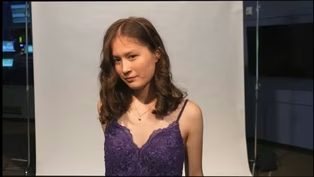
Maya Lindsey | Harp Philly Native
Preview: S20 Ep4 | 30s | Philadelphia native Maya finds her voice through the harp at Curtis. (30s)
Providing Support for PBS.org
Learn Moreabout PBS online sponsorship New Episode
 New Episode
- Arts and Music

Innovative musicians from every genre perform live in the longest-running music series.


 New Episode



 New Episode
 New Episode
 New Episode

Support for PBS provided by:
On Stage at Curtis is a local public television program presented by WHYY