State of the Arts
Maya Lin's Ghost Forest
Clip: Season 39 Episode 6 | 7m 38sVideo has Closed Captions
Maya Lin's Ghost Forest and the South Jersey forests where the giant trees were sourced.
Artist Maya Lin's 2021 installation Ghost Forest in NYC's Madison Square Park uses Atlantic White Cedars that were victims of climate change. Lin sourced the giant trees from the NJ Pine Barrens, where some forests are dying due to saltwater inundation after storm surges and rising sea-levels. Meet the artist and Bob Williams, the forester who helped her. Williams gives a tour in the Pine Barrens.
Problems playing video? | Closed Captioning Feedback
Problems playing video? | Closed Captioning Feedback
State of the Arts is a local public television program presented by NJ PBS
State of the Arts
Maya Lin's Ghost Forest
Clip: Season 39 Episode 6 | 7m 38sVideo has Closed Captions
Artist Maya Lin's 2021 installation Ghost Forest in NYC's Madison Square Park uses Atlantic White Cedars that were victims of climate change. Lin sourced the giant trees from the NJ Pine Barrens, where some forests are dying due to saltwater inundation after storm surges and rising sea-levels. Meet the artist and Bob Williams, the forester who helped her. Williams gives a tour in the Pine Barrens.
Problems playing video? | Closed Captioning Feedback
Where to Watch State of the Arts
State of the Arts is available to stream on pbs.org and the PBS app.
Providing Support for PBS.org
Learn Moreabout PBS online sponsorshipNarrator: In Madison Square Park, deep in the heart of New York City, 49 skeletal trees stretch to the sky.
[ Music plays ] Ghost Forest is a six-month installation by the artist Maya Lin, made with Atlantic white cedars that were victims of climate change.
Lin: Each tree, I realize, has a distinct personality.
I kind of call them gentle giants.
These trees are 80 years old, 60- to 80-year-old trees, so they were magnificent.
Narrator: Maya Lin found these trees in a dying forest in the New Jersey Pine Barrens.
[ Music plays ] Her guide was forester Bob Williams.
Williams: Here we are in the real ghost forest.
We're in northern Cape May County on the Delaware Bay coast.
This forest is certainly dying.
It's dying from sea-level rise and storm surges from the hurricanes.
Cedar can't tolerate salt.
Therefore, it dies.
Narrator: Atlantic white cedar once ranged from the coast of southern Maine to the Florida Panhandle, but now, only pockets remain.
Southern New Jersey has some of the most significant stands left anywhere -- healthy forests with mature trees and a low-growing understory.
But there are also large areas where the Atlantic white cedar is in decline.
These are the ghost forests that Bob showed Maya Lin and her team.
Lin: The first time down when we were driving through some of the stands that were really hit hard by Hurricane Sandy.
I took pictures.
It was haunting.
And I was -- I get out and I go... "This is the piece.
This is what I want to capture."
[ Music plays ] Williams: After they had installed the trees, my wife and I drove up to the city to see them, and I'll be honest, driving there, I was pretty skeptical that this is gonna look fake.
You know, "That's an artist.
"She doesn't know a forest like I do," and really, really happy to see that it does look like a natural forest, and her vision from an artist viewpoint jives with mine as a forester who looks at forests in terms of their structure.
And I think she actually did that.
Narrator: "Ghost Forest" is part of "What Is Missing," an ongoing series and website focused on the environment.
Maya Lin calls the series her last project because she plans to spend the rest of her life working on it.
It's that important to her.
Lin: We have very little time, but that I am going to be absolutely an optimist.
This is the time when you absolutely don't give up.
This is when you work even harder.
Anything we can all do.
Rapaport: Maya Lin is one of the great envisionary artists of our time, and she brings an acute vision as an artist and pairs that with her environmental activism.
This work is a call to action.
Narrator: Maya Lin created what is perhaps the best-known public artwork of our time, the Vietnam Veterans Memorial in Washington, D.C.
[ Music plays ] Her environmental works are also memorials of a kind, but they ask us to look to the future, as well.
[ Music plays ] "Ghost Forest" is the latest of these.
It was commissioned by the Madison Square Park Conservancy.
Myer: We have three core programs -- art, horticulture, and sustainability.
The art program is just an extraordinary way to change the space.
When you bring -- each artist does their thing, and suddenly, the place is a different place and it's a different conversation and it stimulates different ideas.
Narrator: Such as thinking about ghost forests.
They're on the rise around the world.
Lin: Mostly, a lot of ghost forests are referring to saltwater inundation, but it really depends on where you are.
Narrator: In some places, forests are dying due to catastrophic fires or beetle infestations.
Each has its own problems and potential solutions.
Some, like the Atlantic white cedar, can be restored.
Williams: The question becomes, "Okay, the forest is dying.
What do we do?"
The answer is huge.
To stand by and just watch it happen... is just irresponsible.
[ Music plays ] Some forests actually will regenerate on their own, and when we can let that happen, we should.
When it's not happening, we need to intervene.
[ Music plays ] Atlantic white cedar is a forest ecosystem that's declining across the entire eastern United States.
It's one thing to lose trees.
It's another thing to lose a whole ecosystem.
Lin: I became fascinated with the Pine Barrens when I read John McPhee's book on it, and I actually had the good fortune of maybe 10 years ago, I got to meet him, and he said, "Would you," you know, "you want to go out to the Pine Barrens?"
So we went out to the Pine Barrens, and it was such a treat and we met with an ecologist, so I have again been very, very fascinated by the ecology of the Pine Barrens, as well.
[ Footsteps ] Williams: Well, here we are in Atlantic County in what really does offer hope.
A beautiful young, restored Atlantic white cedar forest that we've worked on for the last 25 years, and look at them grow.
Here you see six or seven trees, and all these smaller trees are dead.
You see the dominant tree here taking over the forest.
They shade out these.
These die off, and trees will be dying off in here for the right reason for decades to come, not the wrong reasons, and these dominant trees are the trees that will become your 100-, 200-year-old trees.
[ Music plays ] Lin: There is hope.
We could turn this around.
We all could chip in.
We could all read about what we could each do in our everyday lives -- what we eat, what we drink, what we throw away, what we buy, as well as helping out groups that are out there in the fields actually doing the work.
[ Music plays ] Williams: When Maya Lin talks about solutions and that we could be doing something now, she's correct.
There are solutions.
If this forest doesn't offer hope, I don't know what does.
Look at it.
[ Music plays ] [ Birds chirping ]
Video has Closed Captions
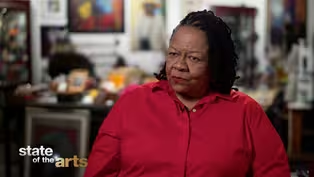
Clip: S39 Ep6 | 8m 48s | Public art transforms sites once marred by illegal dumping, creating a New View of Camden. (8m 48s)
Nancy Cohen: Atlas of Impermanence
Video has Closed Captions
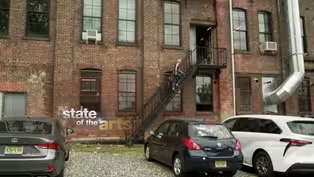
Clip: S39 Ep6 | 7m 25s | Artist Nancy Cohen creates work responding to industrial contamination and climate change. (7m 25s)
Providing Support for PBS.org
Learn Moreabout PBS online sponsorship New Episode
 New Episode
- Arts and Music

Innovative musicians from every genre perform live in the longest-running music series.
 New Episode




 New Episode
 New Episode
 New Episode

Support for PBS provided by:
State of the Arts is a local public television program presented by NJ PBS