
Maybe Burke (AD, CC)
Season 3 Episode 4 | 26m 46sVideo has Audio Description
Artist Maybe Burke discusses representation and inclusion in the entertainment industry.
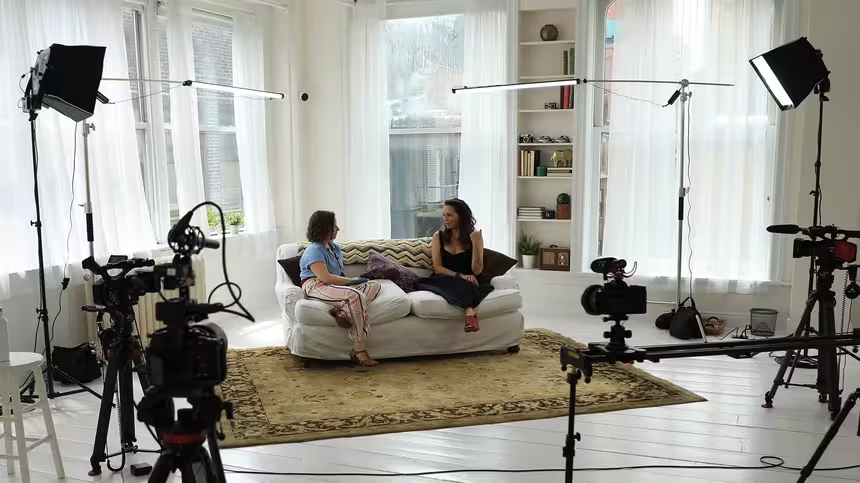
Artist and educator Maybe Burke (Hulu's "Ramy") and Lynne Marie Rosenberg (HBO's "High Maintenance") discuss transgender and nonbinary representation and issues of inclusion in the entertainment industry. Access: Audio description, captions.
See all videos with Audio DescriptionADProblems playing video? | Closed Captioning Feedback
Problems playing video? | Closed Captioning Feedback
Famous Cast Words is a local public television program presented by WLIW PBS
Maybe Burke (AD, CC)
Season 3 Episode 4 | 26m 46sVideo has Audio Description
Artist and educator Maybe Burke (Hulu's "Ramy") and Lynne Marie Rosenberg (HBO's "High Maintenance") discuss transgender and nonbinary representation and issues of inclusion in the entertainment industry. Access: Audio description, captions.
See all videos with Audio DescriptionADProblems playing video? | Closed Captioning Feedback
How to Watch Famous Cast Words
Famous Cast Words is available to stream on pbs.org and the free PBS App, available on iPhone, Apple TV, Android TV, Android smartphones, Amazon Fire TV, Amazon Fire Tablet, Roku, Samsung Smart TV, and Vizio.
Inside the Series
Go behind the scenes of "Famous Cast Words" to learn about how the episodes came together.Providing Support for PBS.org
Learn Moreabout PBS online sponsorshipThe following program is available with audio description and closed captions.
♪ We are getting back to an understanding of gender before colonization and white supremacy destroyed our understanding of gender.
♪ Hi.
I'm Lynne Marie Rosenberg.
Welcome to "Famous Cast Words."
I am joined today in my home by my dear friend Maybe Burke.
Maybe is an actor, writer, and advocate.
You might know them from the TV shows "Ramy" or "Nora from Queens."
You might know them from their award winning solo show, "Love Letters to Nobody," or from their wildly viral and popular videos on Instagram and TikTok.
You might not know them from the tech run of a community theater production of "Legally Blonde," in which they played Margot, Vivian, Paulette and Brooke all at the same time.
Welcome, Maybe.
Thank you so much.
You're very welcome.
Never an Elle.
[ Laughs ] Always a Brooke.
Never an Elle.
[ Laughs ] Thank you so much for joining me today.
Thank you for having me.
It is especially meaningful for me to have you here in my home because the first ever video that I shot as the prototype that became this TV show was with you.
But beyond that, I remembered that the first time we ever met was in this living room.
Yeah.
I used to host readings, you know, any time an artist wanted to come in and use my space to hear work of theirs out loud.
And you came to do one, and, you know, kind of the rest is history.
So it means a lot to me to have you, A, on the show, but, B, specifically in my living room.
Yeah, it means a lot for me to be one of your people.
We've been friends for a long time, but I've spent the last month of my life researching you deeply to interview you more formally.
And you have all these wonderful Instagram and TikTok videos often where you talk about issues that face the trans and non-binary community or political issues at large.
And one of the things you talked about that I was so interested in is the more representation you have, the more story telling you do have, even if it is positive representation, there is also a backlash to that, right?
Yeah.
And I wonder if you could talk about what you're seeing happening now in media in terms of representation and inclusion for trans and non-binary story lines and performers?
Yeah.
I think what you're saying is correct.
There's a lot -- there's good happening, and there's a lot of bad happening.
The problem is because representation was so terrible for so long, those stories are what people know and what people are used to.
And in our current age of like rebooting a bunch of old stories and everything, I think we're in that same kind of thing of like, let's just reclaim what was problematic.
Let's like spin that on its head instead of just like casting me in a show.
Right.
You know, just like letting me be like the neighbor friend who, like, doesn't really talk about gender.
And just, like, let us be in your stories.
Right.
Because, like, trans people exist everywhere, and we're not always -- I mean, my TikTok would probably disagree, but we're not always talking about our genders.
Right.
You know, like, that's like a thing.
I remember when Laverne Cox was on the cover of Time magazine, and it was referred to as this transgender tipping point in 2014, I remember a lot of my friends talking about how much they hated it and how we were more visible and noticeable now, and people who had been kind of flying under the radar experiencing discrimination that they hadn't been experiencing as much, you know?
And there is like a rise in that.
As people know how to talk about us, they know how to attack us and they know what to use against us.
Right, and the the onus on media and representation in some ways, you know, on the one hand, you want to highlight these stories and know the real truths of what people are going through.
On the other hand, the more we rehash the narrative, the more we're going to stay in this spiral.
We're going to stay in this loop.
If we're always telling the sob story or the horror story or the murder story, we're teaching audiences that this is what happens to trans people.
This is what we do with trans people.
Like, this is how we treat trans people.
And we're teaching trans people that they have no futures.
Right.
They have no love.
They have no relationships.
They have no lives outside of that.
Yeah.
And that's why we're seeing with a rise of positive representation, we're also seeing rise in numbers of young people claiming their identities earlier in life.
Right.
Because it's not as scary anymore now that we have better options and better ways to go about things.
Any time I hear arguments sort of against progressive advancement or advancement in being inclusive of all humans, you just want to shake people and say, "It's going to make it better for everybody."
I mean, you know, the structures that decrease the value of the quality of life for a trans and non-binary person are the same structures in misogyny.
Transphobia, homophobia, it's all misogyny with a different filter slapped over it.
Right.
It's all the same system of power, and it's all rooted back to white supremacy.
Right.
The reality is, we're not expanding a concept of gender that is natural to our species.
We are getting back to an understanding of gender before colonization and white supremacy destroyed our understanding of gender.
Right.
Before European colonization, societies and cultures had much more expansive views around gender.
And there's histories and legacies and words and language to describe those experiences long before Christopher Columbus brought a little boat over here, you know?
We're not expanding the conversation around gender.
We're getting back to our roots.
One of the things that affects marginalized people in general is hair and makeup on set.
So I wonder if you could talk about both positive hair and makeup experiences you've had, and also maybe some less than positive experiences?
Yeah, I mean, so, you know, I'm currently -- I just got my first certificate to be a makeup artist professionally, and I'm working on kind of shifting into that vein more.
Who knows where I'll go.
I might just be a beauty influencer, which...
Here for it.
100% here for it.
Doing the good work.
Yep.
But part of that is because I've always felt held and taken care of by the makeup girls on set, and I'm saying girls because I think they've always been women that I've worked with.
And there's, I mean, a lack of trans representation across the board, but like, I didn't know any trans and non-binary people doing that.
And I don't know folks, and I think I could be a person who makes those people feel safer, and, like, actors like me can feel better knowing that they're not the only one in the room, right?
That somebody who understands is taking care of them.
Because I've had some rough goes.
Mm-hmm.
A show that I worked on, I sat down, I was a day player, so I wasn't making, like, lasting relationships with these people.
But I sat down in the makeup chair, and the artist looked at me and asked, "Have you ever worn makeup before?"
[ Chuckles ] My first time.
[ Laughs ] And I was like, "I've been acting since the fourth grade."
Mind you, she had a mood board in front of her with a picture of me wearing makeup.
[ Laughs ] Who asks a professional actor if they've ever worn makeup before?
Yeah.
I was like, "I don't think you would be asking me this if I was cis."
Bronzer!
Hey, I'm Maybe Burke, and you're watching "Makeup For Lost Time."
So you have this TikTok and Instagram life.
[ Laughs ] I was like, what word are we using here?
Life.
I went with life.
It's an experience.
Presence.
Is that -- Yeah.
Recently you have shifted that more specifically towards makeup tutorial.
Right?
Can you talk a little bit about that?
I always said this as an actor.
Like, I can't be an actor and have it not be political.
I walk on to a stage.
It's a political statement because of the world we're living in right now.
And I think the same is true of me making a silly makeup video.
Like any time it's just me looking at the camera in makeup that I did that I love, it's inherently a political act because I'm a trans woman living in America, you know?
I took a summer break from TikTok specifically and hadn't posted TikTok content for three months.
And I really started thinking about my relationship to content creation and what that means and what that looks like.
And I decided that the thing that I want to do is to help people feel better.
Yeah.
About whatever.
Yeah.
If that means they see somebody who looks a little bit like them giggling with some makeup on today.
If that means I'm making a video where I'm saying your name and pronouns because you don't hear them enough from other people.
If that means you don't know how to do a cut crease, so I make a little video showing you how you can do a cut crease, you know, like whatever that is, my core reason for doing all of the work that I do is to help people feel better.
Yeah.
Specifically trans and non-binary people are my reason for living.
Yeah.
Um... And the reason I do everything that I do.
Yeah.
This is Raine, and they said it would mean a lot if he could get a video hearing their name and his pronouns.
So let's all say hi to Raine.
So now we're going to look at some breakdowns.
Maybe, you need no introduction to the art of the breakdown, but for anyone at home... [ Both laugh ] ...a breakdown is essentially a little bit of text that is used in the entertainment industry as a job listing.
I'm sorry, "The Art of the Breakdown" is going to be the title of my next solo show.
[ Laughs ] A breakdown most often begins with a character's name, and for trans-feminine and non-binary roles, the name will often give you a sense of what your narrative arc might be.
Oh, they get an arc?
No.
[ Laughs ] I've never met one with an arc before.
"Nightclub, transgender, hooker."
[ Laughs ] And "Surprise."
"Surprise."
I won't get into the nature of the surprise, but needless to say, it's a tired, harmful trope for transgender roles.
The surprise is her dick.
[ Laughs ] Glad we have that on camera.
[ Laughs ] Not her dick.
Well, in several shows, you do, though, actually.
In several movies, you do get it on camera.
That's true.
Sometimes character names will even tell you what to bring to an audition.
"Gender ambiguous water gun person!"
[ Laughing ] Now, to be fair, there is nothing offensive about that one.
It is just my favorite character name of all time.
Correct.
This is better than "sobbing homeless queer teen."
[ Laughs ] Sobbing homeless queer teen, which you played.
[ Laughs ] My first TV credit.
Thank you so much.
One line.
As far as how your character may be described, there are really only two types non-binary and trans-feminine roles fall into -- abused... Oh.
"Bullied, ostracized, neurotic."
And abusive.
Oh.
Huge ego, as sassy as she is bitchy.
Malevolent.
Reckless.
Conniving femme fatale hungry for revenge.
Which, like, this, is directly contributing to violence against trans women.
Exactly.
This is like where it comes from.
Yeah, that this is the story line.
Yeah.
And no matter what your emotional state, you'll need to fit one physical type.
Busty.
[ Laughs ] Ah.
"An androgynous, toned, transsexual beauty.
Beautiful and seductive."
[ Gulps ] [ Laughs ] "Oozes sexual confidence with masculine feline features."
[ Laughs ] "Like a large predatory cat."
Stop describing trans women as masculine, 2014.
Please, yeah.
But get ready for this.
But at the end of the day, your most important skill set will be having a thick skin to deal with toxic language like this.
"Can be cast with a woman or a very passable transsexual.
If the light is right, she can be quite beautiful, but to the observant eye, she isn't fooling anybody.
A transvestite prostitute, strong character faces that capture the qualities of worn, weathered, broken."
I mean worn, weathered and broken is what I feel like from looking at casting language all day long, always.
Worn, weathered, and broken is my relationship to the industry.
[ Laughs ] That's true.
It might be mine, as well.
It's getting there at least.
One thing that I couldn't find a way to work into the breakdowns discussion because it is an omission instead of a presence.
Humanity.
[ Laughs ] And its humanity.
No.
Compassion?
It's this new thing that I am seeing in breakdowns where there will be boilerplate language at the top that says, you know, "We are interested in expansively casting," and blah, blah, blah, blah, blah.
And then... in the ensemble call, it is specifically requesting gender fluid and non-binary performers, but then in the principal calls, it either specifically says man or woman, or it does not mention anything about gender fluid and non-binary performers are welcome to audition.
Or, you know, "We are actively seeking..." And I wonder if you have noticed this.
Yeah, we can't let them talk, though.
[ Laughing ] Yeah.
Yeah, that seems -- in some ways, that's what it is, right?
I see the intention of trying to make jobs, carve out space.
There are some shows in particular that like don't just say like they want, encourage actors to apply and things, but like will carve out like this ensemble track is going to be a trans or non-binary person.
First of all, there's a lot of different kinds of trans and non-binary people.
Right.
But also, I've gotten some of those calls and I've been like, "Oh, I'm really good for that role.
But this is the one you're going to see me for."
Right.
And I'm not going to book that one.
I would book her.
And so I see the intention to be like, we're going to cast a trans or non-binary person.
But then I'm like, then just let me audition for what I'm right for.
Right.
And across the board, just make sure that you do have a cast that reflects the world around you.
Right.
Don't be like, "We need a non-binary person to play this role."
Don't make that decision before we walk into the room.
I think the language you use of carving out space is such a -- that's the clear both success and problem here, right, is that there is now an effort being made to carve out space.
But the carving is occurring in the ensembles and not occurring in the principal tracks.
Right, and it's like, okay, we have to cast trans and non-binary people.
So I guess we'll just like throw some in the back.
And it's like, I can be in love, too.
Yeah.
I have a mom.
I have a job.
Right.
You know?
Like I have talent.
Yeah.
I have ambition.
Like, I have all of the things that we tell stories about.
Yeah.
And that's like, there are no cis roles.
Right.
There are very few roles that you're like, "That has to be a cisgender person."
Right.
There are just roles where you assume it.
We've had a very serious conversation.
I think it is time that we move away from this couch and we do something very different.
At the bottom of every actor's résumé is a section called Special Skills, and it's where they list their talents and abilities.
So this is our segment Special Skills.
Maybe, what is the special skill you'll be sharing with me today?
I'm gonna do some makeup.
Well, so we were talking about doing eye shadow, which I never ever, ever wear.
Incredible.
We love to see it.
You have free free rein.
You can do whatever you'd would like for me.
That's the worst thing to tell me.
I know.
[ Laughs ] I immediately regretted it.
Immediately.
[ Laughs ] What I'm going to do for you is a more natural, everyday kind of vibe, just a little elevated from what you normally do.
Great.
So I'll take a shade.
Thank you for closing.
And we're just going to come over here on the side and draw a little "V".
So we'll go down to your lash line, and then up in your crease with a little "V." Up in my crease.
[ Laughs ] You like that?
Yeah.
I don't know why getting makeup applied makes me feel like a child.
Have you ever worn makeup before?
[ Laughs ] I have a makeup application processes that I don't think you would agree with.
[ Gasps ] Let's talk about it.
Instead of blush, I just use lipstick.
Oh, no, that's great.
Is it?
That's great.
Yeah.
Oh, I thought I was doing something terrible by doing that.
No, that's actually a fun trick to, like, get more consistency across your whole look.
Right.
The reality is, like anything that's built to be put on one part of the face can be put on any part of the face.
Oh!
You know, like...
I thought I was going to appall you by telling you that.
That's great.
Oh, no.
No, I'm a big proponent of using anything for anything.
I mean, we can take a little bit of a shimmer here and highlight your nose with it.
[ Laughs ] Now I feel like a child.
[ Both laugh ] You're doing great.
Yeah.
But that's.
I mean -- You don't like that at all.
No, I just -- it never, ever occurred to me to highlight my nose.
And then the fun part of any more, like, natural makeup look, unless you're trying to do something specific, is just blend it all out, and you just go in with some buffing, small circles.
Wait, so is that with a brush that has nothing on it?
Yeah.
I see.
You can also take like a lighter, like a taupey or a lighter brown to soften the edges.
Another fun trick, and you'll like this for the consistency and whatnot, is you can use your blush color around the edges of your eyeshadow to like...
So first I need a blush color.
[ Laughs ] Should I look at what I look like now?
Of course.
Oh, that's really pretty.
Got a little shimmer glam.
Yeah, yeah, yeah, yeah.
A little shadow.
It's very simple.
It's very me.
I like it.
Yeah.
An everyday wear.
An everyday wear.
There is absolutely no way I'm doing that every day.
Now that I am fully made up, shall we return to the couch and continue our conversation?
Let's do it.
[ Both laugh ] Let's talk about traveling while trans.
One of the things that we have to deal with as performers all the time, and you certainly as an educator, have to deal with this travel, right.
Transportation and travel all the time.
And you've done some really interesting TikTok videos about what it means to travel while non-binary.
You know, travel while being trans in this world and the the things you have to think about that the cis world does not need to think about on a regular basis.
I wonder if you could talk about that a bit.
It's one of the very clear areas where it's like, oh, I think about this differently than cisgender people do.
Right.
And it's one of the only areas that, like, it's at the forefront of my mind constantly.
I have grown into a person who, like, I'm not thinking about gender when I get ready in the morning.
I don't sit in front of my closet and like, "Do I want to be perceived as a lady today?"
Some people do.
I don't want to be, like, mocking that.
Yeah.
But for me, my gender expression is usually like, do I have to walk a long distance?
Is it going to rain?
Like, do I get to sit at this event?
Like those things influence what I do much more than gender.
Unless I'm traveling.
And so flying in particular, I have the privilege of the TSA PreCheck, which makes things a little easier.
If you're not familiar, if you go through the full body scanners at TSA, a TSA agent decides whether they're doing the scanner male or female.
They don't read your ID.
They read you.
And they press M or F. I didn't realize that they made determinations on gender at all.
Yeah, because the scanner, and this is where trans and non-binary people run into problems at TSA in particular.
The scanner will often pick up an "anomaly in the groin" or an "anomaly in the chest" for people who have bodies that don't fit into our binary understandings.
Right.
And so I think the TikTok you're referencing was an experience where I was flying recently, and I got to the airport and the PreCheck line was closed.
And I had not thought too heavily about my presentation.
And then I was standing in line for security, and I was like, "Do I run to a bathroom and take off my bra?"
Like, how do I go about, like, all of these things?
Because I know people who, dealing with TSA or like when they've been arrested at protests and things and like agents questioning them about what they're wearing and their undergarments and all of those things.
I went with my family to South Carolina, and I remember the first night that I was there, I went to the bathroom at the restaurant we were at, and I was sitting in the stall Googling the law to see whether or not I was allowed to be in there.
I mean, we laugh, but that is a traumatizing thing to have to deal with.
Yeah.
And that's -- I mean, I'm already a person that like, if somebody else is in a women's room with me, I will sit in my stall until I think nobody else is in the space.
But I didn't pee in public for a week because I didn't know my surroundings, and I, like, wasn't comfortable in that space.
And that's not good for my bladder.
That's not good for my mental health.
You know, like, that's not good.
I have to reconsider so much when I'm out and about.
And too many of us have to do that and consider where we can go on trips.
And when I went to Little Rock, Arkansas recently, they had me stay in Memphis, and then we drove over, you know?
Yeah.
And we're deliberate with where we go because I can't go everywhere.
Right.
Or I can, but I might not make it back.
Right.
They were a travel them.
They said, "See you later, femme."
I'm presenting butch for this flight.
[ Laughs ] I wonder now, if you were a young trans person or a young non-binary person coming out, do you feel like there would be a different experience, there were different things you could see in the world?
100%.
Yeah.
The thing that I think has really changed the game since I was a kid is social media.
Young people can see me.
Yeah.
Not me playing a character.
Me packing for a trip to Arkansas.
You know, they can see multiple people living genuine lives and talking about their experiences from their perspectives.
You know, the things that we've been asking writer rooms to do and to hire people, to tell their own stories.
And that's, I think, really shifted the game and kind of why I lean so much heavier into social media presence than I do acting these days, because the reason I'm doing it is for those kids and for those people.
Thank you so much for joining me today.
Thank you for having me.
Thank you for watching.
Take care of each other and be professional.
And don't be transphobic.
[ Laughs ] ♪ ♪ ♪













Support for PBS provided by:
Famous Cast Words is a local public television program presented by WLIW PBS