
Mayor Marty Small; Cynthia Oberkofler; Rick Santoro
9/10/2022 | 27m 38sVideo has Closed Captions
Mayor Marty Small; Cynthia Oberkofler; Rick Santoro
Steve Adubato welcomes Marty Small, Sr., Mayor, Atlantic City, to discuss food insecurity; Cynthia Oberkofler, Executive Director, Millhill Child and Family Development, examines pressing issues in the Trenton community; Rick Santoro, CCP, Special Improvement Division Director, Casino Reinvestment Development Authority, explains their plan to allocate tax money derived from casinos.
Problems playing video? | Closed Captioning Feedback
Problems playing video? | Closed Captioning Feedback
Think Tank with Steve Adubato is a local public television program presented by NJ PBS
Mayor Marty Small; Cynthia Oberkofler; Rick Santoro
9/10/2022 | 27m 38sVideo has Closed Captions
Steve Adubato welcomes Marty Small, Sr., Mayor, Atlantic City, to discuss food insecurity; Cynthia Oberkofler, Executive Director, Millhill Child and Family Development, examines pressing issues in the Trenton community; Rick Santoro, CCP, Special Improvement Division Director, Casino Reinvestment Development Authority, explains their plan to allocate tax money derived from casinos.
Problems playing video? | Closed Captioning Feedback
How to Watch Think Tank with Steve Adubato
Think Tank with Steve Adubato is available to stream on pbs.org and the free PBS App, available on iPhone, Apple TV, Android TV, Android smartphones, Amazon Fire TV, Amazon Fire Tablet, Roku, Samsung Smart TV, and Vizio.
Providing Support for PBS.org
Learn Moreabout PBS online sponsorship- [Narrator] Funding for this edition of Think Tank with Steve Adubato has been provided by Kean University.
Where Cougars climb higher.
Community FoodBank of New Jersey.
Valley Bank.
Atlantic Health System.
Building healthier communities.
The New Jersey Economic Development Authority.
Operating Engineers, Local 825.
Horizon Blue Cross Blue Shield of New Jersey.
Here when you need us most, now and always.
The Turrell Fund, supporting Reimagine Childcare.
And by NJM Insurance Group.
Serving New Jersey'’s drivers, homeowners and business owners for more than 100 years.
Promotional support provided by Northjersey.com and Local IQ.
Part of the USA Today Network.
And by The New Jersey Business & Industry Association.
[MOTIVATIONAL MUSIC] - Hi everyone, I'm Steve Abudato.
We are honored to be joined all the way from the nation's capital.
He's not the mayor of Washington D.C., he's the mayor of Atlantic City, but he's in the nation's capital.
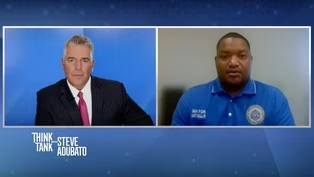
Mayor Marty Small.
Good to see you, Mr. Mayor.
- Yes, thank you for having me, Steve, you know, hello to your viewing audience.
And even though I'm in D.C., it's a great day here in the city of Atlantic City.
- Okay, I love it.
Hey, do a favor for us.
When you and I were just talking before we got on the air, you greeted the Vice President, Kamala Harris, as she got off the plane to come into Atlantic City for the NAACP National Convention.
What was the most significant outcome, not just of her speech, but of the convention overall from your perspective?
- Well, the title this year was "This is Power."
And, you know, we feel that as African Americans, we play a major role in, you know, the election process.
And, you know, it was said that after Atlanta's election in 2021, we went to sleep.
And there's no time to go to sleep.
A lot of people, unfortunately, even, I always say this locally, you know, your local elections are, you know, more important, because you can reach out and touch people.
But some people tend to only vote when it's a presidential election, because it's the thing to do, you know, it's all over social media.
But, you know, elections are important and elections have consequences, wins or losses.
So this is a big midterm election, there's a lot at stake.
You know, we talked about we felt that the country is going backwards.
This was a major shot in the arm for the great city of Atlantic City.
We had over 8,000 people at the National Convention, and the city showed itself well.
And you know, personally, you watch it on TV all the time, not just here in our country, but all over the world.
When Air Force One lands, you know, at the bottom there's some type of dignitaries.
And for me to be the only one there to greet the Vice President, that was definitely a historic moment for me.
And she kind of echoed what she said at the convention.
She said, "Look, you know, Mayor..." First she asked about Atlantic City, and told her the exciting things that we're doing.
And of course I told her, this a great day here in the city of Atlantic City.
And I even got a "great day" out of her, I said, "Can we say 'great day'?"
She said, "Great day."
But then she said that it's important, this election coming up, and you know, she kind of fired up the speech.
And afterwards I was a part of a round table with other New Jersey state legislators, talking about reproductive rights, which is extremely important, considering the unfortunate decision that was overturned by the Supreme Court.
- You know, Mr. Mayor, the other issue, Mayor Small, that other than reproductive rights, it's a huge issue in Atlantic City, is the issue of food insecurity.
Talk specifically about the work that is being done in Atlantic City, along with the Community FoodBank of New Jersey, our friends over there, that we are attempting to create greater public awareness around food insecurity issues, and also its involvement.
And there's a grant, if I'm not mistaken, $500,000 grant connected to food insecurity that went to a variety of organizations in Atlantic City, to address the issue of food insecurity.
Please talk about it.
- Yes, specifically during the pandemic, I have to give kudos to Creda, the Casino Reinvestment Development Authority.
They poured millions and millions of dollars, along with Hard Rock and other unions, Local 54, the Building Trades, the AFL-CIO.
They knew that a lot of people during the pandemic needed help, and millions and millions of dollars was poured into, you know, to assist with people making sure that they got, you know, healthy meals.
I mean, the lines were amazing.
We are in a little better place now, but with Atlantic City being a food desert, we're still, you know, ready to break ground on the Shop, right?
Which is the first major supermarket in Atlantic City in decades.
And us at the city of Atlantic City, our senior services department, under the leadership of Rashidah Nelson and Brian Gunter, we are actively engaging organizations.
As a matter of fact, we're setting up a meeting with a group out of Philadelphia, who identified Atlantic City as a place that they wanna do weekly food giveaways.
So we going continue to make sure that our residents have all of their needs, while we continue to navigate through the waters with the supermarket coming to town.
- But along those lines, Mr. Mayor, there have been many, it's not me who's saying this, it's just many, many people talk about there continuing to be two Atlantic Cities.
The casinos, and we hope they do well, and the revenue matters, and the support for other programs from the profits of AC casinos matter.
But in many ways there are people that argue that there are two cities: one on the boardwalk, and then the rest of the city.
To what degree does that thinking align with the reality of Atlantic City, that there continue to be two very different cities there?
- Well, that started under the Christie administration.
The bill was authored S11, that bifurcated the city in the two parts: the tourism district, and then the rest of the city.
However, with our relationship with the state of New Jersey, with our relationship with the casino industry, with our relationship with Creda, we don't see it as that.
Can the casinos do more?
Yes, and they said it themselves.
I had a conversation with resorts owner, Morris Bailey, who said that, you know, they should be doing more.
I don't look at it that way, my focus, obviously, is on the residents of Atlantic City, as well as tourists.
The city is on the move, this is going to be a record-breaking summer here in the city of Atlantic City.
You know, there's a lot of jobs and opportunities out there.
And that's why I'm in the nation's capital now, to bring in an infrastructure program, to create high-paying jobs for residents of Atlantic City, in a partnership with Exelon and Atlantic City Electric.
So should more be done?
Yes.
Will it be done?
Absolutely.
And that's my job as mayor, to make sure that everyone is rowing in the same boat for one Atlantic City.
- Before I let you go, Mayor Small, every mayor of every city, particularly in urban communities where crime is very real, I ask this question of.
What is the most pressing issue connected to crime for you, and the other residents of Atlantic City?
- It's economics.
If you provide people with opportunity, no matter the background, a lot of people come from disadvantaged circumstances.
This administration is teaching Atlantic City residents how to win, and win on their own.
'Cause as you know, Steve, the pandemic taught us all one thing: no jobs are guaranteed.
So we get creative.
So what I've done as Mayor is to create the Mayor's Office Small Business Academy, which is a 10-week program that's ran by John Harmon in the New Jersey state African- - John Harmon, from the African American Chamber of Commerce.
- Yup.
Yes, Chamber of Commerce.
This is the second cohort.
We also teach in the community how to invest.
We have a second cohort of investment coming up in the fall, we're gonna teach people how to improve their credit.
And then at the end of the year we wanna teach people how to build a financial plan.
As far as violence and crime, you're never gonna stop it, it's an urban community.
But what I've done, unlike any other mayor, we have an anti-violence program called One Neighborhood Evolution.
And I'm gonna just tell you some stats, as you know, Steve, I was saying, "Men, women, political opportunists lie, but the numbers and facts don't."
Last year this time, there was eight murders in Atlantic City due to gun violence.
This year, there are no murders in Atlantic City due to gun violence.
And I want to give kudos to the programs, and some of the things that we're doing, to let Atlantic City residents know that it's more than the streets.
We have one murder overall, but that was a drug situation.
We're headed in the right direction, we doing fascinating things for children, a lot of free programming.
And as I often say, the rumors of Atlantic City's demise are greatly exaggerated.
And this is a great time in Atlantic City, and we are all the way back.
- Mayor Marty Small may be in D.C., but his heart, how corny is this, is still in AC.
You like that, Marty?
- I like that.
- That was terrible.
- I liked it.
(Steve laughs) - Can I get a "great day" out of you?
Can we say, "great day"?
- It's a great day.
It is a great day.
That's Marty Small, he's the mayor of Atlantic City.
Thank you, Mr. Mayor, stay with us we'll be right back.
To watch more Think Tank with Steve Adubato, find us online and follow us on social media.
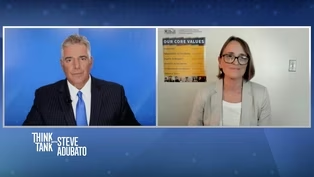
- We're now joined by Cynthia Oberkofler, who is Executive Director of Millhill Child and Family Development.
Cynthia, great to have you with us.
- Thanks for having me.
- Tell everyone what your organization's all about, as the website comes up.
- So we've been around for about 50 years and we focus in the areas of education, mental health, family support, and youth engagement, and community collaborations.
- And based in Trenton.
- Yes, we are based in Trenton.
Yes.
- So the population you serve, describe it, describe them.
- So it's mostly African American.
It's mostly people who don't have much more than a high school education.
They're mostly living in the poverty level.
- You've mentioned the issue of mental health and your website pushes and promotes that service.
Describe some of the most pressing mental health challenges faced by the people and the community you serve?
- It's mostly trauma and simply sometimes it's just trauma from living in poverty and not knowing, you know, where your next meal's coming from, getting good jobs, not having transportation to get where you need to get.
So, the challenges that come with living in poverty.
- And the younger people makes youth engagement, the younger people who are struggling and living in poverty and facing adverse childhood experiences, et cetera, et cetera, et cetera, which is not an et cetera thing, I apologize, you've been saying that because it minimizes it.
How hard is it to engage the young people and the community you serve in Trenton?
- Well, we've built a relationship of trust with the community, so I think that really helps, we've been here for so long.
And we're dealing with some of the most challenging issues that the community faces, because we have a mental health outpatient clinic.
So we see about 600 individuals a week, all Medicaid, and we have a very long waiting list for those services.
So I think there's some recognition and realization that particularly with our youth, that they need help after the pandemic and it's getting in the way of their education and their success.
- You know, you mentioned that many of the folks in the community you serve, wind up with- or have a high school education or less.
But pursuing college for the young people in the community you serve, is critically important.
How do you help facilitate that, you and the organization?
- Well, in our youth engagement programs we partner with an agency that does nothing but makes sure that kids get to college, and they get to college without having any debt, which is part of the barrier for a lot of our kids.
But, you know, along the way we address mental health issues, whether in high school and middle school, and give them tools so that they can cope with what they're challenged by and able to learn.
Because if they don't get through middle school and high school, they're not gonna get out, you know, get to college.
So, we help with that as well.
- The Rising Stars program, what is it?
- So we have a summer youth employment program where we partnered with the Mayor and the regional Chamber of Commerce.
And we've identified 10 youth out of that program that we're gonna stick with over the school year and provide services and get them into college, in addition to some of our other programs where we do the same thing.
So, it's an opportunity to interact with youth over the summer and then bring them into this program during the school year and then get them to college.
And we've been very successful.
- Cynthia, how did you get into this work and why?
- Well, I'm an accountant.
That's my background.
About, yeah, I know strange, right?
So, 20 years ago I came to Millhill as their CFO, and then my predecessor retired about 10 years ago and he recommended me for the position.
Also, I knew about the Trenton community, I live in Hopewell, I'm seven and a half miles away from the Trenton community.
We had an opportunity to interact with some of the youth from this community and saw what they were up against.
And it really, you know, tugged at my heartstrings and I wanted to get involved.
- It's interesting, Hopewell.
How many miles away is Hopewell?
- Seven and a half.
- Yeah.
- Yeah.
- So, psychologically, emotionally, financially, how far away is Hopewell from Trenton?
- Another world, you know.
- Tell folks who are watching us, I'm sorry for interrupting.
There are people who may not even know why I'm even asking that or what you mean by what you're saying.
So talk about that.
- Well, for instance, in Hopewell township, there's a minimum of two acre plots, which is, just that alone, which means that you pay very high taxes, real estate taxes in the township.
The kids, you know, predominantly go off to college.
There's no question about it.
The parents are, you know, well equipped to get them there.
You know, not just financially, but they understand the process and they have resources that the kids here in Trenton don't have.
- To what degree do you believe, and listen, you do the work you do, you described why you care as deeply as you do and I know this is a really big picture question, but I often wonder about this.
For those of us who are so blessed and comfortable in our lives, and don't face many of the issues if not all the issues that you raised before, to what degree do you believe most of us are aware A, and B care, to any meaningful or significant degree?
- Well, I don't think we quite are aware of the degree that the challenges are here, particularly for young people, 'cause you, and the gang element to it as well.
But I think there are a lot of people that have a passion for helping this community and get engaged, whether they be donors or board members or volunteers.
I'm always just impressed with the amount of people that are willing to step in and help.
Particularly during the pandemic, it's really been wonderful to have the support.
- Well, Cynthia, particularly in our state capital in Trenton, we appreciate and respect the work that you and your colleagues are doing at Millhill Child and Family Development.
And we wish you and the team all the best.
Thanks so much.
- Thank you.
- We appreciate it.
I'm Steve Adubato.
Stay with us.
We'll be right back.
To watch more Think Tank with Steve Adubato, find us online and follow us on social media.
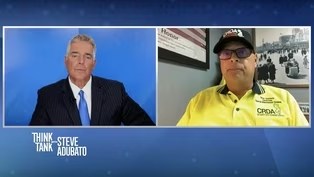
- We're now joined by Rick Santoro who is Special Improvement Division Director for the Casino Reinvestment Development Authority, otherwise known as Creda, CRDA.
Good to see you, Rick.
- Good to see you too, Steve.
Thank you for having me.
- You gotta it.
Tell everyone what the CRDA a is all about.
- All right, CRDA is a special, a very unique authority within the state of New Jersey that invests and puts money back into the community and into the state that's derived from certain taxes that are leveraged from casinos, for gaming and gaming revenue, and luxury taxes.
- We've been familiar with the CRDA for many years, and your chairperson, Mo Butler, we've known for a long time.
So in the process, we heard about a whole range of work going on around the issue of food insecurity.
Talk specifically about food insecurity exacerbated by COVID and the work that your team is doing together with the folks at the Community FoodBank of New Jersey.
- Yes, sir.
Back in, starting in May of 2020, the CRDA board allocated about a million dollars to assist with food insecurity here in the Atlantic City area.
We come to realize very early on that our hospitality workers, Atlantic City residents, and casino workers were heavily affected 'cause most of them were furloughed and put outta work when the pandemic hit.
So many of these people, they're hardworking, blue-collar people, it's a blue-collar town, they were not equipped to be outta work for such long periods of time, and had immediately been into the food insecure categories.
So the board of directors ponied up money and partnered with area labor unions, casinos, and casino owners themselves to allocate resources.
Once the resources were allocated, my division, the Special Improvement Division, was tasked with providing the logistics to the Community FoodBank to deliver food to these masses of people.
We were able to use the Bader Field, a deactivated airport within Atlantic City.
- Yeah, tell everyone what Bader Field is.
It's pretty well known but not everyone knows what it is.
- Yes, sir.
Bader Field is a deactivated commercial airport.
It has three large runways, taxiways, and a roadway system around it.
It's right at the entrance of Atlantic City.
And years ago, it had been deactivated.
It was mainly an airport for small planes and helicopters, but it had been deactivated.
So that was sitting there, and the challenge was, how can we get so many people, thousands of people, through?
This initiative actually provided food for, 110,000 people came through these food drives over this time period.
- How long of a period of time?
- It was about 11 months.
We did 17 food drives.
We unloaded five tractor trailers of food a day.
Inside of Bader Field, we were able to put 200 cars in, inside the bowl before we started distributing food.
Every day when we showed up at 6:00 in the morning, there was already people waiting for us at the gates.
Five to seven tractor trailers would come.
Our manpower used forklifts and front-end loaders to unload the food under the FoodBank direction.
And we brought these recipients into the airport to start to stage them.
100 volunteers showed up every day from different unions.
- Yeah.
Were they...
Were they... (coughs) Excuse me.
Primarily union members?
- Yeah, they were the recipients.
Well, if you're talking about recipients- - The volunteers?
- The volunteers were predominantly union members that were furloughed.
These men and women that showed up to load the food in other people's vehicles, they were among the food insecure too.
Bartenders, waitresses, maids, housekeepers, highly-skilled electricians, carpenters, security guards.
They were put outta work and they couldn't work because the casinos were closed.
So they came every single time, rain or shine.
We operated all the way from over 100 degree heat index down to 13 degrees.
The volunteers, we stacked the food up in lanes.
We brought the cars forward, and these volunteers loaded food from the pallets into the vehicles.
- First of all, it's so extraordinarily impressive that people who are struggling, who've been furloughed, who are facing economic challenges, and their families struggling, decided that they would help others.
In and of itself, it's not only inspiring, but gives us reason to be hopeful.
But fast forward, which you can't, for the people we're talking about, they don't fast forward.
Where would you describe and how would you describe the condition of Atlantic City as we speak?
We also, as we're taping today, we actually interviewed Mayor Marty Small and asked some of the same questions.
But your perspective, Rick, on how Atlantic City is doing, particularly the people you're talking about who face such serious challenges, please.
- Yes, Steve, Atlantic City's back.
We are exploding with business and exploding with customers.
There's events, major events, concerts, beach concerts, airshow, fishing tournament.
The men and women that were furloughed are back to work.
And many others have had to have been recruited to come in to this handle this great surge of customers.
So we're blessed that Atlantic City is back now.
And there's this pent up demand for people, even though the pandemic is still with us, there's this pent up demand for people to party and let their hair down and come down and enjoy themselves.
So the men and from our community are the blue-collar staff that deliver those services, so they're back at work.
- Let me ask you something, Rick, in the time we have left.
This experience dealing with people, helping people, working with people around the issue of quote, unquote, food insecurity, how do you view, not just the issue of food insecurity, but those who are struggling with it differently?
- You know, it brings tears to my eyes to know that we have this in our country, that people can struggle and be hungry.
Again, our town is a blue-collar, hardworking town.
There's so many people behind the scenes that live day to day and week to week, multiple jobs, part-time jobs.
And you know, it was so heart wrenching to see them struggling.
One instance I could share that just broke my heart- - We have a few seconds left.
I'm so sorry, Rick.
Got a few seconds left.
Go ahead, share.
- I realized the pain that people suffered, and also the the embarrassment and the shame that they felt to be in those lines to receive food.
So I, you know, I'm proud to have been able to help and deliver this initiative, and it continues today.
We still provide food throughout the community in micro food donations.
But it's a real problem here.
And it just really saddened me that many, many families were struggled.
And I don't know if all of them were able to survive or even stay around here after that happened.
But we're back and we were fortunate to help.
- Hey, Rick, I apologize for cutting you off.
There are these hard time limits.
But you represented your organization well in this interview, and more importantly, told the story of people who are struggling and those who chose to be helpful to all those folks in Atlantic City.
We wish you and the folks down in Atlantic City all the best Thank you so much, Rick.
- Thank you.
And thank you for shedding light on this.
We thank you very much.
- Thank you.
I'm Steve Adubato.
That's Rick Santoro.
We'll see you next time.
- [Narrator] Think Tank with Steve Adubato has been a production of the Caucus Educational Corporation.
Funding has been provided by Kean University.
Community FoodBank of New Jersey.
Valley Bank.
Atlantic Health System.
The New Jersey Economic Development Authority.
Operating Engineers, Local 825.
Horizon Blue Cross Blue Shield of New Jersey.
The Turrell Fund, supporting Reimagine Childcare.
And by NJM Insurance Group.
Promotional support provided by Northjersey.com and Local IQ.
Part of the USA Today Network.
And by The New Jersey Business & Industry Association.
(Music playing) NJM Insurance Company has been serving New Jersey policy holders for more than 100 years.
But just who are NJM'’s policy holders?
They'’re the men and women who teach our children.
The public sector employees who maintain our infrastructure.
The workers who craft our manufactured goods.
And New Jersey'’s next generation of leaders.
The people who make our state a great place to call home.
NJM, we'’ve got New Jersey covered.
How Casinos Can Help Combat Food Insecurity in Atlantic City
Video has Closed Captions
Clip: 9/10/2022 | 9m 34s | How Casinos Can Help Combat Food Insecurity in Atlantic City (9m 34s)
Long-Standing Issues Plaguing the Trenton Community
Video has Closed Captions
Clip: 9/10/2022 | 8m 27s | Long-Standing Issues Plaguing the Trenton Community (8m 27s)
Mayor of Atlantic City Addresses Food Insecurity
Video has Closed Captions
Clip: 9/10/2022 | 10m 21s | Mayor of Atlantic City Addresses Food Insecurity (10m 21s)
Providing Support for PBS.org
Learn Moreabout PBS online sponsorship
- News and Public Affairs

Top journalists deliver compelling original analysis of the hour's headlines.

- News and Public Affairs

FRONTLINE is investigative journalism that questions, explains and changes our world.












Support for PBS provided by:
Think Tank with Steve Adubato is a local public television program presented by NJ PBS