
Mayor of Newark Addresses Public Safety and Gentrification
Clip: 6/3/2023 | 12mVideo has Closed Captions
Mayor of Newark Addresses Public Safety and Gentrification
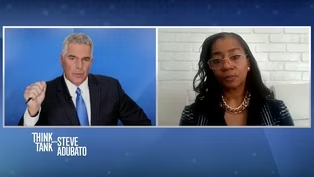
Newark Mayor Ras Baraka joins Steve Adubato to address public safety, the relationship between residents and police officers, and the ongoing gentrification of Newark.
Problems playing video? | Closed Captioning Feedback
Problems playing video? | Closed Captioning Feedback
Think Tank with Steve Adubato is a local public television program presented by NJ PBS
Mayor of Newark Addresses Public Safety and Gentrification
Clip: 6/3/2023 | 12mVideo has Closed Captions
Newark Mayor Ras Baraka joins Steve Adubato to address public safety, the relationship between residents and police officers, and the ongoing gentrification of Newark.
Problems playing video? | Closed Captioning Feedback
How to Watch Think Tank with Steve Adubato
Think Tank with Steve Adubato is available to stream on pbs.org and the free PBS App, available on iPhone, Apple TV, Android TV, Android smartphones, Amazon Fire TV, Amazon Fire Tablet, Roku, Samsung Smart TV, and Vizio.
Providing Support for PBS.org
Learn Moreabout PBS online sponsorship- Hi, everyone.
I'm Steve Abubato.
We kick off the program, and we are honored that he's with us again, the honorable mayor of the great city of Newark, Brick City, Ras Baraka.
Mr. Mayor, thank you so much for joining us.
- Thank you.
Glad to be here with you.
- Always.
Mayor, let's jump right into this.
The issue of crime, particularly violent crime, we're doing a lot of programming around that.
The statistics in Newark, as it relates to violent crime, are down.
First of all, what are those numbers, particularly around homicides, and why are those numbers what they are, please?
- Well, just in context, the numbers in Newark are probably, now I'm finding wood to knock on here, (knuckles thumping) are probably as low as they were since John F. Kennedy was the President of the United States.
So in actual numbers, when I took office, we were over 100.
In fact, crime had increased four years straight in a row, and we were over 100.
Last year we had 50- - 100 homicides?
- 100 homicides last year.
- Right.
- Last year.
We ended the year with 50.
We, at this present moment, are just one up from where we were last year.
So, God willing, and things continuing the way they continue, we'll probably hold strong, you know, with a lot of work and a lot of prayer.
You know, it's not- - So, Mayor, I'm sorry to interrupt, but in so many urban communities, that isn't the fact.
The numbers, forget about the numbers, in terms of people's lives, there is more violent crime, or at least there's a perception of more violent crime.
Well, right across the river in New York City, other places, Chicago.
What is different in Newark?
- Well, I think the collaboration between police and the kind of ecosystem we created that involves the police of like, kind of, CVI organizations that they calling it nationally, that the White House has called it, and other national organizations, Community Violence Intervention groups that are more than just guys going to talk to people to stop them from shooting each other.
And I think at one level, that's what people think it is.
And it's much more than that.
It's hospital-based intervention that involves hospital professionals.
It's social workers, and job developers, and counseling, and outreach workers, and high-risk intervention teams that are out there.
They have to be funded to do this kind of work.
Art and art therapy, and all kind of stuff that we do engage.
And we work alongside of the police department.
Not in spite of the police department, but with the police department.
And the police themselves have changed the way they police.
And I think the constitutional-based policing, the consent decree and all of that has focused us on more intelligence-based policing, more focused deterrent.
So we actually focus on areas and people who are committing crimes and not just throwing a wide net out there hoping we catch somebody, which was the broken windows thing before which I think led to a broken strategy that forced us into this consent decree.
- Real quick, the consent decree the mayor is talking about is the federal government stepping in after a disproportionate number of incidents between the police and the community of Newark disproportionately affecting African-Americans and Hispanics in the city.
The numbers were off because something was off.
The federal government stepped in.
That's where the decree came from, the consent decree.
But also in New York City, way back when Mayor Giuliani was the mayor, the broken-windows theory was you stop every minor crime, if you will, before it gets worse.
That being said, Mayor, shift gears, if you could with us.
The mayor of New York City, Mayor Adams, not Mayor Giuliani, the mayor now, is saying that the Biden administration is really giving a shaft to the city and urban communities across this country by their failure, according to Mayor Adams in New York City, to deal with the immigration crisis.
And so many immigrants are coming to New York, they can't handle it.
Where does Newark fit into that, only across the river from New York City?
- So we thought we were gonna get some of those buses.
By God's grace, it didn't happen.
We prepared ourselves for it.
But we do get a byproduct of folks who migrate from New York into Newark.
I mean, once they come into the city, you know, into the proximity, they're free to go where, people can go wherever they want to go.
And so we get families here in the city, so our social service infrastructure has to take care of it.
And because you have to be a citizen for a certain amount of time, they can't get county welfare, county services.
They can't get any of those things.
So, you know, we basically have to provide for them with the best that we can.
You know, even helping people find jobs, and all kinds of other things.
Housing, and opportunity.
We have to do that.
And so yeah, I would would agree with Mayor Adams in a sense that there needs to be a federal strategy to this.
This can't be left to municipalities to deal with on their own.
It's not fair.
It's not sustainable, and it's certainly not tenable.
You know what I mean?
It's untenable, right?
So at the end of the day, without help, you're gonna drown at some point.
I mean, the normal, the right thing to do is to help people who come into your community, but you need assistance with that.
- Mayor, it's interesting how you speak about the the housing situation, homelessness, connected to that question.
With all the redevelopment going on, urban revitalization, some might call it gentrification, a lot of economic development activity in Newark, for those of us born and raised in the city who can appreciate when downtown wasn't the downtown it is today, question, to what degree, with all this economic development and money coming into Newark, is it making Newark less affordable for those who do not have the means to stay in the city they love?
- Yeah.
It will.
I mean at, you know, just scientifically, based on how capitalism works, and supply and demand, the prices are gonna go up as the cost of living increases, as the value of property increases, your taxes increase.
And so that's trickled down to renters, people who have priced outta New York City can come into Newark and pay a lesser rent, which is more than what everybody else is paying.
It's natural progression of the way things happen.
So what you have to do as a local mayor local elected official, you have to mitigate these things by putting in opportunities for affordability, affordable housing, sustaining the housing that you have, putting things to keep rent stabilized in the community, and create more home ownership at the same time, which takes a lot of work.
And you can do that, and we have been doing that, and are doing that.
But you are competing with the rate, the speed, of the way these things are happening.
You have to build these things at a commensurate speed, right?
Or else you're gonna fall behind.
- There are market forces, I'm sorry, Mr. Mayor.
There are market forces that are driving up those costs.
- Absolutely.
And so you have to mitigate those market forces by creating other kinds of opportunity for people as quick as that's happening.
And the thing that this allows that often is the amount of investment that you have and affordability versus the amount of investment you have in market rate kind of stuff, which means you need state and federal subsidy, and support around this affordability piece that's not always all the times there as fast as you need it to be.
- Mr. Mayor, let's talk a little bit about, it's not just energy because there's more to it than the simple question of energy.
You are opposed to a new power plant.
What power plant are we talking about, and why is this power plant, as you see it, so detrimental to the citizens of Newark?
What power plant are we talking about?
- Well, you know, this is not the first, there's been many.
The problem is Newark is a overburdened community, right?
We are one of the Justice40 communities that the federal government talks about that have been unduly affected by environmental injustice over years.
- That's right.
- Partly because we're an industrial city.
And so we have all the industrialization, and everything that comes with that.
The air, the pollution of the air, the pollution of water.
So when people talk about, "Oh, Newark has made the list of one of the dirtiest cities.
", they think they're just talking about garbage.
But that's not what people are talking about.
They also talk, they're talking about air pollution, They're talking about the pollution in the Passaic, which has been done by these corporations that come here and dispose of waste in our waterways, who, our air, while our kids have more higher asthma rates than anybody else in the state, or comparable to other people in the country.
Or why the heat index in Newark is 10 degrees higher than other municipalities around the country.
And so all of those things we have to weigh in, which is why we have a Cumulative Impact Ordinance in Newark, why the state also has a Cumulative Impact Ordinance, meaning all of the cumulative things that have taken place in the city to add something onto that, increases the burden.
That's really what we talking about, that we don't want to further increase the burden, the health burden, of our residents without having any kind of help or mitigation.
- Question, there is a lot of banning of books going on, at least debating about that.
Some of your dad, who we were honored to remember in our series, "Remember Them", Amiri Baraka, an extraordinarily important figure in American history as a poet, as a writer, as a social activist.
There are efforts to ban some of his books.
As it relates to book banning, what's your greatest concern?
- Well, you take away young people, and everybody's opportunity, to learn not just about history, but to take in ideas, right?
And figure out what these ideas are, and compare them to one another, and make decisions about what you believe, and what you don't believe.
You can't just erase history, or erase ideas because you disagree with them, right?
You have to allow all of these things to blossom, and then you contend with the ideas.
And that's what intelligent people do, and that's what academia is for, to contend with ideas and to debate because at the center of democracy is debate.
If you can't have debate, then you can't have democracy.
- Civil, meaningful, substantive debate and discussion.
Mayor Ras Baraka from the great city of Newark, Brick City.
I wanna thank you for joining us, Mayor.
Thank you so much.
- Thank you.
- You got it.
Stay with us.
We'll be right back.
- [Narrator] Think Tank with Steve Adubato has been a production of the Caucus Educational Corporation.
Funding has been provided by Kean University.
PSEG Foundation.
Newark Board of Education.
The North Ward Center.
The Healthcare Foundation of New Jersey.
Choose New Jersey.
The Turrell Fund, supporting Reimagine Childcare.
RWJBarnabas Health.
Let'’s be healthy together.
PSE&G, And by these public spirited organizations, individuals and associations committed to informing New Jersey citizens about the important issues facing the Garden State.
And by Employers Association of New Jersey.
Promotional support provided by NJ.Com.
And by New Jersey Globe.
Here at Kean University, everyone gets their chance to climb higher.
Michael came to Kean and found his passion for health care, and now he's a doctor.
After Tricia graduated, her graphic design work was featured in The New York Times.
Samantha is studying athletic training and finding her path to an internship with the New York Giants.
Real Students.
Real Stories.
Real Success.
Cougars Climb Higher.
Kean University.
Addressing Low Morale in the Childcare Profession
Video has Closed Captions
Addressing Low Morale in the Childcare Profession (7m 41s)

Sen. Testa Addresses His Concerns About Public Education
Video has Closed Captions
Sen. Testa Addresses His Concerns About Public Education (9m 5s)
Providing Support for PBS.org
Learn Moreabout PBS online sponsorship
- News and Public Affairs

Top journalists deliver compelling original analysis of the hour's headlines.

- News and Public Affairs

FRONTLINE is investigative journalism that questions, explains and changes our world.












Support for PBS provided by:
Think Tank with Steve Adubato is a local public television program presented by NJ PBS