
Measles Cases on the Rise as Childhood Vaccine Schedule Changes
Clip: 1/7/2026 | 10m 17sVideo has Closed Captions
The number of measles cases in the U.S. has reached its highest level in more than 30 years.
The CDC has decreased the number of vaccines recommended to American children from 17 to 11.
Problems playing video? | Closed Captioning Feedback
Problems playing video? | Closed Captioning Feedback
Chicago Tonight is a local public television program presented by WTTW
WTTW video streaming support provided by members and sponsors.
Measles Cases on the Rise as Childhood Vaccine Schedule Changes
Clip: 1/7/2026 | 10m 17sVideo has Closed Captions
The CDC has decreased the number of vaccines recommended to American children from 17 to 11.
Problems playing video? | Closed Captioning Feedback
How to Watch Chicago Tonight
Chicago Tonight is available to stream on pbs.org and the free PBS App, available on iPhone, Apple TV, Android TV, Android smartphones, Amazon Fire TV, Amazon Fire Tablet, Roku, Samsung Smart TV, and Vizio.

WTTW News Explains
In this Emmy Award-winning series, WTTW News tackles your questions — big and small — about life in the Chicago area. Our video animations guide you through local government, city history, public utilities and everything in between.Providing Support for PBS.org
Learn Moreabout PBS online sponsorship>> In perhaps its most dramatic and consequential move yet the Centers for Disease Control and Prevention has cut the number of vaccines.
Vaccines recommended to American children.
Meanwhile, the number of measles cases in the country has reached its highest level in more than 30 years.
At more than 2000 confirmed cases in the U.S.
last year, 14 of which were in Illinois.
The country is in danger of losing its so-called elimination status.
Joining us, our Chicago Chicago Department of Public Health Medical Director, Dr Brian Bora.
Dr.
Alison Bartlett, professor in pediatric infectious diseases specialist at University of Chicago, Medicine and on Zoom, We have Dr Samir director of the Illinois Department of Public Health.
Welcome back.
Thanks to all of you for joining us.
Okay.
So starting with this news about the immunization schedule, here are some of the major changes.
The HPV recommendation, ships from 2 doses to stating that one dose of the HPV vaccine is as effective as 2 doses.
This is, of course, according to the federal government.
Now only children who are considered, quote, high risk are recommended to receive the RSV hepatitis A hat, be dinged.
A meningococcal.
See tell you why.
And Meningococcal you guys didn't know easy to do.
And immunizations based on quote, shared clinical decision-making are for wrote a virus COVID-19 influenza at several others.
Meaning those vaccines can only be administered after consulting with healthcare provider.
I want to get your reaction to these changes and I want to go around the table.
Dr.
Brian Boyle start with you.
>> Yeah, things.
I mean, this is this decision was based entirely on ideology and was not based on any new scientific evidence were any new data.
You know, this was sort of a predetermined outcome by a group of people leading HHS.
I you know, here in Chicago, we still The old set vaccine recommendations.
Unfortunately, we have our own processes in place here in the state to continue in a transparent process, a transparent way using scientific evidence to make recommendations for the people of Illinois.
Dr Bartlett.
>> I echo the fact that I'm grateful to be in Illinois where we are again, relying on the it's historic recent recommendations that are science-based, but it really poses some confusion for parents and families.
And I think also gives the impression that the recommendation to use discussions with family, about decisions for their children is that's something that do all the time and we provide medical care.
Everything is done in great consultation with patients and families.
Doctors, mayor, for a your reaction.
>> Yeah, I would say I agree with both Dr Bora and Doctor Bartlett.
The challenge here is we're in a place where decisions are being made by the federal government that are not based on up-to-date scientific information.
And we're fortunate here in Illinois with the governor's leadership.
The recently passed House Bill 767, that the only apartment public health in consultation with our immunization Advisory committee, Dr Barlett.
He's a member Dr Bore has given presentations that really allow to maintain those scientific process.
Ease ultimately here, Illinois, that changes by the federal government have no bearing on Illinois's recommendations.
We provided a notice to providers on that today.
We're ensuring that we have good clear messaging so that our providers know what recommendations to follow to ensure the health of their patients.
>> Hhs Secretary Robert F Kennedy Junior says that changes to the immunization schedule align with the schedules of other developed nations, Denmark, Germany, Japan, ADR Bora, was America's longstanding guidance?
Was it really that different from our peers?
>> It really was.
the truth of the matter is, every country has a vaccine.
Schedule designed for that country, specifically historically, you know, for decades we've had an established process by which vaccines were reviewed, recommended no scientific evidence looking at their effectiveness and their safety.
We're carefully scrutinized for every single individual vaccine.
And so this vaccine schedule that was developed for the United States.
It's based on decades.
In decades of scientific evidence.
>> Doctor Bartlett, what are your concerns with comparing the U.S.
vaccine schedule to that of other nations?
So I think there's a couple concerns.
One is, as based on the epidemiology, the frequency of diseases in each country can vary.
So recommendations can vary.
I think, you know, vaccines are really powerful.
Preventative health tool.
We don't have access to the kinds of preventative health care government provided, right?
Insurance and other access that other countries have.
And so we rely more on some of the vaccines compared with other nations who have different health care systems.
And also, I mean, a nation like Denmark is the size of its been come paired the size of the state of Wisconsin, for example, rated much bigger nation.
Us going to different issues.
in a statement.
Dr Mehmet Oz administrator for the Centers for Medicare and Medicaid Services said, quote, All vaccines currently recommended by CDC will remain covered by insurance without cost sharing.
>> Dr Vohra.
Does this mean that, you know, vaccines that are not offered will no longer be covered and how is Illinois responding to that?
>> Well, I think there was some reassurance and the statements by Doctor Oz, doctor and Secretary Kennedy to ensure that access will remain on all of the immunizations that were recommended weather shared clinical decision-making or routinely recommended and they'll be covered by government base insurance programs.
Private insurance is have said that they will continue to cover vaccinations before with the schedule before these changes are being made.
Through our efforts.
We are working to ensure that that is the case.
>> we want to be prepared It's good that those things have been declared.
>> But we're seeing a number of changes as Doctor Bartlett previously mentioned, it causes uncertainty to do.
Our providers were working or across state agencies with the statewide vaccine initiative to ensure clarity and to provide as many tools to ensure that access is there for all Illinois, based recommendations that need scientific standards.
>> And then there's the measles the largest measles outbreak in the country currently in South Carolina with 214 confirmed cases followed by Arizona with 205 cases and 176 in Utah.
Dr.
Or what would you say is driving these outbreaks and, you know, the lower vaccination rates as well.
>> You know, they're they're they're one and the same.
So when you have pockets of people that are unvaccinated close, you know, that are that in close knit community.
That's a recipe for a measles outbreak.
So I think, you know, I over the past couple years we've seen decline in vaccine coverage across the nation really and unfortunately think we're seeing some of the consequences here in the form this outbreak.
And we're not the only nation seen, as you know, our neighboring nations in Mexico in Canada have seen a lot of measles as well.
So we have a lot of work to do.
>> As mentioned, federal health officials, they still recommend that all children vaccinate against measles.
But the CDC is investigating whether or not to break up our vaccine for measles, mumps, rubella, essentially saying that it should be separated, separate vaccines rather than one combine shot.
Dr Bartlett.
What would be the impact of separating So the impact of separating them would be I think that fewer individuals be vaccinated for each of those components that we just mentioned.
Our health care delivery issues in the United States.
>> And giving more vaccines at more visits where there's already limited access is a challenge.
Families.
You don't have challenge is traveling to their appointments getting in to see their doctor.
So being able to do 3 or 4 vaccines at the same time is a much more efficient way to deliver.
What are some of the long-term effects contracting measles?
So that's a great question.
So many kids who get measles have a freezing that feb route illness with a rash, but about the brawl, meaning feverish high fevers.
Thank you so Big impressive rationed that stuffy nose, but about 10% of kids end up being hospitalized with measles.
I speak more about children because many adults have a more likely to be mute and all infants under age 12 months are vulnerable because they haven't been vaccinated.
And then there are much more serious severe consequences like swelling and inflammation of the brain and one to 3 out of every 1000 kids will die.
Dr Vohra before we run out of time.
What are the sort of a societal repercussions to having a measles outbreak?
I think both Dr Born Doctor Bartlett said this is part of the challenge around.
>> Vaccine hesitancy.
But I think there are also those who Ways in which we here in Illinois, through partnership in Chicago, in other states that we saw still 14 cases, but only 14 cases when we've seen kind 2000 across the country part of this has been great partnership local health departments.
Providers putting out opportunities for mobile clinics, getting education out there and really trying to move these efforts on grass root levels to really ensure that people stay healthy.
And that's the core message here that despite the hesitancy in reluctance putting out the best science answering people's questions.
So that we can to minimize these conduct.
is still unable to respond to them very quickly.
Thankfully is just 14, not more than that.
>> Thanks to the doctors,
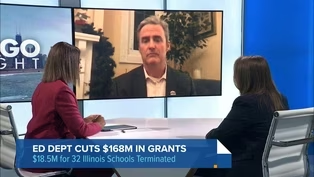
What New Cuts in Grant Funding Mean for Full-Service Community Schools
Video has Closed Captions
The schools partner with community groups to provide a range of services for students and families. (8m 12s)
Providing Support for PBS.org
Learn Moreabout PBS online sponsorship
- News and Public Affairs

Top journalists deliver compelling original analysis of the hour's headlines.

- News and Public Affairs

FRONTLINE is investigative journalism that questions, explains and changes our world.












Support for PBS provided by:
Chicago Tonight is a local public television program presented by WTTW
WTTW video streaming support provided by members and sponsors.