VPM News Focal Point
Media Literacy | October 27, 2022
Season 1 Episode 13 | 26m 46sVideo has Closed Captions
Newsrooms are shrinking, so many groups are helping to combat disinformation.
Non-profit newsrooms fill the gaps in shrinking local news coverage; News Literacy Project helps people become more active, engaged, and critical thinkers about news consumption; the Disinformation Project empowers teens to combat disinformation.
Problems playing video? | Closed Captioning Feedback
Problems playing video? | Closed Captioning Feedback
VPM News Focal Point is a local public television program presented by VPM
The Estate of Mrs. Ann Lee Saunders Brown & Dominion Energy
VPM News Focal Point
Media Literacy | October 27, 2022
Season 1 Episode 13 | 26m 46sVideo has Closed Captions
Non-profit newsrooms fill the gaps in shrinking local news coverage; News Literacy Project helps people become more active, engaged, and critical thinkers about news consumption; the Disinformation Project empowers teens to combat disinformation.
Problems playing video? | Closed Captioning Feedback
How to Watch VPM News Focal Point
VPM News Focal Point is available to stream on pbs.org and the free PBS App, available on iPhone, Apple TV, Android TV, Android smartphones, Amazon Fire TV, Amazon Fire Tablet, Roku, Samsung Smart TV, and Vizio.
Providing Support for PBS.org
Learn Moreabout PBS online sponsorshipANGIE MILES: The internet has changed the way people consume news, leading to the rise of more nonprofit newsrooms.
We'll take a look at what that means.
The internet has also enabled the spread of more misinformation, which can sometimes cause serious harm.
We'll examine efforts to minimize the harm.
And we'll introduce a family that is driven to drive out disinformation.
It's time for "VPM News Focal Point."
Production funding for VPM News Focal Point is provided by Dominion Energy, dedicated to reliably delivering clean and renewable energy throughout Virginia.
Dominion Energy, Actions Speak Louder.
The estate of Mrs. Ann Lee Saunders Brown.
And by... ♪ ♪ ANGIE MILES: Welcome to "VPM News, Focal Point."
I'm Angie Miles.
Many forms of media are available these days, online and off, making it easy for misinformation to masquerade as fact.
We'll focus on some solutions to this challenge, but first we explore a national issue through a Virginia lens.
With the midterm elections just weeks away, there are people on the ballot and people going to the polls who are still questioning the validity of the 2020 vote.
Norfolk-based political analyst, Dr. Eric Claville, shares why this trend is dangerous for American democracy.
ANGIE MILES: Virginia's governor has been touring the country, granting interviews.
GLENN YOUNGKIN: Kari Lake is inaugurated as the 24th governor of?
ANGIE MILES: And campaigning for Republicans.
Lake is a former journalist, and a 2020 election denier.
GLENN YOUNGKIN: And I think that the Republican party has to be a party where we are not shunning people and excluding them, because we don't agree on everything.
JAKE TAPPER: This isn't a disagreement over tax policy.
This woman doesn't believe in legitimate election.
ANGIE MILES: Youngkin accepts the 2020 election results, but says the benefits of electing Republican governors outweighs debates about election fraud.
According to a recent poll, about a third of Republican congressional candidates, a small percentage of Democratic voters, but more than half of Republican voters, say they believe Donald Trump was cheated out of a second term.
Dr. Eric Claville is a legal expert, and a veteran political analyst.
He spoke with our editorial producer, Samantha Willis.
Claville says, "Labeling people or situations as illegitimate can be an attempt to gain or retain political power."
ERIC CLAVILLE: This movement really started with the election and reelection of former President Barack Obama.
I saw an underground movement of rumbling, and we saw where with the election of President Donald Trump, where he actually took that, and rode that into the White House.
In part with the Birther Movement.
ANGIE MILES: The Washington Post reports that eight of Virginia's 11 GOP candidates for Congress, and more than half of Virginia Republican voters, say Joe Biden is not the legitimate president.
That's despite no evidence of widespread election fraud.
Claville says that for some, disputing the election is simply a bid to win votes, going back to those who first challenged the accuracy of the votes in court.
ERIC CLAVILLE: You'll see in their testimonies and in their depositions, that they really didn't believe what they said, right?
And the evidence showed also that it was not true.
ANGIE MILES: Dr. Claville predicts that election denial won't have too much impact on Virginia's midterm elections, but says the continued, unfounded erosion of trust in our voting processes could have serious consequences for the 2024 presidential election.
ANGIE MILES: Right alongside the erosion of trust in elections is the loss of confidence in the news media.
Speaking with people across Virginia we've heard about concerns ranging from garden variety dishonesty to corporate-driven greed.
TOM CHAFFEE: When people are frustrated, they'll do things like purchase something.
That's easy to do versus solving the problem, which is very complex, you know?
And it's difficult.
So I think that really I think that the media should really do some soul searching on the... what they're trying to get out of people.
MICHAEL SMITH: The media is becoming less trustworthy by the stuff they tell that's not true.
And I think most people know that they're telling something that's not true.
ANGIE MILES: We've also heard concerns that news consumers have become conditioned by social media echo chambers to only hear what they want to hear.
ANDRE FENNELL: People just go with what they believe.
And if they hear that confirmation, they have like that confirmation bias and then they'll just go with that.
BOB WELSH: You know, I think hopefully most people can find a spot.
Above and beyond any social media that they find they find to be factual news.
And I think there should always be a question.
There's some some degree of doubt in anyone's mind.
Whenever they hear anything, report it and perhaps take it upon themselves to look into it from several different sources.
ANGIE MILES: As news viewership and readership have declined, newspapers across the state have sustained years of cuts leading to fewer experienced reporters covering stories and more news deserts in Virginia.
At least four non-profit newsrooms have emerged to fill this void.
Multimedia journalist, Adrienne McGibbon reports.
MARKUS SCHMIDT: When you cover state politics, it's almost like a microcosm of the federal government.
Everything is a little bit smaller, but in principle everything is the same.
It's just an incredibly fun time for me as a political junkie to be part of the coverage here and see how the sausage is being made.
ADRIENNE MCGIBBON: Marcus Schmidt is the state politics reporter for Cardinal News, a non-profit news organization that covers southwest and south side Virginia.
MARKUS SCHMIDT: We try to, you know, make people understand how the issues in Richmond affecting them back home.
And also they know that we come from a nonpartisan angle that's very important to us, so they know we have unbiased reporting.
LUANNE RIFE: We didn't set out to duplicate what someone can get elsewhere, but to tell the types of stories that tell you more about yourselves and your communities.
ADRIENNE MCGIBBON: Luanne Rife was a longtime reporter for the Roanoke Times.
She left after years of cuts and teamed up with the paper's former editor to start Cardinal News.
LUANNE RIFE: The last round of layoffs in the spring of 2021 meant that we could no longer do in-depth reporting.
It also meant that there would no longer be a full-time political reporter covering this part of the state.
ADRIENNE MCGIBBON: Schmidt, who spent years covering the capital for the Richmond Times Dispatch also saw cuts in that newsroom.
MARKUS SCHMIDT: We were six or seven reporters covering the legislature and the executive branch, including a couple of columnists as well.
When you cut that down to maybe four reporters, you have a situation where newsrooms statewide now really have to pick and choose and see where can we cut.
ADRIENNE MCGIBBON: Nonprofit news Organizations like Cardinal News are surfacing across the state.
Many rely on donations to operate.
LUANNE RIFE: So we are supported wholly by donations from foundations, corporations and individuals.
And I think most people understand that when say we're based on the same model as public broadcasting, they get it.
ADRIENNE MCGIBBON: But some experts like veteran reporter and journalism professor, Jeff South, say as more non-profit newsrooms crop up, competition for donor dollars could make it harder to maintain reliable funding over the long term.
JEFF SOUTH: There's not an unlimited supply of deep pocketed foundations to help news organizations that are non-profit.
And at some point the public might say, gosh, you know, I'm already giving money to these two other non-profit news organizations and to my daily paper, you know, and now there's another one that's asking me for funding.
ADRIENNE MCGIBBON: One non-profit is using a different model.
The Virginia Center for Investigative Journalism has partnered with Hampton Roads based WHRO Public Media to cover in-depth investigative stories statewide.
MECHELLE HANKERSON: We have this infrastructure that allows us to be financially sound as a newsroom.
We know what our funding is going to be year to year and it's very transparent because it has to be.
ADRIENNE MCGIBBON: WHRO News Director, Mechelle Hankerson, says in today's media environment the non-profit model may be an even more reliable funding source.
MECHELLE HANKERSON: When something becomes not as valuable to an owner whose only interest is making money, they just offload that asset.
We saw that with the Virginian Pilot, because to the hedge fund that owns them, it's just an asset.
It's not any more or less important than a couch they want to get rid of in their office.
ADRIENNE MCGIBBON: But those working in the non-profit space are seeing reasons to be optimistic.
MECHELLE HANKERSON: The power of a regular person pulling the money that they can pull together and giving it to us, or whatever non-profit entity is something that proves we're doing something right.
ANGIE MILES: Some of Virginia's legacy newspapers are now experimenting with the non-profit model.
The Prince William Times and the Fauquier County Times converted to nonprofit status in 2019, allowing them to reap tax benefits and stretch tight budgets.
Vews News Focal Point is interested in the points of view of Virginians.
To hear more from your Virginia neighbors, and to share your own thoughts and story ideas, find us online at vpm.org/focalpoint.
ANGIE MILES: Serious journalists ascribe to a code of ethics that includes seeking and reporting truth, minimizing harm to others, acting independent of undo influences, and being both accountable and transparent.
Serious journalists also adhere to standards, such as verifying facts, avoiding bias, and providing context.
But can you recognize quality journalism?
And in a world of newscasters, podcasters, editorialists, entertainers, and influencers, with information flowing to you every minute of every day from reporters, promoters, partisans, and bots, how do you know what is real?
Could the answer be a dose of prevention for your brain?
DONALD TRUMP: Thank you everybody.
Thank you.
ANGIE MILES: Did you hear about a world famous boxer attending a Donald Trump rally while wearing a hijab and daring people to fight?
That's fake news, a story started on a sports comedy website and it went viral, but people didn't know whether it was true or not.
That same month, March 2016, some people claimed that leaked emails between Hillary Clinton and a staff member held hidden messages that proved Clinton was involved with human trafficking.
This fake news also went viral and it led to a man firing shots in a Washington, DC pizza restaurant.
Pizzagate is one example of what can happen when fake news or misinformation spreads.
Research suggests that false news and information travels much faster than the truth on social media, and the more falsehoods are repeated, the more easily people believe them.
SANDER VAN DER LINDEN: Fluency has to do with how familiar something is, so the more you hear something, the more it's repeated, the more familiar it becomes and the more likely the brain is to think it's true.
ANGIE MILES: Cambridge University professor, Sander van der Linden, specializes in how to arm the brain to recognize and repel fake news before it can do harm.
Here's a Cambridge experiment you can find online.
VIDEO: You might think about skipping this ad.
Don't.
What happens next will make you tear up.
(somber music) (video whirring) Wait, you're still here?
ANGIE MILES: The goal is to vaccinate, or inoculate, people against misinformation by showing them common tactics used to manipulate people's emotions, beliefs and actions.
Appealing to your feelings, blaming scapegoats, (goat bleats) and setting up false dichotomies.
VIDEO: If you're not with me, then you're my enemy.
ANGIE MILES: Are some of the ways content creators can influence people.
Sometimes the intentions behind the manipulation can be malicious.
HILARY CLINTON: The epidemic of malicious fake news and false propaganda that flooded social media over the past year, it's now clear that so-called fake news can have real world consequences.
ANGIE MILES: Chuck Salter understands this.
Having been a school teacher, principal, superintendent, he's now CEO of the nonprofit, nonpartisan News Literacy Project based in Washington, DC.
The mission, educate the public how to recognize so-called fake news.
CHARLES SALTER: With the 2016 presidential election, regardless of who anyone was for or against, it became pretty obvious to the public that we had a serious problem with disinformation.
When someone uses that term, fake news, really what that means is it's news they don't like or news they don't agree with, regardless of its voracity or accuracy.
And so we really steer clear of that, because unfortunately it's become a weaponized, almost politicized word.
So disinformation has the intent to deceive, misinformation is simply the byproduct of people continuing to share and spread whatever rumor or misinformation that they see.
ANGIE MILES: From 2016 through the 2020 election, the constant attack on the mainstream media as fake.
DONALD TRUMP: You are fake news.
ANGIE MILES: Followed by insistence that the vote itself cannot be trusted, has undermined American's confidence in journalism and in government institutions.
G.K. BUTTERFIELD: Falsehoods spread about routine election processes, such as mail-in vote and drop boxes and how votes are processed and counted, and even more, have led to threats to election officials, the January 6th attack on the peaceful transition of power.
ANGIE MILES: Congressional hearings in 2022 sought advice from experts on how to combat the disinformation that threatens democracy while also protecting the right to free speech.
MIKE ROTHSCHILD: But the 2020 election and its aftermath have seen disinformation not just employed by candidates or printed in crank books, but weaponized to cast doubt on the validity of elections themselves.
CHARLES SALTER: So we accomplish our mission several ways.
The first is in our public schools.
PATRICIA HUNT: You've got three questions.
CHARLES SALTER: So our focus in the education space is to train teachers and provide them with cutting edge curriculum for them to actually use in their classroom.
PATRICIA HUNT: So it has incredible power to make people do things.
PATRICIA HUNT: I teach United States and Virginia government and I teach government through the news.
They need to be able to recognize news for what it is and the standards of journalism and I believe that it is a skill that will carry them beyond the classroom and into adulthood as they become voters and engaged and participate in our democracy.
Students have, at their fingertips, more information than ever before in human history, and the ecosystem in which they dwell is polluted.
LYDIA DAWIT: We're learning about, like, different info zones, so, like, we're learning how to differentiate propaganda and entertainment and, like, raw information from the articles and videos we're watching.
JACKSON VOYDA: I think lessons like this are really good because it actually, like, activates your mind as opposed to just looking at a textbook or, like, a test, like one of those kind of environments.
I like talking to my peers and getting their opinions too.
Especially after the 2020 election, I think a lot of people lost a lot of trust and they're trying to get it back, but they really don't know where to start.
TERENCE NEEPLO: There's a lot of false information going out and if you understand that it's false, you can think appropriately and accordingly and make the right decisions.
RAYANE RAZANAKOTO: It's really important to, like, know what's an opinion or what's actually news and if you want to, like, state your own opinion, I feel like knowing the facts and the truth will be very beneficial to, like, stating your case as well.
ATHENA SOLORZANO: I think it's a big problem.
People hear fake news and it gets around and changes the perception of a lot of people's opinions.
People could believe in, like, wrong things and it could end up hurting them if they don't know the truth.
JONATHAN HERNANDEZ: How often do kids our age really, like, look at news and stuff like that and really, like, talk about it and process it?
And it was good because I didn't know there were so many types of info zones.
Like, I didn't really know how to separate them when we first started, but now, like, we're here going through these lessons and I'm getting all of them right.
LYDIA DAWIT: Some people are more gullible than others, so I feel like it really depends on who the person is, but I personally, I don't, I don't believe things as easily, like, when I see them, I'll fact check and I'll make sure, like, it's real.
JACKSON VOYDA: If they're the one retweeting or sharing, like, false information, you're just spreading it and getting it to more people and you're just making it worse for everybody.
But you can't really blame the people sharing 'cause they probably didn't know themselves, but... ANGIE MILES: When you know better, you do better.
JACKSON VOYDA: Yeah, when you know better, you do better.
PATRICIA HUNT: There are just too many people who are relying on false information to make vital decisions for our democracy.
ANGIE MILES: The News Literacy Project would like to see every school system in the country adopt these kinds of lessons.
The Checkology e-learning platform is a free teaching tool.
CHARLES SALTER: Those responsible for the founding of the country understood that a free press is necessary for a free people and they put it in the Constitution.
And I think the sooner that school systems account for that and make room for it, and I understand that that's difficult with all the other obligations they have, I think the better off we'll be.
And so, yes, I think this, the idea of news literacy embedded in our public education system so that all people are taught it, just like they're taught how to read, and just how they're taught how to write and to do arithmetic, has been important and has been recognized as being important since our very founding.
VIDEO: Don't be manipulated.
ANGIE MILES: The News Literacy Project does not take sides, does not tell people where to get their news.
But they do want you to learn how to differentiate among fact, opinion, and falsehood.
Free resources for learning more about news literacy as well as those Cambridge videos for spotting misinformation are available through our website.
Earlier this year, President Joe Biden launched the Homeland Security Governance Board to combat disinformation, which can erode the trust that holds a nation together.
He called on Nina Jankowicz to lead that effort.
We spoke with Ms. Jankowicz, and we spoke with attorney Gary Lawkowski, an expert on election law and the First Amendment.
ANGIE MILES: Can you just summarize, if you can briefly, what it is that you would advise individual American citizens to do to fight disinformation and misinformation?
NINA JANKOWICZ: Yeah, I think the most important thing to understand is that disinformation preys on our emotions, and it preys on the infrastructure of social media, which is built on those emotions.
So I often like to say that the most enraging content online is the most engaging content online.
Think about that before you hit the share button.
We spoke with Gary Lawkowski with Dhillon Law Group based in Alexandria.
Could you talk just a little bit about your work as a senior fellow at the Institute?
GARY LAWKOWSKI: Sure, so I got involved with the institute cause free speech is something I'm very passionate about.
I think it's important.
I think it kind of undergirds all the other freedoms we have, you know.
Representative government only works if we, the people are able to communicate our views back to our elected representatives.
You can watch the full interview on our Web site.
ANGIE MILES: A Northern Virginia family is trying to stop the spread of disinformation by teaching teens to think critically about what they see online.
Our Adrienne McGibbon shares their story.
ANNA VERICH: Okay, guys, we are The Disinformation Project Club at West Po.
Disinformation is something that affects everybody.
We want to teach people what it is so that you're not one of those people that falls for it.
FILM NARRATOR: Research alternate explanations, and consider other points of view.
ANNA VERICH: The club that we have at West Potomac is a chapter from my dad's nonprofit, The Disinformation Project.
MATT VERICH SR: The Disinformation project is a nonprofit 501(c)(3).
It has the mission of raising awareness of disinformation and the problems of disinformation with teenagers.
MATTHEW VERICH JR.: Disinformation is misinformation, which is just false information that is deliberately spread to create divisiveness.
ANNA VERICH: In 2020 when COVID hit, a lot of kids my age and just people in general had nothing better to do but to just sit on their phone, scroll on social media 24/7.
MATTHEW VERICH JR: I started noticing during this time period, peers posting information online that was kind of not really true.
A specific example was the drone strike in Iraq.
People were just convinced that this attack was going to immediately lead to World War III and then immediately lead to girls being drafted into the war.
And I remember seeing that and being like, "That sounds pretty farfetched and ridiculous."
And then, I mean, some people would actually be upset about it, and that kind of upset me as well.
ANNA VERICH: So my brother just was fed up, and my dad was like, "Well, let's make a change.
Let's do something about it."
MATT VERICH SR: So the first step was just starting a conversation with my kids about what they were seeing and sort of understanding from their reactions that they were struggling.
They knew some of this stuff was unhealthy or divisive or probably not true, but they didn't have the tools, the strategies, the resources to help them navigate that.
ANNA VERICH: So then my dad started his nonprofit, and then the club came off of that.
MATTHEW VERICH JR: We kind of settled on awareness that these problems exist, awareness that maybe you should double check whether what you're posting is true.
It can be an easy fix and a good fix, a really effective one.
And so that's where the club at West Po.
started.
My club officers and I were able to spread disinformation awareness campaigns to get the word out that not everything you're seeing online is true.
ANNA VERICH: We made stickers that have a QR code, and our QR code has a lot of information on disinformation.
There's videos that you can look at.
There's links that explain disinformation.
There's also our Instagram that if you were to click on that, it could help you just give a little explanation on what disinformation is.
MATT VERICH SR: And we see ourselves as the bridge between a lot of really good research that's being done at universities and think tanks, a lot of really good information that's being made publicly available by the government, and our teens.
MATTHEW VERICH JR: A kind of side mission of The Disinformation Project is to prepare students, especially high school students who are at that kind of point where they are developing ideologies, developing their sense of political activism, to develop good habits and have a good sense of what is true and what is not.
ANNA VERICH: We've already started two other chapters at two other schools, so that was really exciting since it's just the beginning of our chapter and we've already had added two more chapters.
This is something that could become a movement.
Stopping disinformation, that is what my major goal is here.
So starting other chapters is just the step one of this whole idea.
ANGIE MILES: Are you able to discern fact from fiction in the media you consume?
We hope today's stories will boost your media literacy and you can further your knowledge with the resources on our website, vpm.org/FocalPoint.
You can watch our extended interviews with Nina Jankowicz and attorney Gary Lawkowski.
Thank you, we'll see you next time.
Production funding for VPM News Focal Point is provided by Dominion Energy, dedicated to reliably delivering clean and renewable energy throughout Virginia.
Dominion Energy, Actions Speak Louder.
The estate of Mrs. Ann Lee Saunders Brown.
And by... ♪ ♪
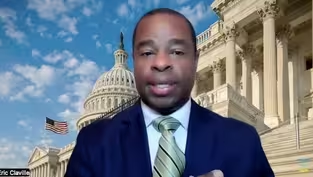
How Election Deniers “Tear at the Edges” of Democracy
Video has Closed Captions
Clip: S1 Ep13 | 2m 5s | Is election denial a dangerous trend for American democracy? (2m 5s)
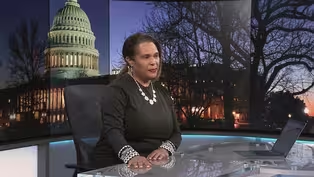
In Focus | Nina Jankowicz & Gary Lawkowski
Video has Closed Captions
Clip: S1 Ep13 | 17m 11s | Watch Nina Jankowicz and Gary Lawkowski talk about issues combating disinformation. (17m 11s)
Media Literacy | People of Virginia
Video has Closed Captions
Clip: S1 Ep13 | 1m 30s | Listen to Virginian's thoughts on participating in social or political activism. (1m 30s)
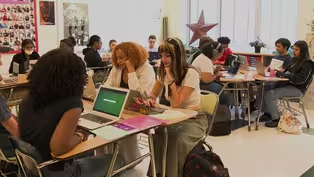
A more media savvy public is the goal
Video has Closed Captions
Clip: S1 Ep13 | 8m 14s | Non-partisan, non-profit organizations are taking aim at misinformation . (8m 14s)
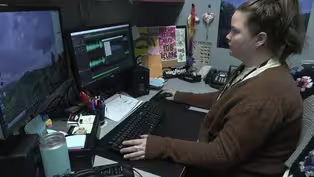
Non-Profit Newsrooms Filling the Reporting Gap
Video has Closed Captions
Clip: S1 Ep13 | 4m 5s | Virginia journalists are using donor dollars to fill the gaps left by corporate cuts. (4m 5s)
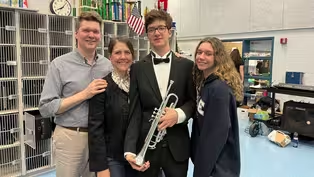
A Virginia family fights disinformation
Video has Closed Captions
Clip: S1 Ep13 | 3m 54s | Teaching teens to double check what they share online to help fight against disinformation (3m 54s)
Providing Support for PBS.org
Learn Moreabout PBS online sponsorship
- News and Public Affairs

Top journalists deliver compelling original analysis of the hour's headlines.

- News and Public Affairs

FRONTLINE is investigative journalism that questions, explains and changes our world.












Support for PBS provided by:
VPM News Focal Point is a local public television program presented by VPM
The Estate of Mrs. Ann Lee Saunders Brown & Dominion Energy