RTP180
Medicine | February 2022
2/23/2022 | 1h 10m 35sVideo has Closed Captions
RTP180 takes on medicine in the February 2022 speaker series.
This RTP180: Medicine speaker series includes professionals from various sectors of medicine: a clinical pharmacist, a professor specializing in nutrition, a music therapist and more. Our experts present their specialties regarding the medical community.
Problems playing video? | Closed Captioning Feedback
Problems playing video? | Closed Captioning Feedback
RTP180 is a local public television program presented by PBS NC
RTP180
Medicine | February 2022
2/23/2022 | 1h 10m 35sVideo has Closed Captions
This RTP180: Medicine speaker series includes professionals from various sectors of medicine: a clinical pharmacist, a professor specializing in nutrition, a music therapist and more. Our experts present their specialties regarding the medical community.
Problems playing video? | Closed Captioning Feedback
How to Watch RTP180
RTP180 is available to stream on pbs.org and the free PBS App, available on iPhone, Apple TV, Android TV, Android smartphones, Amazon Fire TV, Amazon Fire Tablet, Roku, Samsung Smart TV, LG TV, and Vizio.
Providing Support for PBS.org
Learn Moreabout PBS online sponsorship- [Narrator] We stand on the threshold of a great new age of exploration.
It's ultimate destination, the furthest reaches of the universe.
- [Announcer] Three, two, one.
[upbeat music] ♪ - Good evening, ladies and gentlemen and welcome to The Frontier, here on the campus of Research Triangle Park for RTP 180.
How's everybody out there doing tonight?
[audience cheering] That's good, whoo was the correct answer.
Now, how many people have never been to an RTP 180 before?
Please raise your hand.
Awesome.
That is a significant number of people.
How many people are seeing RTP 180 for the very first time tonight?
That should be the same people, it was about 10%.
Matt's heard that joke before.
Well, whether you're here for the first time or whether you've been here before, you are here at The Frontier for RTP 180, our topic is medicine.
Everybody say ooh, - [Audience] Ooh.
- Everybody say, ah.
- [Audience] Ah.
Now you know how Mussolini came to power.
Now, what we have here is five experts.
They'll be giving their expertise on the subject of medicine, after which we'll have five minutes of Q and A.
That's how this works.
Now, The Frontier, where you are sitting right now, is home to RTP 180, which is brought to you by RTI International, our longtime sponsor.
And every time I forget that slide's in there, but that's a me problem, not a you problem.
Now you can connect with us during the show as the slide says, you can hashtag us, you can add us.
I don't know what that means, 'cause I don't know anything.
But you can connect with us and we will take your questions on social media as well as here in the room.
Now, normally if you're here during the day, this place looks a lot like that, there's tables and stuff.
That's because you are in the areas only free, pause for dramatic effect, co-working facility.
So, whether you are in Durham, whether you're in Raleigh, whether you're in Karioi Forest, this is a great place to come post up, get some work done.
You can even go outside on nice days like today, we have events, we have yoga, we've got food trucks, all sorts of cool stuff happens.
We've even got the Boxyard now right across the street.
If you have not been there, please do that, it is a wonderful facility.
Now over at the Boxyard on March 8th in the morning, we're gonna have our Breaking the Bias: Women's Leaders in RTP panel discussion.
So if you get here at nine o'clock in the morning on March 8th, you can hear from local business leaders, women in the industry, find out about that stuff.
Excellent.
So we are now live here for RTP 180 Medicine.
We have a broad variety of topics and you're tired of hearing me talk.
So we're gonna get right onto it.
So our first speaker of the evening, is a clinical pharmacist by background and the CEO at PQS.
Please welcome to the stage, Todd Sega!
[audience clapping] - Thank you.
I feel like I'm heading into the ring with that introduction, but great to be here.
Thanks for coming out.
And I think we have some fun things to look at, just a little bit about PQS.
So we're actually right across the street, and we are a healthcare technology company that manages healthcare quality improvement information between health plans and community pharmacies, so patients can get the best outcomes.
But what I'd like to start off with a little bit more, is a fun fact, who doesn't like that?
So how many of us have heard of amoxicillin?
Okay.
How about augmentin?
Keep it up if you've heard of augmentin as well.
Similar for that.
So, what the interesting thing about that, is that obviously penicillins were discovered decades ago, but then we had amoxicillin several years later, researchers came out and realized that if you added one compound to that clavulanate, that it actually expanded the coverage, the broad spectrum of the antibiotic and the ability to penetrate the cell wall of the bacteria, and you had augmented amoxicillin, Augmentin, so there's the name for it.
I can't tell you that the names are that easy today.
It doesn't work that well for some of the meds that we see.
So with that, I'd like to talk about something that we believe can really augment medicine today, that is the untapped power of the patient's voice, that many of us don't even realize exists.
But before we get there, we need to understand really quickly, the way drugs are approved here in the US.
Do they work and are they actually safe?
So do they work as the efficacy portion of that?
And the reality is, we don't necessarily set an extremely high bar on the efficacy side, because of what we compare it to.
Oftentimes drugs are compared to a placebo, so, nothing at all.
So it's something for us to make sure we look at, even after a drug is approved in the postmarketing phase, which is the phase four, to make sure that we're getting as much data to see how to maximize the outcomes for that particular medication.
And clinical trials don't always represent the actual population, they're small samples.
So we have some challenges there, and we need to always apply what we've learned in the post-marketing phase to see if we could maybe even beat the outcomes that were approved in the clinical trials to begin with.
So here's the stage for oncology.
So this is where we're gonna focus today.
But in particular, last year was another record year.
So we had 50 medications approved, new molecular entities, by the FDA.
Over 1/4 of them were in oncology.
That's huge, that's a massive category.
If I showed you a donut chart from prior years, it would actually look very similar to this, and there are actually years that beat this.
So we have a lot of new drugs that we're working on in the pipeline for oncology.
And we know that they're also not cheap.
So they're also quite expensive.
When we look at drug spend for oncology drugs, we can see that it's been increasing every single year.
And if we look into the forecast for the next few years, although we see that there's at least a flat line, it's still an average out of a 10% forecasted growth year over year.
If we put that to the numbers and compound it, we're at $270 billion in oncology drug spend by the end of 2025.
That's incredible.
So if we step back and think that we have a lot more drugs, we're paying a lot for them.
It seems like a fair question to ask, what are we getting for those drugs and what we're spending?
So if I haven't gotten your attention yet, hopefully this slide captures some of that.
And if we look at 2011 and we actually see that we were using, and these are oral oncolytics, that one of every 10 drugs that we used, didn't have any impact on overall survival.
Not always the most important I guarantee, I know it's not the prettiest of endpoints for us to look at, it's quite morbid.
But then fast forward to 2018, seems like we're going backwards a little bit.
Six out of every 10 drugs we're using have no documentation to impact overall survival, but this isn't all of the equation that will get to you in a couple of minutes, because we know that there are other things like quality of life, that are also endpoints of value, to patients and their families.
So fortunately, as we think about these outcomes and how we may impact it, there is the ability to tap into patient reported outcomes, hence getting into the patient voice.
And who else has also seen this benefit as the FDA?
And the FDA recently launched a program in 2020, from the Oncology Center of Excellence, to try and bring in patient reported outcomes from clinical trials, to help patients and prescribers and caregivers, make a more informed decision, about what drugs may be best.
And they started this with one manufacture in particular which was AstraZeneca, focused on non-small cell lung cancer, and the drug was tagrisso.
So what we learned from this is getting a snapshot of half a year, to see how patients respond, and here's the value that comes from us.
We're gonna talk about two quick things from this slide.
And on the left hand side, you can see that this is tagrisso, and we see before treatment, so here's the baseline.
And this gives a little bit of a light at the end of the tunnel, but this is data that isn't typically shared or discussed with patients and their care teams.
And we see that at week five, we actually have some of the lowest nausea, 'cause this is the end point of focus for this particular snapshot that I took.
And you can see that what to expect is that it actually subsides a little bit.
So how you felt before treatment, it doesn't seem to get much worse.
Now, every patient's different, but this is information that can help guide and inform patients undergoing treatment and be very effective.
The next thing we can look at, is compared to standard of care.
So this is chemotherapy on the right hand side and you can see that now we're talking about a side effect profile, in particular for nausea.
So while we didn't necessarily have the overall survival rate increases that we wanted, take a look at the quality of life that's probably associated with those benefits.
But what we can really think about with this, is now comparing this to other drugs.
And if we use some patient use case examples, we've been very fortunate to work with a group of nurse navigators out of John's Hopkins, who have helped give us some patient stories about the benefits.
And there are certain patients undergoing treatment that talk about what's valuable to them and what helps bring them joy while they're going through treatment.
For one person it might have been playing the piano.
So if you can think about how this can become powerful, why not look at another end point and be focused in on joint stiffness?
So now we can compare several drugs and look at which one patients are reporting, to have the least amount of joint stiffness.
And now therefore, we might wanna pick that medication, 'cause it's gonna help that patient live and have an experience during their treatment, with something that they absolutely enjoy to do.
So in the last couple of slides I wanna point your attention to a few of the studies.
There are many that are out there.
This bottom study is actually led by a researcher at UNC, a researcher and oncologist.
And this is showing that there is a control group, and an intervention group.
The intervention group simply just had patient reported outcomes, and the ability to share how the patient was feeling, and share it back to their care team, so that nurse navigators can help intervene on their side effects and symptoms before they down spiraled.
And that was the only difference, because the standard of care was the control group, which was, ask how you're feeling when you come in for the visit.
Maybe it's a follow up phone call every couple of weeks once they've changed the dose or the therapy.
And the incredible part to this slide, is that that was the only difference, and look what that had, on overall survival increases.
So just by asking and connecting into how the patient felt and being able to react to that, that improved overall survival by 5.2 months, that decreased emergency department visits, and increased health related quality of life.
Medications are expensive.
How expensive is it to ask how the patient's feeling and incorporate that into standard of care?
And I wonder what we could see if we go back to that donut chart, and think about overall survival rates and six out of 10, not having that benefit.
What if we just layered the additional 5.2 months by this new process to those treatments?
If we look at what we have today, going from left to right, probably worst to best case, and best case simply on the notes app for people's phones, simply because they probably bring that with them to their appointments, whereas the others, they have to remember to pick it up or that it's legible, and remember what they want to say.
So this became extremely motivational for us, as we were developing our mobile app called Cancer Symptom Tracker.
It's available free for patients and their caregivers.
And we've had some incredible feedback because they were able to use this app as a quick daily check-in and they're able to record that, and then even create a My Summary report, because we've heard firsthand, that many folks going in for their treatments often forget the questions generally asked, "How have you been feeling?"
Well, miserable.
I can't articulate the specifics or what symptoms and side effects I think I've had.
So we allow a create My Summary which then allows them to actually just read how they felt over the last 30 days, which can then be copied and pasted, put into the MyChart or share it as they wish.
But the feedback has been incredible and we've really appreciated the guidance that we've had but we've been very motivated, and led by just the incredible impact and value that can be seen, by what we think is a very simple thing to unlock the power of the patient's voice, to actually maximize the outcomes that we see with the medicines that we have.
Thanks for your time.
[audience clapping] - Great stuff there.
Now, you audience, you are small, but mighty like a corgi but I need questions from you for Todd Sega.
Raise your hand, I will bring it out.
There will be prizes, that's right.
We are having paint glasses, ooh.
So I will get up, aren't you very excited?
So we'll go back here first for our very first question.
[inaudible] - That's the most difficult thing.
So you nailed the question for engagement.
We did try to layer on some gamification.
So that's one way that we approached it, because we know there are apps that people do engage with, and some of the number one apps in cancer actually are motivational quotes apps.
So the more you interact, the more we unlock things that patients have seen as value, such as you get a motivational quote, you unlock additional features.
And if you have a streak, guess what, you get to spin a wheel and then you'll actually be able to have a chance to win books, audio auto books, that have been curated by nurse navigators and oncology.
That's one way we've tried to incentivize that.
- Fabulous Friday.
Now we got a question at the front?
Yes we did.
[inaudible] - So can you talk a little bit about [inaudible] same process and, maybe a proportion of patients that actually do consent to provide information to you?
- To us or to their providers?
- I mean like through the app, what's the uptake rate?
- Oh, we have it as a re... if you don't want we share it up front in the app.
So we share what our intentions are with kind of the terms of service and it's up to them to continue forward if they wish.
But we also share at the beginning that this is for patients who are serious and motivated about tracking, because in different user personas, we've notified that some are just casually interested or others are seriously committed to it.
So for those that are seriously committed, we find that they are willing to engage.
And because this is a patient directed tool, it's not necessarily to get into the legal side, the business associate of a treatment center that's saying use this.
So because of that, we're really empowering the patients to share from bottom up, rather than most programs and designed apps that seem to be clinician down.
They're not what patients wanna use.
- All right.
Our last question will be coming from right over here.
- Hello, can everyone hear me?
Thank you.
So I'm actually an oncology nurse.
So I take care of people with cancer.
I do take care of lots of people with colon cancer who have ostomies, and I would like to mention there is unmet need in our country for ostomy care.
'Cause it really hasn't changed very much within the past 15 years.
Now, one of the quality of life issues that people with ostomy suffer, is that depending on their particular cancer status, they may have lots and lots and lots of fluid coming out of their ostomy.
And so, just imagine if you had a bag like that attached to you in the front, and then you want to go to a restaurant or go out and meet your family, or maybe you're in palliative care because you are already diagnosed with supposedly a death sentence perhaps, where you only have a couple years to live or a couple months to live.
Just imagine if you want to go out and see your family and meet with them and talk with them, how would you feel if your ostomy bag didn't work correctly or it leaked all the time?
So I think that is an unmet need.
Now in your platform, have you seen that kind of feedback from patients?
- Not that specific use case, however, what we have found that relates to that partially is engaging with caregivers.
So we actually built in a companion version of the app, so that people can help each other with certain tasks and help.
So, while that's not directly applicable to that, we've noticed that in cases like that, it's helpful to know that you are empowered by other family members, they can help.
And just knowing that that assistance is there, can somehow help people get through the day, and move along.
So that's one part that we tried to bring in.
- All right, ladies and gentlemen, a big hand for Todd Sega!
[audience clapping] Excellent.
We're moving on to our second speaker of the evening.
He's the founder and CEO of Merakris Therapeutics based right here at The Frontier.
Please welcome Chris Broderick!
[audience clapping] - Thank you very much for the introduction.
So today I'd like to talk to you guys about advancing wound care for the future and the approach that we're taking at Merakris Therapeutics as a regenerative medicine, but not just a medicine, but a precision based treatment regime that we think is an innovation in wound care.
So there's a large problem within wound care for wounds that don't heal, which will be approaching a $16 billion market, with primarily three different categories of wounds, from acute surgical wounds, diabetic wounds and venous wounds.
While there may be different underlying pathologies that contribute to diabetic ulcers as compared to venous ulcers, in surgical or trauma wounds, the common denominator is that the cells are not properly functioning, therefore these wounds are not healing.
And when wounds don't heal, patients face serious risks such as infection and ultimately amputation, whether that be their toes, a portion of their lower extremity, or a full lower extremity loss.
So wound care has evolved over the last 100 years from dry dressings to wet dressings, innovations and devices that have treated wounds, such as vacuum based systems to pull blood into the wound bed and pull the wound together.
And most commonly today in advanced wound care, there are a variety of products commercially marketed, that are biological skin substitutes.
Some of these come from animal origin, some from human origin, some from birth tissue origin.
But what they do all have in common, is they're all topical biological bandages.
Some have living cells on them, some have different protein factors, some are native proteins that are found in human tissues.
And that's where we stand today.
And our thought at Merakris Therapeutics is.
What if we could treat the phase of the wound, wounds have three different phases of wound healing and what these wounds need to go through in a succession of stage one, stage two, and stage three, is the epithelial cells, which are skin and barrier cells need to convert into a mesenchymal type of a cell or a medicinal signaling cell.
That really is the powerhouse of healing, the wound bed and filling in that wound bed and depositing collagen and secreting, all types of proteins that contribute to the tissue regeneration in a wound that's not healing.
And that would be stage two of wound healing.
And after we go through stage two we need to resurface and smooth the skin.
So we need to move those mesenchymal cells back into an epithelial cell to restructure, reorganize and resurface the skin.
So what we're doing at Merakris therapeutics, is we're using human after birth tissue from healthy C-section births.
Mothers are consented, screened and they agree to donate various afterbirth tissues.
So for anyone that may have had a child recently they may have been questioned as to whether or not they want to donate their cord blood tissue for research or medical purposes, very similar process.
And we're using those after birth tissues to try to rebirth adult cells that are not correctly functioning into an active cell type that can promote healing in a wound bed.
Specifically, we focus on human amniotic fluid.
That's harvested from a C-section birth where the mother is consented, rigorously screened.
Blood is collected for infectious disease testing, a healthy mother, a healthy baby leave the operating room.
And there's a harvest procedure to collect the amniotic fluid which contains all types of molecular components.
We make three different products from these molecular components.
I've classified them as molecule P and molecule X and happy to take some questions or discussion afterwards.
But, when we have a purified fraction from amniotic fluid of molecule X what we've been able to show in our research is that we can actually convert an epithelial cell, which might be stuck in phase one of wound healing.
And we can convert that cell.
And we've shown this through the genes that are activated into a mesenchymal like cell or a medicinal cell which progresses that wound into stage two of wound healing.
When we use a combination of the class of molecules, PNX in a formulation, we're using that as a fertilizer to promote growth and activity with the converted epithelial cells that are now mesenchymal, like, and they start to deposit collagen.
And it's kind of like feeding yourself espresso on a day that you're drained, right?
Do the work fill, in the wound.
And as that wound goes through the remodeling stage using a purified fraction of the fluid with a class of molecules of P, we can convert the cells back to an epithelial like cell state and support the resurfacing or keratinization of the skin.
And so by approaching wound healing based on the phase that the wound is in we're able to have a precision wound healing algorithm.
But currently our company has an investigation on new drug cleared just for our PX formulation, which we're evaluating in venous leg ulcers.
This is the final slide here in a case study that we did, the patient family found us from a press release that we had.
It was a 44 square centimeter, three year non-healing wound.
We prepared the wound leading up to treatment at week zero.
Over 17 weeks, a wound that hadn't healed in three years, patient was facing amputation.
We were successful at getting that wound close to complete closure.
By week 17, there was a follow visit at the clinic, the patient never returned, and we never had a follow up picture.
And we got great success from the conversations that we had with the patient family.
That's what we're doing here at Merakris Therapeutics.
I appreciate the frontier putting up with us for, I think we're going on at least three, maybe four years now.
Happy to take some questions from you guys.
[clapping] - That's some fascinating stuff about wound care.
We've got question and answer time.
So we'll go right up here to the front for our first question.
- Well, that's just, that's just fascinating and so promising for a lot of different types of external wounds.
I'm wondering if this is something that you're also exploring for internal inflammatory issues.
There's, we hear so much of intestinal issues that might benefit for something like this.
- Sure.
I think our current science, and I think our strategy has been follow the science.
Five years ago, if you had asked me what we're gonna do as a company I probably would not have said wound healing but just following a lot of the early stage science, it just kind of told us like, you gotta do this.
There's great data here.
And, so we actually did a complete left turn when we thought we were going right.
And just decided that, it was a decision tree that we hit to go into wound healing but the company was actually founded in an effort to support organ regeneration.
And as kind of the research progressed this wound healing was what we saw as a first base hit, specifically not with a precision based treatment model because the regulatory path's gonna get a bit complex with three different formulations.
But we had a formulation, what I call PX, that we interacted with FDA and have entered into a phase two clinical trial.
So that's kind of where we are today but we're super interested in regenerative medicine for all types of therapeutic applications.
And specifically the organ regeneration is something that we have in the research pipeline.
But I think wound is the hyper focus of let's just try to get a commercial product into play.
And then let's kind of build on that with more precision based focus.
So, I hope that gives kind of some answer there.
- All right, next, question's coming to you from your left.
- Thank you, sir.
I had a text from a colleague.
They asked how can I order Optisight if I suffer from dry eye.
- Separate commercial product and happy to point them to you, Jamar.
- Always be closing, always be closing.
All right, next question.
Coming from right here.
- I have kind of a question.
It, is there a, any thought of doing this for just regular wound healing?
Like, so I had a knee replacement, right?
And it took a long time for the wound to heal.
And I didn't know.
I mean, it, I think it finally healed fine in, you know, nothing's, but if this could help the healing process, I was kind of wondering if not necessarily a complete, like, oh, it hasn't healed in three years, but something that, you know the person's going through a surgery is there a way to use this type of drug to help the recovery process?
- I absolutely think that this is something that should be used in postsurgical suture applications.
I think we looked at, you know, when you go into an investigation on a new drug you gotta pick an indication.
You know, we got a lot of different feedback from healthcare providers.
And one of the areas that we felt like the largest unmet need in chronic wounds was venous leg ulcers.
We identified one product that had questionable data, it's a topical application product for venous leg ulcers.
You know, even though there's a lot of underlying pathological issues that we're not treating, we're trying to treat the wound.
That's kind of the symptom of the, of venous reflux disease.
We thought this was the market that really needed innovation, was really serving an unmet need.
And so it was really the stepwise approach, right?
Do we need to go into diabetic foot ulcers?
There's a lot of things out there in advanced wound care and diabetic ulcer care.
And so we decided let's just take a risk, let's try to be an innovator.
And let's really try to help patients with venous leg ulcers.
That was our step one, to get the product in a commercial state, we are gonna need a drug label.
And so venous leg ulcers was the primary target, but I could see this as something being used for all types of postsurgical application, whether it be elective or not, but in order to get it into the market, we needed to, you know go through a series of clinical trials.
And today we're in phase two studies, but I think it's a completely needed application to reduce scarring, enhanced healing, but would that meet an unmet need?
And I think some of the payers in the market may argue like, all right, well scarring is just gonna be something that's natural and it might be elective that, you know, how do we get paid for a product that's just an elective product.
So I think long answer short, yes there there's an opportunity there but that was kind of the justification on why we selected the initial disease state that we were targeting.
- All right.
Give it up for Chris Broderick.
[clapping] Lot of questions.
Now, many of our panelists will be sticking around after the show.
If you did not get your question answered you might be able to buttonhole them grab a beer and ask your question then.
You can also do the same to me but I don't know anything, up next.
Thank you for the pity laugh.
Up next is our third speaker of the evening.
She's a board certified music therapist and certified child life specialist.
Please welcome to the stage, Elizabeth Smith.
- Good evening, everybody.
I'm gonna start with a quick kind of poll on how old everybody is with this next picture, who all was more excited about the halftime show than they were about the football game?
Now, I know I wanted to see a really good game but when I heard that these artists were announced, I got really excited because this is my music.
This is the music that was really important to me during that time in my life, when I was figuring out who the heck I am, and that is what speaks to us.
So, it's one of the reasons that music therapy works because those memories that we associate with the music during that time between the ages of about 15 to 20, that's our music, that is so ingrained in our brain.
That sometimes that's the only connection that we have left to who we are.
I'm gonna use an Alice here.
That's not who she is, but we're gonna use her.
So I worked on a geriatric psychiatry unit and I did music therapy groups, daily.
And Alice came to our group one day, very quiet, did not engage, was sitting in her wheelchair, looking down.
This particular day, we were just playing songs that were important to us and discussing them.
So people were making specific requests for songs.
We were talking about where they were, what they were doing during that song when it was popular.
Someone requested Amazing Grace, very popular song with this age group, played it.
We were all singing along, Alice started to move a little bit.
She started to lift her head.
She started to move her lips along as she was singing.
And then she was singing, to the song.
It was, I mean, I get goosebumps still thinking about it now It was a very, just, it meant a lot.
After the song was over, I asked if she enjoyed it.
She said, yes.
So I was at a teaching hospital, which means we have student nurses around, there was this poor girl in the corner bawling her eyes out.
And I thought, okay, keep it together lady before I have to kick you outta my group.
And afterward, you know, went up to her and asked if she was doing okay, if I could do anything to help her.
She said, that's the first time she'd ever seen Alice interact with anything.
She'd been working with her for days and had not gotten any kind of reaction.
It's because of the music.
I did a lot of data collection while I was on the same unit, using music to help with agitation levels.
A lot of these residents and patients suffer from sundowning.
So toward the end of the day they get a little bit more agitated.
A lot of sedative medication is, have to be administered.
And I said, well let's try music therapy and see what happens.
So I gave this agitation scale to nurses before the group, about half an hour before the group, they rate their patients.
We had a music therapy session.
Sometimes it was singing like we did with Alice's session and discussing music.
Sometimes it was music and art.
Sometimes it was improvisation on different instruments.
But then again, after the session about 30 minutes afterward, the same nurse would rank that same patient.
This is just a little bit, we did a whole lot of patients but it trended down every single time.
So this meant there was no sedative medication given at this time of day these patients were relaxed because of the music.
One great example.
We also use music for coping.
I know a lot of us use music.
We listen to our favorite songs to get us pumped up when we're working out, we listen to some of our favorite music to help calm us down.
Music is also great for that coping.
This is my, you're not supposed to have favorites, but one of my favorite patients, Dylan.
Dylan was diagnosed with cancer.
He came into the hospital, not only was he facing this diagnosis and just treatment, he was also really bummed because his mom had just signed him up for guitar lessons and he wasn't gonna get to take them.
I said, we're gonna change that.
I went in there, and I said, we are gonna have you, we're gonna turn you into a rock star while you're fighting cancer.
You got this.
So we started with the basics.
We progressed.
He really loved it.
That was his coping skill.
He came to the hospital, not only to fight cancer but to get a guitar lesson.
It gave him something to look forward to.
Nobody wants to go to the hospital.
He did.
He got his music lesson.
We started again, started at the basics, went through by the time we were finishing up, he wanted to write a song.
He wrote a song.
He picked the lyrics.
He wrote the chords.
He wrote the melody.
It was his message to others.
He used it to help his coping and he wanted his song to help others that were going through the same thing.
I have a little bit of a song for you today.
[upbeat music] - [Dylan] You've gotta keep climbing the mountain, never look down.
It seems hard, but soon your life will turn back around.
God is with you everyday.
He loves and cares for you.
So do your part, fight real hard.
It'll be over soon.
I believe in you.
- So now, Dylan had that song to share with others.
And now his family also has that song forever recorded.
So they always have his voice.
And I mean, I, those are just two quick examples of music therapy.
I have worked, and music therapists work everywhere from forensics facilities, to hospitals, to preschools, to elementary schools with children with autism.
But I, main thing I wanted to come here was to educate because most people think music therapy.
Oh, was that therapy for musicians?
Is that music for therapists?
Is that just sitting around listening to music?
No.
Yes, some of it is sitting around listening to music but is also being able to use that music in a very clinical and scientifically research based way by a board certified music therapist.
So thank you so much - Time for Q and A. I also was real happy that the super bowl stopped putting on halftime shows for old people and finally put one on for, oh God no, faced with my own mortality there.
All right.
First question, coming up here for the man with the jaunty beard.
- Okay.
So for the dementia patients, I'm curious for the types of music you played, did you choose music that you thought they would recognize?
Or did you do any tests with music that just like general pop music they may not be familiar with?
Or just any kind of genre?
Like, did you see any differences between stuff they understood or could remember from their past or just general music?
- Yeah, there is a lot of research that goes into showing that musical preference is integral in the success of music therapy interventions.
If I went in there and had played the halftime show for these Alzheimer's and dementia patients who would've been nothing like they still would've been sitting there in the same way, it is using that music, their music from that time in their lives, when they had their first date, when they went off to college or when they got their first job.
Those times are the ones that really those memories and the music that was popular at that time is so ingrained in the brain that it really is some of that last, the last connections that they have with who they are.
- Next question, coming from the back left of the room.
- Hi, you said you, music therapy works with the children.
So particularly children with learning disabilities, what kind of music therapy or lessons and strategies work with them, autism or learning disabilities and ADD kind of children.
- Yeah, I actually have a lot of private clients that I see with ADD, ADHD and we use music to kind of, it's kind of trickery therapy in a way because we're having so much fun, they don't realize how hard they're working.
I use a lot of with literacy music therapy in literacy is really big right now using music to even like, I can lay out drums and put words on each drum and it's getting from left to right.
'Cause I have a patient that has a learning disability and he goes right to left every time.
So it's in training that well I'm giving them the positive feedback of using the drums as they're going along and reading these words to get them in the left to right zone to be able to successfully read at their age level.
Many more examples, I could talk to you about it forever.
- All right, next one, coming up from the back of the aisle here.
- Did you see that wonderful documentary about music therapy that was out years ago?
That's part one and part two.
How long have you been involved in music therapy?
And then a third comment is just, I see myself in the years ahead being influenced by music therapy myself because as I grew up and music was such an integral part of my life that I think that if I lose contact with my loved ones, that I can be reached through music.
So I guess going back to, how long have you been doing this and did you see that wonderful documentary and where influenced when you were younger to go into this full time, with great enthusiasm?
- Yeah, I've been practicing for 18 years.
So, I've been in the field for a little while.
I've been in this area since 2007.
I specifically went to school for music therapy because I knew that's what I wanted to do.
I knew I wanted to use, I mean I grew up with music, performing and singing and I knew I wanted to give that back somehow.
I wasn't really familiar with music therapy until only went to Governor's School in high school.
And a girl told me about the music therapy program.
And then I went to a vocal competition at ECU and that I was, it just fell into place 'cause they had, I fell in love with the faculty there.
They had a music therapy program and I thought the universe is telling me this is what I need to do right now.
So, I started the program and I never looked back.
I knew that I wanted to be able to use my talents with music to help others and to foster their love of music.
I didn't need them to become a concert pianist but I wanted them to be able to take that music and really change and improve their quality of life with it.
- All right, give it up for Elizabeth Smith.
[audience clapping] Some great stuff on music therapy there.
We're moving into our fourth speaker of the evening.
She's the founder and CEO of EXO Technologies.
Please welcome to the stage, Emily Maginn.
[audience clapping] - Thanks Wade, good evening.
Let's see if I can get this clicker work, there we are.
This evening I'd like to speak to you about the ramifications of disparities in women's health research.
The problem, there are huge disparities in women's healthcare, research and treatment.
Therefore, solutions are often misguided, ineffective and even dangerous.
I'll start by giving you a brief history on women's participation in clinical research.
In 1977, the FDA implemented a policy that excluded women from clinical research.
In 1991, the NIH tried to address this by establishing the Office of Research on Women's Health.
However, it wasn't until 1993 that inclusion of women became law.
And that was through the NIH Revitalization Act of 1993.
Now this is not a problem of the past.
Here are some current statistics.
Only 4% of R and D budgets go towards solutions for women's health.
To give you something to compare that to, gentlemen, your prostate receives 2% of budgets of R and D. So, your prostate is getting half the amount of funding of all of a woman's body, but it's not just a disparity in funding.
Let's look at the research itself.
80% of pain research is conducted on men.
But 70% of people that experience chronic pain are women.
I'm not gonna breeze past that.
I really want you to feel the significance of this problem.
So for this example, let's say that I am one of the 70% of people that experienced chronic pain.
And I reach for a pain reliever.
We're gonna assume that this pain reliever was developed off of that pain research that was conducted in the United States.
The average participant in a clinical trial is a white man.
According to the CDC, the average white male is 5'9, 199.8 pounds.
I am 5'1 and I weigh a 100 pounds.
So that pain reliever that I just reached for was developed, dosed, and tested off of someone twice my size.
And that doesn't even take into account any type of anatomical or physiological difference between genders and that research is underfunded as well.
So these problems are not just limited to physical interventions.
It's also a problem within digital interventions as well.
Within the past few years, we've seen a surge in development of digital interventions, which is fantastic.
We wanna meet the user where they are on their phone, through an app, but what exactly does a science based app mean?
Is there any efficacy to it?
I pulled some headlines from just the past month.
Some of you may have seen this article trending on Twitter.
They were looking at the app Noom.
Noom claims to be a science based app that uses psychology to help people lose weight.
The investigative article found this is not true.
So when it was trending, I decided to take a couple screenshots for you of some trending tweets.
We'll look at this one, Noom is trending, Noom's venture capital banking on primarily women hating their bodies.
Diet culture is an industry, end it.
Do you know how much venture capital Noom has raised?
$650 million for their science based app.
But once again, let's not just focus on disparities and funding.
Some other tweets, Noom you're not fat, you could just be thinner and better looking.
Or how about this last one?
Since Noom is trending, I'll take a moment to include that as a four week postpartum, an exclusively breastfeeding mother, Noom told me to eat 1200 calories a day.
Do you know how many calories that a breastfeeding mother should consume daily?
According to the NIH twice that amount, 2,400 calories.
So digital interventions, we need to have efficacy to them 'cause they can cause real harm to women.
But let's stop hating just on Noom.
Here are some other headlines, two weeks ago to the day, this article came out saying that, "Congratulations, we have an accurate illustration of female anatomy."
Why is this groundbreaking?
Why is this newsworthy?
Because a lot of medical illustrations they found were just adapting male anatomy in certain regions of the body.
We'll move on, Wired published this article about how the internet is failing moms to be.
They examined pregnancy apps and postpartum apps and found that the majority of them had no medical advisory or scientific basis.
Basically, they were monetizing off of women's pain.
And lastly, here's an article from last week.
They did a review of science based mental health apps and they found that they're wildly flawed.
Let's look at a statistic.
Within that article, they cited a study from the "Journal of Anxiety and Depression."
They reviewed mental health apps and concluded that less than 4% of them were rigorously tested.
And of all of the mental health apps that they reviewed, two thirds of them did not have any health professional involved in the development of the app.
Now moving on to female centric apps, researchers at Columbia University Medical Center reviewed period apps and they concluded that 95% of them were inaccurate, 95%.
And few cited medical literature or health professional involvement.
If you don't sit back after listening to me talk for the last five minutes and think this is absolutely appalling, I don't know.
But I decided that something needed to be done.
So I founded EXO.
And what we do is we bridge the gap in disparities in women's health research to develop female focused health solutions that fit women's physiology.
Now I don't expect everyone in this room or watching at home now or later on the internet to go out and found a company to address this problem.
However, my call to action and challenge for you is to figure out now that you've been educated on this horrific matter, what are you gonna do about it?
What is in your hand?
What is within your sphere of influence?
We are doing something of great significance at a pivotal time in women's health and we'd love for you to join us.
So for please do, thank you.
[audience clapping] - It's time for Q and A.
Raise your hand if you've got questions on how science is failing women.
Real thing y'all.
Seriously, nobody?
This is TV.
This is not TV, I can see you people.
All right, we got another question coming from here.
- Thank you and excellent work you've started.
It's just not women.
It's just a comment I want to make.
A lot of this research.
Like you said, it's all mostly focused on white men.
- [Emily] Yep.
- If you take minorities, whether it is cholesterol or any of the markers, it has nothing to do with a lot of medicine we consume and the baseline they set up.
So, this work needs to be extended more than women to make sure that research are more inclusive.
So the medicine reflects the individual characteristics of the patients that are consuming it, right?
That's my comment and my request and for all of us to think about it.
- Yeah, you're correct.
And there is a local startup actually that my friend is a CEO of, that is addressing just that.
- All right, next question coming front and center.
- Hey, can you talk about what are some of the highest priority items that you're addressing in the health solutions or that you see that your data could be used to solve?
- Right, so we are starting with meeting people where they are on their phone, developing digital interventions.
And we are starting with a postpartum rehabilitation app and we have assembled the best team of experts in the world for that, we are addressing it holistically by physical rehabilitation with a physical therapist who is certified in pelvic floor rehabilitation.
And we also have the number one expert, the number one psychiatrist in the world for women's mental health and perinatal and postpartum anxiety and depression, working on the mental health part of our app.
And there's the customer facing part of the app.
And that is what the usual be most familiar with.
It'll feel more like something that they would use with a fitness app, plus a mental health app that actually has efficacy.
And then, they can opt in to be a study participant.
And through the health dashboard, they can actually input their own reporting of similar to the first app that was discussed at the beginning of the night where they can report their symptoms.
And that's actually a waterfall for us.
So that we would like consider a digital trial and then they're gonna be like, wow, these people are great.
They're really helping us.
I wonder if there's anything else that they are doing that we can be a part of.
And they can then see if they're doing any in person studies, which we will be.
So then they can come do that.
And we will always be looking at how to holistically care for women studying pain and mental health.
So we will scientifically and formulaically scale off of this patient population, which is postpartum women.
And for those of you who don't know, pregnancy is not a health neutral event.
It's an on, off switch for a lot of diseases.
And so we will scientifically and formulaically scale off the data collected to help address other women's health issues.
- All right, our last question is coming here from this center aisle.
- So, you said that these clinical trials recruit, I dunno if you meant they recruit or they study primarily men of a certain age or whatever.
Is it could it be because women don't volunteer for these trials and minorities don't volunteer for these trials or is it because they're not actively recruited or they're somehow excluded if they do volunteer?
What is the reason currently why women and minorities are not better represented in clinical trials?
- For a long time, legally they were excluded.
And then even though they were ought to be included, they still were not being recruited because there was not the appropriate pipelines.
And then women's health issues themselves are not being funded, right?
So, then they're not being recruited to those studies.
So one, historically excluded, two pipeline, three, no funding.
- All right, ladies and gentlemen, give it up for Emily Maginn.
[audience clapping] And we have moved on to our final speaker of the evening.
He's an Associate Professor of Nutrition at the University of North Carolina Chapel Hill.
Please welcome Dr. Kyle Burger.
[audience clapping] - Thanks everyone, it's an interesting question.
Just to quickly follow up on the last question.
It is really challenging to recruit underrepresented groups.
There's a long history of lack of trust with researchers.
In nutrition, typically we find women.
We tend to over recruit women because they're more interested but nevertheless, it's a very heterogeneous sample.
I mean, homogeneous sample, here we go.
I'm gonna tell you right now even the perfect weight loss diet is not gonna work.
So there you go.
That's that's my hot take.
My click bait for those online, smash that like button, et cetera.
We'll come back to this.
Yeah, so I'm Kyle Burger.
I'm an Associate Professor at University of North Carolina Chapel Hill.
And yeah, I'm the Director of the Neuropsychology of Adjusted Behavior Lab, which that's a mouthful.
I just spent forever trying to find an acronym that said nibble, because I study eating behavior.
So yeah, we do primarily study eating behavior and there's a couple reasons I study nutrition and one is as like a 17 year old is probably my brightest move ever is I was like, people need to eat, therefore, I'll always have a job.
Parents are proud of that one, you know?
So, and the second reason is I love, I so in my soul, love how consistent and clear nutrition messaging is to the public.
It's so good.
I mean, here we have Ancel Keys.
Hey, "Eating May Not Be Good For You."
Oh, cholesterol's bad.
No way, cholesterol is good.
Hey, what really makes you fat?
No, what to eat now next year.
What to eat now?
And we finally just say, eat butter.
[audience laughing] So that's the end of my talk.
We solved it, go home.
Have a stick of butter.
Not margarine, not margarine.
No, no, but primarily we study food choice and particularly why we overeat, but eating behavior.
And like a true academic researcher, I know, I try and take the most simple question and come up with the most complex answer ever.
Right?
That's what we do.
We get a lot of money to do it.
Thank you taxpayers.
But yeah, no, we do study primarily food choice.
Primarily one of the best things that we do we study a lot of different ways to do this.
We use eye tracking technology so we can see pupil dilation which is related to serotonin release.
So maybe you have an attentional bias to food.
We use the Pavlovian conditioning paradigm, you know with the bell and the food and that the salivation, that kind of thing, but what we're primarily known for is using FMRI.
So we can use FMRI to look at brain response while people are actually consuming food as well seeing food cues.
Image, not to scale.
We have more healthy weight people in the scanner.
[chuckles] Nevertheless, but this really helps us out with the the study of food reward because food reward really, really matters.
Basically, it's a pleasure to get reward.
Primarily we, we talk in terms of dopamine which it affects Hedonically motivated behaviors.
I love doing this to people.
[audience chuckles] You have no idea.
So someone in the audience especially around dinner time, isn't that awesome.
I either get lunchtime or dinner time talks.
You know, someone in this audience's is pupils just dilated or at home, they salivated a little.
So congratulations your research subject.
Thank you.
We'll talk about consent later.
No, but really so one of the things I wanted to talk about food reward is obesity.
So obesity, what you tend to see with obesity there's these two kind of pathways that you see as far as brain response that you see when you see food cues and while actually consuming food.
What you see in an individual with obesity you see this hyper response hyperdopaminergic response, attention response, brain response to food cues.
Like those nice pictures of food.
Or like if we give a signal that, you know a food is coming, you get hyper response, hyper response.
And then what you see is when you actually receive the food you see this kind of low dopaminergic response.
Which seems counterintuitive until you think about tolerance with some substances of abuse, like considering alcohol or those kind of things.
You can consider cigarette smoking, and or you see those cues.
You're like, "oh yeah now I want a cigarette.
That sounds great."
But what my lab has specifically done is we've shown that these are actually an effect of overeating or eating in general, not necessarily obesity.
So why does that matter?
Because when you have obesity you have excess adipose tissue and these kind of things, the excess adipose tissues alters your neuroendocrine functioning in general.
And, you know, prevention of weight gain is a lot easier than treatment of obesity.
So we're trying to, you know, curb it off.
But the thing that happens is we see, say, "Hey, these are a function of overeating."
They look like these neural pathways that are, you know, similar to these things of substance abuse, you know?
And you think that sugar can elicit a greater dopaminergic response then cocaine, and animals.
But yeah, it's pretty powerful.
So we don't really subscribe to the food addiction notion although something's going on the there but anytime we do a study, we get stuff like this.
You know, I, a couple of these are my favorite.
One, I got engaged like two weeks ago, so it's super fun.
So science explains why ice cream is a great go-to breakup food.
We don't need ice cream in the household right now.
So I'm very proud of that.
But yeah, actually my favorite one honestly is your brain doesn't know the difference between ice cream and crack.
I mean, I assure you I was 35.
I really worked hard in this study.
I did not say that.
I promise.
[bell chimes] All right.
So we're gonna make a shift.
I want you to think about diet as prescription.
If you're a weight loss diet.
So you have, someone says you need a low carbohydrate diet.
Okay, cool.
What happens with that?
You need to know what carbohydrates are what foods are with low carbohydrates.
You need to be able to access those foods.
You need to be able to make those foods and maybe you like carbohydrates.
So now you're fighting against food reward.
It's a pain in the butt.
You gotta do this three times a day.
Let's think about medication as a prescription.
You go to the doctor, you need access to the doctor.
You need access to prescription.
You go, you grab the prescription.
You take the pill one, twice a day.
You take a shot.
You're really only dealing with the side effect.
So here's the trick, roughly 50% adhere to prescriptions their prescription medication.
Yeah.
Wait what?
Yeah.
50%.
50%.
So let's go back to that.
Even the perfect diet isn't gonna work.
So if we had the perfect diet it was as easy as taking a pill.
It still would only work in half the population that's not even and getting into metabolics.
So what we're talking about here is a lot of the times we intervene on the food level, meaning low carbohydrate and that kind of thing, And metabolic response is super important.
However, it doesn't matter until unless you put that food in your mouth.
So what we were working on now is really working on nudges and inter reappraisals that teach the person to not actually put the food in their mouth.
Some of the examples are you can change the ease of choosing the things.
Maybe you don't walk down that aisle in the grocery store.
Maybe you don't keep those foods your house.
Reminding people, what you reminding yourself what you know, repeated practice of "ah I don't really need that.
That's not that healthy" is actually ridiculously effective.
It just takes repeated practice and then sometimes social accountability.
So in that, I'd just like to close just to remind you that the choice is always yours.
I still think it's okay to make matrix references these days, but you know, there you go.
Thank you very much.
[audience clapping] - Ah, my pandemic coping with carbs.
Yeah.
All right, Q&A bad food information here.
We've got first one right here.
- Hi, Dr. Berger.
Thank you so much for your talk.
I totally agree.
Behavioral interventions are the way to go.
A lot of really great research out of the Peach Lab.
Another fun name out of Penn.
And I'm curious on the neuronal responses to of food, how is the research evolving to kind of integrate all these various systems of, you know endocrine signaling, gut-brain, microbiome not even just the vagus nerve, but now like proteins and molecules secreted by the microbiome.
And just curious how all it comes together in understanding human response to food.
Or would you say the field is the fields are still pretty disparate right now?
- [Dr. Berger] You have no idea how much that question hits my soul because I'm working on a review paper right around that now.
But yeah.
Okay.
So some of the things that fields are doing the field is doing is like one of the things that we're doing as far as eating behavior specifically in food decision making, right is we're doing randomized control trials.
Yes.
I get paid to give people Kool-aid to drink every day for three weeks.
I get, that's that is legitimately my job.
Right.
And see if we can induce those.
So there there's that end of it.
There's an excellent paper by Ivan de Araujo and Dana Small called "Rethinking Food Reward."
That is actually really focused on the differences between a perceptual reward as far as taste and gustatory processes, which is conscious.
And then the gut-brain response which goes directly to the dopaminergic response which that conditioning reinforcement processing which is largely unconscious.
So basically you have these unconscious and conscious pathways that are driving to you where the unconscious pathways are actually driving you towards food.
In those, in this case would be compulsive-like eating behavior versus these conscious things regarding taste which will select, act to select like those foods in more of a compulsive-type eating behavior, but a ton going on with the gut-brain axis, including the microbiome.
- [Wade] All right, next question coming here from the back of the center aisle.
- Hi, Dr. Berger.
My question is about intuitive eating.
I've been hearing a lot about it and I struggle with it because my body creates Oreos.
[chuckles] So how does intuitive eating play in that?
- [Dr. Berger] Yeah, no, you're not alone.
I like Oreos too.
Yeah.
So there is a lot about so intuitive eating is gonna be based on a lot of interoception.
right?
So interception is like feeling body sensation.
It's not necessarily just fullness or, you know those kind of things.
So there is part of the reason that intuitive eating and those kind of interventions can work in some individuals.
Now to be clear, not all interventions gonna work in all individuals there's a lot of personalized nutrition going on which is actually improving outcomes.
Nevertheless, the cognitive appraisals techniques kind of curb that in curb that initial craving, and basically the sensation typically of fullness on the interception on the intuitive eating and that kind of thing.
It really seems to be effective for individuals.
Interestingly enough, a lot of the food reward reinforcement processes that I was talking about and travel or the vagal nerve.
And one of the ways you measure interoception is trying to do a heartbeat task where you're trying to assess your own heartbeat and your heartbeat variability is actually related to obesity.
So there there's a lot there.
It's like a really cognitive and physiological connection that actually is running right through your CNS, which ideally in a interoception, mindfulness based, intuitive eating based intervention can really work in some people.
- All right.
Last question will be coming from the back row here.
- Are there mechanisms for hijacking that unconscious reward to incentivize good dietary choices?
- So mechanisms to from eye tracking like attentional bias?
- [Audience Member] So you mentioned the fact that there's an unconscious component to reward this dopaminergic component of that reward.
Is there mechanism for hijacking that to incentivize eating broccoli instead of eating those Oreos?
- Yeah, yeah, yeah, yeah, no, that's a great question.
So we're basically, we're talking about reinforcement based learning and unlearning and devaluation of outcomes.
Right?
Right.
So the mechanism of behind that is gonna be is similar to any substance abuse or unhealthy actually just basically habits.
Right?
So to way to intervene on that is what you would end up seeing as an obese individual and an individual with, that is overeating.
What you would see is after you're pairing that reinforcement part with, and could be represented in opioid response, but also dopaminergic response is how quickly that devalues when that dopaminergic response is no longer there.
So based basically the mechanism, and there's a really interesting work we've done a randomized control trial that we haven't had the results yet, of a dopamine agonist in this case trying to increase the receptor viability so it's not constantly going after that, particularly in individuals with Attack A1 allele, which leads to them to have a dopamine deterior receptor compromised dopaminergic functioning, essentially.
But yeah, there are it's gonna really fall into that reinforcing structure.
That's operating at a subconscious level through the dopaminergic system.
And so GLP-1 agonist is another example that approving to be successful and they tend to help with meal termination relative to meal initiation.
So smaller meals in that way in a similar fashion operating through dopaminergic regions, reward regions.
- All right, let's give it up for Dr. Kyle Burger!
[audience clapping] - So Dr. Berger got into Food Science, huh?
It reminds me a lot of my old high school gym coach, Coach Go-Run-A-Lap.
All right, ladies, gentlemen we have reached the end of RTP180 for February of 2022.
Time is a social construct.
Give yourselves a hand for coming out here and enjoying a nice night out at the Frontier.
Now next month we're doing it again but the topic is going to be gaming.
Ooh, that's right.
We're gonna have Minecraft set up.
It's gonna be awesome.
I can't promise that.
I don't set this thing up.
On behalf of of RTP180, presented by our friends at RTI International, I've been your MC Wade Minter saying, "thanks for coming out."
Go enjoy the bar.
It's open again and have a safe journey home.
Goodnight, everybody!
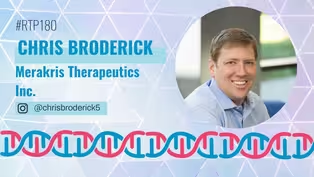
Chris Broderick, Merakris Therapeutics Inc. | Medicine
Video has Closed Captions
Chris Broderick talks about the focus of Merakris Therapeutics on RTP180 Medicine. (12m 58s)
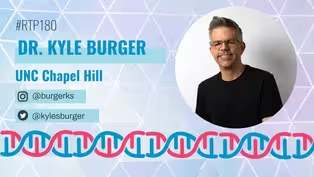
Dr. Kyle Burger, UNC Chapel Hill | Medicine
Video has Closed Captions
Dr. Kyle Burger discusses his research of eating behaviors on RTP180 Medicine. (15m 23s)
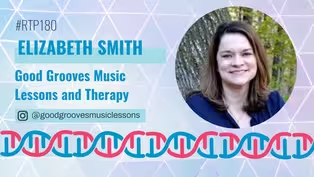
Elizabeth Smith, Good Grooves Music Lessons & Therapy | Med
Video has Closed Captions
Elizabeth Smith talks about benefits of music with patients on RTP180 Medicine. (11m 42s)
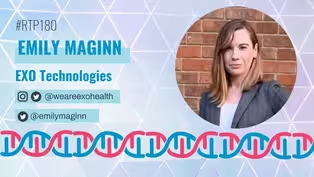
Emily Maginn, EXO Technologies | Medicine
Video has Closed Captions
Emily Maginn talks developing female focused health solutions on RTP180 Medicine. (12m 11s)
Todd Sega, Pharmacy Quality Solutions | Medicine
Video has Closed Captions
Todd Sega discusses Pharmacy Quality Solutions efforts with technology on RTP180 Medicine. (13m 59s)
Providing Support for PBS.org
Learn Moreabout PBS online sponsorship New Episode
- News and Public Affairs

Top journalists deliver compelling original analysis of the hour's headlines.

- News and Public Affairs

FRONTLINE is investigative journalism that questions, explains and changes our world.


 New Episode





 New Episode
 New Episode
Support for PBS provided by:
RTP180 is a local public television program presented by PBS NC