This Is Minnesota Orchestra
Meet YourClassical MPR's Melissa Ousley
Clip: Season 8 Episode 2 | 7m 58sVideo has Closed Captions
Minnesota Orchestra’s Hanna Landrum visits with YourClassical MPR’s host Melissa Ousley.
Second Violin Hanna Landrum visits YourClassical MPR’s Melissa Ousley at Minnesota Public Radio in Saint Paul to learn about Melissa’s role as host of the Minnesota Orchestra’s Friday night live radio broadcasts and the station’s history with classical music.
Problems playing video? | Closed Captioning Feedback
Problems playing video? | Closed Captioning Feedback
This Is Minnesota Orchestra is a local public television program presented by Minnesota PBS
This Is Minnesota Orchestra
Meet YourClassical MPR's Melissa Ousley
Clip: Season 8 Episode 2 | 7m 58sVideo has Closed Captions
Second Violin Hanna Landrum visits YourClassical MPR’s Melissa Ousley at Minnesota Public Radio in Saint Paul to learn about Melissa’s role as host of the Minnesota Orchestra’s Friday night live radio broadcasts and the station’s history with classical music.
Problems playing video? | Closed Captioning Feedback
Where to Watch This Is Minnesota Orchestra
This Is Minnesota Orchestra is available to stream on pbs.org and the PBS app.
Providing Support for PBS.org
Learn Moreabout PBS online sponsorship- Hi, Melissa.
So good to see you.
It's good to see you.
Hanna.
Welcome to MPR.
Yeah, thank you.
Yeah, I'm excited to show you around.
Meet - you.
I'm Hanna Landrum, and I'm visiting Minnesota Public Radio in Saint Paul, talking with Melissa Ousley about broadcasting Minnesota Prchestra's, classical concerts, live on the radio on many Friday - nights.
Now while you're here, I wanna introduce you to Tom Crann.
He was in Classical, and then he was host of All Things Considered for 20 years, and now he's a Classical host again.
Tom Crann.
- Melissa, how?
Hi.
Do you - mind if I interrupt you for a minute?
- Of course, yeah.
- I wanna introduce you to my friend Hanna Landrum.
She's a violinist.
Hi.
Hi, Tom.
Oh, - with Minnesota Orchestra.
Hi, nice to meet you.
Nice to meet you too.
- Yeah.
You know, I should have asked you this before, but do you listen to Minnesota Orchestra concerts many Friday nights?
- What do you think?
Of course I do.
I listen most Friday nights.
I really do.
I've slacked you during concerts.
You have, because you do such a great job bringing us there to the hall.
- Welcome to Orchestra Hall in Minneapolis for a live broadcast with Thomas Søndergård and the Minnesota Orchestra.
We're about to begin with a work for 11 brass instruments by TMru Takemitsu.
The piece is called Night Signal, and the 11 brass players are divided into two groups on either side of the stage toward the back.
Thomas Søndergård is in front and taking his bow just now.
- There are very few stations doing this anymore, and this makes it available statewide to everybody, whether you can be there or not.
That's an amazing thing.
Yeah, it's a great tradition we have.
Yeah, I love it.
I'm a fan.
- Thank you, Tom.
Oh, you're - Welcome.
You're welcome.
- Check's in the mail.
- Okay, good.
I look forward to it.
Nice - To meet you.
Take care.
- Nice to meet you, Hanna.
- Now, this is a really cool space too.
It's the Maud Moon Weyerhauser studio, so I'm really glad we're having our conversation in this room.
There is a lot of history here, - So classical music has always been part of MPR's roots.
- Yeah, absolutely.
1967 is when MPR was founded, and classical music was at the core of what we did from day to day.
And it's easy to forget that because now we have three separate services.
We have one that's all classical.
We have one that is news, MPR News, and we have The Current, which is, you know, pop music.
So it's easy to forget.
But yeah, classical music has been there since day one.
- What's the history of the Minnesota Orchestra broadcast?
How long has that been going on?
Do you know?
- It started in the 1970s.
It is a long history.
- Really.
Wow.
- Yeah, so when I'm not at Orchestra Hall, I'm often in this studio, which is where we broadcast our classical service.
And for that I have complete control over when music stops and starts, because I press the button to get it started.
So I have my playlist in front of me.
I have weather and underwriting information, and everything is is right here.
It's kind of like driving a car.
It's pretty simple once you get the hang of it.
Oh, - Okay.
What's your background?
What brought you to classical music and to MPR?
- Well, how much time do you have?
No, my story is, I had a lot of music when I was a kid and I studied piano, and I grew up north of New York City.
So as a kid, I actually had the chance to go to Manhattan School of Music.
They have a prep department on Saturdays.
So I took piano lessons and studied theory and ear training, and was in a choir for a while.
And then eventually I went to school, to college for music.
But I wasn't really sure what to do because performance was not my thing.
And did we discover, we were both in Rochester, New York at at one point?
Is that where you were?
- Oh, yes.
My job before this, I was the principal second of the, the Rochester Philharmonic in, in upstate New York.
Oh, okay.
For two years.
- Yeah.
'cause I went to Eastman School of Music for undergraduate, so I was in that hall many times.
- Oh yeah.
Kodak theater.
Yep.
- I sort of wanted to be a teacher, but more like a college professor, which requires a lot of education.
So it gets a little complicated.
But I found myself living in Wichita, Kansas with my soon to be husband, and that's where I became aware of the opportunity of working in radio.
And there's a program that they had at the time called Guest Conductor.
And anytime someone knew would come to town, not even necessarily in the music community, they would often interview them on this two hour show.
So my husband was interviewed because he was teaching double bass at the university and playing in the orchestra.
And at the end of the interview off air, they said, oh, is your wife a musician?
Paul was like, yeah, she's available.
So anyway, I was on a few weeks later and one thing led to another and I was like, this is really fun.
I would much rather do this than practice piano.
So that's kind of how it all started.
- Oh, wow.
And when did you come to Minnesota?
- I came to Minnesota in 1989, And when I first came here I was working for WCAL, which is the radio, was the radio service of St.
Olaf of college, a classical music service.
So I kind of cut my teeth as the morning host, the drive time host on WCAL.
I mean, it's just amazing to me because I do love radio.
I mean, yes, I listen to podcasts and all kinds of other stuff, and I curate my own music.
But I do love the intimacy of radio and the fact that you can hear Minnesota Orchestra Friday nights at eight is just incredible to me.
I mean, I think it's really cool.
So I'm proud to be a part of that.
- So what does it mean to host these concerts?
How do you prepare?
What is that process like for you?
- Oh, it's pretty fun - And terrifying - At the same time.
Maybe you feel that about your job in time at times, but I love doing research and preparation, learning more about the music for each program.
I always interview the conductor and I try to interview the guest artists, or sometimes a musician in the orchestra if maybe they're the featured soloists.
So I like digging into that information and trying to be more informed so when I talk to them, we have good conversations.
I wanna talk to you about this program, and especially I'm curious about the Symphonie Fantastique by Berlioz.
- I learned about the symphony when I, when I was a young man, and it's so deep in my DNA, - It's so much different to host a live broadcast than a program where you have recordings, CDs, or digitized music, because I can't really control when it starts.
- Oh, I guess so.
- And I can't really control how long the stage change takes when they bring a piano out, but we have to keep our listeners entertained.
So the preparation, sort of being able to pivot when you have more time or to wrap up a thought if something, you know, if they're ready sooner than you thought they'd be ready to play the next piece.
- Yeah, I never thought about that.
I will from now on, on Friday nights, - And at the beginning of the show, you might not think about this either, but our broadcast starts at eight o'clock, but the concertmaster, usually Erin Keefe doesn't come out on stage till 8:05.
So there's also five minutes that we have to fill.
- Ah.
- Which we try to give listeners an idea of what's coming up, and there might be clips of a piece or - Oh, I see, - Okay.
Or from one of the guest artists.
- Right.
'cause if you actually come to the concert, you have the program with the program notes, and you can read through those things when you're in your seat.
But when you're just listening in, that all has to come from you.
Right.
- So how long do you think it's gonna take between the first two pieces for that stage change?
- I'm guessing since... Melissa, is one of the greatest radio people I've worked with, she's extremely talented, knows a lot about music.
- That was Thomas Søndergård and the Minnesota..., - And then her warm, friendly style of announcing, she brings people in and makes them feel like she's talking to them.
And that's a real art.
- I'm so glad you could join us for the live broadcast with the Minnesota Orchestra on your classical MPR.
We'll be back.
What are you thinking about when you're sitting in that booth listening?
As much as I love being in there, I often wish I could be out in the hall Because when I come to rehearsals and, and listen to rehearsals, it is a very different experience.
But in a long piece like Symphonie fantastique, I can let my mind wander and really let the music kind of take me away.
And I, I really enjoy that.
This Symphonie fantastique by Hector Berlioz played tonight by the Minnesota Orchestra under Thomas Søndergård, a live broadcast from Orchestra Hall in Minneapolis on YourClassical MPR.
I love being at Orchestra Hall and I feel very privileged to be listening to that music and bringing it to a lot of people who get to hear it from week to week.
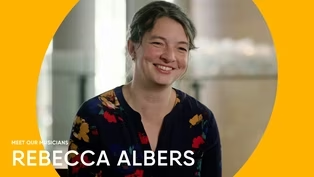
Musician Portrait: Rebecca Albers
Video has Closed Captions
Clip: S8 Ep2 | 10m 29s | Principal Viola Rebecca Albers leads her tight-knit section of the Minnesota Orchestra. (10m 29s)
Providing Support for PBS.org
Learn Moreabout PBS online sponsorship New Episode
- Arts and Music

Innovative musicians from every genre perform live in the longest-running music series.

- Arts and Music
The Best of the Joy of Painting with Bob Ross
A pop icon, Bob Ross offers soothing words of wisdom as he paints captivating landscapes.
 New Season






 New Episode
 New Episode
Support for PBS provided by:
This Is Minnesota Orchestra is a local public television program presented by Minnesota PBS