
Mental Health Awareness Month, Wareologie, AAPI Stories seri
Season 7 Episode 50 | 26m 46sVideo has Closed Captions
Mental Health Awareness Month, Wareologie, AAPI Stories series and “One Detroit Weekend.”
One Detroit discusses the stigma around mental illness and self-care in the African American community for Mental Health Awareness Month. Our Future of Work coverage takes us to Wareologie, a Michigan company that’s making major advances in the medical device industry. Plus, our AAPI Stories series looks at how one student organization on MSU’s campus inspired activism and changed a student’s life
Problems playing video? | Closed Captioning Feedback
Problems playing video? | Closed Captioning Feedback
One Detroit is a local public television program presented by Detroit PBS
Mental Health Awareness Month, Wareologie, AAPI Stories seri
Season 7 Episode 50 | 26m 46sVideo has Closed Captions
One Detroit discusses the stigma around mental illness and self-care in the African American community for Mental Health Awareness Month. Our Future of Work coverage takes us to Wareologie, a Michigan company that’s making major advances in the medical device industry. Plus, our AAPI Stories series looks at how one student organization on MSU’s campus inspired activism and changed a student’s life
Problems playing video? | Closed Captioning Feedback
How to Watch One Detroit
One Detroit is available to stream on pbs.org and the free PBS App, available on iPhone, Apple TV, Android TV, Android smartphones, Amazon Fire TV, Amazon Fire Tablet, Roku, Samsung Smart TV, and Vizio.
Providing Support for PBS.org
Learn Moreabout PBS online sponsorship- [Announcer] Just ahead on "One Detroit," it's Mental Health Awareness Month.
We'll talk about eliminating the stigma around mental illness in the African American community.
Also, coming up, a Future of Work report on a Michigan company that's making major advances in the medical device industry.
Plus, in our AAPI stories series, an MSU grad reminisces with her former student advisor about how a student organization on campus inspired her activism.
And we'll have some ideas on how you can spend this weekend in Metro Detroit.
It's all coming up next on "One Detroit."
- [Announcer] From Delta Faucets to Bear Paint.
Masco Corporation is proud to deliver products that enhance the way consumers all over the world experience and enjoy their living spaces.
Masco, serving Michigan communities since 1929.
- [Announcer] Support for this program is provided by, the Cynthia & Edsel Ford Fund for Journalism at Detroit Public TV.
The Kresge Foundation.
- [Announcer] The DTE Foundation is a proud sponsor of Detroit Public TV.
Among the state's largest foundations, committed to Michigan-focused giving, we support organizations that are doing exceptional work in our state.
Visit dtefoundation.com to learn more.
- [Announcer] Nissan Foundation and viewers like you.
(inspiring music) - Just ahead on this week's "One Detroit."
Our Future Work series looks at a Michigan company that is helping restore independence to people with physical limitations.
Plus a Michigan State University grad explains how joining the school's Asian Pacific American Student Organization changed her life.
And Peter Whorf and Cecelia Sharpe of 90.9 WRCJ share details on some activities and events coming up in Metro Detroit this weekend and beyond.
But first up, May is Mental Health Awareness Month.
It's time to check in on your mental wellbeing.
"One Detroit" contributor and American Black Journal host, Stephen Henderson, spoke with representatives from two nonprofits that provide behavioral health services.
They talked about the stigma surrounding mental illness, especially in communities of color, and the increase in mental health challenges among young people during the COVID pandemic.
(soothing music) - So, I wanna talk specifically about children, our kids, and the ways in which the pandemic made mental health more of an acute issue for them.
In some ways, I think it's kind of an obvious thing to have happened, given the disruption to them.
But again, I'm not sure that the kind of attention that the issue needs is being put on at.
Jamila, tell us about the kind of things that you're seeing with children that is different from the rest of the population.
- I think one of the things that we're seeing here at Judson Center, as we're providing services to our community members, and we also provide services in the schools, is this disruption in regards to development.
So, one of the things we have to remember is that, as some of our younger kids, even kindergarten and younger, were starting their development in school, they were isolated.
And part of child development is peer-to-peer interaction.
And so one, we're seeing, as the kids are returning to school, their sensory issues, they're overly, since there's an overabundance of this interaction of individuals that they weren't accustomed to, which is then causing them to have a reaction and behavior which in some instances may look like negative behavior, but it's really anxiety.
It's really this impact of being thrust into an environment that they did not really have the chance to step into an a traditional way.
So that's at our elementary, younger age, as the kids get older, grief and trauma, there's a delay in that process.
So, you're in shock.
And now those symptoms of grief are presenting themselves where there is a higher rate of suicidal ideation, a higher rate of depression.
I'm getting referrals every day, and the ages are getting younger and younger, for kids who are experiencing those intrusive thoughts and those internal responses to stress.
Now, at a later time, with the loss and grief that they were experiencing, was a year, or a year and a half ago.
- Yeah.
So, I wanna talk about how we know and how individuals know when they should be seeking help when they're having, you know, the kind of problem that, you know, a professional care environment would help with.
But I also want to talk about that in the context of our community, the African American community, where there is still a bit of a stigma, you know, associated with mental health care and the idea of raising your hand and saying you're having a hard time.
What should we be looking for and how do we get people to engage, Jamila?
- I think the first key is that mental health services is not for a specific community or specific diagnosis.
Most individuals have a mental health benefit for their insurance, and that means that it's accessible to all.
So, I think there's a misconception around when to seek services.
Our role is, when people come in, is to determine what level of care they need based on what they've experienced.
So, that's the first step, taking away the stigma of, you have to have a particular type of severity in order to receive mental health services, which could consist of therapy as well as medication, as well as support services, case management services, things like that.
So one, what those services entail, and that is accessible to all.
I think one thing that is a key to look for, specifically in our community, is that if you begin to disengage even more, and you find yourself exhausted more than usual.
If you are having what I stated, those intrusive thoughts, just random thoughts coming through your mind, don't ignore those.
Pay attention to them.
Because over time, thoughts can turn into action.
And then also if you're noticing that your temper is changing.
Part of anxiety is that sort of adverse reaction to things, being angry or aggressive, we assume that we're upset or it's just a bad day.
But you could be overstimulating and your anxiety could be increasing.
- Michael, how do we identify when we need help and how do we get more African Americans to be comfortable with that idea?
- So, African-American.
Well, African Americans, this is an issue that's unique to African Americans.
Let me first state that.
And predominantly in communities of color, whether it's Latino Americans, Arab Americans, Asian Americans, the stigma for people who require mental health treatment and people seeking mental health treatment is extremely high.
The fear that they're gonna be labeled crazy by their friends and loved ones, is still out there.
One of the encouraging signs that we've seen is that the younger generation, particularly people who are under the age of 21, have been far more, and college-age individuals as well, have been far more receptive to being open about their mental health struggles, engaging in treatment, and seeking out that help.
So, generationally, it is changing, but anecdotally, our aunts and uncles, and grandmothers, and grandfathers, they're still on that same page of, you know, "Just deal with it, walk it off, it's gonna be okay.
We don't talk to people about our problems."
That's not the path forward that we need to do.
Encouraging signs have been that the primary care community has started engaging in things that can help get more people into treatment.
If you've been to a physician in the past few years, oftentimes they'll ask, "How are things going at home?
Have you had any thoughts or any struggles with regard to stress?"
Or "Have you had any thoughts of harming yourselves or others?"
Your primary care doctors are now asking those questions.
I think we could all benefit from what I call a mental health checkup every year.
Just like you go to your primary care doctor to make sure that your blood sugar levels are okay, your cholesterol is okay.
Talk to a therapist or a psychiatrist once a year.
You may not be having any issues that you may be aware of but just sit down, talk to 'em.
If they say, "Okay, everything seems to be fine with you."
"Great, see you next year."
But if they detect something that may require a follow-up visit, then handle that at the appropriate time.
- [Announcer] We're continuing our "Future of Work" series with a report on a company that is creating innovative solutions in the healthcare and medical device spaces.
Wareologie manufactures products that help restore independence to people with physical disabilities.
I spoke with the company CEO and founder, Gina Adams, about the inspiration behind her products and the process of getting them to market.
(upbeat music) (wind whooshes) After my "Future of Work" conversation with Dan Radomski, the founder of Michigan's only manufacturer product incubator, Centrepolis Accelerator, I wanted to talk to a company they had worked with in healthcare, because this is a sector that will need to grow its workforce and innovate to meet the needs of a large and aging Michigan population.
So, Dan suggested I talk to Gina Adams, CEO of Wareologie, who's an innovator in the healthcare space who first found success with Buttons2Button magnetic adapter set, a no-sow solution for converting shirt buttons into magnetic closures.
- What was the initial inspiration behind Buttons2Button?
Where did this idea come from?
- Thank you for asking.
Yeah, my stepfather was struggling with Parkinson's, and there's a ripple effect on caregivers, such as my mom.
And so it's not only that physical impact but the emotional toll it takes when you have somebody as, you know, my stepfather was a PhD engineer, and so to lose any sense of independence, he was, you know, the rock of the family.
And so to take one activity that he could regain and do independently, that really impacts a person's emotional wellbeing.
And so that's really the impetus behind it.
- [Will] With the success of Buttons2Button, Gina has introduced another product, portable parallel bars for physical therapy.
A mobile therapy solution on wheels that delivers physical therapy treatment safely.
But getting it into the hands of the people who need it the most poses challenges that, if addressed, could give other Michigan healthcare product companies an edge in the global healthcare market.
- Do you think that there's something that could be done there to make the on-ramp to getting a product manufactured for a small company easier?
- You know, we're in what they call the valley, right?
You have the idea, you have to put a lot of money into that to get it through the development phase, the prototype phase.
And then when you move into commercialization, everything takes on a whole new, I would say cost.
- [Will] Right, yeah.
- So, you know, what the state could provide for us, I believe, is a little more access to that runway of how do you get your product commercialized and into the market.
You can't do it alone.
The windows are pretty tight because of the networks.
I've been to the doctor over eight times, getting all of my vaccines like hepatitis, and typhoid, and all these things so that I could actually walk into a hospital and service the hospital as a vendor, right?
So, there's a lot of these hoops that I feel, while they are there and the protocols are important because you need safety in place, but for medical devices where we're really trying to revolutionize people's health.
It would be great if there was an incubator that kind of supported that space.
- Something to help navigate the process overall.
- Yeah, yeah.
I mean, I was at a conference, and we're there with large global medical wholesale suppliers, and you know, getting a foot in the door is not always easy.
- As you're going through this journey, as you're developing these products, as you're building this company, you've stayed here in Michigan?
- Well, we're based here in southeast Michigan and have incredible access to world-class manufacturing.
And there's no better place to develop a product, in my opinion.
The opportunity to create jobs here in our home state is really important to us.
And because we are committed to helping people with disabilities, we are excited to also partner with, not only our manufacturers, but down to the people that kit our products.
So, the first product, Buttons2Button, actually kitted by people with disabilities as a form of job creation.
It's great to have the opportunity to collaborate directly with your manufacturers so that we are building together.
There's a lot of lessons learned along the way, and to take a product from a prototype that's 3D printed, into a commercialized product, is a huge leap.
And so, working here with incredible manufacturers has really helped expedite the process versus, I can't imagine the cost of going overseas.
Whether they're in a bed, or they're in a wheelchair, and standing up, now you have something that is structurally- - In the next five years, what do you hope for the future of work at your company?
- You know, the next five years are going to be so exciting because we know that we have sales verticals within the VA. We have hospitals that have given us the thumbs up, they have use for it.
It's a matter of going through those protocols.
So, if we can help people get standing sooner and safer, we're gonna be in a great spot.
- [Announcer] And for more of our "Future of Work" reports, head to onedetroitpbs.org.
Let's turn now to Asian American and Pacific Islander Heritage Month.
One Detroit's AAPI story series continues with the story of Brenda Hu, a 2015 graduate of Michigan State University.
Recently she reunited on campus with her former student advisor, Meaghan Kozar, to talk about how they met and how membership in the Asian Pacific American Student Organization opened Brenda's eyes to her identity and inspired her activism.
(calm music) - Hello!
(both laugh) How are you?
- Good, it's so good to see you.
Ooh, and it smells so great in here.
Oh, good.
- Well, I don't remember when I first met you, Meaghan, but I do remember when I first saw you, and I think I was a senior in high school at Okemos High School.
And because Okemos High School was in the East Lansing area.
I always went to Michigan State to kinda, you know, check out what was going on.
And I had some friends that said, "Hey, Brenda, check out the Asian Pacific American Student Organization.
We have this general body meeting where people come gather.
It's very social, there's often food, drinks."
And I said, "You know, you had me at food, but I'll show up."
(laughs) And I remember it was in this room actually, that I saw you.
- So, I met you at APASO's pageant, which is the Asian Pacific American Student Organization.
I was the advisor.
And that event was an opportunity for students within APASO and their affiliate organizations to just celebrate Asian American identity through awareness, through talent.
And I saw you- - I think I was representing the Chinese Student Coalition.
- Oh, really?
- Yeah, I'm part Chinese, part Vietnamese.
- I didn't know that.
Oh my God.
- Look, I was like, "However I can get into this pageant.
However they'll take me, sign me up."
(laughs) - So, and you ended up winning?
- Yes.
- Which is exciting.
- Honestly remarkable.
I don't know how I did it.
I think I always thought that I had to be Asian or that I had to be American.
I don't think I ever realized that I could be both.
And for the first time in my life, when I went to Michigan State University and saw you and people from this Asian Pacific American community, I thought, "Oh my gosh, I'm not alone, and we can be cool.
We can be kings and queens in this pageant, and rock on."
Like, "I wanna be a part of that."
- So, what drew you to APASO and what made you, more importantly, stay with APARO Because you were an E-board member for several years.
- I think freshman year I was an affiliate, so just a member attending Asian Pacific American Student Organization events.
And I thought, "Wow, this is really cool."
Like, "I want to build a home here."
And a lot of the people that I've met, like, I want to be in touch with them, I wanna be around them.
"This is great."
I think that was also around the time when I was really establishing who I was as a person, my identity as an Asian-American, as a college student, as the daughter of, you know, my parents, and as a college, all the things.
And I thought, "How can I get more involved in an advocacy way, but also in a programming way too?
Because if I don't serve on the board, you know, how are we gonna make change?
How am I gonna make change?"
So I started as secretary my sophomore year, and that was really fun.
And I thought, "Wow, this is truly a way to make change."
- But I remember what was so unique about you.
You were doing things to advocate for women.
- [Brenda] Yes.
- And what made you lead to do programming around sexual assault awareness?
- Yeah.
- I think that that is something that I won't forget.
And then you also part of the Women's Advisory Board.
- Yes.
- Yes.
- It was the first year that MSU was requiring incoming freshmen to take the sexual assault relationship violence prevention class.
And they were looking for peer educators, is what they called them.
I grew up, you know, with sexual abuse, and I knew a lot of people who had been sexually abused.
And I think it's a very taboo topic to talk about, not only in general, but in the Asian American community.
And I'm passionate about this.
Like, I have this opportunity to connect with other students who, you know, might be going through the same things as me, and now I get to help them know that they're not alone.
And I thought that that was so important, and I really wanted to de-stigmatize that in the Asian American community here, because it's a tough topic to talk about, period.
So, woman empowerment was super important to me.
My mom is a strong, beautiful, independent woman.
She inspires me every day.
That's why I wanted to, you know, share my story and also advocate and get into activism, not only for communities of color, but also for survivors.
- Yeah.
Well, I loved how your programming supported the Asian American community, but it was also topics that were very universal.
It was really important and very eye-opening when you did that.
- [Announcer] And you can see more of Brenda and Meaghan's story, along with our other AAPI stories, at onedetroitpbs.org Now here's Cecelia Sharpe and Peter Whorf of 90.9 WRCJ, with a rundown on some upcoming events in today's "One Detroit Weekend."
- Peter, I am brimming with excitement because there is so much to do this weekend.
What do you have your eye on?
- I'm looking at the Spring Awakening Concert from the Livonia Symphony Orchestra.
Saturday May 13th, beginning at 4:00 p.m.
Enjoy the sounds of the LSO, the Livonia Symphony in concert, featuring excerpts from Stravinsky's "Firebird Suite," Rossini's "Cinderella Overture," and Alexander Glazunov's "Concerto for Alto Saxophone."
With special guest, saxophonist Dr. Riccardo Silva.
This program makes for a fine afternoon.
It's happening at the Louis Schmidt Auditorium, inside of Clarenceville High School.
- If you are a fan of the "Madagascar" movie, well, you'll definitely wanna move it, move it to the Fox Theater to see "Madagascar Live."
See all of your favorite characters in an action-packed adventure.
It's a production the whole family will love.
So, Peter, I really loved King Julien from the "Madagascar" movie.
Who is your favorite character?
- Oh, it's gotta be those crazy penguins.
- (laughs) They were always trying to make an escape.
- Yeah, they were awesome.
- Planning all those plans.
- On Sunday night, starting at seven, the Scarab Club is wrapping up their concert with Barber and Bates, "Chamber Music at the Scarab Club."
Baritone John Doherty will perform Samuel Barber's stunningly beautiful "Dover Beach" and "Il Tramonto" by Respighi.
And you'll be treated to an innovative work by composer Mason Bates, "Life of Birds" for violin, flute, clarinet, and cello.
- I got a little historical fact for you, Peter.
Did you know that the Scarab Club was built in 1928, designed by one of the club members, and it definitely, you know, to me, has a really charming yet mysterious quality about it.
So, Peter, what else can people check out this weekend?
- Well, people can check out the Blue Llama Jazz Club in Ann Arbor on May 13th.
Their multifaceted Detroit native instrumentalist, vocalist, and composer, King Alexander, blends jazz, gospel, R&B, and hip hop elements into his own unique style.
- Peter, you always have a little nugget tucked under your cap.
So, you know the saying, April showers- - Bring May flowers.
- That's exactly right.
And in the case of this next event, April showers bring May floral cocktails.
Stop by the Grosse Point War Memorial on Thursday, May 18th, at 7:00 p.m. to learn about floral liquor, and channel your inner mixologist.
The class includes a combination of history and stories, technique, instruction, and hands-on making of cocktails, plus sampling, of course.
Peter, we should definitely sign up for that class, and maybe we can host our own event, with mocktails, of course, "Sips and Sounds" with C. Sharpe and Peter Whorf.
- There's always so much to do around the city.
- Here's more of what's happening ahead.
(upbeat music) - That will do it for this week's "One Detroit."
Thanks for watching.
Head to the "One Detroit" website for all the stories we're working on.
Follow us on social media and sign up for our weekly newsletter.
- [Announcer] From Delta Faucets to Bear Paint.
Masco Corporation is proud to deliver products that enhance the way consumers all over the world experience and enjoy their living spaces.
Masco, serving Michigan communities since 1929.
- [Announcer] Support for this program is provided by the Cynthia & Edsel Ford Fund for Journalism and Detroit Public TV.
The Kresge Foundation.
- [Announcer] The DTE Foundation is a proud sponsor of Detroit Public TV.
Among the state's largest foundations, committed to Michigan-focused giving, we support organizations that are doing exceptional work in our state.
Visit dtefoundation.com to learn more.
- [Announcer] Nissan Foundation, and viewers like you.
(soothing music) (piano keys ring melodically)
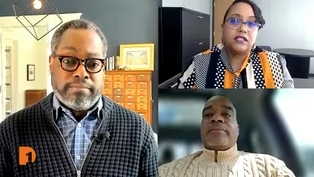
Mental Health Awareness Month in the Black community
Video has Closed Captions
Clip: S7 Ep50 | 7m 29s | Communities of color address stigmas and self-care for Mental Health Awareness Month. (7m 29s)

One Detroit Weekend: May 12, 2023
Video has Closed Captions
Clip: S7 Ep50 | 3m 12s | Cecelia Sharpe and Peter Whorf share what’s coming up this weekend in metro Detroit. (3m 12s)
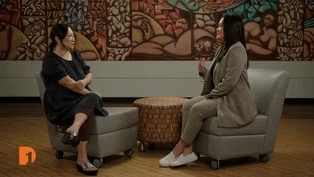
Two women bond through AAPI advocacy, APA Studies Class
Video has Closed Captions
Clip: S7 Ep50 | 5m 47s | Two women create lasting bond through AAPI Advocacy, APA Studies Class at MSU. (5m 47s)
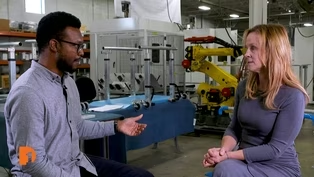
Wareologie makes major waves in mobile, at-home caregiving
Video has Closed Captions
Clip: S7 Ep50 | 5m 36s | Medical device company Wareologie makes major advancements in mobile, at-home caregiving. (5m 36s)
Providing Support for PBS.org
Learn Moreabout PBS online sponsorship
- News and Public Affairs

Top journalists deliver compelling original analysis of the hour's headlines.

- News and Public Affairs

FRONTLINE is investigative journalism that questions, explains and changes our world.












Support for PBS provided by:
One Detroit is a local public television program presented by Detroit PBS