
Mental Health Awareness Month/Senator Carl Levin
Season 49 Episode 20 | 26m 46sVideo has Closed Captions
Mental Health Awareness Month/Senator Carl Levin | Episode 4920
A conversation about mental illness and eliminating the stigma associated with it, especially in the African American community. Plus, retired U.S. Senator Carl Levin is here to talk about his new memoir and some of the highlights of his long political career. Episode 4920
Problems playing video? | Closed Captioning Feedback
Problems playing video? | Closed Captioning Feedback
American Black Journal is a local public television program presented by Detroit PBS
Mental Health Awareness Month/Senator Carl Levin
Season 49 Episode 20 | 26m 46sVideo has Closed Captions
A conversation about mental illness and eliminating the stigma associated with it, especially in the African American community. Plus, retired U.S. Senator Carl Levin is here to talk about his new memoir and some of the highlights of his long political career. Episode 4920
Problems playing video? | Closed Captioning Feedback
How to Watch American Black Journal
American Black Journal is available to stream on pbs.org and the free PBS App, available on iPhone, Apple TV, Android TV, Android smartphones, Amazon Fire TV, Amazon Fire Tablet, Roku, Samsung Smart TV, and Vizio.
Providing Support for PBS.org
Learn Moreabout PBS online sponsorshipComing up on "American Black Journal," we've got a great show for you this week.
We're talking about mental illness and eliminating the stigma associated with it, especially in the African-American community.
Plus retired us Senator Carl Levin is here to talk about his new memoir and some highlights of his long political career.
Stay where you are.
"American Black Journal" starts right now Announcer 1: From Delta faucets to Behr paint, Masco Corporation is proud to deliver products that enhance the way consumers all over the world experience and enjoy their living spaces.
Masco, serving Michigan communities since 1929.
Announcer 2: Support also provided by the Cynthia & and Edsel Ford Fund for Journalism at Detroit Public TV.
Announcer 1: The DTE Foundation proudly supports 50 years of "American Black Journal" in covering African-American history, culture and politics.
The DTE Foundation and "American Black Journal," partners in presenting African-American perspectives about our communities and in our world.
Announcer 2: Also brought to you by AAA, Nissan Foundation, Ally, Impact at Home, UAW Solidarity Forever, and viewers like you.
Thank you.
♪♪ Welcome to "American Black Journal."
I'm Stephen Henderson, your host, and as always, I'm glad you've joined us.
It's estimated that more than 51 million adults in the United States are living with some form of mental illness.
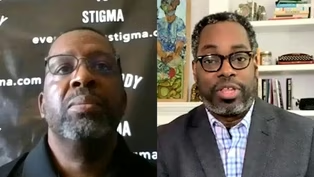
May is Mental Health Awareness Month, and my first guest, Kevin Fischer, leads the Michigan Chapter of the National Alliance on Mental Illness.
He also has a personal motivation to eliminate the stigma associated with behavioral health disorders.
His son struggled with mental illness and committed suicide at the age of 23.
Here's my conversation with Kevin Fischer.
Kevin Fischer, welcome to "American Black Journal."
Thank you for having me.
Yeah.
So let's start with National Mental Health Awareness Month, May, why is this an important issue to focus on this month?
First of all, because we, as Americans, need to understand that our mental health is as important as our physical health.
Unfortunately, mental illness has a stigma associated with it.
And unfortunately, most people think of it as more a personal weakness than a medical diagnosis, and mental illness actually is a medical diagnosis, not a weakness of character.
Yeah.
The work that you're doing in this area is focused on the African-American community, as well, where this issue takes on a really different kind of dimension.
Talk about why it's a different issue for us.
Well, we understand that stigma affects everyone, but it is unique to culture and community.
And unfortunately, in the African-American community, for a number of reasons, there are what we refer to as racial disparities.
There's trust issues with the medical community.
There is sometimes the inability to receive services from people who look like us, who properly diagnose us.
So in the African-American community, there are a number of issues that we need to address.
And we, unfortunately, receive behavioral health care services at about half the rate that people, quite frankly, white Americans receive it at.
So we need to take our mental health as seriously as our physical health.
Yeah.
How much of that is cultural hesitation, the idea that, hey, if I raise my hand and say, "I'm having a hard time with this, "and I probably need some help," that I'll be made fun of or that I'll be seen as weak, versus the kind of structural inequities that are about access?
Frankly, I'm gonna hedge my bet a little bit here and say 60/40, and I say that because I believe that we in the African-American community have to take some responsibility for, in fact, raising our hand and saying, "Yes, I need behavioral health care help."
It is one thing to say that our specific needs may not be being met, the cultural competency may not be there.
Again, there's not enough behavioral health care professionals available nationally, and then certainly, not enough behavioral health care professionals of color out there, but we can't let that stop us.
We can't say that, if I can't find an African-American provider, I simply won't seek services.
And then, the other part of it is we need to encourage young African-Americans to pursue a career in behavioral health care, because quite frankly, we're giving back to our community and you know, it's not a bad way to make a living.
Hmm.
Yeah.
I would also imagine that this has taken on a really different look during the pandemic, which, of course, affected the African-American community more than other communities because of the inequities that exist.
But also because it is itself an enormous stressor and a driver, I think, of the need for mental health care.
Absolutely, and amidst the COVID pandemic, we also finally recognized, as a nation, that racism is a public health crisis too.
So African-Americans are facing a pandemic on two fronts.
And so yes, it has exacerbated the situation for us.
It has made it incredibly more necessary for us to get the help that we need, and we should do that, we should absolutely do that, because we're only hurting ourselves by not.
Yeah.
So talk about some of the things that will happen during National Mental Health Awareness Month.
Well, first of all, it's literally a call to action for all of us, again, to take our behavioral health as seriously as our physical health, not just mental health diagnosis, not just the issues that rise to the level of needing professional help, but we also need to think about the fact that we, the level of substance use has risen during this period of time.
And so there are a number of things that we need to do to take care of ourselves.
NAMI has been at the forefront for over 40 years of raising awareness and educating people about not only what is mental illness, what's the difference between mental health and mental illness, but what resources are available to us?
And if there's one single thing that I would ask of us to do it is let's set aside this stigma associated with getting behavioral health care help.
If you need it, get it, and secondly, educating our communities, specifically communities of color about what resources are available, because we always hear about the lack of resources, but the fact of the matter is, there are resources available in our communities that we need to take advantage of.
I also wanna give you a chance to talk about your personal connection to this issue, which is, you know, a difficult and tragic story, but often, that's the inspiration for the kind of work that you're doing, the kind of activism that you're bringing to this issue.
Tell us about your son.
So it is.
You know, like many people, unfortunately, I got involved in the mental health movement as a result of my son, Dominique.
At age 20 in 2007, Dominique was diagnosed with very serious mental illness, bipolar schizophrenia.
And we quickly learned how little we knew about mental illness, mental health care, recovery plans, all of those things.
Unfortunately, as we tried to navigate that system of care, on June 27th of 2010, we lost Dominique to suicide.
And for me, of course, any parent would be devastated by losing a child that is not the national, I'm sorry, it's not the natural order of things.
And I really struggled with the grief myself.
And so, my wife actually found NAMI for me as a way to help myself by helping others.
And so I started with NAMI as a volunteer in 2011, 2014.
I assumed the responsibility as the State Executive Director.
Along the way, we established the Dominique Fischer Memorial Foundation, and most recently, within the last two months, we established the Everybody Vs.
Stigma Campaign, simply as a way for people to understand you are not alone.
We are all in this together, and we want people to understand that you see someone wearing an Everybody Vs.
Stigma shirt, you know you're not alone, and that's a person that you can talk to, maybe, and they can help you receive the resources and help that you need.
Yeah, yeah.
The Everybody Vs.
Stigma Campaign, which is depicted behind you there on the banner, and it's a takeoff on the Detroit Vs. Everybody logo, which I think most people here are familiar with.
When you think about what happened to your son and what's happening now, do you feel like there's been progress?
Do you feel like somebody in the same situation might be better situated to get help?
I like to think so, yes.
And what's really good about what I've seen happen over the last 10 years is that we're moving the needle, not as fast as I like on reducing stigma, but there are a lot of legislative efforts to make resources more readily available.
For example, Senator Stabenow has done a phenomenal job with the certified community behavioral health clinics, where anyone, and there are 14 of 24 in the state of Michigan are located in Southeast Michigan, but anyone can present themselves to any one of those 14 providers and receive behavioral health care help regardless of the severity of their diagnosis, regardless of their insurance status and regardless of their ability to pay.
So we're moving the needle in that direction, and slowly, people are becoming more comfortable talking about their mental health and accessing resources and help.
Yeah, and I mean, of course, we're still reeling, really, from the dismantling of the state's mental health system by Governor John Engler and that's now almost 30 years ago, but we still see the effects of that, don't we?
Oh, absolutely.
What happened 30 years ago was devastating to the state of Michigan.
We do not have enough resources, and I wanna be clear about that.
While we have some, we do not have enough.
We have a responsibility to deliver on the promise that John F. Kennedy envisioned in '63.
The last piece of major legislation he signed was the Community Mental Health Act of 1963, which was actually utilized to, for lack of a better term, justify the closing of those hospitals in the '90s.
So his intent was good.
The execution was poor, but we have an opportunity to right that, and that is absolutely my goal and my mission.
Okay, Kevin Fischer, it was really great to have you here, and we look forward to more events during National Mental Health Awareness Month.
Thanks for being with us.
Thank you for having me Retired U.S.
Senator Carl Levin holds the distinction of being Michigan's longest serving senator.
He spent 36 years on Capitol Hill and a total of 44 years in public office.
The Detroit native has published his memoir which is titled, "Getting to the Heart of the Matter."
It chronicles Levin's early days as a lawyer, his eight years on the Detroit City Council, and his distinguished career in the U.S. Senate.
He sat down with me to share some of the highlights of his life as an elected official.
So I wanna start with, of course, talking about this wonderful memoir you've written, but I wanna start sort of specifically with the idea of your career and the long career you had in, especially in the U.S. Senate.
For so many of us in Michigan, you are synonymous with the word senator.
You're the first person I ever remember associating with that word.
And that says a lot, I think, about how long you did the job and how much of an impression you made in that job.
So I wanna go back, though, to your decision to do that job.
I mean, you were the President of the Detroit City Council and then you decided you wanted to be a U.S.
Senator.
What was it about the Senate that attracted you to run that year?
Oh, well, a number of things, actually.
First of all, I had to get the permission, support of family, that's always important.
But secondly, it was my experience in Detroit, actually, which led to a decision (clears throat) that I should try to bring a point of view that I to Washington.
And that point of view was that the government has got, elected officials have got to be responsive to the public, to their people.
They don't always agree with the majority of their people.
You know, a good elected official (clears throat) sometimes is gonna do some things which is unpopular, as a matter of fact, but in his or her judgment, it's for the common good and it's necessary, and it's his obligation or her obligation, I believe, to do what he or she believes in conscience is best for his city or for his state or his country.
And so, what I found when I was in local government in Detroit is that too often, the federal bureaucracy would just, we'd be told by elected officials, well, we can't do much for you.
You got 10,000 vacant HUD houses, sitting there vacant in your neighborhood, maintained by HUD with, as eyesores.
They're not be being boarded up, they're not being taken care of.
There they sit, helping to destroy my town's neighborhoods.
And when I went to my elected officials, too often, I was told, well, the problem isn't with us.
It's with the bureaucracy.
They're handling this.
This is a federal agency decision.
And so, I actually went to Washington, believing that Congress should have the obligation of overriding regulations by federal agencies.
It was actually a part of my platform.
It was called Legislative Veto, kind of an obscure thought, in a way, but I believed in it because of a very disastrous experience with HUD in Detroit.
And so, that kind of was one of the driving forces.
And it was also, of course, a lot of other things I wanted to try to do for my state, a lot of beliefs that I have in people being heard, listened to, respected, and considered fully when it comes to a decision-making.
Hmm.
And so, you get to Washington and as I say, you have an incredible and very long career there that takes you, it seems like, to lots of different ideas and places, but talk about those early years in Washington.
What frames your work and kinda what frames your thinking about the role once you have it?
Well, I focused on two things right away.
One was the oversight responsibility, which I've just tried to describe, that I believe Congress has the responsibility and it's one of its major responsibilities, to oversee the operations of the federal bureaucracy, and to correct things that are happening in society which shouldn't happen.
In other words, we decided to be part of an investigative effort of the government, to investigate both bureaucracy shortfalls, and also the shortfalls in the private sector.
And so, I was appointed head of a subcommittee right away that was doing an investigation and oversight.
And later on, would spend about 10 years as chairman of the the major permanent subcommittee on investigations.
The other thing I wanted to do was to focus on an area that I knew very little about, and that's the military.
That's the security of our country and how the military operated and to learn more about something I had not experienced personally, 'cause I had never served.
And I wanted to fill in that major gap, and to really understand the importance of the military, where it may be wasteful, for instance, that also occurred in the military.
But also to, I also gained a huge respect for our military leadership and the people who serve us.
Frankly, I gained a lot more respect for some of our military leaders who were under the control of civilians than I did for some of their civilian leaders, to be blunt about it.
You know, some of the presidents I did not think were great leaders at all, including the second George Bush.
He's a nice guy, but not a great leader in a lot of ways.
And anyway, I came to have great respect for the leadership, the training, the insights, the thoughtfulness, the respect that our leaders have for the men and women they lead and their families, which is also very important.
But also to help the public understand that we've got to work together as a people.
And the military leadership understands the importance of their units, of their combat unit, that they're brothers and sisters together.
And so they operate, the idea that a military leader would denigrate, would be a racist or a bigot, or have a problem with females or with ethnic origins, the idea that that could take place in the military is anathema to the idea that you're there together.
And you developed an incredible expertise on the military while you're in the Senate.
You also developed some real expertise on foreign relations and do a lot of important work in that realm.
Tell us how that developed.
What interested you in that realm?
Well, it's when you decide whether or not to send people to war or authorize it, you're making the most important decision that you can make.
There is no more significant decision than putting our men and women at risk, and doing what we have to call upon their families to do.
And so when you finally gain that understanding, you have to take it seriously.
We did a lot of traveling all over the world.
We met with a lot of leaders.
As a matter of fact, Joe Biden gave us one of our early lessons in the importance of meeting with foreign leaders and having coalitions with allies.
You know, the idea that we would have a president like this last president of ours, who hopefully, is the last president like him, Trump divided people.
He divided us from our allies, and my gosh, if we're gonna be in a more secure world, you've got to work with allies and people who have similar points of view, who believe in democratic government, hopefully.
And there's threats to that which have taken place.
Did you ever imagine that we would see, in our time, something like we saw on January 6th, where the building where you worked for decades in Washington was literally under attack from Americans who wanted to disrupt the process of certifying our every four year presidential election?
I mean, it's still, just describing it is kinda surreal to me, but I wonder, as somebody who spent so much time in that building, how that visited with you?
Well, I was obviously disgusted, distraught, but not totally surprised.
You know, there's some really crazy people out here who are racist, who will destroy things they don't like.
Thankfully, it's not a big number, but they're there, and we have to protect ourselves against them, in many ways, by looking at our own shortfalls and seeing where each of us can be more open to friendships and other people, where we can cross lines, which maybe haven't been crossed before, to make us a stronger community.
We can always do that, but I was not, I wasn't surprised totally that those kind of people exist.
And I also was not surprised when they lost, 'cause there's some real strengths that this country has that we've proven over the years.
And we've got to stand for those strengths in the world.
And one of the things that this new president is so strong at is working with other countries to rebuild the values that internationally, we've gotta stand for if the world itself is gonna be safer.
Now, of course, Senator Levin had a lot more to say about his long career and his new memoir.
You can check out the entire interview at americanblackjournal.org.
That's gonna do it for us this week.
Thanks for watching.
You can always catch up with us on Facebook and Twitter, and we'll see you next time.
♪♪ Announcer 1: From Delta faucets to Behr paint, Masco Corporation is proud to deliver products that enhance the way consumers all over the world experience and enjoy their living spaces.
Masco, serving Michigan communities since 1929.
Announcer 2: Support also provided by the Cynthia & Edsel Ford Fund for Journalism at Detroit Public TV.
Announcer 1: The DTE Foundation proudly supports 50 years of "American Black Journal" in covering African-American history, culture and politics.
The DTE foundation and "American Black Journal," partners in presenting African-American perspectives about our communities and in our world.
Announcer 2: Also brought to you by AAA, Nissan Foundation, Ally, Impact at Home, UAW Solidarity Forever, and viewers like you.
Thank you.
♪♪
Video has Closed Captions
Clip: S49 Ep20 | 10m 25s | Mental Health Awareness Month | Episode 4920/Segment 1 (10m 25s)
Video has Closed Captions
Clip: S49 Ep20 | 12m 8s | Senator Carl Levin | Episode 4920/Segment 2 (12m 8s)
Clip: S49 Ep20 | 21m 17s | Senator Carl Levin (Extended Version) (21m 17s)
Providing Support for PBS.org
Learn Moreabout PBS online sponsorship
- News and Public Affairs

Top journalists deliver compelling original analysis of the hour's headlines.

- News and Public Affairs

FRONTLINE is investigative journalism that questions, explains and changes our world.












Support for PBS provided by:
American Black Journal is a local public television program presented by Detroit PBS