Jay's Chicago
Mentors Changing Lives
Season 2022 Episode 4 | 24m 7sVideo has Closed Captions
Jay meets some of the city’s great mentors.
Jay is on the hunt for great mentors. A Chicago singer was once bullied for losing her hair; now she inspires girls with the same condition. The Black Fire Brigade helps young paramedics, EMTs, and firefighters. A Chicago dance legend teaches teens - how did his inspiration come from a TV clown? And a wrestling coach says his life was saved by his own high school coach; now he pays it forward.
Problems playing video? | Closed Captioning Feedback
Problems playing video? | Closed Captioning Feedback
Jay's Chicago is a local public television program presented by WTTW
Jay's Chicago
Mentors Changing Lives
Season 2022 Episode 4 | 24m 7sVideo has Closed Captions
Jay is on the hunt for great mentors. A Chicago singer was once bullied for losing her hair; now she inspires girls with the same condition. The Black Fire Brigade helps young paramedics, EMTs, and firefighters. A Chicago dance legend teaches teens - how did his inspiration come from a TV clown? And a wrestling coach says his life was saved by his own high school coach; now he pays it forward.
Problems playing video? | Closed Captioning Feedback
How to Watch Jay's Chicago
Jay's Chicago is available to stream on pbs.org and the free PBS App, available on iPhone, Apple TV, Android TV, Android smartphones, Amazon Fire TV, Amazon Fire Tablet, Roku, Samsung Smart TV, and Vizio.
Providing Support for PBS.org
Learn Moreabout PBS online sponsorship(upbeat music) - When I was in my 20s and just getting started in TV, I had the good fortune to be assigned to assist a fine documentary maker.
What an opportunity to watch him in action and pick his brain, and then to get his advice when I started doing my own work.
We all need mentors.
And in the next half hour, four stories of the remarkable power that a mentor can have.
A Chicago man's life was changed by his high school wrestling coach.
Now he pays it forward and has built a Chicago wrestling powerhouse.
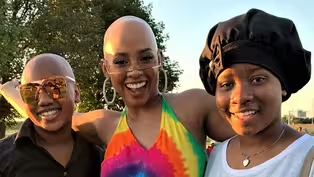
A local singer goes from bullied to bald and proud.
Now she inspires young people with the same condition.
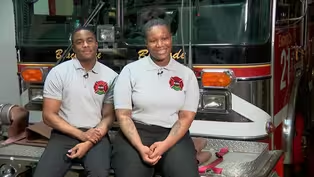
The Black Fire Brigade, mentoring and training EMTs, paramedics, and firefighters.
And this renowned Chicago dancer is now bringing up young dancers.
He found his first inspiration on an unlikely TV show.
Stick around.
That's right now on Jay's Chicago.
(happy whistling music) Hi, I'm Jay Shefsky.
A high school coach can have a huge impact on any child's life, but for some young athletes, a coach can be a real lifesaver.
That was true for Ron Wilson when he was a kid.
Now he's changing lives himself while building one of the top wrestling squads in the city.
- Okay.
Ready.
- [Jay] Wrestling is a winter sport.
So when Bowen High School coach, Ron Wilson wants his team to sprint, he takes them up to the long second floor hallway.
- There you go.
Nice, nice, nice, nice.
- [Jay] Ron Wilson came to Bowen in 2000 as a special ed teacher.
There hadn't been a wrestling program here for four years.
He started one by recruiting five kids.
- And I told those five kids.
I want you to go and bring a friend next day.
And they brought a friend next day, I had 10 and we built from there.
Push his head down.
There you go.
Now throw the half in there.
See that - - [Jay] They built fast.
It took just three years for Bowen to win the city championship.
That year, they went on to be the first Chicago public school to win a state regional title.
Since then, Bowen has been one of the winningest teams in Chicago, two more city championships, seven regional wins, (coach's whistle) and many victories for individual wrestlers.
There have been 35 city champions, 48 regional champions, and on, and on.
- Wrestling at Bowen is kind of like a phenomenon.
- Bowen Principal, Priscilla Horton arrived just a few years ago.
- [Ron] Yeah.
Yeah (wrestler shouting) - [Jay] and was soon confronted by Bowen wrestler pride.
- [Priscilla] They came to see me in like a group it's like four or five of them.
And they said, Ms. Horton, you know, you've been here for, you know, a couple of weeks now.
And you know, you haven't been to a wrestling meet yet.
- [Jay] Bowen High School is on the Southeast Side of Chicago.
An area once dominated by US Steel and other heavy industry.
The team is called The Boilermakers.
In any school in any city, a coach's influence goes beyond teaching the sport.
That's especially true and important in a school like Bowen.
- We have a memorial wall downstairs in the hallway, and I've been coaching here since 2000 and probably from 2000 to present, I probably lost about 15 wrestlers.
And so you just try to keep them on the right path and keeping them into sports, keeps them on track.
- Okay.
(coach whistles) - [Jay] Part of that is just giving kids a positive activity, but at Bowen, it also seems to be the atmosphere that this coach creates.
- That team is truly a family.
They stick up for one another, they hold each other accountable.
Like you see them saying, you can do this man.
I know you can do this.
And I'm just glad to be an adopted member of the family.
- If I said it's easy, I'll be lying to you.
- [Coach Ron] Grab the leg.
Grab the leg.
- [Jay] Kenny Welcome is a junior.
He says wrestling has made him physically and mentally stronger.
- I actually used to be a really skinny guy before I came in to Bowen and kind of got beat up a lot, so.
- Okay.
Come here.
- [Jay] When Ron Wilson was a kid, he wrestled not far from here, at Hirsch High School.
- My coach was always in my life.
Even when the season was over with, I was always doing chores for him around the house or, or cutting the grass.
And he always told me, whenever you get a chance to help someone else, I want you to do the same thing.
And that's what I've been doing all my life.
- [Jay] After he'd been teaching special ed at Bowen for a few years, Ron Wilson changed careers.
He became a full time Chicago fireman, but he still coaches The Boilermakers.
- With the fire department, we work 24, and we're off 48.
And so the days that I'm not at the fire department, I'm at the school.
- Ready.
Wrestle.
- [Jay] And he takes all his vacation during wrestling season.
So he can be here full time.
- [Jay] Are you married, by the way?
- Yes - [Jay] So what does your wife?
You put a lot of time.
- She thinks I'm crazy, but, you know, the thing is, is that I was that kid and my coach took care of me.
- [Jay] At Bowen, there are two girls that train with the boys.
- I really love wrestling.
So it actually helped me with like grades and such.
Like I have straight A's now, like I'm just really motivated with that.
And I'm motivated with my work too, so.
It's hard.
You gotta really be motivated and have discipline to wrestle guys.
There are a lot stronger than you and you gotta have a lot of techniques to even be able to take them down.
And once you get that discipline with wrestling, you can make it through anything.
- Where is your support at?
- [Jay] With a winning program like Ron Wilson has established at Bowen, other schools have definitely shown interest.
But he says his heart is with the Bowen Boilermakers - End of the lesson.
I would rather have that kid that doesn't have anything because when they get it, they really appreciate it.
So I would rather be right here where I'm at.
Grinding every day.
- Boilermakers on three.
One, two, three.
- Boilermakers - Then go.
Hurry up, you've got three minutes to get back.
(upbeat instrumental music) - The woman you're about to meet, grew up being bullied for a medical condition that causes her to lose all her hair.
These days, she inspires young girls with the same condition to walk proudly in the world.
- I grew up in a salon with hairspray and flat irons and the smells.
I love the smell of a salon there's nothing like it.
It was always like, man, I wish I could get in the chair and do what all these beautiful women are doing.
♪ Don't touch my head ♪ ♪ No, no, no, no, no.
♪ - [Jay] Keya Trammell is like a lot of aspiring singers, loads of talent and big dreams.
But for years, Keya had a secret.
When she was two, she started losing her hair.
- I have something to call alopecia areata, which is I bald in spots.
So if I allow my hair to grow, it would grow, but it would just be super patchy.
Like I'll let you like, see, I don't know if you really, you should be able to see.
♪ Cause it's the feeling I wear ♪ - [Jay] Today Keya shaves those patches and wears her alopecia proudly.
♪ Where I had to go ♪ ♪ What maged to me ♪ - [Jay] But that bold bald pride was a long time coming.
When she was young, Keya hid her bald or patchy head, but she couldn't hide it completely.
Kids laughed at her and adults thought she had cancer.
- What's going on South Suburbs, Hazel Crest, Homewood, Markham - [Jay] With her larger than life personality, easy laugh, and great singing voice, Keya was still pretty popular in school.
But that didn't protect her from bullying.
Even from her first crush.
- He was just like going at it, baldheaded, ugly.
You know, this, that, nobody'll like you.
♪ I finally found what, where I'm ♪ - [Jay] Keya is lucky to have family who always worked hard to keep her positive.
- My parents have always instilled this, you're still beautiful to me and not even still beautiful.
You're beautiful to me.
I accept you for who are.
- [Jay] But that didn't mean she was ready to wear her bald head.
- I always say to people like, yeah, I'm Keya.
I have alopecia.
I always said it vocally.
But I was not willing to show it.
♪ Hello.
Hello.
Hey now ♪ - [Jay] And even when she started performing, it was always in a wig.
It was her grandmother who encouraged her to stop hiding her head.
But she wouldn't listen until about four years ago when she was getting ready to record a singing video at home.
- I was trying on different wigs.
And I was like, nah, I'm just not feeling it.
♪ We were made in ♪ - [Jay] And so finally she took her grandmother's advice.
♪ Until I still not believe in God ♪ ♪ But they fear us just the same ♪ - [Keya] And it went viral, like 1.3 million views viral.
- [Jay] The thousands of comments included people loving her look and trashing it.
♪ I go aw, aw, aw, nah nah no, no ♪ - [Jay] That was hard.
But she had found a mission.
♪ Oh no, no, no, no, no ♪ I feel like I should take on the responsibility to walk the streets bald, to walk the streets as an alopecian.
♪ I was going under water ♪ ♪ With three dollars and six dimes ♪ And the moment I did that, I felt like myself for the very first time.
It was just like, this is me and I'm good with me.
And when you're good with yourself, you know, other people are like, Hey, why are you bald?
And I'm like, Oh, I got alopecia.
- [Jay] Soon after that, Keya was performing bald in Central Illinois and saw a little bald girl in the audience.
- And I saw her mother crying.
And I was like, I think that little girl has alopecia.
- Hi.
- Hi.
Of course I started crying right away because that was the first person besides Zion that I've ever seen with alopecia.
- [Keya] Now, Zion and I have made a relationship.
I go visit her.
- I just want Zion to know that it's okay.
This is who she is.
And that she is gonna still be amazing.
And then to meet Keya and to see that she's actually walked in the same shoes as Zion.
That was just, that was a major load lifted off me.
- What's up?
How are you feeling?
- [Jay] Now, Keya mentors and inspires lots of girls with alopecia.
Like sisters Jayla and Denise Winkfield.
- Come on Jayla, let me see what you got.
Let me see, don't be acting bashful now Come on, girl.
Come on.
Come on.
Come on.
Come on.
Ey.
Ey.
Hey.
Hey.
Get it, get it with the shout outs.
- Well, I think she's a good role model to like children like me because she's not stopping what's she doing.
She's not stopping life, trying to be sad and stuff.
♪ I just want what she has ♪ - But she moved on and going to bigger places and doing greater things with her life.
- She should be like a poster girl for alopecia.
You know what I'm saying.
She's human.
I'm sure she has sad feelings about this disease.
I'm sure any human would, but she doesn't stop.
♪ How can I love somebody else ♪ ♪ If I can't love myself enough to know ♪ Having alopecia gives you the incentive to really dig deep down within yourself and not have to put so much emphasis on your outer exterior.
And when you do put emphasis on your outer exterior, you better know you, the baddest, baldest thing, walking, okay.
(upbeat instrumental music) - The Chicago Fire Department has long been overwhelmingly white, but that's changing in part because of discrimination lawsuits, but more recently with the help of The Black Fire Brigade, which mentors and trains young paramedics, EMTs, and firefighters.
A word of caution about this story.
They use training scenarios that some might find disturbingly realistic.
(siren wailing) - [Man] Ambulance 41, Ambulance 41, 42, 42 was 47.
- Oh my god.
(people shouting) - [Jay] This is not what it seems.
That's not real blood.
No one's been shot.
And the frantic onlookers are also acting.
Why?
Well, everyone here is either in training to be an emergency medical technician, or is a firefighter volunteering to help the young trainees.
Stanley Williams is a 34-year Chicago Fire Department veteran, now a battalion chief.
- This is what they're gonna see You know, if we just tell them and show them a couple of videos and stuff like that, they probably will get on the scene and they could freeze, you know, freeze up on you because it's pretty dramatic.
I mean, you have dogs running through the scene and you have, you know, sirens and noises and it's a, it's a reality of what happens.
And we're just really trying to give them a real taste of what to expect because we want to actually turn out the best people.
- [Jay] This free course is run by The Black Fire Brigade, a Chicago non-profit, which trains emergency medical technicians, or EMTs, as well as paramedics and firefighters.
- So we teach them how to handle gunshots, stabbings, heart attack, strokes, anything that could possibly happen to you in the medical field.
- [Jay] Chicago Fire Department, Lieutenant Quention Curtis is a 32-year veteran and the BFB's co-founder.
- The Black Fire Brigade is the first of its kind in this country.
It is built around getting young people off the street, away from gun violence and things of that nature.
And so our motto became, if you teach a kid to save a life, they'll be less likely to take a life.
Going to so many gunshots and doing CPR on so many kids and just seeing the carnage.
And I just said enough was enough.
- [Jay] The Chicago Fire Department has been historically overwhelmingly white and has paid out millions in racial discrimination lawsuits.
Today, the force is roughly 17% Black and 16% Hispanic.
And over 90% male.
- I'm trying to change that narrative.
So young kids can actually see us.
They can actually see us working, see us productive in the community, see us saving lives.
When I was 10 years old, I seen a black firefighter get off a truck, right?
And I was like, oh wow, that's what I want to do when I grow up.
- One, two, three - [Jay] All the students in this group are between 18 and 30 and get their primary EMT training at area schools or ambulance companies.
And The Black Fire Brigade helps them every step of the way with tuition, for those programs, if needed and additional training like this.
Marlon Sykes has worked as an accountant and is in the Naval Reserves.
He says the added risk of this work doesn't worry him.
- I'm from like the West Side of Chicago, pretty urban neighborhoods.
So I've seen a lot and been through a lot throughout my lifetime.
But I want to actually be able to assist people out there now, help and save them.
- Tabbitha Dorsey is an Army vet.
She has two kids who are proud of her new goal.
- They think I'm cool.
Cause my son, all he wants to do is drive an ambulance.
That's more like his dream job forever so now that he knows that I'm doing it, he's like fascinated with it.
- You gotta remember, right?
- [Jay] The Black Fire Brigade started in June of 2018 and in just the first 18 months, put more than 250 people through the program.
- We have EMTs that work for every ambulance company in Cook County.
We have EMTs that are EMT techs in the emergency room at Loyola, Northwestern Hospital and constantly moving in to more of the hospitals now too.
- The Black Fire Brigade operates out of this old firehouse in the Bronzeville neighborhood, leased from the city for $1 a year.
- We needed a center that we can actually train these students and we can actually give them hands-on experience.
And this facility allows us the opportunity to do that.
We have an ambulance that was donated by ATI ambu service.
And we also have a engine company that was donated by the Chicago Fire Department.
- [Jay] The Black Fire Brigade is 100% volunteer run and supported by donations.
- The students pay for absolutely nothing.
We even provide their uniforms.
- Let's go - [Jay] And just as importantly, they provide the students with a meaningful career and a chance to be role models themselves going forward.
- Yeah.
Good job (people clapping) (upbeat instrumental music) - Sometimes inspiration can come from unexpected sources.
This next story is about a long time Chicago dancer, choreographer and teacher.
He found early motivation and training by watching a TV show very familiar to many Chicagoans.
(upbeat music) - Five, six, seven, eight.
- [Jay] As the third of seven kids in a blue collar family on the West Side, Randy Duncan says he was always a little different than his siblings.
- (Randy) My brothers were all involved in sports.
I wanted to twirl the baton, I wanted to jump Double Dutch and anything that has movement in it that was pretty.
I enjoyed watching musicals on television, whether it was Shirley Temple or whether it's Fred Astaire, Ginger Rogers or something coming on PBS.
I just really, really love that.
I love the costuming, I love the lights.
I love everything about it.
One more time and then lift.
- [Jay] Taking classes was out of the question he says, so his first lessons came from a surprising place.
- Bozo's Circus is on the air.
- [Jay] Like most Chicago public school kids in the 1960s, Randy came home for lunch.
- You got an hour for your lunch break.
So I would rush home from school every day.
And at the 12:30 hour, I knew they were gonna have their guests on and I was hoping it was the acrobats.
- [Jay] Randy studied the acrobats, every flip, twist and back bend.
- And I would go outside and try the tricks, everything that they did.
- [Jay] Then came the movie that set the course for his career.
- West Side Story came on television, seeing those guys dressed up in just regular street clothes and dancing and synchronization and telling a story.
That is what I want to do.
- Up.
Good.
- [Jay] Randy was in seventh grade and by chance, the following year, he saw a notice about auditions for an all-city high school "West Side Story."
- And the poster also said that, you know, they were looking for acrobats.
Mind you, I didn't even know what an audition was.
I didn't really know the meaning of it.
Rise.
Three, four, five.
- [Jay] More than a thousand students tried out, many who clearly had a lot of training and experience.
Randy was sure he didn't have a prayer, but in that huge auditorium, he took a chance that changed his life.
- Something came over me to raise my hand in the middle of all the, you know, a thousand folks and say, excuse me, I thought you said you wanted acrobats as well.
And they said, can you do any?
And I said, well, yeah.
And they said, well, come on up and show us.
So here I am with my little eighth grade self get up there on stage.
And I started doing my acrobatics from Bozo's Circus.
And I started doing my acrobatics from Bozo's Circus.
Next thing you know, I'm a Shark.
One more time.
- [Jay] Randy's star rose quickly.
The choreographer of that show invited him to train on scholarship.
He became a professional dancer at age 15 when he was invited to join the Joseph Holmes Dance Company.
19 years with Joseph Holmes, the last seven as artistic director.
- So I don't want so much arch in the air.
You know what I'm saying?
- [Jay] Now he's Chair of the Dance Department at Chicago Academy for the Arts, where he's been teaching since 1994.
- Okay guys, places for Stand By Me.
♪ Stand come on and stand ♪ ♪ Stand come on and stand ♪ They have a passion for doing what they do.
And they're very gifted, very talented, young artists.
All they want to do is dance.
And that's really, really where I come from looking into those beautiful eyes and seeing myself in their eyes.
They remind me of myself when I was their age.
Because I was their age when I first started.
♪ Come on and stand, stand ♪ ♪ Come on and stand, stand ♪ (upbeat instrumental music) - You can watch any of these stories again, along with 15 years worth of other stories on our website.
wttw.com/jayschicago And while you're there, tell us what you thought of the show.
I'm Jay Shefsky.
Thanks for watching.
(happy whistling music)
Video has Closed Captions
Clip: S2022 Ep4 | 6m 4s | As a kid, she was bullied for her hair loss. Now she helps girls live bald and proud. (6m 4s)
Video has Closed Captions
Clip: S2022 Ep4 | 4m 37s | The Black Fire Brigade mentors and trains Black firefighters, paramedics and EMT's. (4m 37s)
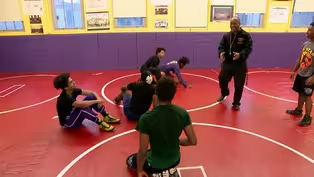
Bowen Wrestling Coach Pays it Forward
Video has Closed Captions
Clip: S2022 Ep4 | 5m 17s | Ron Wilson’s high school wrestling coach saved his life. Now he pays it forward. (5m 17s)
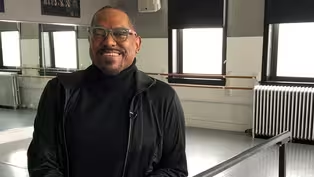
Dance Inspiration from an Unlikely Source
Video has Closed Captions
Clip: S2022 Ep4 | 4m 30s | A legendary dancer, choreographer and teacher with a surprising back story. (4m 30s)
Providing Support for PBS.org
Learn Moreabout PBS online sponsorship













Support for PBS provided by:
Jay's Chicago is a local public television program presented by WTTW