21
Mercer County
12/22/2022 | 10m 40sVideo has Closed Captions
Sharing her recovery journey Stacey Ross helps others overcome addiction in Mercer County.
It's rare to find Stacey Ross without her phone. Each call is life or death but one step closer to helping someone on the other end into recovery. Following a lifelong battle with addiction, the Mercer County native and certified peer recovery specialist became sober at age 44 and is committed to helping others do the same, providing resources for treatment and mentorship to young women.
Problems playing video? | Closed Captioning Feedback
Problems playing video? | Closed Captioning Feedback
21 is a local public television program presented by NJ PBS
21
Mercer County
12/22/2022 | 10m 40sVideo has Closed Captions
It's rare to find Stacey Ross without her phone. Each call is life or death but one step closer to helping someone on the other end into recovery. Following a lifelong battle with addiction, the Mercer County native and certified peer recovery specialist became sober at age 44 and is committed to helping others do the same, providing resources for treatment and mentorship to young women.
Problems playing video? | Closed Captioning Feedback
How to Watch 21
21 is available to stream on pbs.org and the free PBS App, available on iPhone, Apple TV, Android TV, Android smartphones, Amazon Fire TV, Amazon Fire Tablet, Roku, Samsung Smart TV, and Vizio.
Providing Support for PBS.org
Learn Moreabout PBS online sponsorship[slow music] [slow gentle music] - It's hard to find someone that isn't affected by the disease of addiction.
I didn't choose this job.
I believe it chose me.
I believe it is my purpose.
Thank you.
I just try to do things from my heart.
It's just the best feeling in the world to just help another person.
[gentle music] I am a certified peer recovery specialist and I'm a person in long-term recovery.
I struggled most of my life with the disease of substance use.
My parents divorced when I was about 12 years old.
I suffered extreme trauma during that time that I didn't wanna talk about with anyone.
Here I am, you know, getting drunk on the weekends and not really realizing that it was an issue.
I just thought I drank too much and other drugs came in like cocaine.
Could have went away to college, I tried and I dropped out.
You know, from that point on is when everything started falling apart.
I didn't know that I could get help and that I could have someone help me figure out what was going on with me.
Over the years, things would be okay for a little bit and then they would get worse again.
When I was in my 30s, I was diagnosed with something called lupus which is a very painful, autoimmune disorder and I was prescribed Percocet.
Before I even realized it, I was completely addicted to this prescription medication.
I went into 12-step meetings, I met a lot of good people and I've had many suicide attempts.
We have a lot of services.
It's just when you're in the midst of addiction, you don't realize all these things are available to you.
This is like the "Boulevard of Broken Dreams" for me.
And this is the boulevard of, you know-- - Restored life.
- Restored life.
- I've been in Trenton for almost 52 years and, growing up, but using for most of my life on these streets.
- [Speaker] Yo.
- And there's the yos.
- Yep.
- Every time I would hear that word, it would be, what is it?
- [Companion] Yeah.
- What you got?
This is the methadone clinic that I was on for six years and every morning my father would get up at about 4, 4:30 in the morning to get me here by 5:00 a.m. Just brings up feelings of my father.
[car engine revs] I spent a lot of time with him here and it's a shame it wasn't something positive, it was sitting in this parking lot, but my dad always showed up for me and tried to protect me the best that he could.
[slow music] I prayed and I said, "Please either take me "or help me figure out a way how to get better."
And one of my friends called me up and I went to a meeting and I've never looked back from that point and I finally found out what my purpose was after all these years.
You know, I didn't stop using until I was 44 years old.
I ended up getting another recovery job with Mercer Council.
I love what I do.
A day at a time, I live this wonderful, amazing life with struggles, with challenges and I do not pick up a drink or a drug to deal with any of them, which is truly a miracle.
My father got to see me sober for six and a half years before he passed.
I work really hard at maintaining my sobriety by doing a lot of service work in the community in Mercer County and surrounding areas.
Opioids are taking so many lives from us, especially in this community.
You know, I have been to probably over, well over 50 funerals in the five years that I've been doing this work.
We need all the help we can get.
- So looking at 50 bags, and at least 25 Narcan kits to be distributed at the event as well.
- I would bring probably 30.
- Okay, 30 it is.
Okay, one of the new standard Narcan kits.
A couple years ago, with the increase in fentanyl, they had to increase the strength of the dosing from two milligrams to four milligrams because two milligrams were not bringing people back.
The more access points we have to clients, the better chance we have of getting them help.
- Absolutely.
My day is basically from, you know, I start boots on the ground at about eight in the morning.
I start moving and I go until sometimes 10, 11 at night and then beyond because we get calls at all hours.
You know, the disease doesn't sleep, so sometimes we don't get a lot of sleep either.
The C.A.R.E.
program was started by Scott Kivet with the Robbinsville Police Department.
So what happens, when somebody is arrested with a substance use charge, we get called out by one of the officers.
We go in there, we meet them where they're at.
We try to set up a treatment plan for them.
They know they can't arrest their way out of this disease.
- When we do these C.A.R.E.
cases, we'll bring them in a clean setting in a private room where they don't feel like they're in a jail cell.
You need somebody that has been through the situation that understands what dope sick feels like.
So we bring people and they talk to them and I say, "Hey, here's a private setting.
"I'm out of the picture now, I'm passing the ball.
"Now, slam dunk it, pretty much," you know what I mean?
And that's what we do.
- [Stacey] It's gonna be our office for the Opioid Overdose Response team.
- That's why it's so helpful to have you guys right here in the police station because you're able to do those intakes and that outreach, you know, right here as people are coming in, you know, for whatever services and resources they might need.
- It takes a village to help the City of Trenton.
It really will take a village to have everybody come together, start trusting the relationship between the officers and people that are suffering with substance use.
I just think it's really important and it's a game changer for the City of Trenton 'cause a lot of people get forgotten about on the streets and they feel like there's no hope and there's no one to help them.
[slow music] What I love about being a peer recovery specialist is, we get to sit down face-to-face with a person who is exactly no different than I am and we get to talk to them about some of the struggles that we have been through.
I know that it is just a judgment-free zone.
They feel very comfortable.
You hang with my girl, you guys hang together?
[indistinct] You know, I let them know that I've been through some pretty hard things in life and I've gotten to the other side of it.
So it gives them some hope that they can get to the other side of it as well.
We got socks, do you need socks too?
Oh you got, okay, perfect.
I was [indistinct] to Trenton till I wasn't 'cause that runs out.
Yeah.
- Damn girl.
- Yeah, that's why my kidneys failed.
That's why I miscarried a child.
That's why, you know, I think I'm living large but you know, all I'm doing is losing.
- [Companion] You wanna come today?
- Tomorrow.
- [Companion] Monday.
- Tomorrow would be good.
- [Companion] Tomorrow?
- Yeah, could she-- - [Companion] Okay.
- Could she do 11 O'clock tomorrow?
Call me at 10 and we'll get you a lift, all right?
- All right sweetheart, we'll be in there.
- All right, yeah, so have a seat here.
- But yeah, I definitely wanna try to get [indistinct].
- Well, you know, I'm always here no matter what.
No matter what.
This girl has the biggest piece of my heart.
You know, there's so many different options for treatment.
So we just see what they're willing to do and we kind of help them get on that pathway.
They ask me to run a couple houses for a nonprofit that does sober living.
So I voluntarily give my time to two houses that have six females in each house.
So I get to mentor them.
I get to show them that, you know, they are worth something.
They have a purpose on this earth.
[slow music] So let's talk about what's going on in the house with the girls.
- The beds have been great.
You know, the house is in order.
They have everything going up that they need for the food shopping list.
And the manager's gonna take care of that.
The rent is, was up there.
Everything's been good so far.
[slow music] - We have both our two men's houses are filled and our Burlington women's house is filled, and we have so many success stories and we have some, you know, we have some tragic things too.
But for the most part, our success stories make it all worthwhile.
A lot of good sobriety, a lot of good recovery.
- Laura went through this house.
She was here for a little over two years.
- I was, yeah, it's when this house first opened.
I moved in the second day that this house opened.
I've been in and outta sober living for 20 years, you know, and this is the one house, it's the accountability, but it's more than that.
It's like you develop a support network.
It's the last step before independent living.
And that's exactly what this did.
It gave me enough time to start to work, to start to save money, to begin paying off wreckage of my past and to start to work back into society.
- Our door is always open when people are ready for this next step.
And, you know, it's absolutely changed my life.
So I've lived in Mercer County for almost 52 years.
I love Mercer County.
I've tried to leave and it always draws me back in.
[slow music] You know, I like to give back to the community of Trenton because there's such an underserved population.
Community is so important for recovery because I can't do this by myself.
We need the whole community involved.
[slow music continues] One size does not fit all and we have to come up with different ways for people to feel like they are getting some sort of help.
So I believe that as a community, a whole, we need to start talking about this more and not stigmatizing it.
My first thought is, what can I do for someone else?
And coming from the most selfish person that was ever created, that is a huge miracle.
So I do these things because, not for notoriety, not for a pat on the back.
I do it because if I can help one person believe that they are worth it and that they do have a purpose, it's the reason I do what I do every single day.
[slow music]
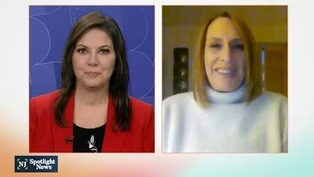
Helping citizens overcome addiction in her community
Video has Closed Captions
Stacey Ross of Mercer County sits down with Rhonda Schaffler (4m 39s)
Providing Support for PBS.org
Learn Moreabout PBS online sponsorship










Support for PBS provided by:
21 is a local public television program presented by NJ PBS