One-on-One
Meredith Gemeiner; Stephen G. Adubato; Andersen and Stigers
Season 2025 Episode 2876 | 27m 17sVideo has Closed Captions
Meredith Gemeiner; Stephen G. Adubato; Andersen and Stigers
Meredith Gemeiner of the Adler Aphasia Center sheds light on the impact aphasia has on those living with the disorder. Stephen Adubato, Associate Editor of Compact Magazine, explores preserving religious traditions. Heather Andersen, President & CEO of Special Olympics NJ & Mike Stigers, President & CEO of Wakefern Food Corp., discuss partnerships between non-profit and corporate organizations.
Problems playing video? | Closed Captioning Feedback
Problems playing video? | Closed Captioning Feedback
One-on-One is a local public television program presented by NJ PBS
One-on-One
Meredith Gemeiner; Stephen G. Adubato; Andersen and Stigers
Season 2025 Episode 2876 | 27m 17sVideo has Closed Captions
Meredith Gemeiner of the Adler Aphasia Center sheds light on the impact aphasia has on those living with the disorder. Stephen Adubato, Associate Editor of Compact Magazine, explores preserving religious traditions. Heather Andersen, President & CEO of Special Olympics NJ & Mike Stigers, President & CEO of Wakefern Food Corp., discuss partnerships between non-profit and corporate organizations.
Problems playing video? | Closed Captioning Feedback
How to Watch One-on-One
One-on-One is available to stream on pbs.org and the free PBS App, available on iPhone, Apple TV, Android TV, Android smartphones, Amazon Fire TV, Amazon Fire Tablet, Roku, Samsung Smart TV, and Vizio.
Providing Support for PBS.org
Learn Moreabout PBS online sponsorship- [Narrator] Funding for this edition of One-On-One with Steve Adubato has been provided by Delta Dental of New Jersey.
We love to see smiles.
The Russell Berrie Foundation.
Making a difference.
Holy Name.
Valley Bank.
Johnson & Johnson.
NJM Insurance Group.
Serving New Jersey’s drivers, homeowners and business owners for more than 100 years.
United Airlines.
Newark Board of Education.
And by Robert Wood Johnson Foundation.
Working to create a future where health is no longer a privilege, but a right.
Promotional support provided by BestofNJ.com.
All New Jersey in one place.
And by New Jersey Monthly.
The magazine of the Garden State, available at newsstands.
- This is One-On-One.
- I'm an equal American just like you are.
- The way we change Presidents in this country is by voting.
- A quartet is already a jawn, it’s just The New Jawn.
- January 6th was not some sort of violent, crazy outlier.
- I don't care how good you are or how good you think you are, there is always something to learn.
- I mean what other country sends comedians over to embedded military to make them feel better.
- People call me 'cause they feel nobody's paying attention.
_ It’s not all about memorizing and getting information, it’s what you do with that information.
- (slowly) Start talking right now.
- That's a good question, high five.
(upbeat music) - Hi everyone, Steve Adubato.
We kick off the program with an important compelling conversation, part of a series we call Voices of Aphasia.
We kick off with Meredith Gemeiner, who's social services and outreach manager at the Adler Aphasia Center.
The website is up right now.
Meredith, great to have you with us.
- Thanks for having me.
I'm thrilled to be here.
- You got it.
And let's make it clear, folks.
We had a longstanding relationship with Mike and Elaine Adler, who established the Adler Aphasia Center.
They've been our partners and friends for years.
We lost Mike and Elaine several years ago.
The work of the Adler Aphasia Center continues, but I don't wanna assume that people know what aphasia is.
Meredith, please help us understand.
- Yeah, yeah.
So, aphasia is actually, more common than people think.
They just don't know the word usually, of what it's actually called.
So, aphasia is a communication disorder that's usually a result of a stroke or a brain injury, could be a result of a brain disease.
If you've ever been unfortunate enough to know someone who's had a stroke and then they are unable to say the words or speak in a way that they can express themselves and find their words, then they most likely have aphasia.
It can affect reading, writing, speaking, and understanding language.
And as you can imagine, it's very hard to live with.
- And I told, and Elaine knew this, and I told Mike as well, that my dad who passed several years ago had aphasia, which was a byproduct of a brain disease that he had.
So, I saw and his inability to communicate, and for a guy whose life was about public communication, it was a real struggle, but I also saw my mom, who was his primary caregiver.
Let's talk about the challenges for caregivers of those who are dealing with aphasia.
- So, there's lots of them.
I run the caregiver program here and I facilitate five support groups almost weekly.
And so, I'm in the trenches and I see what they go through.
And I've heard this several times, that it's like living two lives, which is not even the half of it, because it's like living two lives, managing two lives, but it's also dealing with the loss of the person that you had in your life.
So, not only are you losing companionship and love and a way to communicate that you've always communicated, you're also managing their lives.
So, it can be, it's obviously, a lot of pivoting and can be really detrimental to a relationship.
- Talk about the specific help and services that the Adler Aphasia Center offers for these caregivers.
- So, like I said, I facilitate caregiver support groups.
I have a few that are virtual.
I have few in Maywood, New Jersey, and one in West Orange, New Jersey.
And I also offer education programs on all different types of topics, whether it's how to communicate with someone with aphasia or it's an attorney talking about long-term planning.
These are all free to people, whether or not they have a member at Adler Aphasia Center.
If you are a caregiver of someone with aphasia, you are eligible to join any one of our programs.
And the caregiver support groups are an amazing place to meet people who understand what you're going through and can you help guide you.
- You talk about being with others, caregivers of those dealing with aphasia.
The caregivers being with other caregivers.
Explain to folks why that's so important, because if you're not, you can try to empathize, you can say you understand, but if you're not experiencing it firsthand, it's very difficult to do that.
Please, Meredith.
- Yeah, I appreciate that, Steve.
Actually, in thinking about this interview, that was a theme that was going throughout my mind that people who are not caregivers can't fully understand it, and that comes out in almost every group I run.
And so, to meet other people who are going through what you're going through, not only does it help you with, you know, maybe tools and resources, but it's a validation, right?
You're not prepared in life to be a caregiver.
And once you're in it, there's no roadmap.
So, to be comfortable with where you are in life and what you're coping with, it's so important to have that validation and understanding, 'cause it can be very isolating.
And when you're with people who get it, you can make friendships as I've seen that like you've never had before, which I've heard people say, - You know, much of the reason we're doing Voices of Aphasia with the support of the folks at the Adler Aphasia Center is to create greater public awareness.
And one of the things that Mike and Elaine used to say to me was that it's important that those who are public figures dealing with aphasia, that the more people are aware of who those people are and what they're dealing with and what their caregivers are dealing with, the better, because people can identify with public people.
Bruce Willis is dealing with aphasia.
His wife is coming out with a book talking about her experience.
Why is it so important for Bruce Willis' wife to write this book?
And we're gonna try to get her on, to talk about her experience, and why is it important for public people, celebrities, others to share their experiences?
And they have every right to their privacy.
I wanna be clear on that.
But if they choose to be public, why does that matter in terms of public awareness?
- Right, I think it's a great question.
I think it's what I was saying before on a broader scale, right?
So, a group can be really validating, it gives you context, but if it's somebody that is a famous figure, it's not only, it's hitting more people.
So, if you hear someone talking in a context that you understand, there are so many things that caregivers go through that they don't know why.
So, you don't know what you don't know.
And if you have a public figure who is stating something that you're feeling, it can be mind blowing.
I do wanna say he has primary progressive aphasia, which is a type of aphasia that progresses into something that looks like dementia.
It's a type of dementia.
So, it's wonderful that she's out in talking about the aphasia, I also, we've seen that it's a little bit of a challenge, because the people we work with, they do not have dementia.
They come to our center, they know what they wanna say, and they have the cognitive awareness.
So, while it's been great for visibility, it's been a challenge, because every time we do outreach or go somewhere, people say, "Oh yeah, Bruce Willis, he has dementia, he has that."
And we want people to know that people with aphasia can be just like all of us.
They just can't get the words right.
- And it's so interesting is that my dad had dementia, had aphasia.
Mike Adler did not have dementia, had aphasia.
Not everyone who deals with aphasia, or caregiver, or someone with aphasia, it's not the same.
We need to distinguish.
Last question before I let you go.
Your passion for this work comes from where?
- I had a grandmother who I took care of as a young kid, and now, I am in the sandwich generation and a caregiver myself.
I like to call it the panini generation actually, because it can be squeezing.
- I like that.
- Yeah, so I've been in the nonprofit world and doing support groups for over 20 years and it's just something I think that people need attention and need to know about.
- Meredith, we thank you for joining us.
We wish you and the team at the Adler Aphasia Center all the best.
And we'll continue in this mini series Voices of Aphasia.
Thank you so much.
Wish you all the best.
- Thank you so much, thank you.
- You got it.
Stay with us, we'll be right back.
- [Narrator] To watch more One on One with Steve Adubato find us online and follow us on Social media.
- I am proud to introduce my son, Stephen Gregory Adubato, Associate Editor of Compact Magazine.
Good to see you, young man!
- Happy to be here.
- You got it.
Hey, Stephen, you not only write and do work with Compact Magazine, you write for a whole range of publications, including, give us a quick synopsis.
You didn't get my gift of bragging, but go ahead and tell everyone where you've been published.
- Yeah, I have written for the New York Times, Newsweek, Daily Beast, a whole variety of publications.
- Yeah, I just want people to know you're not on just because you're my son.
Hey, listen, you introduced me to an interesting organization, and you also wrote a piece about it and the website will come up, The Italian Apostolate of the Newark Archdiocese.
What the heck is it and why is it so significant?
We've been doing a lot on Italian-American culture and history, and this is part of it, particularly tied to the Church.
Go ahead, son.
- Yeah, so the Italian Apostolate is basically meant to serve the Italian-Americans and Italians in the Newark Archdiocese.
But most importantly, as I wrote in in the article, they're trying to keep alive the traditions that our ancestors started over 100 years ago, 'cause if the younger generation doesn't, they're gonna die out.
- A part of our culture, and by the way, Stephen is part Greek, his mom, my ex-wife comes from a Greek-Turkish background, and Stephen also has an Italian-American connection, he relates to all of his ethnic heritage.
But that being said, son, do you remember I did this documentary on "Newark's Little Italy" and having to do with the Feast of St.
Gerard?
Do you remember me taking you there as a little, little kid to force you, as I've tried to force your siblings, my three other kids, to understand and appreciate our culture?
I forced it on you, did I, did not?
- You did.
I mean, I went along willingly most of the time.
But I remember from the documentary, I think I make an appearance in one of the last scenes.
So yeah, I remember very well.
- Why does that matter, that as parents, grandparents, and others, that we attempt to pass on the culture, the tradition?
And by the way, my friend, Maria Laurino, wrote this book, "The Italian Americans: A History."
Why is it so important that we do this, son?
- 'Cause we need to know our roots.
If we don't know where we come from, the people that we belong to, who brought us here, then we don't really know our identity.
So this is why, for me, the fact that you forced me to go to the Feast, it helped me understand who I really am.
And again, the people, the people that we come from, the traditions that are part of our culture that make us who we are.
- But it's also tied to the Church on your end.
And you lead a very spiritual life connected to the church.
- No, and for our culture, it's all interconnected.
The feasts, the procession, the masses, the music, the food, it's all one experience that embodies these various elements.
But no, the faith penetrates every aspect of the feast, of course.
- So I was having a conversation with your siblings the other day, and they, when I was pushing, I was telling 'em you were coming on, and we're doing this right after the Feast of St.
Gerard, which comes outta St.
Lucy's Church, where my grandfather, Luigi Calvello, emigrated from Italy, settled in that neighborhood, my grandmother came, that's where my mother was born, my father was born, they met, et cetera, et cetera.
That's part of our culture.
But I was trying to talk to your siblings about this, and they're not alone.
They're like, "Dad, but that's not really us, that's back then."
And they just see themselves less as Italian-American, less having Italian roots, and we're just regular white people like other white people.
And I know it sounds very crass, but I said "No, it's more complicated than that."
Do you think it's an age thing?
- Part of it is age.
Part of it's generational.
I mean, it's natural that when an immigrant community comes to the US, to any country, that they'll eventually start assimilating, they'll start becoming part of the larger culture.
But this is why I think, you know, something like the Italian Apostolate is so important, because it's really making an effort to retain those roots.
As much as, again, it's natural that we assimilate, traditions change, the culture changes, we can't lose it completely, we can't forget who we come from and who we are, ultimately.
So we... - But language matters too.
Sorry, Stephen, for interrupting, but language matters too.
When we went to the mass at the Basilica, Sacred Heart Basilica, you asked me to go to that mass, went to the mass, and the Archbishop served, he presided over the mass, and he spoke in Italian.
Does he not have an Italian background?
Why is it so important that the language be preserved, son?
By the way, can I just keep calling you son, because that's gonna sound weird _ I'm used to it.
- on the air but go ahead.
No, but the language is a very tangible way to connect with the culture, because there are nuances in language, there are things you can communicate in another language that are lost in translation.
So this is why, for me, I mean, I made an effort to try to learn Italian.
I haven't perfected it yet, but I wanna know the language that, you know, our ancestors spoke.
- Switch gears.
How incredibly challenging is it to have a meaningful, productive paying career in media today?
- It's not easy.
Not easy, needless to say, because, you know, publications are shutting down, they're being taken over by larger conglomerates so it's hard to find full-time work.
But I think if you have that gift, you have that calling, you have to find a way to make it work, because we need writers who are gonna communicate important things to society, absolutely.
- Talk about your passion for writing.
- No, I mean, it's very much connected to my passion for teaching, because you know, I mean the way that you raised us you taught us to really value communication, communicating things that are important that are true, things about, you know, justice, issues in our society.
And for me, in addition to teaching, in addition to education, writing is one way to communicate these ideas and to get people to think on a deeper level.
- Before I let you go, if it's too private you'll tell me, 'cause it's too late, I've said it on the air.
You were raised Greek Orthodox, went to Greek school, right?
- Yep.
- Up until what age?
- I think I was 14 years old.
- Yeah.
So you're at Fordham University and you convert to Catholicism.
But culturally, you have a Greek background.
You've talked about this part of your life as well, the Italian culture.
What about Catholicism and these incredibly difficult complex times, including where the Church has its own challenges, which I've talked about to you privately and I've talked about as a journalist as well?
What draws you to the Catholic Church today?
- I think there's something universal about the Catholic Church's mission and its message, and, of course, I'm always gonna value my Greek Orthodox roots.
But the reality is you see the Catholic Church present all over the world, in Africa, in Asia, South America.
And I think it's, you know, it really has a way of spreading the good news, spreading the fact that there's hope.
Even with all the issues the Church has, that message of hope, I think, is crucial.
- Your faith is a big part of your life, isn't it?
- It is.
It is.
- I'm proud of you, Stephen Gregory Adubato.
- Thank you.
- By the way, I think your mom said "Let's call him Gregory, so he's not a third," is that correct?
- That's right.
I can't be the third, unfortunately.
- We did not need three with the same name.
I love you, son.
Thank you.
- Thank you.
- Good stuff.
And by the way, check him out.
We put up the website before, Compact Magazine, check out Stephen's work and also a range of other great writers there as well.
I'm Steven Adubato Jr.
He's Stephen Gregory.
We're right back after this.
- [Narrator] To watch more One on One with Steve Adubato find us online and follow us on Social media.
- Hi, I am Jacqui Tricarico, Senior Correspondent for One-on-One and so pleased to be joined now by Heather Andersen, the President and CEO of Special Olympics New Jersey, as well as Mike Stigers, who's the President and CEO of Wakefern Food Corporation.
It's so great to have you both with us.
- Great to be here, Jacqui.
- Good to be here.
- Well, Heather, I wanna start with you because the Special Olympics of New Jersey has been present here in the state, I think since the 1960s.
First, for people who don't know, tell us a little bit about the organization and how it's really grown and evolved over the years.
- Sure, our core is a sport.
We're a sport organization for children and adults with intellectual disabilities.
And we have been around since the late 1960s in New Jersey.
We celebrated our 50th anniversary a few years ago, and really as an organization, we offer 22 sports.
Everything we do is free of charge due to the generosity of individuals in New Jersey, donors, corporations like ShopRite, Wakefern.
So everything we do is free, but really, it's more than sport.
It brings people together, it brings families together.
It brings the New Jersey community together to celebrate the abilities of our athletes.
We don't focus on disabilities, and it's really pure joy when you come to one of our events because it really... We always say, "Just come once, just come once."
So we have over 20,000 athletes that are registered in New Jersey alone, anybody from the age two up to 72.
So it's a lifetime organization for not only our athletes, but the families.
- Mike, so out of those 50 years, about 40 of them, Wakefern and ShopRite has been involved.
Tell us why you and your colleagues continue to be a really significant part of Special Olympics New Jersey.
- You said it right there.
Come once and you've got it.
You look at the athletes, some of those athletes are our teammates who work in our stores.
They're our neighbors, they're the communities we serve and ShopRite, we're all family owned.
Every one of our stores, it's under the wake front umbrella, but all shop rights are owned by a family and a family member.
And those families support the communities they serve.
And for us to be able to support Heather in what her and her team does on a daily basis at the summer games is just absolutely incredible, but we're there because that's where our hearts are.
Our hearts are with the communities, and it all starts with the athletes and all the courage, the courage that those athletes put forward every single day and then to honor them at their Olympics is just really something special.
- You touched upon it a little bit, Mike, but can you elaborate more on the job opportunities that you're also creating for some of those athletes and how that synergy between ShopRite and the Special Olympics really helps provide those opportunities?
- My gosh, absolutely.
Grocery stores are the center point of a community, and the grocery store, the local ShopRite store, serves those communities to which they serve and those are our teammates with perhaps have special needs or don't have special needs, but we need good, good solid, hardworking teammates, and we're very, very proud of our athletes who work with others organization, who also work in our stores, and we're able to provide strong, strong employment opportunities for those teammates.
- That's incredible, Heather, I know there are really events and things happening all year round all throughout the state.
I saw something more recently called Pooling for a Cause.
It was presented by United Airlines at the Newark Airport.
Tell us a little bit about that, because it was really unique and I know it raised a lot of money for what you all are doing.
- So, United Airlines has been a long-term partner of ours, just like ShopRite, Wakefern, and they're part of our family and fabric of the organization.
But we have teams of 20 pulling a 737, 12 feet, and we have the fastest pole and the lowest combined weight pole.
So it's been a staple event for ours in New Jersey for many years, and it's the only day of the year you get to be out on the tarmac at the Newark Airport, really without getting arrested.
And you get to be part of an event to pull the plane.
And so it's... And we have athletes out there pulling the plane along with maybe where they work, but we raised probably over $100,000 a couple of weeks ago for that event.
And so again, it's one of those events come once and you're kind of hooked, so.
- It sounds incredible and what a sight to see I'm sure for everybody that was involved that day.
Mike, being a part of this for so long, what's one of your most favorite memories of being at some of these events and seeing these athletes and the joy that it brings so many people?
- The greatest part is when you're there, you're at the event.
You know that one of your teammates is participating, you go watch the teammate and you just watch the sheer excitement on their face that they finish the event.
They run up to me afterwards and show us their badges and their medals, the pride that's on their face, the sense of accomplishment that they feel, the courage and the confidence that gives them to the teammates is incredible.
But then you look at their family and the pride the family has, it truly brings the full community together.
And that is, by far, Renee, my wife, we enjoy this so much.
We go out every year.
We served over 15,000 meals last year on that weekend.
So we get just literally hundreds of our teammates out helping support the athletes and the Special Olympics event.
But then it's just to be there with our teammates, their families, and all of us just giving back to the community, - Heather, there's so much to look forward to, but in 2026, what are we gonna be seeing?
What are some really fun events that people can check out that are happening in 2026 for the Special Olympics of New Jersey?
- Well people ask me when the next event is, and I'll tell you, it's probably in about 15 minutes because we have things going around across the state every day, everywhere in the communities.
We're in every county at a very local level up to our statewide games and events, every weekend there's something going on.
So the best thing I would say is to check out our website, SONJ.org for a full list of events.
But we've got an exciting year coming up in 2026.
Above and beyond, we have Team New Jersey representing our great state at the Special Olympics USA games in Minneapolis, Minnesota.
So we have about 100 athletes and coaches and team will be flying out to Minneapolis later in June to represent our state and we have 12 sports that we'll be representing there so we're so excited for them and their families.
70% of the team has never been to a USA games before.
So it's just the excitement is brewing already on top of all the other events that we have.
So lots of good things happening and again, I just encourage everybody to check us out, come once and you'll come back.
- Creating opportunities, such incredible opportunities and experiences for so many.
And finally, Heather, someone's watching and wondering how they can get involved with your organization.
What's the best way to do that?
- They'd go to our website.
We can't do what we do without thousands of volunteers across the state.
We need volunteer coaches, we need volunteers that will help out at events on a weekend to help run special events.
I mean, ShopRite, Wakefern, 500 employees and their families come out every year to cook and serve food with us at summer games.
So it's like an army of humanity across the state with the generosity of our volunteers.
So if you want to get involved or you have a family member or you know somebody that could benefit from our programming, again, everything is on our website and the contact information, but sometimes we talk about we're the best kept secret, even though we're over 55 years old.
But just come once, get involved, you'll never regret it.
And there's so many good things that this mission does that I think can touch the lives of thousands of New Jerseyans.
- I'm glad we could just give a little spotlight of some of the incredible work that's being done.
Thank you both Heather and Mike for joining us.
We really appreciate it.
- Thank you.
- Thank you - For Steve Adubato and myself, thanks for watching.
We'll see you next time.
- [Narrator] One-On-One with Steve Adubato is a production of the Caucus Educational Corporation.
Funding has been provided by Delta Dental of New Jersey.
The Russell Berrie Foundation.
Holy Name.
Valley Bank.
Johnson & Johnson.
NJM Insurance Group.
United Airlines.
Newark Board of Education.
And by Robert Wood Johnson Foundation.
Promotional support provided by BestofNJ.com.
And by New Jersey Monthly.
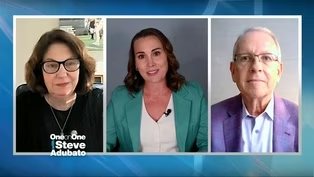
How non-profit partnerships can improve our community
Video has Closed Captions
Clip: S2025 Ep2876 | 9m 36s | How non-profit partnerships can improve our community (9m 36s)
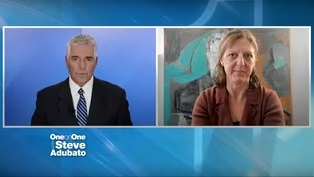
The impact aphasia has on those living with this disorder
Video has Closed Captions
Clip: S2025 Ep2876 | 8m 50s | The impact aphasia has on those living with this disorder (8m 50s)
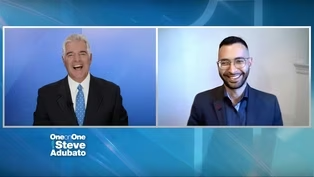
Stephen G. Adubato discusses preserving religious tradition
Video has Closed Captions
Clip: S2025 Ep2876 | 9m 17s | Stephen G. Adubato discusses preserving religious tradition (9m 17s)
Providing Support for PBS.org
Learn Moreabout PBS online sponsorship
- News and Public Affairs

Top journalists deliver compelling original analysis of the hour's headlines.

- News and Public Affairs

FRONTLINE is investigative journalism that questions, explains and changes our world.












Support for PBS provided by:
One-on-One is a local public television program presented by NJ PBS