
MetroFocus: April 17, 2023
4/17/2023 | 28mVideo has Closed Captions
NYC’S FIRST FEMALE FIREFIGHTER; THE HEROIC FAMILY STORY OF FOUR GENERATIONS IN THE FDNY
Trailblazing firefighter Brenda Berkman joins us to discuss her experiences as one of the first and few women on the force, and about her work for the organization Monumental Women. Then, author Brian McDonald joins us to discuss his new book, "Five Floors Up: The Heroic Family Story of Four Generations in the FDNY.” .
Problems playing video? | Closed Captioning Feedback
Problems playing video? | Closed Captioning Feedback
MetroFocus is a local public television program presented by THIRTEEN PBS
MetroFocus: April 17, 2023
4/17/2023 | 28mVideo has Closed Captions
Trailblazing firefighter Brenda Berkman joins us to discuss her experiences as one of the first and few women on the force, and about her work for the organization Monumental Women. Then, author Brian McDonald joins us to discuss his new book, "Five Floors Up: The Heroic Family Story of Four Generations in the FDNY.” .
Problems playing video? | Closed Captioning Feedback
How to Watch MetroFocus
MetroFocus is available to stream on pbs.org and the free PBS App, available on iPhone, Apple TV, Android TV, Android smartphones, Amazon Fire TV, Amazon Fire Tablet, Roku, Samsung Smart TV, and Vizio.
Providing Support for PBS.org
Learn Moreabout PBS online sponsorship>> Tonight, the FDNY captain who paved the way for women to join the ranks for the first time.
Meet the firefighting family hearing on the legacy of the highest ranking FDNY member killed on 911.
"MetroFocus" starts right now.
>> This is "MetroFocus," with Rafael Pi Roman, Jack Ford, and Jenna Flanagan.
MetroFocus is made possible by Sue and Edgar Wachenheim III, Filomen M. D'Agostino Foundation, the Peter G. Peterson and Joan Ganz Cooney Fund, Bernard and Denise Schwartz, Barbara Hope Zuckerberg.
And by Jody and John Arnhold, Dr. Robert C. and Tina Sohn foundation, The Ambrose Monell Foundation, Estate of Roland 40 years ago Jenna Bergman paved the way for women to join the FDNY, winning a lawsuit against New York that made it possible for women to become firefighters for the first time in history.
After serving 25 years, a career that included acting as a first responder during 9/11, she decided to follow her passion for activism and arts.
She is the vice president of programs at the nonprofit organization Monumental Women which advocated for and secure the installation of the first monument in all of Central Park to honor real women.
Her own artwork as part of an exhibit at the 9/11 memorial and museum.
She has also been an author, teacher, White House alone, among many other things.
She joins me to talk about her life, her career and what ties all of those pursuits together.
Welcome to MetroFocus.
Brenda: It is great to be here.
Thanks for having me.
Jenna: I want to hear about your groundbreaking career.
The FDNY is such a storied institution in New York and you broke a huge career as a woman to be able to serve as a firefighter.
Take me back to that time and tell me about that experience.
Brenda: people do not remember that prior to 1977, women were not even allowed to apply to become New York City firefighters.
It did not matter if you had won the Olympic gold medals or whatever or your entire family had been on the fire department, you were not allowed to even apply if you happened to be a woman.
That changed in 1977 in response to federal sex discrimination laws.
When women were allowed to apply, the city decided to change its test to make it the most difficult test Ever Given for any job in New York City.
A lot of people had doubts about women's physical capabilities, even about our courage to do dangerous things.
There was a lot of opposition among men and women to women coming on the job.
I believe the city was not actually testing for job related physical abilities.
When all of the women who took the physical portion of the exam field it and I felt it, I brought this lawsuit and I won.
That was the beginning of the struggle for women, a struggle that continues to go on today, to be fully integrated into the fire department.
Still very small numbers of women.
When I won my lawsuit, 40 of us came on together.
And then another woman was not hired for 10 years.
After that, three.
One of them retired recently.
Only now are we over 100 women in the New York City fire Department, and a department that has 11,000 members.
It has been an uphill battle.
I believe women had a lot to contribute to the fire service, to our communities.
We want to serve our communities the same way men do.
It is a great job.
It just was not the easiest thing for me when I came on because of a tremendous amount of resistance.
Jenna: I want to talk about your work once he retired, but very quickly, once you got in, how was it for you to be able to rise to Captain, and what a lot of accounts sounds like a boys club.
Brenda: Well, we do have civil service exams.
I studied, I got promoted to Lieutenant.
I study some more and got promoted to Captain.
I really like being an officer.
I liked having drilling and control over the day so that we could go out and do the things we were supposed to be doing.
I highly recommend to women that they study for promotion and take it when it comes along.
Thanks they get better for the first group of women as we went along.
But honestly, I still got some harassment on the day I retired.
Which just seems goofy to me because, why would people not want to make it a job where everybody feels like they are part of the team?
It is a dangerous job, it is a demanding job.
I really thought that all of us, men and women, should be working as one team.
Jenna: How did you take those experiences and use that to build your career in activism and art?
There is usually some sort of adversity for artists that drives them to create.
Brenda: I was an activist by the time I was a little girl.
I had interest that a lot of people believed little girls should not have, like sports.
We did not have title IX in those days.
Other things, like leadership roles.
When I came on the job as a firefighter in New York, I formed an organization because I knew the women had to work together and help each other out.
But I was trained as an historian.
I have a Masters degree from graduate school.
I was having an interest in women and people of color.
Marginalized groups.
And how they had been left out of the history books.
I thought this is not right.
Women clearly had a lot to contribute to our country over the years.
I was always interested in women in history.
I think learning about women in history, women like Sojourner Truth, Susan B Anthony, the first real women to be memorialized in Central Park in its 167 year history, that was not an easy task to get them in the park.
But they did so much to make our lives as women and men so much better than they were previously.
And they had to break a lot of barriers to do it.
And they inspired me.
I thought, if they could do these really difficult things, women were not allowed to speak in public.
Sojourner Truth had been born a slave.
Elizabeth Cady Stanton wanted to go to law school and could not go to law school.
All these things that they had to experience that were unfair and they continued to struggle.
Not just for their own benefit, but for the benefit of all of us.
I thought they could put up with that come I could certainly put up what was going on at the fire department.
History has always been an inspiration for me.
When I retired, I got involved with this group called Monumental Women.
We did not just put the statue in Central Park.
That was a seven year project.
We had to raise $1.5 million in private funds in order to do that.
When you go there, you can hear Viola Davis speaking as Sojourner Truth.
Meryl Streep as Elizabeth Cady Stanton.
Rita Moreno in Spanish.
It is a great thing.
But we also have a women's rights history trail.
We are building on that so you can go all around the five boroughs and learn about women who did important things in New York City, the country and the world, things that have not been memorialized in our public spaces.
Jenna: Whenever I hear about people working on behalf of marginalized people, why do you think that they were left out?
Brenda: I still believe that women are regarded as unequal to men, even in these days.
And people of color, immigrants, people who do not have economic advantages.
There is a hierarchy that people still want to look down on other groups of people, which is inconceivable to me.
We are all stuck on this planet and it is important that we help each other to live our lives together.
So I cannot explain it other than some people need to feel like they are more important or better than other people.
And that women do not have what it takes.
We have seen over and over again how wrong that is.
Women have been on the New York City fire Department for 40 years.
One of the younger women and I made a book chronicling the history of women in the New York City fire Department because we knew the fire department was not going to do this.
[LAUGHTER] It is great.
We have from 1982 until 2022, all the different eras of women in the fire department and their various accomplishments.
When something does not get done, you have to do it.
Jenna: We have about 10 seconds left.
Your advice to young women who might be considering the fire department.
Brenda: Go for it.
It is a great job.
You have to prepare yourself, both mentally, physically.
Study and also physically trained for the exam, but there is an organization there to help you, but United women firefighters.
There were other people around, some of us old-timers who would love to see more women come on the job.
♪ For four generations, the fee and family has been at the heart of the fire department.
Deputy Commissioner Bill Feehan and two decades later his legacy lives on.
It is the foundation of Ryan McDonagh's new group -- book, a story about four generations in the FDNY.
First of all, why is the title of the book, five floors up?
What do they say about the dangers that firefighters face every day?
>> The second generation made person in the story, he was assigned to fire hearths -- fire in Harlem.
He walked into the firehouse for the first time to see this crew of firefighters he was going to lead, naked sitting at the table.
She did not say word, he passed the initiation.
The neighborhood was lined with these five story tenement buildings and firefighters will tell you tenement buildings are one of the toughest fires to fight.
They have small hallways, lots of windows.
When they would get a call at a tenement, they would say our luck will be on the fifth floor, five floors deep into the apartment.
So they came up with the expression and that is how I got the title.
>> One of the things your book underlines is how dangerous it is for these men every day.
The chief protagonist is chief Bill Feehan .
But you start with his father.
Tell us a little bit about him and how he reflected the FDNY.
>> There were circumstances, he was goodness of 10 children in an Irish immigrant family.
He took care of his mother until she died.
He was a late comer.
As soon as he came in, he knew what he wanted to do.
He was ferocious as a firefighter.
There is a class a firefighter who will stay as a firefighter, will not look to be promoted because they love the action of running into burning buildings.
It has nothing to do with any ambition to get ahead.
They want to fight fires.
The first William Feehan was deafly that kind of firefighter.
He would run into a burning building to save somebody he did not know with no regard to his own safety.
I believe he was hospitalized at least four times.
It was a dangerous time to be a firefighter.
>> His son was also off -- also a hero.
But unlike his father, I do not know if he had ambition, but tell us a little bit about him.
>> She had a remarkable career.
He was the only member of the fire department who held every rank in the department, including fire Commissioner for a short time in the 1990's.
I think his wife had a lot to do with that.
He wanted to start a family and his wife wanted to make more money.
Firefighters were underpaid.
When you are trying to raise a family on that salary, you have to work second jobs.
Firefighters across the country are famous for moonlighting at other jobs.
>> Let's turn to 9/11, which is the most powerful section of your book.
As you write, on learning that his father had rushed to the twin towers, chief Feehan reasoned that somebody so high in the chain of command would not be put in harm's way.
But of course he was and he paid the ultimate price.
How did that happen?
How does a 71-year-old deputy commissioner end up in the thick of it?
It was as if Eisenhower had been on one of the boat Sunday day.
>> She did not know any other way.
When his son believed his father would be safe, on further consideration, he knew his father would be in the middle of it.
There was no choice.
When he was in the north tower, the Commissioner did not want him there.
They went over to chief Feehan and he had some very short words for them.
>> The Commissioner actually asked them to give another firefighter his helmet.
That did not go so well.
>> They may as well have asked them for his pants.
That was not going to fly.
After the first tower came down, there were firefighters trapped in the Marriott Hotel.
They were orchestrating the rescue operation for firefighters trapped in the Marriott Hotel.
And that is when the north tower came down and killed them.
>> At least his family has the consolation of knowing that chief Feehan, that would have been the way he wanted to go from everything that you write.
>> The next day, Billy Junior, the younger Billy went to see where his dad was killed.
He said he could have stayed there all night.
He felt like his father's last breath hung in the air.
It was very emotional.
She tells the story 21 years later and the tears come.
>> Throughout your book, you write about a number fires that occurred, fires which contained lessons that would probably have saved a lot of lives on 9/11.
What were those lessons?
>> I did an event with chief Pfeiffer, and remarkable man.
And he worked tirelessly to solve some of the problems, including communication between the agencies.
There were police and police helicopters over the buildings warning that the buildings were going to come down and that warning never got to the fire department.
There was a lot of culture differences between the two departments.
The structure was off.
They have done an enormous amount of repair in that regard.
>> There were signs that skyscrapers faced with severe fires could be vulnerable, but people thought that they could not be.
>> In 1993, chief Feehan went to the World Trade Center bombing, and even he was convinced that these buildings would never come down.
Feehan was pretty confident.
However, she had responded to a fire in the financial district and the fire had worked the struts of it and that building would have come down had the fire been as hot as the fire in the World Trade Center.
>> You also talk about two other generations of Feehan, his son John and his son-in-law Brian.
Plus his grandson, Connor.
And they reflect the same kind of qualities that chief Feehan did.
But you also write that the FDNY had qualities not so exemplary, racism, nepotism.
>> I think those problems are slowly, but surely getting better.
And Connor's class, there was the most women who passed the Academy and went to the fire department.
It is changing slowly.
>> With the FDNY modernizing and making the changes you just mentioned, do you think a dynasty like the Feehans come out we will continue to see them in the future?
>> I think there is a chance for that to happen.
Just recently I was reading about a three generation black family of New York City firefighters.
One of the things that surprised me is how much fun firefighters have.
They have dangerous jobs, but all of them love to go to work.
When kids see their parents do that, that makes the kids want to do what their parents did.
>> We are going to have to end it there.
Thank you so much for joining us .
It is a wonderful book, five floors up.
Thank you.
"MetroFocus" is made possible by Sue and Edgar Wachenheim III.
Filomen M. D'Agostino Foundation.
The Peter G. Peterson and Joan Ganz Cooney Fund.
Bernard and Denise Schwartz.
Barbara Hope Zuckerberg.
And by Jody and John Arnhold, And by Jody and John Arnhold, Dr. Robert C. and Tina Sohn foundation, The Ambrose Monell Foundation, Estate of Roland Karlen..
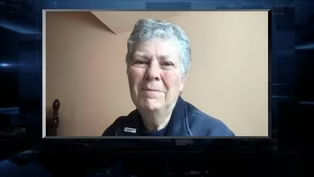
BREAKING BARRIERS: NYC’S FIRST FEMALE FIREFIGHTER
Video has Closed Captions
Clip: 4/17/2023 | 12m 57s | NYC’S FIRST FEMALE FIREFIGHTER LEADS THE CHARGE TO BUILD MONUMENTS TO WOMEN (12m 57s)
Providing Support for PBS.org
Learn Moreabout PBS online sponsorship
- News and Public Affairs

Top journalists deliver compelling original analysis of the hour's headlines.

- News and Public Affairs

FRONTLINE is investigative journalism that questions, explains and changes our world.












Support for PBS provided by:
MetroFocus is a local public television program presented by THIRTEEN PBS