
MetroFocus: April 20, 2023
4/20/2023 | 28mVideo has Closed Captions
WHAT’S HOLDING UP CLIMATE PROGRESS IN NEW YORK CITY?; NEW YORK’S “COMPOST CHAMPION”
Local Law 97, part of the New York City Climate Mobilization Act of 2019's goal is to cut 40 percent of carbon emissions by 2030. Stefanos Chen of the "New York Times", explains why New York City is struggling to meet that goal. Also, Domingo Morales, founder of “Compost Power,” joins us to discuss how a grassroots campaign is helping combat global warming and promote inclusivity.
Problems playing video? | Closed Captioning Feedback
Problems playing video? | Closed Captioning Feedback
MetroFocus is a local public television program presented by THIRTEEN PBS
MetroFocus: April 20, 2023
4/20/2023 | 28mVideo has Closed Captions
Local Law 97, part of the New York City Climate Mobilization Act of 2019's goal is to cut 40 percent of carbon emissions by 2030. Stefanos Chen of the "New York Times", explains why New York City is struggling to meet that goal. Also, Domingo Morales, founder of “Compost Power,” joins us to discuss how a grassroots campaign is helping combat global warming and promote inclusivity.
Problems playing video? | Closed Captioning Feedback
How to Watch MetroFocus
MetroFocus is available to stream on pbs.org and the free PBS App, available on iPhone, Apple TV, Android TV, Android smartphones, Amazon Fire TV, Amazon Fire Tablet, Roku, Samsung Smart TV, and Vizio.
Providing Support for PBS.org
Learn Moreabout PBS online sponsorship>> tonight, New York City's ambitious climate law targets one of the biggest carbon polluters, apartment buildings.
While your building might have a tough time going green and cutting carbon before fines kick in.
From public housing to compost champion.
The young man on a mission to make composting cool and accessible for everyone.
MetroFocus starts right now.
♪ >> this is MetroFocus, with Rafael P Roman, Jack Ford, and Jenna Flanagan.
MetroFocus is made possible by sue and Edgar Wachenheim the third, Phil and M foundation, the Peter G Peterson and Joan Ganz Cooney Fund, Bernard and Denise Schwartz, Barbara Hope Zuckerberg, and Jody and John Arnhold, Dr. Robert C and Tina song foundation, the Andro's Monell foundation, estate of Roland Karlen, Dr. P Roy and Diana T Vacek los, estate of Worthington a Smith.
♪ ♪ >> good evening and welcome to MetroFocus.
In 2019, the New York City Council passed a groundbreaking climate law designed to drastically reduce carbon emissions by setting strict limits on the biggest polluters, buildings.
The law part of the mayor's New York City renew deal was hailed at the time of the model for how cities can take bold action on climate change.
A recent report revealed on the clock ticking, many homeowners are facing a tough time, facing million of dollars of penalties if they fail.
Infrastructure updates are costly, especially for the oldest apartment buildings.
Some more than a century old.
Property owners feel they are stuck between a rock and a hard place.
Adapting the law would weaken the city's efforts to go green.
Joining me to talk about the issue as part of the ongoing promise initiative on climate change and solutions is Stefanos Chen.
Thank you so much for joining us.
It was a fascinating article that you wrote.
I will admit not living in New York City, I was not familiar with all of the details.
Let's start off with the backdrop to help viewers understand this.
How was it that the law came about back in 2019.
>> in 2019 when they passed the landmark bills attempting to curb the carbon emissions to do something about climate change.
I think what a lot of folks don't realize is our biggest polluter in New York City is not trucks outside, though they are a big component, it is buildings.
In New York, having one of the dirtiest housing stocks in the country has quite a lot to retrofit an upgrade.
>> that was one of the more fascinating aspects.
It was not all of the trucks and traffic coming in and out, it was buildings.
That is the backdrop.
Give us a sense of what this law , this series of laws, what do they provide?
>> a framework for stopping climate change to a degree that we believe, the scientific community believes, can be sufficient to prevent the worst catastrophic climate change events in the future.
And there are very rigid dates in which we want to get this done.
The loss outline by 2030, significant carbon emission reduction we need.
2040, 2050.
If we don't hit these mile markers, we are in trouble -- it is too late, to make those changes.
>> then the introduction there could be hefty penalties, what kind of penalties might we be talking about?
>> I the criticism from some is this is a law with a lot of steak and no carrots is the way it is described.
Also important that the penalties are to dis-incentivize building owners, whether it is condo, rental building, office buildings, and to do that, they have created a measure, this complicated formula by which they measure at the end of the year how much carbon the building has put out.
If you are in excess of that goal, you will be fined for this carbon emission.
Most buildings by 2024, the first major hurdle, will pass this.
Those that don't have huge fees.
By 2030, the first giant hurdle buildings have to cross, some buildings are looking at hundreds of thousands of dollars a year they will have to pay.
Thinking of some of the condos, if you have ever been one of these meetings, a lot of these buildings don't have the deep reserves to pay for that year on year.
>> you point to a number of particular situations.
One I was struck by with a conversation with a man who works in the realm of climate change.
And he is in one of these positions where they have to make some hard decisions.
Give us a sense of his situation and why it was so ironic.
>> it was interesting we interviewed a person very much behind preventing the worst of climate change.
He has a PhD, specifically these issues of climate change mitigation and the waste due to buildings.
When he gets home after his day job, he's on the board of his condo.
He has a more than 100-year-old brick building in New York that just recently had to fight all sorts of issues to get off of oil in the building.
Some of the dirtiest oil in the buildings.
Now you have a building struggling to get up-to-date because of the costs involved with it and construction is expensive in the city.
Now they have this decision to make with a hard deadline that says you've got to cut down emissions by this much by 2030.
There is no clear way for them to do it.
Adding solar panels to the roof, putting in what are called the split heating systems that are electric instead of the gas boiler or the oil boiler?
All of these comes with trade-offs and different costs.
It is hard to run up these systems through old buildings.
He's telling me he's got to spend over $600,000 to spend as of today and be compliant with city rules.
All of these other projects are on top of those costs.
As much as he wants to hit these goals, he's worried he's got to convince everyone else to go along with it.
Indecisive means nothing gets done in the building and they are facing fees.
>> another one of the telling illustrations you used was a housing complex Queens.
A series of homes.
Tell us about that situation and their particular problems.
>> the thing about New York housing stock, not only is it old, but it is Corky and really out of the gambit in terms of what you're looking at.
It is a co-op community.
But when you think of a co-op, you think of one vertical building, brick.
This is near the border of Long Island where it is on over 100 acres, if you look on the street, they look like several dozen single-family, two family homes.
They are considered a single co-op entity under this law.
This 100 acre property, they also have to comply with these rules.
The estimate that the co-op board owner has come up with is just to go all electric as has been suggested to them to get out of the gas and oil systems, would cost somewhere in the range of $30 million.
When he crunches the numbers on that, it seems he would have to raise maintenance on these numbers, many of them elderly folks.
He's struggling those concerns.
There is also a reluctance and cynicism because they feel as though they have already complied with recent changes to the law.
Change to natural gas, they thought natural gas was clean.
Making these changes, will it come back to me in a few years and say I have not done enough?
>> I was going to ask about that.
You talk about the notion of increasing standards as we go along here five years, 10 years, 15 years.
The problems that that provides for landlord-tenant owners.
>> these are going to be staggered goals.
They only get harder from here.
That is why the buildings really have to start being forward-looking.
Many of them in conversations have not given this much serious thought, which is troubling.
These are projects that will take years to get going.
Think about those that take place on these boards for anyone on board anyone is willing to increase the common charges or the maintenance fees to pay for this stuff.
20 or 30 is not far away.
2024, the first year buildings can start to get penalized based on what they do is around a corner.
It is only going to get harder.
The decision they make today has to future proof them for years to come.
>> is there any prospect of financial health for state government or the federal government?
>> there are several programs both city and state are offering.
There are loans and grants.
Financial help for these buildings.
Right now, it is an issue of communicating these programs to the boards.
Helping them understand what is available.
There is still confusion.
The department building still has to rule on important contours of this law.
The main one is local law 97.
There will be a group of them that may get -- under something called good faith exemptions.
Buildings that have tried their best but can prove they can't do anymore under certain conditions.
May not to have pay as much penalties for instance.
That guidance has not come out yet.
There is also concerned about whether there may be loopholes in this law.
A lot of environmental advocacy groups are concerned they fought this fight to get the law on the books, and now that there are large industry special interest groups who will carve out enough holes that it makes the law ineffective.
>> are there any talks taking place, any movements that might result in either pushing some of these deadlines back or creating some sort of amendments to the laws?
>> there is a councilmember in Northeast Queens who has sponsored a bill to essentially pause this law for seven years.
The thinking is it will give homeowners more time to get their ducks in a row, get ready for this.
The concern is it is kicking the can down the road.
We already know through substantial research that this is coming one way or the other.
We cannot postpone what is seemingly inevitable.
If we don't cut down on these emissions, we are in deep trouble.
New York is one of the biggest cities and is being looked at.
If New York kicks the can down the road, what does it mean for the other municipalities who have adopted similar laws?
Do you anticipate that there will be changes or a pause impose on these laws?
>> Hard to say.
As you mentioned earlier, it was Bill de Blasio's big push.
We were under a different administration.
As of today, Department of buildings, agencies involved are saying that they are committed to doing this and enforcing this.
We also know that Mayor Adams has made sharp cuts in the budgets of these same agencies and will be required to enforce the laws.
It is an open question.
>> stuff enough chen, it was a marvelous article, well reported.
Certainly very revealing.
We appreciate you spending time with us.
We will check in with you as it moves on to see what progress is taking place.
Thank you so much.
>> thank you.
>> in a city where one third of all garbage is compostable, most trash ends up in landfills where it releases methane and contributes to global warming.
Our next guest has made it his personal mission to do something about that.
He grew up in New York City public housing.
As a young man, he discovered a passion for urban farming, environmental justice, and composting.
He started compost power.
An organization that maintains a growing number of public housing composting sites across the city.
Here is Domingo explaining what he's trying to do.
>> I want to build a compost site and help the community stand on their feet so they can take over it and I can walk away and build more.
I was not just giving the power to the people.
Not only am I reducing the waste that goes to landfills and generates methane emissions, I'm creating a resource.
I want to hit the areas the sanitation, dsny, sort of missed.
Those spots I really wanted to compost but did not have a job nearby.
>> joining us reporting on the human stories of climate change and its solutions is Domingo Morales, the founder of compost power.
Thank you for joining us.
>> thank you for having me.
>> let's start with the first question.
Explain what is composting.
>> composting is basically the human managed process of recycling organic matter and turning it into something we can use as fertilizer to grow more food, to cultivate tree pits, plants and shrubs through New York City.
>> if you were going to engage in some composting today, what would you be working with, and what would you be doing with it?
>> if we are composting today, we are working on residential food scraps.
Things in people's home they cannot eat, apple cores, banana peels, anything you cannot really eat, you cannot use.
Green waste comes to the farms.
Composting is when you take that nitrogen rich material and we blend it in leaves, would chips, that nitrogen put together starts a chemical reaction, biological reaction with microorganisms.
Fungus, bacteria, and incense work together to recycle that material and turn it into something new plants can use as nutrients and organic matter.
>> I will ask more about where this is being done.
But how about your involvement in this?
You are still a young man, you became passionate about these issues and working on this.
I also read that when you were a young man, you did not like germs, you did not like dirt, which makes it an interesting question.
How did you become the champion of composting in New York City?
>> I hated the thought of germs.
I did not like public transportation because of how dirty it can be.
My family members would drink from my cup and I would not be able to drink that anymore.
I've always had a fear of germs.
I hated bugs.
When I started in America Corp. program, they sort of threw me under the table, like here you go, you will farm in a public housing community, you will work with food scraps.
I was working around food.
It was hard for me to get used to working in these conditions, but working with my mentor at that time, he showed me the importance of the good terms.
The fungus and bacteria essential for creating life.
Suppressing those diseases I was afraid of.
Really the education and hands-on training that got me away from being afraid of germs, and now I love germs.
It took a life of its own.
Now I'm teaching the importance of composting and working with these germs.
>> we often hear the notion of how engaged convert can be.
I think you fit the definition, somebody who said no to our want to do this, you mentioned teaching.
How important is the education component of what you are doing and what compost power is doing?
>> it is important.
When I talk about composting in New York City, a lot of systems are in place that are centralized.
We have the program with the Department of sanitation where they put a been in front of people's building, and it goes away.
The difference is we are giving people the hands-on training.
They are giving your food scraps.
It takes a lot of work.
People shoveling, chopping food scraps, blending it.
It takes months for this to turn into a product we can use to rebuild our land.
Through that process, we can change people's behavior.
They see how much works go into it, how many staff members we need to process organic matter.
We cannot really change the behavior of the average resident without giving them the infrastructure to compost and education necessary to do it.
Once we have the infrastructure and education, hands-on training, only then can an average resident change their behavior in their individual households.
>> education can have a number of components.
What do you say to somebody who seems to be interested?
you explain the process the way you explained it to us.
And they say I understand this, but what is the big picture?
What is the benefit other than get rid of this, how can it be helpful?
>> if everybody was composting organic waste in a local facility in their household, however they want to compost, and reduce the amount of trucks trucking waste through the city, we can reduce the waste going to landfill.
When it goes to landfill, it generates methane.
It can be 80 times more potent than regular CO2.
If everybody composted, we can grow the rate of climate change by 30%.
That is something people don't realize.
It regenerates our soil, allowing us to grow food in soil that might be contaminated with lead, arsenic, we can grow new food in local communities.
We are rehabilitating our soil, diverting waste, and reducing the amount of greenhouse gases we are reducing with our waste.
On top of that, we are feeding people.
>> all good benefits.
Tell us about what you have done in terms of setting up and how you have set up the various composting sites around the city.
>> the great thing about the sites I have is I'm partnered with Green city Forest.
The America program that threw me into it.
They are growing food in public housing communities on public housing land and giving the food away to residents for free.
What I was aiming to do was utilize that farm, build a compost component where we are taking the organic waste from the farm, also food scraps from the residents who come once a week to pick up fresh veggies they can eat.
A barter system, that your food from the farmers market and bring us food scraps.
We will build a wooden structure with three different bins that have different stage of compost.
The first stage, just food scraps and carbon rich materials.
Second stage, begets all the way to 55 degrees Celsius.
You will see steam coming from it.
The third stage, the mature compost with earthworms, biodiversity.
That is the material we use to apply compost to the canvases we operate.
We have five sites on public housing land, one on private land with a partnership with management in Williamsburg.
We use it to bring large groups of young adults to give them the training to manage smaller scale sites through the city.
>> do you envision this is a grassroots movement, or do you see it being something government takes over, or a combination of the two?
>> right now it is a grassroots movement.
When New York City faces financial hardship, sustainability.
I put it on the back earner until they can find the money to do those programs.
We have been able to utilize grants, fundraising, we have the pool from the neighborhoods.
We have been able to keep it consistent.
Since we started working with Green city Forest in late 2020, we have been able to keep these consistent.
We have not shut down any programs.
The idea is we keep it grassroots.
For this to work, we have to work with large scale, posters, the New York City compost project, Department of sanitation.
It will take the centralized system sanitation has come a decentralized system compost powerhouse, other nonprofits the city working to get to the zero waste program.
It will be grassroots, but we will take funding if that is something they want to give us.
>> somebody is watching this and saying it sounds interesting, I wonder how to get involved.
What is the answer?
>> there are many programs you can get involved with.
Go online and look up New York City composting.
You will find outlets.
Food scraps drop-off is a keyword.
A place to bring food scraps and you know they will take it to a compost facility.
You can visit the compost power on our website.
It has a list of the sites we have.
Reach out to these different partners through the city.
Send a message through Instagram, email.
Let us know that you want to get involved.
Another way is separating waste at home.
>> that first step.
Domingo Morales, good work.
Thank you for joining us.
Good luck moving forward.
>> thank you.
>> thank you for tuning into MetroFocus.
Take our award-winning program wherever you go with MetroFocus the podcast.
Listen and subscribe wherever you get your podcasts or you never miss an episode, or ask your smart speaker to play MetroFocus.
Also available at metrofocus.org, and on the NPR one app.
>> MetroFocus is made possible by Sue and Edgar Wachenheim the third, Philip and M D'Agostino foundation, the Peter G Peterson and Joan Ganz Cooney Fund, Bernard and Denise Schwartz, Barbara Hope Zuckerberg, and by Jody and John Arnhold, Dr. Robert C and Tina song foundation, the Ambrose Monell foundation, estate of Roland Karlen, and Diana D of Angelo's, estate of Worthington Mayo Smith, -- ♪
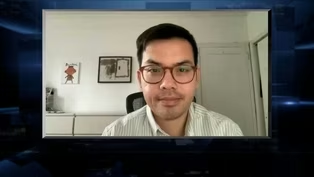
WHAT’S HOLDING UP CLIMATE PROGRESS IN NEW YORK CITY?
Video has Closed Captions
PERIL & PROMISE – WHAT’S HOLDING UP CLIMATE PROGRESS IN NEW YORK CITY? (13m)
Providing Support for PBS.org
Learn Moreabout PBS online sponsorship
- News and Public Affairs

Top journalists deliver compelling original analysis of the hour's headlines.

- News and Public Affairs

FRONTLINE is investigative journalism that questions, explains and changes our world.












Support for PBS provided by:
MetroFocus is a local public television program presented by THIRTEEN PBS