
MetroFocus: April 25, 2023
4/25/2023 | 28mVideo has Closed Captions
PEPSICO & ROBIN HOOD REPORT HOW THEIR PARTNERSHIP TRANSFORMED THE LIVES OF YOUNG WOMEN
Tonight, as part of our Chasing the Dream initiative on poverty, justice, and economic opportunity in America, the PepsiCo and Robin Hood teams discuss how their partnership has transformed the lives of young women in the Bronx. Then, The 92nd Street Y hosts a discussion series called “Reel Pieces." The series host Annette Insdorf shares some behind the scenes stories.
Problems playing video? | Closed Captioning Feedback
Problems playing video? | Closed Captioning Feedback
MetroFocus is a local public television program presented by THIRTEEN PBS
MetroFocus: April 25, 2023
4/25/2023 | 28mVideo has Closed Captions
Tonight, as part of our Chasing the Dream initiative on poverty, justice, and economic opportunity in America, the PepsiCo and Robin Hood teams discuss how their partnership has transformed the lives of young women in the Bronx. Then, The 92nd Street Y hosts a discussion series called “Reel Pieces." The series host Annette Insdorf shares some behind the scenes stories.
Problems playing video? | Closed Captioning Feedback
How to Watch MetroFocus
MetroFocus is available to stream on pbs.org and the free PBS App, available on iPhone, Apple TV, Android TV, Android smartphones, Amazon Fire TV, Amazon Fire Tablet, Roku, Samsung Smart TV, and Vizio.
Providing Support for PBS.org
Learn Moreabout PBS online sponsorship♪ >> We spotlighted the good deeds at Robin Hood and PepsiCo, fighting poverty that is still going strong, helping young women from the Bronx break into new careers.
Then she sat down with Hollywood's biggest stars, film historian Annette sits down with us.
MetroFocus starts right now.
♪ >> This is MetroFocus, with Rafael, Jack Ford, and Jenna Flanagan, MetroFocus is made possible by Sue and Edgar Wachenheim III, Filomen M. D'Agostino Foundation, the Joan Ganz Cooney fund, Barbara Hope Zuckerberg, and by Jody and John Arnhold, The Ambrose Monell Foundation, state of Roland Karlen, The JPB Foundation.
>> Good evening and welcome to MetroFocus, the Bronx is owned to the highest concentration of women living in poverty, one in three women lacking the proper resources to support themselves and their families.
We brought you a story about two organizations coming together to solve the problem, if she and Robin Hood -- PepsiCo and Robin Hood.
These organizations have been collaborating to support workforce training programs for thousands of young women in the Bronx.
We are following up with our friends from PepsiCo and Robin Hood to hear how successful this collaboration has been.
Joining us as part of this is Charlene Denizard, Senior Director, Sarah Oltmans that chief of grand strategy at Robin Hood and to the women who participated in the nontraditional program for women, Nyaisha Lee and Fox Williams.
Thank you for joining us.
Let me start off, let us take a look back, I will start off with Charlene first if I can.
What was it that made you look at the Robin Hood group and say this could be a good place for us to partner?
Charlene: Thank you for having me and highlighting this work, it was wonderful to highlight what we were going to do and even a better story when we came back and said this is what we actually accomplished.
New York City is in our backyard, the world headquarters is in here -- is here.
Like to do work in our own backyard, we looked for wonderful partners where we could invest so that we do not just do work on we are making an investment and it is important to be looking at folks who are underserved, who need a step up, a leg up in opportunity and access to be able to achieve.
Robin Hood was obviously one of the best organizations in New York City, also similarly minded.
I worked for some of the best businesspeople in the world, I am fortunate enough to do philanthropy.
We are business minded and similarly Robin Hood has a board of amazing business people.
It is about impact, taking the money that they have, you can never have enough money to put the money we have and making sure that it is doing the most it can do.
Finding the best nonprofit partners who can execute on our vision.
>> Let us look at it from your perspective.
This partnership with PepsiCo and the foundation and the work that they have done, tell us about your decision to focus on the Bronx and the programs that you put together?
Sarah: Thank you again for having us here today.
I am excited to have this conversation.
We believe that your starting point should not define where you end up.
Every New Yorker deserves a fair shot.
Coming together with the coat there was for shared values, commitment to New York City -- with PepsiCo, their work shared values, a commitment to New York City, we had seen the starting statistics and we know these well.
183 women in the Bronx are living in poverty.
We felt like coming together we would be able to have greater impact.
Over the past five years we have been funding five different programs that are focused on educational opportunities and economic opportunities for women and girls.
>> Let us bring in Fox and Nyaisha to talk about your participation.
What were you doing before you became engaged in one of these programs?
What were you hoping the program could provide for you?
Fox: Before I started knew I was a robotics engineer and I taught robotics to middle school students.
I had to join because I wanted to see what commercial.
Electrical work was like.
I only focused on electronics in the smaller scale.
It helped me get exposure to commercial electrical work.
>> Let me ask you the same thing here.
What were you doing first and what drew you to the program?
Nyaisha: prior to my time with them I was working in the information technology field, as a help desk specialist or a level two helpdesk specialist.
What drew me in is I wanted to change career, have a change of pace and I wanted a tangible scale I was able to take with me -- skill I was able to take with me throughout my career.
They made me feel confident even though I am a woman, there is a place for me in all industries and the sky is the limit.
>> Just so our employers -- of yours now, we are talking about the new opportunities for women.
You mentioned you are now involved in an industry?
That has been primarily male throughout the course of its history.
How are you fading in and do you feel in some ways your presence is helping -- fitting in and how do you feel in some ways your presence is helping?
Nyaisha: we think differently at times.
I would be part of teams and we came across a problem on the site and the guys would not be able to figure it out.
With my background and the different way of how I think, I will suggest a new solution and that is what solves the problem.
It is a nice moment to have where people from different walks of life and think differently come together and we are able to create a practical solution.
>> Certainly, the essence of the notion of diversity and inclusion.
Different thoughts and different approaches and backgrounds, people who look different from others and see when they blend together.
You can indeed achieve some things.
How about you?
Nyaisha: I also would like to agree with Fox.
A woman's perspective can be very helpful.
At times, it is also important that women are present because there are preconceived notions that women cannot do the job or are not capable or have do not have the wits to do it.
It is good to show other men on the job we are capable, we are willing, and we are able.
I think that the demand is earned as well.
I am grateful to be a great representative of that.
>> I have to ask you now when you listen to these talented and successful young women, and talk about what they have gained from this program.
How does it make you feel?
Charlene: Immense pride.
I love hearing your stories and hearing how what was the concept of an idea of how we wanted to help people a few years ago it really impacts individual lives.
We should not think about the numbers are impressive and we are delighted with the numbers, our goal was to help 20,000 young women and we helped 37,000.
>> An astonishing number that you should all be very proud of!
Charlene: We feel great but it should not get past us that each one of those young women is a person with a life and who is trying to make it in the world and in many cases supporting a family, perhaps on a single income.
That is the driver and where the great sense of pride happens.
You are helping individuals.
It is not just about the big, audacious goal.
>> How about you?
Sarah: When you listen to Fox and Nyaisha speak about their experiences, if you give people opportunities you eliminate the.
Barriers in their lives.
whether it is -- barriers in their lives.
Whether it is a transportation or childcare barriers, give the people opportunities, it can be transformative.
Give them an opportunity to support themselves, their family, impressive work they have been doing.
>> What do you think, I will come back to you here, clearly, when we look at the successes of women like Fox and Nyaisha We can point to individual stories.
What about dispelling misperceptions or misconceptions about people who want to elevate themselves?
Looking for an opportunity to elevate their lives?
Charlene: I think those individuals are what do it and shows like yours who are willing to have them on and showcase them and see that Sarah and I are not the story.
They are the story.
I think it is inspirational and I think when you are a corporation or an individual and you want to help, think about where your money is going towards helping and how the organization operates.
Sarah brought up a great point about the wraparound support.
We supported a program at the college that was all about wraparound support.
It is not just about the will and the desire for people to want to get a new skill or do better, there are barriers, transportation, books, childcare, your program is not taking that into account you are not really thinking about success.
You are thinking about giving away training degrees which is not helpful.
They are a wonderful inspiration for others.
>> I will come to you for the last words and I can personally appreciate what you have done.
I was raised by single mother who went back to college in her late 30's so that she could become a teacher and raise her four children.
I know how difficult what you are doing is and how you should be applauded for the successes.
A quick question to both of you.
What would you say to another woman you may meet who heard I you got involved, what would it do for me?
Fox: It could give you limitless opportunities.
When you see the new poster you think of construction trades, and now I am in a trait I have so many more opportunities where I can become an estimator, a project manager, I had run my own electrical shop, a drafts woman, so many things, it is the entry point.
That is what branches out to numerous opportunities.
I encourage women to try it out, get into the trades, with unions, they pay for your college if you want to go back.
I know many people have gone back to get their bachelors in electrical engineering to become project managers.
The opportunities are limitless.
>> The last quick question to you, what would you say to somebody else?
Good thing you have the electrical training!
You got us back online there.
What would you say?
Nyaisha: It is the steppingstone for you to have opportunities and take advantage of this program.
It is specifically designed to help you.
In all facets of life.
You may be stock, you do not know what to do in your field, you come across a difficult situation.
There is guidance.
It is not just you graduate from the new program and you are just forgotten about.
It is a family, it is a cohort and a camaraderie amongst other women.
I just within the electrical -- not just within the electrical trades but all trades.
We will ask each other when come through this program?
You will hear yes.
It is an additional sisterhood that we have amongst each other.
>> It is a marvelous success story, you are to be applauded for what you have done and the opportunities you have taken advantage of.
You are two very talented women and clearly the sky is the limit for your successes.
Congratulations to you all for also putting this together to give women the opportunity.
Thank you for joining us, congratulations to all of your successes.
You all be well now.
♪ For the past 35 years the 92nd St has hosted irregular deception series -- a regular discussion series giving New Yorkers an inside look of the biggest movies of our time.
Since inception it has featured conversations with actors and directors and early review screenings.
It has been hosted by Annette, a world-renowned film historian, author, and academic.
Through her time moderating pieces and her time as a film professor I yell at a and her impressive career, she has interacted with countless celebrities including among many others Meryl Streep, Al Pacino, Tom Cruise, Martin Scorsese, just to name a very few.
Joining us tonight with more on her remarkable life and career is a true New York treasure, the host of the real pieces series Annette, welcome.
It is so nice to have you.
Annette: A pleasure to be with you.
>> Let me start with you, how and when did you first develop this deep passion for film?
Annette: I always loved movies as a child and because I was born in Paris, when we came to the United states my father who did not speak much English at the time, it was from movies he was learning English and I went to every film I could as a child with him.
Every time I did that the more I realized especially in my teens I do not simply love the entertainment and the spectacle, but that the way that movies were telling stories and I read a lot at the time, I loved books.
These were telling stories in an equally rich way but I had to watch them differently to understand how visual storytelling was taking place.
When I got to grad school during my PhD at Yale of all places I realized that I was not happy in the PhD program because I was missing something.
I had the sense that anything I could say about a book, a poem, had already been said.
Movies, in the 70's they had not yet been discussed to death.
I started going to the Yale film society every night, the Berkeley film society, the Yale film society, I would go twice, sometimes I would see the film twice in a row back to back, the first time to enjoy and the second time taking notes to see how the film created my reactions.
I was in the right place at the right time, the day I got my PhD in English I was hired that afternoon by the art history department at Yale because they had just lost the adjunct professor who was supposed to be teaching two film courses the final year.
A lot of it is luck and I had already taught a seminar on the French new wave as a grad student that had been quite successful.
I went.
>> Right place, right time.
As a student of Yale I went to so many film societies, they provided me with wonderful opportunities to sit down and to watch and listen and be moved.
Let us move ourselves as I mentioned, Utah to a Yale, Columbia, overlapped for a period of time.
You have written a number of books about films.
How did that come about?
Annette: I was approached around 1979 when I moved to New York from New Haven.
By the 92nd St White it was John Cascade and Daniel Stern, I was writing a book about filming the Holocaust, it was my landmark study.
They asked me to talk about the Holocaust film and at that time around 1979 or 1980 there were not that many elevated discussions about filming the Holocaust.
After that it was quite successful, co-moderated series with Michael Webb and with film and politics and history.
I got my own series in 19 83.
It was the first time, criticism and screenwriters and I realized how much I loved the audiences.
They were literate, curious, affectionate, they were they were familiar with a great deal from the other arts, poetry, the poetry center I used to go to at night.
I was encouraged by a number of different superiors over the years to suggest things I thought the audience would appreciate in Manhattan of all places.
Real pieces emerged after a certain time because I did not want to interview just actors, just screenwriters, just directors, I had already done two series where there were no guests, it was me discussing the books.
With real pieces I said let me have free reign to interview whoever I think will be able to help us appreciate and understand cinematic storytelling, how it film was made, what it is supposed to be doing for us and the first year was exactly.
It was 1987, 37 years ago that I did one week was the editor Ralph Rosenblum and we showed Andy Hall and the producer was David Putnam.
It was a fantastic way to engage with not just at that time -- it was not celebrity oriented, it was to show a really good movie and have somebody who played a key role in it answer questions about its gestation, process, its meaning.
>> To truly learn and mixing metaphors and pulling back the curtain if you well on films.
The 92nd two why has been so good at these offerings.
I had the great fortune to host some interviews and some panels are number of years back including Opera covered the O.J.
Simpson trial and I interviewed the participants of that.
I was so struck by the audience and how engaged and engaging they were.
I am sure you have been asked this and this is akin to asking a parent about their favorite child so I would not phrase it that way.
Give us one or two of your more memorable interviews?
Who would you point to?
Annette: The first time that Ben was my guest I was dumbstruck, actually by extraordinarily articulate he was.
I am not used to interviewing actors who are more perceptive of their process and able to articulate it then directors and writer.
Here was Sir Ben Kingsley with just the most beautiful way of expressing what he does as an actor but also what films can mean in the lives of those who watch them.
The deep enhancement that can come from that.
If I had to pick only one interview to watch again I think that would be the one.
I also have been so fortunate, on that evening, Ben Kingsley quoted me because I had been on the jury of the Berlin film festival with him.
I suggested that we had to have some shared criteria for what makes a film great.
He agreed.
I came up with a proposal that he accepted and then on stayed with me that night he told my audience Annette has given us a way to understand what criteria should be.
He had said something like it should be a good story worth the price of admission, it should use the appropriate cinematic language for the tail being told, and number three, it should offer some kind of illumination, an enhancement of our lives to take with us after the film is over.
Something that makes us a better person.
We adopted that and -- >> I will add this, I have seen where Sir Ben Kingsley had said since that time whatever he reviews a script for some potential work for him, he said I use Annette's three guidelines.
For me to decide is this something I want to do?
That is pretty impressive that he has an impact on you and you had an impact on him.
Here is another thing is we are talking about New York City, talk about Hollywood.
.
An overarching term to talk about the film industry.
How about New York's impacts on the film industry?
Back then and even today?
Annette: It is huge.
Let us just admit that I am drawn perhaps much more to independent films nurtured by an East's coast -- East Coast sensibility rather than Hollywood movies.
The pawnbroker, the 92nd St wide, the films of Woody Allen, he was my guest at least twice, possibly three times.
The films of Scorsese who was my guest early on.
It goes further back to an individual that I show in classes.
He was the maverick of New York, low-budget, indie filmmaking, it captured the rhythm, not just of the street but the rhythm of our bodies moving through the streets in movies like shadows, his first feature around 1959.
I do believe one of these pieces remains exciting for me and hopefully the audiences is because we are in New York and even if I show a foreign film or a Hollywood film, the sensibility we bring to movies is a little bit sharper and faster.
>> We are in New York, we are of New York, and many ways we are New York.
There is so much more I would love to talk with you about.
Unfortunately do not have the time but I want to make sure we come back and continue this conversation.
I want to remind people this marvelous series does such wonderful work across the board.
35 years, still counting and still being wonderful.
Thank you so much for joining us and we look forward to talking with you again.
You be well.
Annette: Thank you very much.
Goodbye.
>> Thank you for tuning in, you can take our award-winning program wherever you go with MetroFocus, the podcast.
It is and to subscribe wherever you get your podcasts so you never forget an episode.
Also available on budget focus.
work/radio -- on MetroFocus .org/radio and on our app.
>> MetroFocus is made possible by Sue and Edgar Wachenheim III, Filomen M. D'Agostino Foundation, Joan Ganz Cooney Fund, Denise Schwartz, Barbara Hope Zuckerberg Jody and John Arnold , Dr. Robert C. and Tina Sohn Foundation The Ambrose Monell Foundation Estate of Roland Karlen The JPB Foundation .
♪
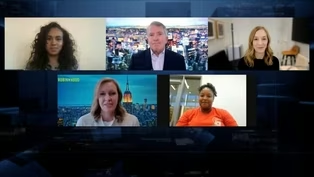
PEPSICO & ROBIN HOOD REPORT HOW THEY TRANSFORMED LIVES
Video has Closed Captions
Clip: 4/25/2023 | 13m 52s | PEPSICO & ROBIN HOOD ON HOW THEIR PARTNERSHIP TRANSFORMED THE LIVES OF WOMEN IN THE BRONX (13m 52s)
Providing Support for PBS.org
Learn Moreabout PBS online sponsorship
- News and Public Affairs

Top journalists deliver compelling original analysis of the hour's headlines.

- News and Public Affairs

FRONTLINE is investigative journalism that questions, explains and changes our world.












Support for PBS provided by:
MetroFocus is a local public television program presented by THIRTEEN PBS