
MetroFocus: April 3, 2023
4/3/2023 | 28mVideo has Closed Captions
NYC COUNCILMEMBER WARNS DON’T TAKE VOTERS FOR GRANTED; THE TESTICULAR CANCER SOCIETY
Are Democrats taking voters in historically blue cities like New York for granted? Councilmember Justin Brannan says yes. He joins us to discuss where the Democratic Party should go from here. Then, Mike Craycraft, a testicular cancer survivor and founder of the Testicular Cancer Society joins us to discuss the "Most Checked Balls On Earth" social media campaign.
Problems playing video? | Closed Captioning Feedback
Problems playing video? | Closed Captioning Feedback
MetroFocus is a local public television program presented by THIRTEEN PBS
MetroFocus: April 3, 2023
4/3/2023 | 28mVideo has Closed Captions
Are Democrats taking voters in historically blue cities like New York for granted? Councilmember Justin Brannan says yes. He joins us to discuss where the Democratic Party should go from here. Then, Mike Craycraft, a testicular cancer survivor and founder of the Testicular Cancer Society joins us to discuss the "Most Checked Balls On Earth" social media campaign.
Problems playing video? | Closed Captioning Feedback
How to Watch MetroFocus
MetroFocus is available to stream on pbs.org and the free PBS App, available on iPhone, Apple TV, Android TV, Android smartphones, Amazon Fire TV, Amazon Fire Tablet, Roku, Samsung Smart TV, and Vizio.
Providing Support for PBS.org
Learn Moreabout PBS online sponsorship>> tonight could a blue city like New York actually turned red.
Why one lawmaker is calling out his fellow Democrats for failing to listen to voters about crime.
Cancer is difficult to talk about especially when it affects the most intimate parts of our body.
Listen to the testicular advocate talking to the stage.
"MetroFocus" starts right now.
♪ ♪ >> This is "MetroFocus," with Rafael Pi Roman, Jack Ford and Jenna Flanagan.
"MetroFocus" is made possible by Sue and Edgar Wachenheim the third.
D'Agostino foundation.
Bernard and a new Schwartz.
Barbara Hope Zuckerberg and by Jordan and Johnny Arnhold, The Ambrose Monell Foundation.
The estate of Roland Karlen.
♪ >> good evening and welcome to "MetroFocus."
Are Democrats taking voters in historically blue states like New York for granted?
he represents the largely working-class 43rd district in Southwest Brooklyn says yes.
In a recent op-ed for city and state he argues that it is a serious problem which urgent lead needs to be -- urgently needs to be corrected.
He wrote the piece not long after the caucus which made up nearly 70% of the entire body lost almost half of its members after the leaders asked them to sign a statement pledging to do everything possible to reduce the size and scope of the NYPD and Department of Corrections.
The council is one of the members that left the progressive Caucus and joins us now to talk about that incident, the op-ed and where Democrats go from here.
Councilmember Brendan, thank you for joining us.
>> thank you for having me again.
Rafael: councilmember, we will try to talk on all of the things you mentioned.
But I would like to begin with a couple of things you wrote in your op-ed that calmly attention.
You stay early in the peas for example that the Republican Party has perfected the art of getting people to vote against their own interests.
Can you give us some examples of that?
>> the first thing that comes to mind is union labor.
So much of what we take for granted now with the rights we have been afforded in the workplace other it is then 9-5 -- 9-5 workday or paid sick leave -- the things we take for granted would not of been possible without the struggle of organized labor which has always been a tenant of the Democratic Party.
I often think about the book "what is the matter with Kansas" at talked about this decades ago that the Republican Party has done a masterful job with concocting these endless and imaginary culture wars that have us does directed from what we should be worried about which is the fact that we should be fighting a class war instead of fighting each other over these culture wars.
I think organized labor is the biggest piece of that.
People voting against their own interests when they owe quality of life and the family they have been able to raise and the house they have been able to buy to organized labor which the Republican party has gone out of its way to the road and destroyed.
That is one of the glaring things that come to mind.
Rafael: you have run twice for a city Council in 2017 and 21 and you won both races but they have been close.
Then your first raise your Republican opponent got nearly 40% and in the second race 49%.
You believe that nearly half of the voters, were voting against their own interest in the 43rd district which is mostly working-class.
>> it is a good question.
Out here in southern Brooklyn ever since Donald Trump, Democrats do not win by landslides.
For us winning by a thousand votes would be a huge feet.
The work we do an margin of victory is thanks to constituent services and helping people with their daily issues they have in quality of life.
Unfortunately now, ever since Donald Trump, things have gotten so polarized and tribal that even that -- I will give you a for instance.
When I worked for my predecessor people used to come up to him and say, you are the only Democrat I vote for.
Whether it was real or not that is what they told him.
Now they are more likely to say to me, Justin, you helped me so many times and you have done this that or the other thing, but I cannot vote for you because you are a Democrat.
Things have become so tribal iced that people are seeing past where they are blinded by what they are seeing on Fox News or Newsmax or whatever these channels are and we are becoming cartoons, basically.
My day to day as a said out -- as a city councilman is helping people with their daily lives.
I don't get involved in foreign policy or what goes on in Washington but that does not matter anymore.
I am a Democrat and if you don't like Nancy Pelosi you are also not allowed to like your local Democrat.
Rafael: I am thinking though -- maybe that is the case but it is also the case, which I think is the gist of your article which is that maybe sometimes Democratic elected officials are unaware of what their constituents think is in their interests.
On the issue of crime and public safety which is the essence of your article, and in the article you argue that Democratic party is in denial about the impact that crime is having on voters.
You write "when some Democratic candidates were asked about top of mind issues for voters like crime and public safety, they also seemed dismissive of their concerns."
How so?
what are some of the colleagues of yours saying to their constituents that you deem dismissive?
>> a great question.
It is the crux of the op-ed I wrote.
The issue I am seeing is what I learned in my years in politics is that you cannot deny someone's reality.
You cannot tell someone they are not experiencing what they tell you they are experiencing.
That is number one.
When someone comes to you and says they are worried about crime, the rise in crime, it does not matter how they got to that point.
They feel a certain way.
You are never going to beat back someone's feeling by a mantra of data and statistics.
No victim of a crime wants to hear about how New York City is safer than it was in the 70's and 80's.
No one who was just mugged on the street or witnessed a crime wants to hear that.
While it may be drew and while the data and statistics may say a certain thing, we have to talk about how people feel.
It is important you don't lean into the historic area -- hysteria.
You have to take people seriously.
Denying peoples reality or telling them they are silly that they should not feel that way because the statistics say something else, that is not a winning strategy.
Democrats have to take people seriously.
If they come to us with concerns we have to number one take the concerns seriously and work to address those concerns.
Telling people they are silly to file certain way or they should not feel a certain way because the data test something else is not a winning strategy.
Rafael: that was in the introduction earlier this year.
It lost nearly half of its members, 15 after its leaders asked the Caucus members to sign a statement saying to do everything we can to reduce the size and scope of the NYPD and a Robin of corrections.
You were one of the 15 who left the progressive caucus.
To what extent did that or does that incident reflect the problems you annunciate -- in NCAA in your op-ed -- enunciate in your op-ed?
and to what extent was that the motivation for you to write your piece?
>> it was a coincidence.
I had already written a piece when the progressive caucus decided to pass around this pledge they wanted folks to take.
It became a bit of a Rorschach test for people.
As a public official public safety will be my top priority.
Any elected official has a number one priority of public safety.
That does not -- in my area we have more cops on patrol than ever before but you also have to address the root causes of crime and you have to talk about access to jobs and health care and affordable housing and education.
And take a holistic look.
But to put a dollar figure on reimagining public safety I think is shortsighted.
There is no dollar figure that you can defund the police department that will allow you to reimagine public safety.
I think it is about taking a holistic approach.
I would agree the scope of the police department needs to be changed.
Police officers signed up to catch bad guys.
Not to be mental health officials or deal with people dealing with homelessness.
They signed up to keep people safe and catch bad guys.
And most cops would agree with that.
When you talk about the scope of the police department I would agree that we need to let cops do the job they signed up to do but when you talk about defunding the police or abolishing the police department, it is a crazy notion and not something I think most New Yorkers or Americans agree with.
Rafael: because of the redistricting that took place last year, all 51 seats are on the ballot this year.
Rather than two years from now which would ordinarily be the case.
I saw an argument in a couple of pieces I read.
Some of the members of the progressive caucus who left the caucus separated themselves from it and its continued demand to defund or reduce funding for the NYPD because the election is happening this year and because they sense that New York voters are moving to the center have not the right on the issue of crime.
>> it was a can one sentence -- it was a coincidence of timing.
I did not wake up and decide to leave the progressive caucus because of an election coming out.
I decided to leave because of the pledge.
That is when those of us that love decided to make that decision.
For me it was not a strategic decision.
I make -- I made two pledges, an oath to serve my constituents and I took a pledge to love my wife in sickness and in health.
Those are the only pledges I will take.
The timing was about when they asked us to take the pledge.
It was not that we woke up, those of us that have an election and decided to leave the caucus.
Rafael: what concrete must that -- what concretely must Democrats do to stop taking voters for granted?
>> the Republican party is a complete circus.
A disaster.
My point is that even so, even if it is a dumpster fire on wheels, that is not enough.
The Democrats cannot say -- they are crazy and we are not them.
That is not a platform.
Emma Kratz have to be grounded on a platform that means voters where they are at and talks to them about the things that they care about, quality of life issues, public schools, Universal Health care, job creation, raising wages, union jobs.
Universal Health care.
Love these issues we have -- all of these issues we have to be eloquent and talk to people in a way we are not talking down to them.
We have to talk to them in a way that shows we are taking their concerns seriously.
And meeting them with solutions.
I think that would work not just in New York but across the country.
Rafael: are you optimistic that the Democrats here and everywhere will take that lesson?
>> I hope so.
I think it is the winning lesson.
I think you will see across the country that people want to hear what the Democrats are doing to make their lives better.
If we can verbalize that I think we can win some elections.
Rafael: councilmember Brennan, thank you for joining us.
Good luck to you.
>> thank you so much.
♪ >> good evening and welcome to "MetroFocus."
New York City is the home to the most checked balls on earth.
Now that I have your attention that does the new campaign coming from the testicular cancer society.
The group is using humor and the famous Wall Street statute about the importance of self-examination.
According to new research, over 40% of American men never bother to check themselves for testing killer cancer.
This despite the fact that doctors recommend a self-examination at least once a -- once a month.
Testicular cancer is the most common type of cancer for men between the ages of 15 and 35 and when it is caught early enough it has a 99% survival rate highlighting the poor for cash the importance of frequent self-examination.
Joining us now to discuss why you should check yourself protest a killer cancer and to highlight the new campaign is Mike, he is a testicular cancer survivor and the founder of the testicular cancer society.
Welcome and thank you for joining us.
>> thank you for having me.
Jack: I think to give us a sense of perspective it makes sense to start with your story about your own condition and how you found it and treatment and how you are now.
>> I am actually a clinical pharmacist by trade so a health care professional.
I was living in Florida after hurricane Wilma.
I sat down on the couch and adjust myself and felt a lump.
I knew it was cancer.
And entered a vicious cycle of fear, denial and mostly not wanting to upset others saying I am sick.
I remained silent about it and convince myself I was going to die from metastatic disease even through my own going away party and miraculously finally went to the doctor seven months later and was diagnosed with stage one disease.
I had the testicle removed and now just monitoring to make sure it does not come back.
Jack: talk about how your experience drove you to the creation of the organization.
>> it was just out of me.
There were not many resources available for testicular cancer in 2006 and what was there was hard to find.
With my survivor experience and health care, professional experience I thought I was uniquely positioned to change that.
Jack: what is the idea behind the society?
>> we are increasing awareness and education about testicular cancer and providing support for those affected by the disease whether that is the one diagnosed, the caregiver or other professionals.
Jack: one of the things I saw mentioned in terms of the purposes is focusing on the cure and you also use the term "and the burden of the cured."
That might sound curious to people.
Why is that so important?
What do you mean when you talk about the burden of the cured?
>> years ago a survivor said to me the doctor's cured my cancer but they did not you are my soul.
With testicular cancer being a young cancer there is a lot of life to live after diagnosis.
It is not just getting through that short-term bump of immediate treatments making sure the treatments do not cause long-term impacts down the road.
I looked out and had stage one disease and got by with surgery.
Others need chemotherapy and there are long terms of effect of that and there are major surgical procedures.
It is the burden of the cured and making sure that people have a long and healthy life after their diagnosis.
Jack: you also talked about how a stigma might impact them surrounding the notion of testicular cancer.
>> the conversations are not normalized yet about testicular cancer and as an easy litmus test if you think yourself that you are at work and with a group of friends and someone says breast cancer it is pretty open and talked about what if someone says testing killer cancer one, I don't know if you ever heard it in a situation like that and usually it is hush-hush.
Cancer is cancer.
It does not matter the body parts.
We need to raise more awareness.
Jack: let's go back and talk about some of the statistics.
Tell us a bit more about the survey your organization conducted and some of the important findings.
>> recent research we did shows over 40% of guys are not checking themselves for testicular cancer.
And those that are checking, 50% of guys are saying they don't know what to look for.
And most importantly what we saw is that 79 -- 79% of those surveyed, men and women, agreed there needed to be more awareness out there.
The need is coming from the public.
Hopefully we will meet those needs.
Jack: let's talk about the specifics that the group is advocating and start with the notion of self-examination.
What is it that men should be doing or others helping them?
I mentioned frequency but what is that you are suggesting it should be in terms of frequency?
>> basically wasted just a monthly self exam.
Simply rolling the testicle between your finger and thumb to make sure there are no lumps or bombs, make sure it is not changing consistency, making sure it is not getting bigger or smaller in size.
Testicular cancer presents as a small and painless lump on the testicle.
Doing it once a month gives you enough time to feel any changes but you are not waiting so long that the changes have a chance to advance.
If you feel something that is abnormal, leading your doctor know and going from there.
Jack: and talk a little more about the rates -- when we talk about cancers we do not always use the word yours but sometimes -- cures but sometimes we can.
We can look at statistics of reoccurrence.
What are your studies suggesting about the idea of the discovery, the treatment, and the rates of success?
>> overall, the survival rate for testicular cancer in general is 95%.
If caught in stage one disease it is almost curable, over 99% out to 15 years.
It is a matter of how far the different studies measure it.
The key is early detection.
We have effective treatments.
It is a matter of getting guys in early.
Jack: let's talk about the campaign to raise awareness.
You have introduced the element of humor into this and we talked about it in our introduction.
Why decide first of all to use the Wall Street bowl as the main character in this and why decide to incorporate the notion of humor into what is an important campaign?
>> the Wall Street balls are the most checked balls on earth.
People will line up to get their picture taken with the bull but they are not checking their own.
To reach young men and women around them because a lot of times it is the woman poking and prodding them about their health is to reach out on social media.
If someone posts a picture with the Wall Street balls we come back with a lighthearted and fun message about awareness and point them in a direction and a tutorial on how to do a self exam as a way to break the ice and to try to help normalize the conversation along with education.
Jack: when you mentioned you have responses, lighthearted responses designed to basically say to someone, you found this and be a little humorous about it but we need to be serious about you moving forward on this.
Give us a couple PBS appropriate, if you would come at responses.
The types of things that might go out as part of the campaign.
>> for example, the bull's balls , the statue is huge as are the balls so we will respond back, those are huge walls, to start a conversation about.
Did you know you should be doing a self exam?
or they will post a picture checking it out and say -- thanks for checking them out now check your own out.
It has been well-received.
A lot of people comment back and say, things or that is too funny.
It is going incredibly well and we are proud of it.
Jack: clearly one of the driving forces behind your campaign is the notion of raising awareness which is so important and we have seen it so often in different types of cancers.
As you said the process is the same, it is just which part of the body is being invaded.
How about the idea of education -- you are talking about awareness, social media which is important but we talk about this affecting young men.
You have to wonder about -- are they getting any awareness education in high school or college that could help to make them understand how important this might be?
what are you seeing right now and what are you hoping it could become?
>> there are a few states that have mandated testicular cancer education at the high school level.
Those are far and few.
We are in Ohio right now and there are 975 high schools.
It is a Herculean task to get in there without mandates and the help.
Unfortunately we have to try to figure out how to reach these guys on a different avenue and hence the social media but the awareness and education are key.
We work with three different pillars -- awareness and education, access to care and quality of care.
Overall we work on all three.
Jack: as someone is watching this or here's the story and they have questions or concerns, how do they reach out to you to get some guidance?
>> go to testicular cancer society.org.
We are here to help and give perspective and understanding.
If you feel something, say something to your doctor.
Jack: once again, the testicular cancer society doing very important work.
Mike, thank you for joining us.
We appreciate it.
♪ Jack: thank you for tuning in.
You can take our program wherever you go with "MetroFocus " the podcast.
Never miss an episode.
Or simply ask your smart speaker to play "MetroFocus" the podcast.
Also available on the NPR one app.
♪ >> "MetroFocus" is made possible by -- Sue and Edgar Wachenheim III, Filomen M D'Agostino foundation, the Peter J Peterson fund, Bernard and Denise Schwartz, Barbara Hope Zuckerberg and by Jody and John Arnold, Dr. Robert C and Tina Sohn foundation, the Ambrose Monell foundation, the estate of Roland Karlen.
♪ ♪
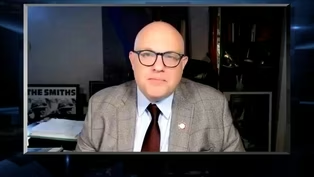
NYC COUNCILMEMBER WARNS DON’T TAKE VOTERS FOR GRANTED
Video has Closed Captions
Clip: 4/3/2023 | 13m 1s | NYC COUNCILMEMBER WARNS FELLOW DEMOCRATS DON’T TAKE VOTERS FOR GRANTED (13m 1s)
Providing Support for PBS.org
Learn Moreabout PBS online sponsorship
- News and Public Affairs

Top journalists deliver compelling original analysis of the hour's headlines.

- News and Public Affairs

FRONTLINE is investigative journalism that questions, explains and changes our world.












Support for PBS provided by:
MetroFocus is a local public television program presented by THIRTEEN PBS