
MetroFocus: July 17, 2023
7/17/2023 | 28mVideo has Closed Captions
BEHIND THE CURTAIN AT HOSPITAL FOR SPECIAL SURGERY, INCLUSIVE EDUCATION
Tonight, we’re going behind the curtain for a closer look at the future of medicine with Dr. Bryan Kelly, President, Surgeon-in-Chief and Medical Director at Hospital for Special Surgery, and Dr. Thomas Sculco, the hospital’s Surgeon-in-Chief Emeritus. Then, "The IDEAL School of Manhattan" has been a game changer for many families as New York’s only K-12+ independent inclusion school.
Problems playing video? | Closed Captioning Feedback
Problems playing video? | Closed Captioning Feedback
MetroFocus is a local public television program presented by THIRTEEN PBS
MetroFocus: July 17, 2023
7/17/2023 | 28mVideo has Closed Captions
Tonight, we’re going behind the curtain for a closer look at the future of medicine with Dr. Bryan Kelly, President, Surgeon-in-Chief and Medical Director at Hospital for Special Surgery, and Dr. Thomas Sculco, the hospital’s Surgeon-in-Chief Emeritus. Then, "The IDEAL School of Manhattan" has been a game changer for many families as New York’s only K-12+ independent inclusion school.
Problems playing video? | Closed Captioning Feedback
How to Watch MetroFocus
MetroFocus is available to stream on pbs.org and the free PBS App, available on iPhone, Apple TV, Android TV, Android smartphones, Amazon Fire TV, Amazon Fire Tablet, Roku, Samsung Smart TV, and Vizio.
Providing Support for PBS.org
Learn Moreabout PBS online sponsorship>> New York's hospital's ranking among the world's best and making the city a go to destination for orthopedic treatment.
The hospital's top doctors are into share the secrets of its incredible 100 -- 160 year run as "MetroFocus" starts right now.
♪ >> This is "MetroFocus," with Rafael Pi Roman, Jack Ford, and Jenna Flanagan.
MetroFocus is made possible by Sue and Edgar Wachenheim III.
Filomen M. D'Agostino Foundation.
The Peter G. Peterson and Joan Ganz Cooney Fund.
Bernard and Denise Schwartz.
Barbara Hope Zuckerberg.
And by Jody and John Arnhold.
Dr. Robert C. and Tina Sohn foundation.
The Ambrose Monell Foundation.
Estate of Roland Karlen.
The JPB Foundation.
>> Good evening.
Welcome to "MetroFocus."
I am Jack Ford.
New York is home to some of the world's top health care providers.
One organization that has turned the city into a go to destination for treatment is Hospital for special surgery.
Celebrating its 160th anniversary this year, HSS has been ranked number one in orthopedics in the nation for 13 years in a row by U.S. news and world report.
The hospital treats everyone from celebrities and sports stars to everyday New Yorkers.
We are going behind the curtain for a closer look at the future of medicine and what makes HA S so successful -- makes HH as so successful.
Keep in medical director will be taking over as CEO later this year.
Dr. Thomas's cocoa is a surgeon in chief marriages and director of the foundation complex joint reconstruction center at HHS -- at HSS.
Let me start off with a full disclosure.
I have been a patient at HSS on a number of different times.
I have had a knee replaced, spinal fusion surgery done.
I will give you an unsolicited testimonial, my results have been nothing short of miraculous.
Let's talk now about what you do and how you do it.
Dr. Kelly, let me start with you.
I mentioned the great success HSS has had in terms of rankings , my question to you is this.
For somebody who is not familiar with the hospital, tell us about its mission, its specialties, and how it has been able to continue its successes over the years?
>> Thank you very much for having us.
HSS, otherwise known as Hospital for special surgery, is an orthopedic muscular skeletal hospital that has been around for 160 years.
We are celebrating our 160th anniversary this year.
It started off in 1863 as a bracing hospital for young children with deformities, and has evolved over the last 160 years to a specialty hospital, focused on all aspects of muscular skeletal health.
We do close to 40,000 orthopedic surgery here per year.
But we also have impressive rheumatology department, mythology, radiology, anesthesia, and what is unique about HSS and one of the reasons why we have been fortunate enough to be able to continue to provide extraordinary care for our patients is because of the singular focus.
The ability for us, regardless of the specialty area, different departments, we are all focused on the same thing.
It is maximizing mobility for patients and allowing them to have as active of a lifestyle as they can and enjoy movement.
I think, aside from the specialty nature of it, the other thing that sets us apart is the culture and the people.
It is an environment that is focused on patient care first, highest quality care possible.
It is focused on making sure it is the best environment for clinicians to provide care, so make sure everyone has the resources they need.
And you really feel that culture of excellence and pride about the organization, at every level of the organization, whether it is the security guard when you first come in, all the way off to the senior surgeons and everything in between.
It is singular focus for high quality patients excellence.
Jack: I can attest to that, tonight unsolicited testimony, having spent a lot of nights and days there.
The quality of the people from the surgeons down.
Let me ask you about this.
People might look at the name, Hospital for special surgery and think, all they do there is surgery.
Names are interesting.
I had seen this when I first went looking at its history.
As you said, 1863, the oldest orthopedic hospital in the country.
It's name was the New York Society for the relief of the ruptured and crippled, which I thought was very curious to see how it has evolved.
Somebody might be watching this and say, the only thing you do there is surgery, nothing else?
That is not really true, right?
>> We are a muscular skeletal hospital, both surgical and nonsurgical.
For example, we have 40 rheumatologists at work here.
We have for Zaia trusts, probably 25 for Zaia just.
These are non-operative specialists in the care of buoyant -- of bone, joint, arthritis, that sort of thing.
We do a great deal of surgery, when nonsurgical treatment does not work, then we are here to deal with problems surgically.
As Brian pointed out, we are about largest muscular skeletal orthopedic Center in the world by far.
For example, a big hospital might do 1000 joint replacements a year.
.
We do 13,000.
The scale of it is tremendous.
Just to reiterate about the culture, people who work here, I'm talking from the top to the bottom, never leave.
They are committed to the care of the patients.
They love working here.
Even though we have grown significantly, it is a family.
And when you come here, they have a great deal of pride in what they do.
That makes it a special hospital.
Jack: Dr. Kelly, I want to talk a little bit about the future of medicine, orthopedic medicine.
All the things you do.
We mentioned the work you do, surgical, nonsurgical, the research done there.
From your perspective, in sports medicine, talk about what you have seen change over your time and what you are looking at the future.
When I played football at Yale back in the early 1970's, if you blew out your knee, generally speaking, you were done.
People did not come back from A.C.L.
tears.
Talk about the progress you have seen and where you think all of this is going in the future.
>> When I think about what are the core foundational pillars upon which our institution since,, the first is patient experience in quality.
The second is academic and teaching.
The third is research.
When I think -- my area of specialization, which is sports medicine, sports medicine focusing on hip injury and athletes.
The field did not exist when I was in residency programs.
When you think about the evolution of the knee replacement, or the hip replacement, much of the progress and even some of the verse knee replacements ever performed in the world occurred here.
The research component of what we are doing is not just research for writing papers and -- but to really change the future of the field of orthopedics.
We have seen a tremendous amount of progress in all aspects of orthopedics.
With much better outcomes.
At the end of the day, the reason why we are focused on research is to improve outcomes, so we can improve not just how we can help patients in the immediate present, but to make sure it is sustainable improvement in their life over time, and that requires a lot of research.
I think the future orthopedics is going to be molded by technology and innovation.
We seen this dramatically increase over the last 10 years with the implementation of robotics surgery and other surgical enabling technology that we are bringing, augmented reality and virtual reality.
We are able to train our young orthopedic residents and fellows in virtual settings.
We can actually hold conferences now and do surgery while people are observing halfway across the world.
We can actually, with virtual reality no, in simulation, we can bring other surgeons into the operating room and stand next to you virtually while you are performing a procedure.
I think it is a really exciting time for orthopedics because of all of the innovation that is occurring and the transformation that is occurring.
I think one of the reasons HSS is such an exciting place is a lot of that innovation occurs here.
We have a large orthopedic staff, incredibly talented, incredibly productive, but also incredibly inquisitive and trying to push the envelope.
We are going to continue to see that transformation.
The biggest change we are going to see is the transition from inpatient surgery to outpatient surgery.
Jack: I will come back to that in a second.
I want to come back to you, something Dr. Kelly talked about, and that is innovation.
I mentioned the complex joint reconstruction center.
You are the director, fairly new.
I know a lot of your research has to do with improvements in surgical techniques and try to eliminate failures in hip and knee replacements.
We seem to be seeing more and more, in terms of technology, the idea of 3D imaging and construction.
And patient specific implants.
Tell us where we are going on that.
>> That is a great point.
If you look at the field of joint replacement, most orthopedic surgeons are trained to do a primary or hip or knee replacement.
This center is unique in the world and that as part of our mission at the hospital, do you want to take care of the most complex problems which other centers are probably not as equipped to do.
We created a center, and it was supported to a large extent by the New Yorkers foundation.
It is the only one in the world.
The center is devoted to caring for patients who oftentimes cannot get access to care.
These are people who have bad infections after a joint replacement.
These are there complications, but they do occur.
To get back to your point about 3D, we use 3D modeling a great deal, because many of them have bone loss problems which are unique to the individual patient.
We can actually make a model.
I did a patient two weeks ago, we made a model of their pelvis, we did a mock operation on the model, and then we created an implant and used it, first on the model, then in the operating room.
That technology has enabled us to tackle the most difficult problems.
This center particularly dedicates itself to that.
Jack: Back to you, Dr. Kelly, for a second.
You mentioned, and people may find this fascinating, that the particular subspecialty did not exist when you were training.
Is your view looking forward, let's say you are looking back 20 years, now let's take 20 years forward, and some of the technology that he mentioned, will that even be essentially old-school 20 years from now?
>> I would never say anything Doctors Coco -- his career, it will always be cutting.
No, I think there will be continued evolution.
There will be improvements in technologies.
Then a example in the joint replacement world, when I was a resident, we always did total knee replacements.
The concept of a partial -- even though there are three compartments in the knee, one of them, sometimes all a three of them are diseased, but other times it is only one.
Eight used two not matter.
You would replace all three compartments.
Now it has evolved, patient specific.
What does that patient need?
Can we do a partial replacement and just address the area that is diseased?
I think -- we deal with broken bones I don't think we will ever change that.
There may be different techniques to do that which are less invasive.
I think arthritis is a very interesting one.
The disease part of arthritis has to do with the loss of cartilage in the knee.
Terror is a lot of research going on, other ways that we can grow cartilage in a laboratory, other ways we can grow cartilage in a joint.
And will there be a way in the future where we can deal with arthritic changes, at least on some level, without doing surgery, by letting the body heal itself?
It is hard to know what the future is going to look like, but I'm sure it will look different from the present.
♪ >> Tonight, we welcome the cofounders of a unique school that is providing a model for inclusive learning in the city.
The ideal school of Manhattan is New York City's only K-12 independent inclusion school.
The school has founded -- was founded 17 years ago out of three mothers from a specific need, a diverse school with small class sizes where students of all abilities can learn together.
In the same classroom.
The school has grown over the years, moving to a new, larger home down in the financial district.
Here to talk about the school as part of our chasing the dream initiative, focusing on solutions to structural inequities, are to have the cofounders of the ideal school of Manhattan.
Audra Zuckerman and Michelle Smith.
Thank you for joining us.
>> Thanks for having us.
Jack: Audra, let me come to you first.
I gave a brief background in the introduction.
We want to learn more about just how and why the decision was made to create this approach to learning.
>> Sure.
Back in 2005, Michelle and I both had young children with down syndrome.
And we were looking for a school setting where our children could be included with their peers, could go to school with their peers of the same age.
They have been included in everything that we did in our lives up until then.
Went to inclusive preschool settings.
Without, this is New York City, there are so many school options.
This will not be an issue.
We ended up coming up against a lot of roadblocks in this process.
Many of the public school settings could not provide the resources or would not provide the resources to support our students in the way that we knew they needed it to be successful.
The private schools were not interested in taking students with down syndrome.
Many of the special education schools were not inclusive or they really focused on a particular type of disability.
We thought, this is crazy.
Again, it is New York City.
How could this be possible?
We should not need to leave the city we love and wanted to raise our children in just to inclusive educational setting.
We got together with another family and we started to say to each other, let's try this.
Let's try to start a school where students of all abilities can learn together in one place, be accepted for who they are, have a curriculum that meets each student where they are in the learning process.
And can replicate the beautiful community of New York City itself and the diverse of New York City.
Jack: Michelle, let me ask you to expand on that a little bit.
I think Audra, some of her answer provided that.
But for some clarity for our viewers, when we talk about the notion of inclusive education, what does that actually mean?
>> It means, educating -- it means co-educating.
Not pulling out of classrooms.
Not any -- and creating a model where people can learn together, as long as the program and the children are surrounded with differentiated instruction.
Jack: That is an interesting point.
Let me ask you to follow up on that.
I'm sure you run into this, where some people may have a misperception or do not fully understand it and they might say, wait a minute, if you are putting everybody in one classroom, does that mean that those with, we hear the term, special needs often, does that mean they will get all the emphasis and the others will not?
What is the answer to that in terms of the balance in the classroom?
>> Our answer to that in our classrooms is c-teaching.
Everybody is met with how they learn.
All the kids, typically developing children that are nontypical are having individualized education learning planes to meet them where they are.
If math is being taught, math is directed the way it needs to be directed for that student, and nobody is being dragged down.
It's a myth.
Nobody is left behind that might be learning at a different pace.
Our answer to it was creating a co-teaching model.
To differentiate the instruction for that learner.
Jack: It sounds like such common sense.
It sounds so simple.
We are in the same structure, the same room, everybody is together, but we have teaching that is tailored to the groups.
I guess my question to you, and you mentioned this before, why wasn't it being done in New York City before you did it?
>> It is a great question.
I think there are a couple of reasons.
First is it does require some additional resources.
You have to make -- every organization has to make decisions about priorities and commitment of resources.
One way resources are important when you're talking about inclusion is the co-teaching model Michelle mentioned, a general educator and a special educator working together in a classroom.
That's an additional full head teacher in a classroom.
There is training that is involved.
There are other resources issues.
You have to make them a priority.
I think the bigger issue you come up against when you are talking about inclusion and other educational systems is it is a matter of prioritizing and believing in the value of having a diverse educational environment.
At ideal, everybody there is on board with the mission of inclusion.
It is inclusive from the top down, to the bottom up.
Nobody walks in that door and has to leave their identity behind.
It is a philosophy.
It's in our DNA.
If you are trying to convince the educators at the school or the leadership of the school, or the teachers there, you are in a different situation.
What we have at Ideal and what we would love to see in other schools, public, private, anything, across the country, is a belief in our children.
.
The belief that all children can learn, all children are valuable to a community.
That everybody bring something to the table.
And all students are teachable.
Everybody at the Ideal school believes that and we'll support one another, we celebrate each other's differences.
It's OK if one student struggles in one area.
There will be another area that they are spectacular in.
Jack: To help us understand, what does a classroom in the Ideal school look like and feel like and sound like?
>> Audra loves this one.
Audra, I would love to toss this to you.
Jack: It's all yours.
>> Quite honestly, it looks like every other classroom in America .
Our classrooms don't look different.
And in fact, oftentimes, you are not going to be able to know which students are receiving extra support.
Not everybody has a visible disability.
What you might see that is different in an Ideal school classroom as there are smaller class sizes, you were going to see more instruct in the room, that you are not going to know which teachers are focusing on which students, because everybody is working with everybody.
You might see flexible grouping, you might see students altogether in a classroom learning about a subject at one point and then breaking off into smaller groups.
Receiving their differentiated instruction, doing different projects related to the same topic in small groups.
You might see at the Ideal school, something I'm really proud of and I think we are all proud of.
We do not pull students out of the classroom to get their therapies.
You might see all students leaving the classroom to go to different electives.
One student might be going to an art elective.
One student might be going to a music elective.
One student might be getting occupational therapy.
There is no stigma, there is no difference in how they are treated and perceived by the community.
>> Here is what you feel.
When you walk in that school and you watch these human beings, teachers, admen, and the students, with each other, you feel respect.
You feel complete immersion of, this is not my friend Dylan with down syndrome and he can't read.
This is my friend Dylan.
That is what you feel.
You see and viscerally feel how, if we started teaching human banks at young ages that differences are OK, they are not scary, we all have to adapt, we all have to coexist, it is an absolutely remarkable social study to watch and feel.
Jack: How did your own children do?
How did they benefit from this type of environment?
>> I can tell you that my son Max, who is now 23 years old, he started the school, he was in first grade when we opened it, he was in the first graduating class in 2018.
He is proud of the fact that he has down syndrome.
He does not think of it as a negative.
It is just a part of his identity.
It is just part of who he is.
That is something we work very, very hard to cultivate at the school with an intentional identity curriculum, with the social justice work we do, from kindergarten on.
Every student.
It is not students with disabilities.
Have an incredibly diverse population.
Our -- are celebrating one another's aspects from the beginning.
There is also the fact that I think he did reach his potential in all of the subject areas that he worked on at school because he felt safe, he felt accepted, and he was taught to access the curriculum at the level where he was at each stage.
Jack: How about you?
>> Our model tackles bullying without having to say, tackles bullying.
My son did not get bullied.
Kids with down syndrome can be targets.
Kids with differences can be targets.
Kids without disabilities can be targets.
This model -- our school is a movement.
Our school is a pioneering movement, way back when.
And the issues that we are seeing now with bullying and the differences and just the harassment is inclusion solves the problem.
This coexistent concept from a young age, and it is in the DNA of everybody and everything, we have word of the month ideal.
It is not word of the month for special needs children.
.
It is word of the month.
We are all about civil rights, civil justice, social justice.
This is an answer to one of the most systemic problems we are seeing in youth.
Jack: Once again, the ideal school of Manhattan, just as I said before, a marvelous idea that has been put into play and has accomplished everything that we could hope for.
We just need more of it.
Our thanks to both of you, Audra and Michelle, for joining us.
We look forward to talking to you down the road and seeing how all of this is evolving.
Be well.
Take care.
>> Thank you.
>> Thank you.
♪ Jack: Thanks for tuning into "MetroFocus."
You can take our award-winning program wherever you go with MetroFocus the podcast.
Listen and subscribe wherever you get your podcasts so you never miss an episode, or ask your smart speaker to play MetroFocus the podcast.
Also available at metrofocus.org, and on the NPR one app.
♪ >> MetroFocus is made possible by Sue and Edgar Wachenheim III.
Filomen M. D'Agostino Foundation.
The Peter G. Peterson and Joan Ganz Cooney Fund.
Bernard and Denise Schwartz.
Barbara Hope Zuckerberg.
And by Jody and John Arnhold.
Dr. Robert C. and Tina Sohn foundation.
The Ambrose Monell Foundation.
Estate of Roland Karlen.
The JPB Foundation.
♪
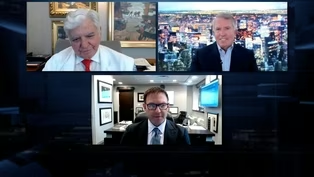
BEHIND THE CURTAIN AT HOSPITAL FOR SPECIAL SURGERY
Video has Closed Captions
Clip: 7/17/2023 | 13m 17s | BEHIND THE CURTAIN AT HOSPITAL FOR SPECIAL SURGERY (13m 17s)
Providing Support for PBS.org
Learn Moreabout PBS online sponsorship
- News and Public Affairs

Top journalists deliver compelling original analysis of the hour's headlines.

- News and Public Affairs

FRONTLINE is investigative journalism that questions, explains and changes our world.












Support for PBS provided by:
MetroFocus is a local public television program presented by THIRTEEN PBS