
MetroFocus: July 25, 2023
7/25/2023 | 28mVideo has Closed Captions
THE CHALLENGE AGAINST "RIGHT TO SHELTER;" CAN NEW YORK SOLVE ITS HOUSING CRISIS?
Attorney Robert Hayes, the original architect of the right to shelter, joins us to discuss the city’s response to the migrant crisis. Then, one of the leading proposals to help tackle New York's affordable housing problem is turning vacant Manhattan office space into homes for New Yorkers. John Sanchez, executive director of the "5 Borough Housing Movement" joins us to discuss.
Problems playing video? | Closed Captioning Feedback
Problems playing video? | Closed Captioning Feedback
MetroFocus is a local public television program presented by THIRTEEN PBS
MetroFocus: July 25, 2023
7/25/2023 | 28mVideo has Closed Captions
Attorney Robert Hayes, the original architect of the right to shelter, joins us to discuss the city’s response to the migrant crisis. Then, one of the leading proposals to help tackle New York's affordable housing problem is turning vacant Manhattan office space into homes for New Yorkers. John Sanchez, executive director of the "5 Borough Housing Movement" joins us to discuss.
Problems playing video? | Closed Captioning Feedback
How to Watch MetroFocus
MetroFocus is available to stream on pbs.org and the free PBS App, available on iPhone, Apple TV, Android TV, Android smartphones, Amazon Fire TV, Amazon Fire Tablet, Roku, Samsung Smart TV, and Vizio.
Providing Support for PBS.org
Learn Moreabout PBS online sponsorshipchallenging New York's right to shelter.
As negotiations continue, and signs of the compromise emerge, we speak to the architect of right to shelter, Robert Hayes, to get his take.
"MetroFocus" starts right now.
>> This is "MetroFocus," with Rafael Pi Roman, Jack Ford, and Jenna Flanagan.
MetroFocus is made possible by Sue and Edgar Wachenheim III.
Filomen M. D'Agostino Foundation.
The Peter G. Peterson and Joan Ganz Cooney Fund.
Bernard and Denise Schwartz.
Barbara Hope Zuckerberg.
And by Jody and John Arnhold.
Dr. Robert C. and Tina Sohn foundation.
The Ambrose Monell Foundation.
Estate of Roland Karlen.
Jack: Good evening.
I am Rafael P Rome on.
Just over 40 years ago, Robert Hayes took on a pro bono case that turned into the biggest hiss -- victory in history for the homeless.
And that victory, the right to shelter, is being challenged, this time by our Adams.
His argument is that the city does not want to nullify but modify the law.
So goes the -- does the mayor's position have merit?
What are his chances of winning in court?
What would be the consequences if the law is overturned?
Joining us is Robert Hayes, original architect of the right to shelter.
Welcome to the program.
Robert: Thank you.
Rafael: In 1979, you were a young lawyer working with what you called one of the most white shoe law firms on Wall Street.
I do not think you associate that kind of place with a homeless advocate, but that is what you became.
How did that happen?
Robert: A lot of tolerance, indulgence provided to me by the firm.
They left me alone.
I still had to do my day job working for corporations on antitrust and securities law, but I learned as a brand-new lawyer and got to talking to people on the streets.
I was as wrong as most New Yorkers in believing that homelessness was a lifestyle choice.
I found out in conversation after conversation that there was nowhere to go.
Rafael: So you took on the city and Callahan versus Kerry.
The original right to shelter case and you won.
What arguments did you use to win that case when at the time there was no city in the country that had such a thing?
There is still no such thing and any other city.
Robert: New York was coming out of its fresh with bankruptcy in the mid-1970's.
I did not go to court right away.
It struck me that if city officials learned what I learned, that there was no way over these homeless -- nowhere for these homeless men to go that there would be some voluntary response.
It was New York.
We come through a period of difficulty financially.
I had thought there would be some reason to help.
Nothing interested city officials last in 1979 then helping homeless people.
I was a lawyer, probably too young to know better.
I started dating.
Rafael: What did you find?
You found something in the Constitution written during the depression.
Robert: There were so many provisions we went through.
Really the foundation is a provision in the New York State Constitution that effectively says the aide, care, and support of the needy is an obligation.
Courts have looked at that and set that is lawyer language.
It is escalation all.
-- escalational.
The mayor wants to shelter people that he does not want to have a right to shelter.
It turned out that this constitutional provision was introduced at the convention in 1836 -- 1936 the height of the Great Depression.
Proponents said no matter how hard times get in the future, this will be an unshakable message as to the relationship between the state of New York and the people.
And I do Butler's did.
I said -- I did what lawyers did.
"Shall" means "shall."
Rafael: The right to shelter has evolved.
Originally, it pertained only to homeless men.
Now it has gone beyond that.
What else?
Robert: It has been trench warfare from the get-go.
We finally got a settlement only after the court ruled that there was a right to shelter.
That was for men.
In 1979, homelessness among men was a big problem.
Three years later, the city ran out of shelter beds for homeless women and Mayor Katz refused to voluntarily apply the right to shelter to women.
That became a second case.
A couple of years later, families.
The fact that we have a mayor in 2023 who has been less than enthusiastic about this obligation has a deep precedent.
Rafael: Let's get to that.
Mayor Adams has asked the courts to modify the right to shelter.
Specific, he is requesting that the court absolve the administration of the mandate to find shelter for homeless adults.
Quote, should the city's Department lack -- necessary resources.
Robert: That is not a modification.
It is the destruction of the right to shelter.
That is at issue here.
Thinking of what government can do, it can do many things.
When one decides that is what we want to spend money on, that is what we want to assign staff to.
There are thousands of dings like that at City Hall every day.
A right to shelter, a right to vote.
There are certain fundamental things that are not optional for the executive branch, in this case the mayor's office.
With the mayor is asking for is not a modification.
He is saying it I will do it when it is easy.
The right during the Great Depression was created during a hard time.
These are circumstances we have with the migrant search.
-- surge.
But we should not walk away from rights during hard times.
Rafael: She said the right to shelter, the original right to shelter, could not possibly be interpreted to mean that the city is compelled to find shelter for everyone from outside the country, documented or undocumented, because in effect that would mean that everybody on the planet has the right to shelter in New York City and the silty -- city is obliged to shelter them.
How do you respond?
Robert: I do not know the Congresswoman and how much she knows about the right to shelter as enshrined in work documents, but this kind of problem was envisioned back in 1981.
There are pages saying there is a right to shelter and what it has to look like.
We thought to make sure shelter was at least minimally decent.
There is also an appendix to that court order that says in cases of unexpected emergency, we are not going to revisit greatly the right to shelter.
We will have discussions about what kind of conditions have to be met.
That is happening.
The current generation of lawyers have been understanding that there will not be a shower for every 15 residents for asylum-seekers.
We really are following that.
It makes what could otherwise be extremely undoable feasible.
The man has many other options rather than ruining the right to shelter to meet this usrge -- surge and demand.
If I were a Republican member of Congress, the first thing I would be doing would be fighting to get work permits for these folks.
These asylum-seekers are not much different from two centuries of immigrants coming to the United States.
These are folks who are willing and able to get jobs.
People are desperate to hire.
Some jobseekers could be licensed in New York, but they can support the needs of the people of New York.
That is true of the majority of these folks.
They will not be in shelters once they can get to work Congress and the Biden administration should listen.
Rafael: New you think that the city will always have an option besides modifying or canceling the right to shelter?
Or do you think there may be a time when that will have to happen?
Robert: I do not think it should happen.
There are generations of judges who have held mayors accountable.
We will also be demanding that Governor Hochul impose a state constitution obligation throughout the state.
The mayor tried to bust folks for a hotel room in Newburgh, they created the state of emergency.
But in the 1980's, the they were also under order.
Does this Congresswoman really want tens of thousands of people living on the streets?
Rafael: That would be what are the results.
Robert: People are still going to be coming.
We have been at this a long time.
And though there is a legal right to shelter that is enforceable.
But more important is over the 40 years since this litigation began, there has been a shift in how people understand homelessness.
I used to think people lived there by choice.
I think now there is a cultural consciousness that recognizes that New York is a better city because we do not have massive encampments.
But there are too many people on the streets.
But in small numbers compared to other cities.
We should not turn our backs on that.
Rafael: You have said that there is a legitimate concern as to whether or not the right to shelter has helped to subvert what people really need, which is permanent housing.
Ask does it kick the housing can down the road, hide the problem?
That is a concern you have had.
What is the answer?
Robert: On the one hand, I recognize the rate to shelter as something that has not just made the city better for everyone that has saved countless lives for people who were able to survive with the not great life as a homeless person.
During one administration, Ed Koch's, the right to shelter was used to force development of affordable housing in neighborhoods that were abandoned.
The city owned a lot of buildings in the interim housing program.
Ed Koch and I agreed that that may have been the best contribution to the city.
But it is hard for governments to do two things at once.
I would like to think we have a better system.
We now have a large supported housing business with too many vacancies.
They should get bureaucrats out of the way and get people out of shelters so they have some progress.
We had the mandate to end homelessness.
We have failed but we have made some contributions.
Jack: Good evening.
New York is facing a massive housing crisis by virtually every measure imaginable.
One leading proposal to tackle the problem is turning empty office space into affordable homes.
Governor Kathy Hochul and Mayor Eric Adams both backed the idea which could invigorate Midtown neighborhoods and provide relief to Outer Borough residents priced out of the city.
So, too, does a diverse coalition of supporters called the five borough housing mirth and.
-- movement.
It plans to keep up pressure on lawmakers to see this idea through.
John Sanchez joins me to discuss the movement and the ongoing housing crisis.
Welcome.
Let's start off by having you give us a sense of the scope of the housing problem in New York.
John: The scope of the crisis is massive.
To build about 500,000 new units in the next decade to keep up with demand.
In the last decade, we created 800,000 jobs but only housing for 200,000 people.
Median rent for an apartment in Manhattan is thousand dollars.
And there is inflation.
And New York has not been a leader in building housing.
We have been following short of building housing.
We need to return to the time when we were a leader.
Jack: Why do you think that is?
Wages are going up, jobs are exploding but housing has not kept his.
Why?
John: A lot of the rules that govern housing are lost from 60 years ago.
Zoning resolutions from 1961.
We have state rules that limit how much housing can be apartments.
A lot of the outdated rules from the state and city are catching up to us.
Because we are relying on infrastructure from the 1920's and 1930's, that is no longer sufficient.
Jack: Who are some of the participants of your group?
John: We are a diverse coalition of nonprofit organizations, labor group, NAACP, groups from around the city that want to see more housing being built and to make sure that there is an affordability component.
It is also important that it is in Manhattan, south of 96 Street.
Neighborhoods like the Bronx have mostly affordable housing projects, but high opportunity neighborhoods south of 96 Street have not done their fair share in providing affordable housing and supporting the people of all incomes have the opportunity to live near transit and amenities.
Jack: Let's talk about the idea of taking empty office space and converting it to housing space.
We have heard that proposal in the past.
Nothing has really happened.
Why do think now might be the opportune time to make that take place?
John: The post-pandemic environment changed everything.
50% of employees at major employers are going into the office on a hybrid schedule.
Some employers are expecting to shrink the real estate footprint.
Midtown is changed.
Because of the housing crisis, having vacant offices available for housing seems a no-brainer.
Interestingly, the state and city have allowed office conversions.
There was a program in the 1990's to allow conversions in the financial district.
It yielded about 15,000 units.
We want to see a bigger program with affordability tied to it.
Jack: I know from looking at earlier proposals that did not happen, one of the biggest hurdles was cost.
Is that still a major hurdle?
Does your group think there are abilities to make that realistic?
John: The cost of conversion is less square foot than brand-new construction.
This is financially viable.
Some buildings have large floor plates and will be expensive to convert, but we want the option.
Right now, we are limited in whether you could convert based on the year you're building was built or its location.
Jack: I mentioned that both Governor Holcomb and Mayor Adams -- Hochul and Mayor Adams seem to be on board.
What about the state legislature and the city Council?
What is your sense as to whether or not they would be on board?
Jack: What is encouraging about this issue is it unites people across the ideological spectrum.
We have city councilmember saying Manhattan needs to allow more housing read we have members of the state legislature saying the same thing.
It is an issue everyone can get around.
So far, the recession has been warm on all levels of government.
It is one of the few things in housing that is not controversial and that has broad support.
Jack: You mentioned earlier that some of these rules and regulation are antiquated.
What are some of the most significant first steps that would have to be taken to allow these types of conversions with regard to rules and regulations?
John: First is changing at the state level.
Right now, it limits where offices can be built and what year they have to be to qualify.
The second thing is the FARA cap that limits the square footage of a building based on how big the lot is.
This is from a time when New York was different.
One million less people were here.
A lot of buildings that brokers hailed for their ability to provide stability were grandfathered in.
Manhattan, Hells kitchen that cannot be built today because of the FARA cap.
Tracey Towers and the Bronx would not have been built today.
There is no wind or reason for the state to a billet -- to limit New York City's ability to determine where it makes sense.
But right now the hands of the city are tied by state rules.
Jack: If those rules are able to be changed, what is your estimation as to how many units we might be tracking about in -- talking about in terms of repurchasing into a residential space?
John: Rep comes to offices, estimates are about 18,000 to about 20,000 new apartments over a decade.
That provides homes for about 40,000 New Yorkers.
We realize not every building will convert but just having the option is important.
20,000 units in Manhattan south of 90 Six St, with 4000 being affordable, that is more than what Manhattan has produced in the past decade.
And we are not even talking about new construction opportunities.
Jack: If this were to happen, the good news and the bad news about getting things done in New York is it takes time.
People will be careful, make sure is the right thing but it is going to take time.
Is there any timeline, any projection as to when we could see some conversions?
John: Step one is to change the state rules.
Step two is to work with the city to see what are some regulations that allow us to use -- be lifted to allow a student speed up the process.
Conversion can take 12 to 18 months.
So we could see conversions in 2025.
Jack: I suspect you are skeptics.
I would not be surprised if you are hearing some say, wait a minute, this sounds like this is just giving developers the opportunity to make money.
What is your response?
John: To those skeptics, I hope they realize we have more than 70,000 New Yorkers in homeless shelters today.
The crisis is dire.
We need to look at every tool in the toolbox.
All these conversions will not solve the crisis, but the ability to allow 20,000 new apartments from office spaces is critical.
Of course, building owners are trying to make sure that their investments are viable.
They want to make sure they do not go bankrupt, but they also want to provide housing.
And the insistence that there be some affordability is important.
A lot of the wealthiest neighborhoods in New York have not done their fair share of providing affordable housing it is pushing people out of burros.
People move to the Bronx.
They moved to Queens, Brooklyn.
It is important that every neighborhood does its fair share.
We cannot have the other burros do their fair share and Manhattan is excluded.
Jack: What about those high-end neighborhoods who as you say have not done their fair share.
You can anticipate some pushback.
What is the plan as to how you would handle that?
John: If the pendulum is swinging, somebody Manhattan recently released a plan that Sharon specific locations where they could identify new units of housing, including affordable housing.
And there was a report two weeks ago detailing lock both blocked in Manhattan that could allow for more housing, including affordable housing.
There is now a growing acceptance from elected leaders and people on the ground that we need to do our fair share.
But it is also a goal to have diverse neighborhoods by income, race, class.
Jack: John Sanchez, director of the five borough housing movement.
Thanks for spending time with us.
Be well.
Thanks for tuning in.
You can take our program anywhere you go with MetroFocus the podcast.
Listen and subscribe wherever you get your podcasts.
Or it simply ask your smart speaker to play MetroFocus: The podcast.
It is also available online and on the NPR one app.
>> MetroFocus is made possible by Sue and Edgar Wachenheim III.
Filomen M. D'Agostino Foundation.
The Peter G. Peterson and Joan Ganz Cooney Fund.
Bernard and Denise Schwartz.
Barbara Hope Zuckerberg.
And by Jody and John Arnhold.
Dr. Robert C. and Tina Sohn foundation.
The Ambrose Monell Foundation.
Estate of Roland Karlen.
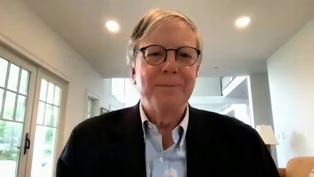
MAYOR ADAMS CHALLENGES THE "RIGHT TO SHELTER"
Video has Closed Captions
Clip: 7/25/2023 | 13m 38s | "RIGHT TO SHELTER” ARCHITECT SLAMS MAYOR ADAMS’ CHALLENGE OF LANDMARK HOUSING GUARANTEE (13m 38s)
Providing Support for PBS.org
Learn Moreabout PBS online sponsorship
- News and Public Affairs

Top journalists deliver compelling original analysis of the hour's headlines.

- News and Public Affairs

FRONTLINE is investigative journalism that questions, explains and changes our world.












Support for PBS provided by:
MetroFocus is a local public television program presented by THIRTEEN PBS