
MetroFocus: July 26, 2023
7/26/2023 | 28mVideo has Closed Captions
CHRIS CHRISTIE'S PRESIDENTIAL CAMPAIGN; SENATOR CORY BOOKER ON CRIMINAL JUSTICE REFORM
Could former New Jersey Governor Chris Christie actually win the Republican nomination? State of Affairs host Steve Adubato joins us to break down the former governor’s campaign. Then, New Jersey Senator Cory Booker joins us as part of "American Cities Rebuilding," to discuss how criminal justice reform is an essential step in helping cities rebuild in a post-pandemic reality.
Problems playing video? | Closed Captioning Feedback
Problems playing video? | Closed Captioning Feedback
MetroFocus is a local public television program presented by THIRTEEN PBS
MetroFocus: July 26, 2023
7/26/2023 | 28mVideo has Closed Captions
Could former New Jersey Governor Chris Christie actually win the Republican nomination? State of Affairs host Steve Adubato joins us to break down the former governor’s campaign. Then, New Jersey Senator Cory Booker joins us as part of "American Cities Rebuilding," to discuss how criminal justice reform is an essential step in helping cities rebuild in a post-pandemic reality.
Problems playing video? | Closed Captioning Feedback
How to Watch MetroFocus
MetroFocus is available to stream on pbs.org and the free PBS App, available on iPhone, Apple TV, Android TV, Android smartphones, Amazon Fire TV, Amazon Fire Tablet, Roku, Samsung Smart TV, and Vizio.
Providing Support for PBS.org
Learn Moreabout PBS online sponsorship>> Tonight, Chris Christie is attacking Donald Trump every chance he gets in the Republican race for the White House.
But is that a winning strategy for New Jersey's former governor and today's GOP?
Then, Senator Cory Booker's bipartisan push to fix the criminal justice system and rebuild cities post-pandemic.
"MetroFocus" starts right now.
>> This is "MetroFocus," with Rafael Pi Roman, Jack Ford, and Jenna Flanagan.
"MetroFocus" is made possible by Sue and Edgar Wachenheim III.
Filomen M. D'Agostino Foundation.
The Peter G. Peterson and Joan Ganz Cooney Fund.
Bernard and Denise Schwartz.
Barbara Hope Zuckerberg.
And by Jody and John Arnhold.
Dr. Robert C. and Tina Sohn foundation.
The Ambrose Monell Foundation.
Estate of Roland Karlen.
>> Good evening, and welcome to "MetroFocus."
I'm Rafael Pi Roman.
A number of Republicans have announced plans to run for president in 2024, but almost all of them have been reluctant to consistently attack the front runner in the race, Former President Donald Trump.
But there is one candidate who seems eager to go on the offensive against Trump, and that his former New Jersey Governor Chris Christie, who has publicly stated he is running not only to win, but also to ensure that Donald Trump loses.
Christie, who has gone from one of Trump's earliest mainstream supporters to one of his harshest critics, recently described the Former President as a loser and has publicly questioned Trump's fitness for elected office.
What explains Governor Christie's changed attitude towards Donald Trump?
And during his Presidential campaign, will he be more than just a guided missile rhetorically aimed at Donald Trump, as David French of "the New York Times" has put it?
Could he win?
Joining us is "MetroFocus" contributor, the one, the only Steve Adubato.
Welcome to the show.
Steve: What do I do after that introduction, Raf?
Thanks for putting pressure on me.
Let's talk Christie.
Rafael: All right.
I don't know anyone who has interviewed Chris Christie more often than you have.
The most recent interview was in April.
As far as you can tell, why is he running for president again?
Does he really think he has a shot at the nomination this time?
Steve: Every time I think, Raf, that I know Chris Christie, I realize that I don't.
Reading his mind is virtually impossible.
But my gut tells me that Chris Christie believes that if he can get on a debate stage head-to-head -- yeah, there will be other candidates, but if he has a chance to engage Donald Trump, he can take him on, he can embarrass him, he can gain in the polls, whwere right as we do this taping he is that 1, 2, 3, 4, 5% tops, he believes he can turn this entire primary upside down.
He has that much confidence in himself.
Rafael: Well, he didn't do any of that in 2016 and he was on a debate stage with Trump.
How do you respond to those who argue that this is all a grudge match?
He almost decided -- he almost said it, he said one of the things he wants most of all is to have Trump lose, as payback, for not having been named vice president by Trump or Attorney General, or even some say because he blames Trump for giving him the case of COVID that almost killed him.
What do you say to all that?
Steve: Do I think it's personal?
Yes, I do.
Do I think there's a grudge?
, yes, I do.
But it is also Chris Christie's way of saying -- you are actually right, Raf -- to go back for a second, he was on the stage in 2016 with Trump, but in his mind and the other candidates, they didn't want to take Trump on directly.
The only one I believe -- you interviewed Christie as much as I have, frankly -- you know Chris Christie could have if he chose to, but he did not take on Trump.
He knows it was a mistake.
They didn't take him seriously until it was too late.
Going back to the garage, it is personal, in my view, it is very real.
There is a vendetta here, but I also believe -- I will repeat myself, Chris Christie thinks he can take Donald Trump down.
That is his goal even if he is not ultimately, Christie, the Republican nominee.
He wants to take Trump down.
Rafael: He has been the harshest candidate so far towards Trump, by far.
Why does he think that's a winning strategy in a Republican Party whose base arguably trump supporters, MAGA supporters?
Steve: I gotta tell you, Raf, how many more indictments need to come down on Donald Trump, how much more evidence, how many more facts, how much has to happen for Donald Trump to lose his face?
-- to lose his base?
I don't see it, Raf.
I really don't.
You and I are not big on clinical prognostication, we like to talk about issues, but Trump is not losing that 30, 30 5%.
You have multiple candidates in the field including Chris Christie.
I don't see Trump's base of support falling apart.
If Chris Christie believes that is going to happen, he is mistaken.
Rafael: Although now he has his harshest critic, as we touched on, he was a big supporter, the first mainstream supporter, much to the consternation of some of Christie's supporters in 2016.
Are the never Trump is going to forget and forgive that?
Steve: I think Christie made a mistake, I really do.
He made a calculated mistake.
I could go back to 2012 and say that was his best time to run, but when Christie says it was not right for him, I defer to him.
Only he knows himself and his family.
By 2016, things that happen.
Bridgegate had happened.
The photo on the beach with the beach closed happened.
The hug, which Christie argues was never really a hug with Barack Obama during hurricane Sandy, it happened, whether people think it happened or not.
Republicans, so-called MAGA Republicans, will never forgive his Christie for what they perceive he did wrong.
I personally think there was a lot of leadership involved in Sandy, but that is not the way MAGA Republican see it.
Rafael: Governor Christie likes to tell the fact that he was a Republican governor of a deeply loose state who managed to get a lot done in a bipartisan -- deeply blue state who managed to get a lot done in a bipartisan way.
Is that an accurate assessment of his time as governor?
Steve: I say yes.
You and I were anchoring the program looking at public policy issues, and we would analyze how Christie with the Senate President at the time, a conservative moderate Democrat, they work together on pension reform, a whole range of issues, fiscal conservatism, if you will.
They worked together on so many things.
Here is the problem, Raf, working together with Democrats, comprising, getting things done does not seem to appeal to the Republicans constituency that is going to dictate with Republican nominee is.
They are not into compromise, they are not into working with Democrats.
They are into "get the libs."
That is not what Chris Christie is all about, and so it may not work out what he thinks he is able to do with this constituency.
Timing's off, constituency's off.
It's a different Republican Party.
Rafael: Besides touting his ability to be a bipartisan and reach across the aisle, which as you say may or may not be a good thing -- probably not -- Steve: It's a good thing for government.
Rafael: Of course.
For winning the nomination, and aside from going after Trump, is there one issue, is there a cluster of issues that he is campaigning for or on?
Steve: It's very simple.
You said in the introduction, Raf.
Chris Christie's main argument beyond the issue of integrity, or lack thereof perceived by many regarding Donald Trump -- beyond all the criminal charges,, civil charges the charges that may come in the future, Chris Christie's main argument is Donald Trump is a loser.
He lost one election after another.
Do you want -- this is Christie's argument -- do you want to lose again?
It's technically correct, but that MAGA base -- I'm a broken record now -- whether he wins or loses, they are going to stay with Trump.
It doesn't matter what Christie says.
But he is technically correct that Donald Trump has been a loser starting before 2020 in the midterm elections, a big time loser for the Republican Party.
Rafael: It's difficult to talk about Christie's current presidential campaign without bringing up Bridgegate, which you already have.
And that is the thing that probably torpedoed his 2016 campaign long before it started.
Summarize what Bridgegate entailed as far as -- and to tell us if you think it is likely to impact his campaign this time.
Steve: there is Bridgegate and then there is the way he frames Bridgegate.
I don't know what ultimately happened.
To be clear, Chris Christie was never charged in the Bridgegate case, but some of his closest aides -- he says they were not very close aides -- Rafael: the two people convicted, all three of them say he was in on it from the beginning.
But he wasn't charged with anything, as you say.
Steve: And Chris Christie says his greatest crime -- I don't mean criminal Graham -- his greatest mistake was trusting people in his orbit, his staff the case is this, that the George Washington Bridge was closed down for several hours, as you and the world know, Raf, close down because the mayor of Fort Lee, New Jersey, whose name is not even relevant right now, did not support Chris Christie, and because Fort Lee is right by the bridge, as political retribution they were going to close down the ridge and pay him back for not supporting Christie.
And it caused havoc, it causes a horrible traffic jam, it caused way worse than that, and there was a case involved, criminal charges were brought, and there was a terrible embarrassment.
Bridgegate was a black mark on the Christie administration, even though Christie says it wasn't him and he didn't know, those involved in the case said who relatively convicted said he did.
It doesn't look good, never looked good, and it never will.
Rafael: It's not going to go away, right?
Steve: No.
A lot of things people forget in politics, Raf.
That is not something you forget anytime soon.
Rafael: Something else you don't forget that you already brought up -- much less important than Bridgegate -- is Beachgate.
Fourth of July weekend 2017, actually, where he was photographed catching rays on the public beach when he had closed all the public beaches for all other New Jerseyans because of a budget dispute with the legislature.
When he was confronted with that, when he was asked, what do you say to other New Jerseyans would've liked to have been at the beach, he said, "well, they should run for governor."
That is funny funny, but we have known Christie -- that is pretty funny, but we have known Christie for a long time and we were the first to interview him on TV -- Steve: As U.S. attorney.
Rafael: That guy had political skills.
What happened?
Steve: You know, Raf, to his credit, and too late, in my view, he acknowledged it was a mistake to be on that beach -- not just to be photographed on the beach, but to be on the beach at the time when other New Jerseyans could not enjoy the beach.
But at the time, as you very accurately describe, he pushed back, basically said if you were the governor, you could do it, too.
That is a "let them eat cake" mentality, and -- Rafael: that sticks with people.
Steve: I wish Chris Christie just said "I was wrong, I shouldn't have been on the beach."
You could have turned it around, but he didn't do that, and that added to the Bridgegate situation.
Rafael: What is his biggest contribution to this campaign, Win or lose?
Steve: I think he will take a few big chunks out of Donald Trump.
I don't know if Trump ever gets on the debate stage with him, but if he does, I bet on Christie nicking him up pretty bad.
He will go down fighting, I know Chris Christie that way.
Rafael: We have to ended there.
Thanks for joining us.
Pleasure and a lot of fun.
Steve: my honor as always, Raf.
>> Since the onset of the 2020 pandemic, American cities have faced particular challenges, the likes of which they never seen before.
Rebuilding a devastating economy, fixing a broken criminal justice system, and dealing with the ever-growing threat of climate change, have all come to the forefront as a sum of the most critical issues affecting our cities and the people who live in the.
In order to address these issues, a WNET group participated in a live-streamed journalism series called "American Cities rebuilding" for the third consecutive year.
The series, made in partnership with PBS stations across the country, and sponsors Wells Fargo and GNP, brings together the top mines of today for conversations on the unique problems cities are facing and what they can do to bounce back hopefully better than ever.
I had a chance to speak with New Jersey Senator Cory Booker as part of "American Cities Rebu ilding" about how criminal justice reform is an essential step helping cities rebuilding a post-pandemic reality.
Take a look.
We want to welcome to this session New Jersey Senator Cory Booker, who is going to join us as we continue our "American Cities Rebuilding" conversation.
Welcome, great to see you.
Sen. Booker: great to see you, Jack.
Jack: I want to start with a bigger-picture questions if I could come and that is why personally you are so deeply invested in the idea that police reform is so essential to help with American cities and communities in their rebuilding and moving forward.
Sen. Booker: I live in the Newark, New Jersey, and have it for the last quarter century.
When I moved there, really serious crime problem.
Eventually I became mayor and was tasked with driving down crime.
It was the number one issue for voters in my city.
We began to make tremendous headway, but we soon found out that there was this long legacy in Newark of erosions of trust between police and communities that ultimately really undermined the progress we were making.
And we had to do a lot.
The DOJ came in and others, and they showed me that when you scrape the data and create more transparency and account ability, you saw what the police were doing that in many ways were disproportionally impacting African-American and Latino communities and violating the civil rights.
We began a much more expansive view of public safety, and a lot of our police leadership leaned in, understanding that that kind of transparency and accountability were to make their profession better, stronger, but ultimately help us better achieve what everybody wanted, which was a safe, strong city.
Jack: This movement has been subject, as with so many, to fits and starts, making progress in stepping back, trying to reach out.
Certainly after the death of George Floyd there seem to be more momentum.
Let's talk about the federal level.
Where are we in terms of progress coming in at the federal level for police reform?
Sen. Booker: Well, we have got to expand what we think of as police reform into a bigger conversation about overall criminal-justice reform.
At every point in the justice system we still have disparities, whether it is who is more likely to get pulled over by police officers, who is more likely to get station house adjustments, higher charges, longer sentences, and the like.
You see a lot of disparities in our system that are very problematic.
Now, there have been very encouraging moves on both sides of the aisle.
In fact, I'm coming out of a staff meeting where we were talking about strong alliances with conservative groups for more reforms that we are pushing.
Everybody understands that these fundamental ideals and our country of liberty and justice really come to the point of policing in our court system.
I've had nine years in the Senate now almost exactly and have been very encouraged by how in a bipartisan way we have been able to pass some significant legislation.
And I continue to be in talks with not just police reform, but overall system reform that will help to restore people's faith in the justice system, help people believe that we together as a society can make our communities safer.
What is wonderful about this is that through this all, I've deepened my relationship with law enforcement groups.
The largest police union that represents the majority of the police officers has been a tremendous partner in everything from making sure that we have more transparency in policing to helping with the mental health challenges we have with police, as well as in trying to drive ideas that we are going to, I think, see more of in society that don't put all the burden for safety on police.
Police officers know when there was more drug treatment and mental health professionals involved in helping people who are in crisis, the less please have to get involved -- police have to get involved, the less things will go bad, and the more we create a deeper understanding of what Public Safety is.
As my police record said to me when I was mayor of the city of Newark, true Public Safety is not having a police state.
True Public Safety is empowering communities so we are not responding to crime, but creating environments whether crime doesn't happen in the first place.
To have a coalition of people across the political spectrum, especially from law enforcement, that have a more expansive view of Public Safety, it's really going to help us make a lot of progress.
Jack: Senator, let me ask you this -- you talked about the conversations you've had with other groups and organizations involved, especially police organizations, and the public.
Have you found that using the right words to communicate what this idea actually means has been helpful in moving forward?
Sen. Booker: Absolutely.
At the end of the day, we all want to be understood.
I think what advantaged me in a lot of my discussions with law enforcement as they understood that I was a guy who was a mayor of a city with a lot of violent crime, and I worked closely with police officers, witnessed the incredible courage of officers, knkow how dangerous their job is.
And starting with that basis of empathy and understanding, really created a great foundation where my colleagues in a negotiations did not feel they were under attack, felt understood, and had a common set of values about this nation needing to do a lot more to really help and support our Police Departments.
That doesn't negate the challenging issues of understanding the history of policing in this country, the challenges that many have faced in terms of racial disparities and more.
Again, it's just indicative of the larger climate in our country -- are we speaking at each other or with each other?
Are we seeking to score political advantage or come to common ground and common understanding?
We have so much we agree on in this nation in terms of our common values and common ambitions, but our dialogue has been suffering a lot from a culture of contempt, where we are not seeking to understand each other, but instead just to try to score political points.
I'm hopeful that this conversation will grow, become more nuanced, and that can use the wisdom of many different stakeholders to come to a conclusion where we have a safer, fairer, more justice system of policing in America.
Jack: Quick question for you -- on the heels of the midterms, as far as we know at this juncture what the results are, any cause for optimism that these results might move things forward at all?
Sen. Booker: I'm a prisoner of hope always.
I think we are dealing with a time in our nation where a lot of the extreme voices in this country are being rejected by voters.
This is not in a partisan way, because clearly we are likely to have a Congress that has house controlled by Republicans and Senate controlled by Democrats.
I just really hope we are learning lessons in our political sphere that this culture of contempt that we are seeing in our politics, this zero sum game we are seeing in our politics, this sense of might makes right, or a lot of our democratic norms being eroded, that at the end of the day we are a nation that the greatest calling, seen in everything from the idea of e pluribus unum to even our pledge that puts one nation indivisible under God, I hope this is the season where the pendulum having gone so far one way, we can start pulling the pendulum in our country where we can deal with difficult issues from policing to immigration and see the truth there, that there is a lot of common ground and a lot of work we can do together to make us safer and stronger and more prosperous as a nation.
Jack: Last question for you -- shifting topics a little bit, you are a member of the Senate committee for agriculture, nutrition, and forestry.
The U.S. Department of agriculture has gotten involved in disbursing funds allocated through the inflation reduction act to help with farmers and the economic distress that they are finding themselves in.
Give us a sense of what is being done and how it can help people.
Sen. Booker: We have a food system that is is so integrated.
We are all part of the same food system.
And so injustices in any part, whether it is for farmworkers, farmers, consumers, it is all interrelated.
We have a farm system where we tell people what is a healthy diet, but only 2% of our ag subsidies go to things that we tell Americans to eat the majority of, fruits and vegetables.
Because of so much of the concentration, farmers are being squeezed economically with their share of the consumer dollar going down dramatically as these large chemical companies or large consolidated corporations are putting tremendous economic pressure on family farmers who have had their farms for generations but now are suddenly losing them.
And so there are a lot of obvious things we could be doing to fix our food system that would help the health of Americans, who right now most Americans don't realize we have a government where one out of three, almost one out of three of every dollar we spend on health care, because we have this explosion of diseases with half our population diabetic or prediabetic, and that all the way to the struggling farmers.
There is things we could be doing to align our subsidies within the health and well-being of families, to align incentives with the kind of agricultural practices that empower environment, and finally to start enforcing the antitrust laws that will use -- that were used generations ago to stop the ag-sector consolidation that our ancestors from FDR, Truman, and Eisenhower saw as such a threat to the health and well-being of American farmers.
And so I'm one of these folks who moved to the agriculture committee as a New Jersey Senator because I know we can do these things better where everybody in our country will not only do better, but we can create a level of thriving health, economically, and environmentally, that is really worthy of our great nation.
Jack: Senator Cory Booker, we always appreciate you taking some time to share your thoughts and updates with us.
Thank you once again, and you take care.
Thanks for tuning into "MetroFocus."
You can take our award-winning program with you wherever you go with "MetroFocus the podcast."
Listen and subscribe wherever you get your podcasts so you never miss an episode, or simply ask your smart speaker to play "MetroFocus" the podcast.
Also on the NPR One app.
>> "MetroFocus" is made possible by Sue and Edgar Wachenheim III.
Filomen M. D'Agostino Foundation.
The Peter G. Peterson and Joan Ganz Cooney Fund.
Bernard and Denise Schwartz.
Barbara Hope Zuckerberg.
And by Jody and John Arnhold.
Dr. Robert C. and Tina Sohn foundation.
The Ambrose Monell Foundation.
Estate of Roland Karlen.
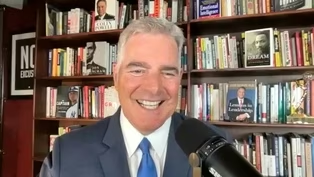
CHRIS CHRISTIE'S REPUBLICAN PRESIDENTIAL CAMPAIGN
Video has Closed Captions
Clip: 7/26/2023 | 13m 4s | DOES CHRIS CHRISTIE HAVE A CHANCE AT WINNING THE REPUBLICAN PRESIDENTIAL NOMINATION? (13m 4s)
Providing Support for PBS.org
Learn Moreabout PBS online sponsorship
- News and Public Affairs

Top journalists deliver compelling original analysis of the hour's headlines.

- News and Public Affairs

FRONTLINE is investigative journalism that questions, explains and changes our world.












Support for PBS provided by:
MetroFocus is a local public television program presented by THIRTEEN PBS