
MetroFocus: July 31, 2023
7/31/2023 | 28mVideo has Closed Captions
METROFOCUS SUMMER OF SPACE SPECIAL
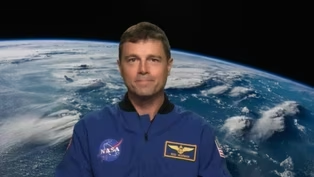
Joining us tonight is Reid Wiseman, Mission Commander of Artemis II, the first moon crew in over 50 years. Then, on July 20, 1969, NASA astronaut Buzz Aldrin made history by being the second person to walk on the moon. Tonight, he shares his story. Finally, the documentary “8 Days: To the Moon and Back” features NASA footage to provide the blueprint for a recreation of the first lunar landing.
Problems playing video? | Closed Captioning Feedback
Problems playing video? | Closed Captioning Feedback
MetroFocus is a local public television program presented by THIRTEEN PBS
MetroFocus: July 31, 2023
7/31/2023 | 28mVideo has Closed Captions
Joining us tonight is Reid Wiseman, Mission Commander of Artemis II, the first moon crew in over 50 years. Then, on July 20, 1969, NASA astronaut Buzz Aldrin made history by being the second person to walk on the moon. Tonight, he shares his story. Finally, the documentary “8 Days: To the Moon and Back” features NASA footage to provide the blueprint for a recreation of the first lunar landing.
Problems playing video? | Closed Captioning Feedback
How to Watch MetroFocus
MetroFocus is available to stream on pbs.org and the free PBS App, available on iPhone, Apple TV, Android TV, Android smartphones, Amazon Fire TV, Amazon Fire Tablet, Roku, Samsung Smart TV, and Vizio.
Providing Support for PBS.org
Learn Moreabout PBS online sponsorship>> 21st time in nearly 50 years, NASA is watching astronauts back to the moon, including the first woman and the first African-American assigned to an intermission.
We meet the mission commander as this MetroFocus, summary of space special, starts right now.
>> This is "MetroFocus," with Rafael Pi Roman, Jack Ford, and Jenna Flanagan.
MetroFocus is made possible by Sue and Edgar Wachenheim III.
Filomen M. D'Agostino Foundation.
The Peter G. Peterson and Joan Ganz Cooney Fund.
Bernard and Denise Schwartz.
Barbara Hope Zuckerberg.
And by Jody and John Arnhold.
Dr. Robert C. and Tina Sohn foundation.
The Ambrose Monell Foundation.
Estate of Roland Karlen.
Jack: Good evening.
Welcome.
For the first time in over 50 years, Nasca -- NASA is on the verge of sending astronauts back to the moon.
The Artemis II crew will launch as early as late next year.
Four astronauts will pave the way for future lunar landings and missions to Mars.
On board will be the first woman in the first person of color to take part in a lunar mission.
Christina Cook and Victor will also be joined by Reid Wiseman and Jeremy Hansen.
>> When I was young, I had a poster of the earth rising, the famous picture taken on Apollo 8.
The fact that it was a human behind the lens made the picture profound.
It changed how we all thought of our own home.
The moon is not just a symbol of exploration.
It is a beacon for science and for understanding where we came from.
>> Pushing ourselves to explore is four to who we are, part of human nature.
We go out to explore about why we are, understanding the big questions about our place in the numbers.
The expiration is the first step on the path of getting humans to Mars.
>> The Artemis campaign has set such an ambitious goal for humanity.
It is inspiring contributions from around the globe.
They are coming together.
>> When I look at the Artemis II crew, they want to do this mission.
They are keenly driven, humble.
It is so cool to be around them.
Artemis II is a huge mission, but I hope we will look back and realize this was one tiny step in humans on Mars.
Jack: As part of our summer of space series, we are meeting some of these next generation space explorers and the astronauts paved the way for them one small step at a time.
Joining us now is Reid Wiseman, mission commander of Artemis II.
To start off, that is the closed backed I have ever seen.
I have done a lot of interviews.
I have been to the White House, red carpets but that wins the award is the coolest backed up.
Thanks for that.
Reid: I certainly appreciate it.
If you got to live and work on the International Space Station, you would have an inbox filled with 300,000 of these pictures.
Jack: Start with the mission and some of your observations.
Artemis II, for those not familiar with Greek mythology, Artemis was the twin sister of Apollo and goddess of the moon.
A perfectly appropriate name for the mission, but I have heard you talk about this being the Artemis generation.
What do you mean by that?
Reid: We've been to the moon.
The generation before us went in the late 1960's.
We know we can do that, but we have not done that in this generation.
I was that alive when they left the lunar service in 1972.
They are the last two humans on the moon.
It is time to go back, temper humans to do bold and daring things.
When we do that, we will inspire and motivate.
We what to see humans -- want to see humans on Mars.
Getting to the lunar environment is the first step.
Jack: Those of us who were alive in 1972, so many have asked, when are we going back?
To know that the answer is now is certainly reassuring.
We will get to some of those in a minute but let's focus on the mission and self.
Give us a sense of what the goals are going to be for Artemis II.
Reid: The goal is to see humans on Mars, coming back and getting to high-five our crewmates will be on Artemis III, IV, V, getting this vehicle ready to hand off to them so they do not have to worry about can the Orion spacecraft support four humans in the loop or environment?
-- in the lienor environment?
And help are the systems, can we find our location?
Those are the questions we will be answering on Artemis II.
Our peers on Artemis III can just focus on landing on the moon.
Jack: The estimate is about 10 days of flight.
Give us a sense of the things you will actually be doing during that span of time.
Reid: I love our mission profile.
It is a little over nine days.
We will launch out of the Kennedy space Center and do one lap around the earth, checking out basic systems on the spacecraft.
If that looks good, we have one larger burn that will send us out to 38,000 miles around the earth.
That will give us 24 hours in the earth environment to check out our life support systems.
If everything looks good there, we do one more burn that will send us out 250,000 miles around the moon and back to Earth.
During that transit to the moon and back is when we will be focused on looking at Artemis III and beyond.
What will the crew be doing to get ready to land?
We will look at space habitation, radiation sheltering and we will do every possible manual maneuver with that vehicle that we can.
Artemis II is fundamentally about four humans living and working on Orion and doing everything we can to bring down risk for Artemis III.
Jack: We talked about the more than 50 years that have passed.
I am curious about the quality of the equipment, the luncheon rocket.
Comparing into what we saw.
Those of us who watched this thought it was difficult to conceive of the fact that we were able to do this.
You talk about the Artemis generation.
I am curious about what this generation brings in terms of technology that we did not have back and that fact then.
Reid: If you watch any rocket, the rocket looks about the same.
Large cylinder, filled with liquid oxygen and propellant, goes through a rocket engine, since you into space.
Takes nine minutes to get into lower orbit.
Those fundamental characteristics will never change but what is changing is manufacturing capabilities, electronics, the way we communicate, the reliability of our systems where we used to have layers of redundancy, now we know how those systems work.
We can put other capabilities in.
When you are looking at Artemis II, you will see a lot of parts that we know work.
You will see an Orion capsule that looks a lot like the Apollo capsule.
We know that that design works, but when you come back the layers of the onion and look at what is went on inside, we have a modern vehicle ready to explore deep space.
Jack: I saw something that said that if you take the present date iPhone -- present day iPhone and compare it to the computer Powell of the Apollo vehicles, your iPhone has thousands of times more capacity than the Apollo.
Does that sound right to you?
Reid: I do not know but everybody always says there is more technology in your iPhone than in the Apollo program.
Although once -- all that once this makes me want to do is be in all of Apollo but I look at what is changed from Apollo until now.
A lot that happened because we landed on the moon.
When people in the 1960's and 1970's, when you watched Neil Armstrong on the moon, you were instantly drawn to stem.
You were brought into that world whether you wanted to be or not.
Lately, I have been thinking about humans doing daring things that are advancing humanity.
Whether you are a few surgeon during cancer or protecting people's DNA, doing things is so critical to advancing civilization.
Jack: We think back to President Kennedy when he talked about going to the moon because it was hard.
We will learn from it.
That underscores what you just said about what we took away from that 50 years ago.
Let me ask about your own background.
You graduated from RPI, one of the great science and engineering schools in the world.
You became an aviator and a combat fighter pilot.
Now this.
When do you remember this dream of becoming an astronaut emerging in your life?
Reid: Great question.
When I was little, I wanted to drive trains.
That changed into flying airplanes.
I have always been fascinated with humans operating machinery that other humans have waited.
It is amazing to me.
But formative in my young life was the Challenger disaster.
I was in elementary school.
We were gathered in the cafeteria watching and we knew something went tragically wrong.
But I also knew that that crew, they were heroes.
It would figure out a way to survive.
They did not.
When I watched our nation more and, if it sounds backwards, but that gave me his desire to explore and to do great rings.
-- things.
Jack: You spent 165 days on the International Space Station, with a number of other people, including Russian cosomauts.
What is the message that we can send in times of such political turmoil?
What is the message the world should get.
Reid: There is 1000 ways I want to answer this question, but there are political differences around our planet and certainly things that I do not agree with that I do not like, but what I have found time and time again is that when you get below the political layer and you find people that have a common goal and you work together that we are waving more alike than apart -- way more alike than apart.
What is my best friends is a Russian astronaut.
I still talk to him to this day.
He is a great human being.
As we work walking up for our exams in Russia before we launched, I stopped with my crew outside the exam building.
They were flying a flag for every member of the prime crew in the back of crew.
I saw the Russian flight, the American flag, the German slate, and the Japanese leg.
I -- japanese falg.
50 years ago we were all outward together now we are doing research together.
That is the message I want people to take away.
Jack: An important message for all of us, commander Reid Wiseman, commander of Artemis II .
We are honored to speak with you.
We want to wish you and everyone working on the project good luck.
Reid: On behalf of my crewmates, thank you for this opportunity.
Jack: Our pleasure.
Be well.
>> One small step for man, one step for -- giant leap for mankind.
Rafael: In 19 69, Apollo 11 became the first space flight to land on the moon.
Neil Armstrong and Buzz Aldrin made history on the lunar surface.
At the age of 80, Buzz Aldrin continues to advocate for space travel.
In his new book, Aldrin reflects on the journey that led to his role in the historic moon landing and shares the lessons he learned getting there.
Joining me now is puzzled.
It is an honor to have you.
Buzz: Brings back memories.
Rafael: You are definitely not a Navy guy.
This is a very interesting book.
It is both autobiographical and inspirational.
You tell fascinating stories, some that surprised me.
In the process, you share the lessons that could help all of us.
Why did you decide to write the book?
Why in this way?
Buzz: Maybe the same reason that I played a cameo with John Travolta.
That was one of the first public appearances.
It keeps me in front of the public as a versatile person, not just in M.I.T.
book form or Dr. rendezvous.
Rafael: Let's talk about you and Neil Armstrong.
You guys cannot have been more different.
The way you write about him is as a brother.
Buzz: When I first met him, I had had a house next to Ed.
I go over to see Ed and here's this guy rollerskating, Neil Armstrong.
According to other test pilots -- but when we were put together as a backup crew for Apollo 8, we worked very closely together.
Apollo 8 was given Jim Lovell.
Jim was with us for a while.
We worked close together.
Rafael: You yourself talk about this in the book, about who was the first to step on the moon and who is the second.
For a period of time, you are not like being the second person.
Buzz: There was the people who thought that the way it should start with the outside activities that they were relatively complex for a short period of time, but -- Rafael: You came to accept that.
How?
Buzz: You do not hear yourself wins every time, but I had a very bright distant cousin who is paralyzed but who would advise governors and others in California.
I shared with him he said, you cannot change history.
Just accept things instead of objecting to the lousy deal I got.
Why me?
You cannot change things.
Rafael: It has been almost 50 years since you set foot on the moon.
I cannot believe you did not think that by now we would be much farther ahead.
Buzz: 1969, there was a space task group that looked at the future.
The vice president was in charge.
There was a strong intensity of space travel.
And a not so strong.
Even the not so strong would reach Mars before 2000.
Rafael: What happened?
Why did the spirit leave us?
Buzz: Public apathy.
There were other things.
Rafael: What do you hope will be your greatest legacy?
Buzz: A space futurist for a futurist in space, a spokesman for space.
I am a global spokesman for space.
Not just the U.S. We do not want to compete with China especiallym not just cooperate, we want to help the nations.
Rafael: Thank you.
It has been an honor and a pleasure.
If the years ago, the Apollo 11 moon landing was broadcast to an audience of more than half a billion people, the largest number of viewers for any program at the time.
Over the decades, the story of Apollo 11 has become a legend, but now, for the first time a new documentary uses it recently declassified audio to take viewers inside the should to the moon.
8 days to the moon and back recounts the day by day experience of the Apollo crew, mainly through conversations the men had with each other.
The film seamlessly blends everything to give us an intimate sense of what it may have felt like to be on that historic gurney -- historic journey.
>> In 1969, humanity held its wrath.
This is what the astronauts experienced.
These are actual audio read wording -- audio recordings.
The mission comes to life like never before.
>> Joining us now is the executive producer of "8 days to the moon and back," Andrew Cohen.
The film recounts the lunar landing.
These are fascinating conversations but almost no one had heard them.
They were classified.
Why?
Andrew: They were not actually classified.
They were released a few the -- a few years ago.
These recordings were made for engineering purposes, not broadcast.
What is interesting is there were thousands of hours released.
We stumbled across them.
What is interesting is that Apollo enthusiasts, you can start to find your way through.
We realized this was a treasure trove of material.
It took us places where no one has ever been.
Jack: You also have three actors playing the astronauts as they go to the moon.
I think it is perfect.
But some film critics frown upon dramatizations and documentaries.
Did you ever hesitate about using them?
Andrew: In the beginning.
The interesting thing was the stumble upon this extraordinary treasure trove.
We knew that within that with these interactions between the astronauts, a sense of human beings and what it meant to go on the greatest Voyage ever.
What do we do?
How do we turn this into a film for the 21st century?
It was quite a process for us to realize that we could use a 21st century filmmaking techniques.
It was an interesting innovation.
It enables you to know that everything in this film are actual words spoken by those astronauts.
Jack: As you said earlier, we have never seen a more intimate look at these three men interacting with each other and mission control.
We get the feeling that these are brilliant and courageous men.
Did you discover anything about them that surprised you?
Jack: What the film delivers his room to discover something about those three men, the characters that they were.
No matter how many interviews you have seen or documentaries, you have never actually experienced how they reacted in the moment.
There are moments of high tension, famous moments of the landing.
Maybe even seeing these moments before, but in this new, intimate way.
And it is the banter between the men.
It is the fact that Armstrong tears of Aldrin for using unscientific language for such a historic moment.
And it is the emotional moments.
You suddenly see that these arguments but humans -- that these are humans but even though they are incredibly controlled.
We see pieces of their humanity.
Jack: It was a wonderful film, a real treat to watch.
I hope a lot of people see it.
Thank you for joining us.
"8 Days to the moon and back" premieres July 17 on PBS.
♪ Thanks for tuning in.
We -- you can take our program anywhere with MetroFocus: The podcast.
Listen and subscribe wherever you get your podcast so you never miss an episode or ask your sport speaker -- smart speaker to play MetroFocus: The podcast.
♪ >> MetroFocus is made possible by Sue and Edgar Wachenheim III.
Filomen M. D'Agostino Foundation.
The Peter G. Peterson and Joan Ganz Cooney Fund.
Bernard and Denise Schwartz.
Barbara Hope Zuckerberg.
And by Jody and John Arnhold.
Dr. Robert C. and Tina Sohn foundation.
The Ambrose Monell Foundation.
Estate of Roland Karlen.
NASA’S GROUNDBREAKING MISSION BACK TO THE MOON AND BEYOND
Video has Closed Captions
Clip: 7/31/2023 | 13m 38s | NASA’S GROUNDBREAKING MISSION BACK TO THE MOON AND BEYOND (13m 38s)
Providing Support for PBS.org
Learn Moreabout PBS online sponsorship
- News and Public Affairs

Top journalists deliver compelling original analysis of the hour's headlines.

- News and Public Affairs

FRONTLINE is investigative journalism that questions, explains and changes our world.












Support for PBS provided by:
MetroFocus is a local public television program presented by THIRTEEN PBS