
MetroFocus: June 7, 2023
6/7/2023 | 28mVideo has Closed Captions
BROADWAY WEEK: “CAMELOT”; INSIDE THE MUSEUM OF BROADWAY
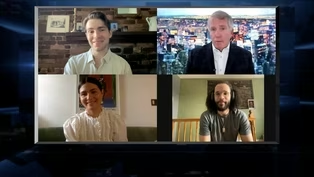
We have an inside look at the latest adaptation of one of the most iconic musicals to ever grace the stage, “Camelot.” Joining us are the three leads of “Camelot”: Phillipa Soo, Andrew Burnap, and Jordan Donica. Then, New York’s first ever museum solely dedicated to Broadway is now officially open. Diane Nicoletti and Julie Boardman, co-founders of the museum, are here with a backstage pass.
Problems playing video? | Closed Captioning Feedback
Problems playing video? | Closed Captioning Feedback
MetroFocus is a local public television program presented by THIRTEEN PBS
MetroFocus: June 7, 2023
6/7/2023 | 28mVideo has Closed Captions
We have an inside look at the latest adaptation of one of the most iconic musicals to ever grace the stage, “Camelot.” Joining us are the three leads of “Camelot”: Phillipa Soo, Andrew Burnap, and Jordan Donica. Then, New York’s first ever museum solely dedicated to Broadway is now officially open. Diane Nicoletti and Julie Boardman, co-founders of the museum, are here with a backstage pass.
Problems playing video? | Closed Captioning Feedback
How to Watch MetroFocus
MetroFocus is available to stream on pbs.org and the free PBS App, available on iPhone, Apple TV, Android TV, Android smartphones, Amazon Fire TV, Amazon Fire Tablet, Roku, Samsung Smart TV, and Vizio.
Providing Support for PBS.org
Learn Moreabout PBS online sponsorship>> tomorrow night, we will have a special report on the smoke and golfing a tri-state area as a code red emergency has been issued across New York City.
Public health officials are warning New Yorkers to mask up and limit their times outdoors.
Two in -- tune in tomorrow night for everything you need to know on the orange haze covering our city.
Now back to our regularly scheduled programming as "MetroFocus" starts right now.
♪ ANNOUNCER: this is " MetroFocus" with Rafael Pi Roman Jack Ford and Jenna Flanagan.
It is made possible by Sue in word walking Chaim the third.
The Peter G Peterson fund.
Bernard and Denise Schwartz.
Barbara Hope Zuckerberg and by Jody and.
Dr. Robert foundation.
The Ambrose monell foundation.
Estate of Roland Karlen.
Jack: welcome to Metro forecast.
Camelot is back.
Brought great -- Broadway whale T. The musical has returned.
Heralded as a more modern reimagining of the tale, written by Aaron Sorkin, the show, called a royal delight by critics, features the familiar breathtaking score, together with extraordinary performances by a live 30 piece orchestra.
All contributing to five recent Tomi -- Tony nominations including Best Revival of a Musical.
Here's a preview.
>> ♪ this is the time of King Arthur And forgiveness is not weakness And justice is not revenge.
This is the time of King Arthur, and we reach for the stars!
By God, Excalibur, I will be a king and we will live through this.
You and I. Jack: we are delighted to be joined by the three stars of the show.
Tony who plays King Arthur, Philip, who plays Guinevere and Jody and portraying Lancelot.
Thank you so much for joining us.
Let me start off this conversation with a compliment.
My wife and I saw the show.
We have in the past, other than the 1960's first show, have seen every version of Camelot film and stage.
I will tell you this one was the most enjoyable.
I certainly got that sense from everybody else around us.
I think it's a good way to start a conversation.
Let me ask you all, it's a bigger question and bigger picture question.
I saw that the chair had said revivals had come back when we need them most as a society and I'm struck by that.
I'm wondering, maybe I will ask you first, what do you think it is about the show and this revival that we, as a society now, need or can appreciate?
>> I think it's asking a couple of big questions.
One being, is humanity innately good, or is humanity innately bad?
And, we can hold both of those questions at the same time to be true because I think there is a level of despair and questioning that we are all experiencing right now, especially coming out of a pandemic, coming out of basically a huge cultural revelation.
And we are seeking some answers to the questions that we have.
But I also think this show, at the same time, presents this idea of hope, and that, in all of our questions and seeking out what makes us good or bad as humans, ultimately there is hope and that hope lies in younger generations, that hope lies in future, and for me personally, I think it strikes a chord in this society that we live in and democracy and how does democracy work and how can we all participate in democracy to make it work.
Jack: Let me ask you each about your roles and I will come back to that notion in some things you just said and how it applies to each of you.
This is an iconic show with iconic roles.
Andrew, I'm wondering, is it daunting for an actor -- and if it is, maybe to what degree, to create a role now that is an iconic role in an iconic production that is -- that has lasted for decades, as an actor, how is that?
Andrew: Short answer is, yes.
It's extremely daunting, it's intimidating, but it's also such a unique and sort of dreamlike opportunity in the sense that you get to put your stamp on this, as you said, iconic character.
The two men who are most closely associated with this are two of the greatest actors ever to have graced the earth.
So when you think about it in that sense, it makes you want to go under the covers and never come back out.
But when you are given an opportunity that Aaron Sorkin writes a slightly new characterization with a new idea and new worlds, it's sort of like a pinch me moment that I get to put my name alongside these great icons and thinking of it moment to moment and the playing of it, that's where the joy and the beauty in this dream lies.
If you think about it as a larger picture of I have to go up against these great men, then it's sort of like you are in the water.
If you think about it as an addition to the already iconic thing that lays before us, it's such a golden opportunity.
Jack: Jordan, Lancelot, his own iconic figure, originally on Broadway, indeed a Broadway legend.
I also want to mention to you that my wife and I are one of I'm sure thousands of people who dance to, if ever I would lead to at our wedding, that was 50 years ago, it worked out well for us.
Jordan: Congratulations, that's awesome.
Jack: Talk about that, similar to what Andrew said, Lancelot is this legendary character and how do you go about making you him, him you?
Jordan: I had the luxury of hearing anything I knew about Camelot came from stories of family of friends who either listened to the album or had seen a touring production of the show and I always said how much of a fantasy it was, but I, myself outside of seeing the sword and the Stone, Disney, with really no relationship to the material, I had done a gala performance of it for years ago, and that was with the original script, so that was actually my introduction to the world of Camelot really proper and so I've just had fun exploring the romance and all the things that she talked about as well, and I echo Andrew sentiments, you can't really think about the fact that Robert made these songs famous when he made them famous because we are singing them for a new generation.
We just did a student matinee yesterday.
We have fresh years of kids who had never really seen Camelot, didn't really know the story, didn't know what was going to happen and it was one of the most electric experiences.
Like Andrew said, you just live in those moments and let that be your guide, let the relationship we develop as a cast, as a crew help us and hopefully develop that relationship with the audience as well, through this story.
And you learn so much, and I have just been on that wave.
Jack: What a great opportunity to bring it to children and introduce the con -- concepts of equity, marker C hope in conjunction with despair, to get young people to children -- young children to see it.
I have used the word iconic way too often, but it happens to be used appropriately.
I did a little research, there have been dozens of doctoral dissertations written about the character of Guinevere.
You -- your Guinevere is a little bit different, intentionally a little bit different.
Talk about some of the differences in the Guinevere that you portray.
>> I like to think that based on the time that we are living in and the opportunities that I have because I'm standing on the shoulders of amazing women who have created incredible characters before me, that we are living in a time where this is may be the most fully fleshed out version of her that we have ever seen, just because we are more evolved.
I think, to your point about these iconic roles and these iconic characters, something that Macy dog -- may seem daunting to people and that I find comforting is that these characters not only exist from Camelot the musical, the original musical that was done in the 1960's, but this is a story and a canon of stories that has existed for centuries.
It's a very old story and has deep roots, and it has many different versions and alternate ways of telling this story.
There some general through the lines that continue to be there, but I think that that only gave me permission to put my own stamp on it and to know and to be humbled by the fact that this is just a small notch in the canon of the story.
That we are coming forth and telling, and trying to serve our society in some way with this story, with these ideas.
Jack: People will go see it and will record dies your partnership with Guinevere and Arthur.
This is both Andrew and Jordan, you guys do a great sword fight on stage.
We are kind of used to -- if you gotta high school productions, a sword fight is to people with things going, banged, bang, bang.
This looks realistic.
There is moves, athletic moves.
Tell me about putting that together and how you go about creating that.
>> our incredible fight choreographer, who has been doing this for longer than any of us have been alive, he is a true storyteller.
So our first day of fight rehearsal was us talking about what story do we want to tell with the fight.
It's not just, to your point, a couple of guys banging swords around, it's two people who have a point of view and an intention of what they are doing in this fight.
So that was a beautiful way to come about fighting because it gives you a larger sense of purpose.
It's not just a sword fight, it is a story in it of itself.
So we started with fingers and saying I'm going here, I'm going there because I want this, and then graduating to bamboo sticks and then finally graduating to swords.
Which nine-year-old Andrew and I'm sure nine year old Jordan were freaked out we finally got swords.
The Dave get a Lightsaber in your hand as a Star Wars nerd.
It's just so fun to do.
>> I can recall when we did -- I feel like I said this and if I didn't, I definitely thought it.
I've been playing swords my whole life but I finally have someone to play it with.
I had this old plastic sword that I had gotten from an estate fear one year when I was a little boy, and I would always wield that theme, so to be able to do it now for a living is so fun.
And it's always maintained the state of play.
When that state of play goes away, that's when things get actually dangerous, and you can hurt yourself and those around you.
So like Andrew said, he considers himself a director, so the way he approaches it is as a scene.
Ultimately, that helps in the growth of the character so that we don't just get to a part of the show where it's like, that was an awesome sword fight, moving on.
It's like, what can we learn about these two, not just these two, but these three through the fight and finding the connection and always maintaining contact with everyone in this scene.
It's been the whole ensemble because the fight doesn't work if we don't have a great ensemble reacting to it in helping us.
As we say, we make each other look good.
We all helped, so it's a cyclical thing.
Jack: We can talk forever, as I said, this is absolutely one of our favorite shows ever, you all are spectacular, I mention the 30 piece live orchestra, which was such a delight in any day and age.
And what we ask for, what we hope for in our theater is to be both entertained and for it to make us think and I think this version does all of those things and you all should be congratulated.
Thank you so much for spending time with us, good luck as this continues to run and hopefully we look forward to talking to you.
Be well.
Thank you.
New York City is home to a number of museum celebrating our rich artistic and cultural history.
Until now there's never been a permanent news -- Museum dedicated to what's New York's greatest artistic contribution.
The plays and musicals of Broadway.
After years of preparation, we can finally say that is no longer the case because the brand-new Museum of Broadway is officially open.
Located in the heart of Manhattan's theater district, 26,000 square-foot museum covers hundreds of years of Broadway's history and showcases props and costumes and other memorabilia from countless Broadway shows.
The museum, created in partnership from the theater community also features permanent exhibits, including one dedicated to the behind-the-scenes cruise that are so essential to putting the shows that we all love.
We are thrilled to be joined to talk about the Broadway Museum with the museum's cofounder and Julie.
Welcome to both of you, thank you for joining us.
So the first question is this, I will come to you and that is, as most first questions are, why the museum, and why now?
>> Really great question.
There has never been a museum dedicated to Broadway in the history of Broadway is so rich.
It's kind of mind blowing that it didn't exist.
We feel really fortunate and are very grateful to be the ones making it happen, and we found this incredible space in the middle of Times Square where we can celebrate brought -- Broadway and its history.
Jack: Same question to you, I'm always interested in the genesis of an idea, where comes from when people say, that's a good idea, how about for the two of you, do you remember when you said, that's something we should be doing.
>> absolutely.
It was all Julie's idea, it was from a conversation she had with a friend and we have been friends for over 20 years.
And she was likewise there not a museum of Broadway, we were just talking about that the other day, and I paused for a minute, and I was like, you are right, how does one not exist, and then we started brainstorming on if we were to create one, what we would do and how we would go about it and then that was sort of impetus for the idea and then, five years later, here we are.
Jack: We talk about five years later but there was a chunk of time in the midst of that five years where everything was thrust into disarray in our lives.
I suspect also the development of the museum, tell us about that and the impact that COVID had on getting this up and running.
>> As Diane said, five years ago we started brainstorming and whiteboarding the concept and what was the story we want -- we wanted to tell, and figuring out how it would work.
So we were working on all that and then starting to fund raise to put it altogether, and then COVID happened and it was hard at first because we were looking for a space and you couldn't actually see spaces.
It gave us some time to really continue to work on the timelines with Ben West, whose our timeline curator and resident historian.
At the design, and we worked a lot over zoom, likely during that time, and then as soon as we could, we got out and started looking at spaces.
This space we are in use to be an Irish bar that unfortunately did not make it through COVID.
They had to shut their doors and I guess, when one door closes, another opens.
We are really fortunate to find the space, as you said it's 26,000 square feet of Times Square on 45th Street right next door to the oldest continuously operating theater, which is a really nice place to be.
A bit of a silver lining, if you will, from COVID that we were able to find the space, security, sign the lease and get going.
Jack: How important was it or was it essential in the beginning for the space to be located in the midst are the heart of Broadway or the heart of theater.
>> It was extremely important.
It was one of the greatest challenges because we were limited into this geographic space, which we felt was very important to be there, and so it took a little longer, we had to get creative because there weren't as many spaces that had the square footage that we needed, and also the layout because we did have the concept prior to finding the actual space, which was important.
Jack: I mentioned this in the beginning, I want to give our viewers a sense of some of what's there just to draw them in and quite literally get them there.
I mentioned in the introduction there are a number of permanent exhibits and there will be other exhibits coming in.
The different types of permanent exhibits, I mentioned one in the very beginning, which is, how does a production get made?
We all see what's on the stage, but as you know, and you have both been involved in this, there are years of work that gets involved before it finally becomes that.
Why was it so important to say, we need a permanent exhibit that says this is how this thing gets made?
>> one of the things, as we were brainstorming what it could be in the story, it was also what we wish existed when we were little and coming to New York.
I was a huge fan of Broadway, I started performing when I was five.
I came to New York to see my first Broadway show when I was 10.
I've been a fan for a long time and had something like this existed when I first came to New York, maybe the trajectory -- maybe my path would've been different.
I was performing and it took me a long time to learn about all the rules backstage and I'm on the producing and for Broadway but I did not know that was a thing when I was growing up, I just thought you had to be the actor.
This room, David Rockwell designed the room and it's meant to show you different jobs that exist in Broadway that you may not have known -- like you said in the audience and you see the final product, you don't know the 7, 10 years sometimes that it takes to develop a show to get it to Broadway and all the stages.
So we wanted to go behind the scenes and show a bit of that magic and hopefully expose people to something they did not know about Broadway.
Jack: give me a quick limps of the other permanent exhibits that are there.
>> we took the timeline of Broadway, so each of the different shows that are highlighted on the exhibit order with the exhibit are like Phantom of the Opera, where we have a crystal chandelier insulation made of close to 14,000, the number of performances that Phantom of the Opera will run once it eventually closes in the spring made out of crystals.
So if you look at it one way, you see this lovely crystal insulation, but if you turn just right, you see the mask come through.
It's original artwork that pays homage to Phantom of the Opera.
We have you go through the cornfields of Oklahoma.
You get to experience cool and America re-created by dancers in the choreography for West Side Story.
Each room has its own unique experience that really sort of brings it to life, in addition to seeing photos and artifacts and costumes as well, so it really immerses you into these different exhibits and shows.
Rick: You mention photos and artifacts and costumes, and I had seen more than a thousand of them are incorporated into the museum, the first question I had is, where did they come from?
Where did you find them all?
>> We have an incredible team of curators we work with them a lot came from just relationships, the people who are a part of the museum are part of the Broadway community, so just conversations in uncovering what still exists, not everything was kept from the past.
So there are a couple of key places we work with Lake Goodspeed Opera House, they have a really wonderful collection of costumes.
The Public theater has done an incredible job of keeping the entire -- basically, from chorus line when a close, they put her weight -- away one of every costume from the lines.
And they have uncovered these incredible costumes.
We have Meryl Streep's costume from when she made her Broadway debut.
We have something from Calvin Klein and these people wore on stage that is just really wonderful for people to get to see up close and that you get to see the hand beating that goes -- hand beating that goes into making these -- hand BEADING that goes into making these.
Our curators are incredible.
Some just happened and I ran into my friend who's the producer of Hades down.
And they were just leaving.
I was like, hey, could we have this costume to put on display and she's like, sure.
So some happen organically.
Jack: do you guys have favorites of the exhibits, the artifacts?
Maybe this is like asking a mother, do you have a favorite child, to some extent, but I will still ask you.
Do you have some favorites in the collection?
>> There are some that have really interesting stories behind them, so there's a part of that that makes it extra interesting.
Follies, Disney, we have these on loan from the early 1900s.
It's just so impressive that they were preserved and they still exist because there are many costumes and many more that don't.
So it's great that we have original volleys costumes that we have on display that are just beautiful, and that's probably one of my favorites.
>> We are so thrilled that Broadway is back.
We will have you back to talk about some other issues about that sometime.
We are thrilled Broadway's back.
We are thrilled the Museum of Broadway is up and running, so folks out there, if you are interested, get there as soon as you can, I'm sure you will love everything available, Julie, Diane, thank you for spending time with us and for the work you did putting this together, a job well done, look forward to talking to you again soon.
You both be well.
>> Thank you so much, U.S. well.
Thanks for tuning into MetroFocus, you could take our award-winning program with you wherever you go with MetroFocus the podcast, listen and subscriber every get your podcasts you never miss an episode or ask your smart speaker to play MetroFocus.
Also available on MetroFocus.org and on the NPR one app.
♪ ANNOUNCER: MetroFocus is made possible by Sue and Edgar Wachenheim III Filomen M. D'Agostino Foundation The Peter G Peterson and Joan fund.
Bernard and Denise Schwartz Barbara Hope Zuckerberg And by Jody and John Arnold Dr. Robert C. and Tina Sohn foundation.
The Ambrose Monell Foundation Estate of Roland Karlen .
♪
Video has Closed Captions
Clip: 6/7/2023 | 13m 47s | BROADWAY WEEK: “CAMELOT” (13m 47s)
Providing Support for PBS.org
Learn Moreabout PBS online sponsorship
- News and Public Affairs

Top journalists deliver compelling original analysis of the hour's headlines.

- News and Public Affairs

FRONTLINE is investigative journalism that questions, explains and changes our world.












Support for PBS provided by:
MetroFocus is a local public television program presented by THIRTEEN PBS