
MetroFocus: June 8, 2023
6/8/2023 | 28mVideo has Closed Captions
AIR QUALITY IN NYC REACHES ‘HAZARDOUS’ LEVELS; “SOME LIKE IT HOT” GOES TO BROADWAY
Tonight, a Special Report on the Code Red air quality alert issued in New York City due to hazardous smoke engulfing the Tri-State region. Then, the hit 1959 film “Some Like It Hot" is back, this time as a Broadway musical. Joining us to discuss how the iconic movie has been reimagined for the stage are the show’s star performers - Christian Borle, J. Harrison Ghee and Adrianna Hicks.
Problems playing video? | Closed Captioning Feedback
Problems playing video? | Closed Captioning Feedback
MetroFocus is a local public television program presented by THIRTEEN PBS
MetroFocus: June 8, 2023
6/8/2023 | 28mVideo has Closed Captions
Tonight, a Special Report on the Code Red air quality alert issued in New York City due to hazardous smoke engulfing the Tri-State region. Then, the hit 1959 film “Some Like It Hot" is back, this time as a Broadway musical. Joining us to discuss how the iconic movie has been reimagined for the stage are the show’s star performers - Christian Borle, J. Harrison Ghee and Adrianna Hicks.
Problems playing video? | Closed Captioning Feedback
How to Watch MetroFocus
MetroFocus is available to stream on pbs.org and the free PBS App, available on iPhone, Apple TV, Android TV, Android smartphones, Amazon Fire TV, Amazon Fire Tablet, Roku, Samsung Smart TV, and Vizio.
Providing Support for PBS.org
Learn Moreabout PBS online sponsorship>> Tonight, a special report on the dangers smoke blanketing the tri-state ranking the city at number one for the worst air quality in the world.
One of the country's top air pollution experts explains the alarming effects the smoke may be having on our health as "MetroFocus" starts right now.
♪ >> This is "MetroFocus" with Rafael Pi Roman, Jack Ford, and Jenna Flanagan.
MetroFocus is made possible by the fill in them D'Agostino foundation, the Joan Ganz Cooney Fund, Bernard and Denise Schwartz, Barbara Hope Zuckerberg and by Jody and John Arnhold, Dr. Robert C. and Tina Sohn foundation.
The Ambrose Monell Foundation.
The estate of Roland Karlen.
Estate of Worthington Mayo Smith.
>> Good evening and welcome to MetroFocus.
I'm Jack Ford.
Tonight we bring you a special report on the dangerous burning smoke blanketing the tri-state area.
This week New York City ranked first and month major cities for the worst air quality worldwide.
Smoke from Canadian fires has been drifting in from hundreds of miles away engulfing the tri-state area casting the orange haze we have seen in the sky.
It is an unprecedented event.
The smoke so thick at times the FAA briefly suspended flights into LaGuardia.
Hundreds of flights have been canceled and thousands more across the country delayed several Broadway shows and sporting events have also been canceled.
For many New Yorkers the reaction has been more visceral.
The site of the red haze choking the city.
The smell of smoke permeating the air raising concerns about how safe the air is to breathe especially for the most vulnerable.
Here to assess the condition and the threat is an atmospheric scientist at the Columbia climate school's Earth Observatory and air pollution advisor to the U.S. State Department.
Thank you so much for joining us.
>> Thank you for having me.
>> Let's start with the first question.
That is how and why is this all happening?
>> The main culprit now is a series of extreme fires to the magnitudes we have not seen before in this part of the country in central eastern Québec.
That coupled with unfavorable wind conditions that have been blowing this smoke into the tri-state area has led to the situation we see now.
>> Let's talk bigger picture first and then we will get to specifics.
I mentioned in the introduction New York City, worst air quality of major cities in the world for the last day or so.
Air quality index and you can correct me, usually around 50.
I think it got close to may be exceeded 400 yesterday.
Talk about what that means when talking about an air quality index, numbers that high and how historic is that?
>> The air quality index is designed to be a public outreach type of tool folks can use to make their decisions about planning their time outdoors.
This 400 level you talked about is something we have not seen at least in about 20 years in New York City.
It is pretty unprecedented.
>> When we look at historically, we have seen at the last 20 years or so and we compare it as I mentioned in the introduction to the rest of the world, I think somebody said at one point it is two or three times than what the worst other case scenario in the world is.
How alarming should that be for us?
>> I think pretty alarming.
Anytime you see concentrations and levels this high you can have health impacts on everybody.
Not just the vulnerable.
Not just people with heart and lung conditions.
Even healthy people can get sick and have negative health impacts.
The good news is these kind of occurrences are rare in New York City.
There other parts of the world where this happens a lot more.
We do have that on our side that this is projected to be a short occurrence right now.
Let >> Me follow up on something you said and that is the health impact.
I will get two precautions we should be taking but let's focus on the health impact.
It is frightening looking.
We have this eerie red orange haze that you can smell the smoke.
Talk about the impact.
How does that get within our system and what sort of impact can it have on various parts of the body?
>> The main health culprit in smoke events like this is what we call fine particles.
Our research shows these small microscopic particles that are floating around in the smoke and we are breeding them in, they can penetrate deeply into our lungs.
Not only did they get into the lungs but most of them are small enough they cross over into the bloodstream.
Once they get into the bloodstream you're talking about all kinds of negative effects on the circulatory system in addition to the possible long issues.
Short-term type of things people can feel from breathing this error in would be typical respiratory and cardio related issues.
You might have shortness of breath, coughing, wheezing, sore throats, stinging of the eyes etc.
>> How about long-term?
The forecasters are saying perhaps in the next day or two that should be diminishing and within three or four days diminishing significantly.
What about long-term exposure within that timeframe?
>> In the long-term, particles of this nature are responsible for millions of deaths globally around the year, premature deaths.
This sounds frightening and I think it should be but it is important to note this is relative to a lifetime or many years of exposure to high levels of pollution.
In the long term, New York City being relatively clean otherwise, folks are going to be pretty protected.
This short event we are having for a few days is not going to help out on the long-term side either.
>> Let's talk short-term precautions.
Masks, are they effective?
How should they be worn and under what circumstances?
>> Masking is a good option right now.
These last few days and through tomorrow.
You want to make sure you have a high-efficiency filtering mask.
These are the N95's if you can go back to the pandemic times we learned about all of that.
The N95's, the KN95's how should they be worn?
I would recommend wearing them outside.
We are in situation that is sort of reverse of the pandemic where outdoor air is a little more dangerous than indoor air.
I recommend wearing them outside.
Recommend they are well fitting and don't have any leaks or gaps.
>> What about your eyes?
Is there something you should be doing if you are outside?
The first device I am sure is don't go outside if you don't have to but if you do, how about protecting the eyes?
>> I would not be as concerned about that necessarily.
The main route for these particles impacting our health is through breathing.
If you want to wear eye protection, it certainly would not hurt, but I think the key would be the masking is the number one option.
>> One of the interesting aspects of this and people have talked about and I experience myself that you can actually taste the smoke which is probably not surprising.
It has raised another question and that is with regard to the safety of our drinking water.
If we are tasting it when we are walking around outside is it being absorbed into the drinking water sources?
Is that a problem?
>> To my best knowledge that is sort of not a very high concern for drinking water.
I'm not saying it does not really happen at all but the way that our water filtration systems work in New York City and most of the water in New York City comes from reservoirs which are well maintained, well protected.
That is probably going to be a pretty minor effect on the water.
>> Let's go back to our first question which is why and how this is happening.
I have seen a number of people raise the question of is this in some way connected to climate change?
Is climate change in some fashion and shooting to this particular event?
>> I think it is likely it has contributed to this particular event.
I do need to be a little careful and say at this point in time it is difficult to attribute any particular event that is currently still ongoing to climate change.
I think that research is going to be happening maybe even as we speak to make that connection quantitatively but what we can say with a little more confidence is the symptoms of climate change that are well known and well-studied from our research, things like hotter temperatures, worsening droughts , changing precipitation patterns, drier soil.
All of these things lead to longer fire seasons, bigger burned areas, and more smoke paired the connection is there.
There is a little bit of work that needs to be done to attribute specific events to climate change.
>> We tend to in order to help us assess things to compare instances to other instances.
You had some involvement in this.
Toxic train derailment that took place recently in Ohio.
How would you compare the two?
>> It is an interesting question.
I think in terms of the magnitude of the crisis and I would say they are pretty comparable.
We have a high pollution problem right now.
There was a similar one in East Palestine, Ohio during the train to Rome it.
We are talking about different types of pollutants.
That is one way they would differ.
In the fires we are mostly talking about fine particles.
In the train to Rome it case, it was a spillage of a chemical that basically evaporates off the surface and becomes this noxious gas.
There is a fundamental difference in the chemistry that it was the gaseous pollution affecting folks in eastern Ohio versus what we are seeing now.
>> Last question for you.
Might be the most important question and that is how do we prevent situations like this from occurring in the future?
>> That is the million-dollar question.
How can we address climate change?
How can we reduce our emissions?
I think there are a lot of things that can be done at the high level policy decision-making level.
Things like switching to cleaner energies.
Electrification.
Technologies to reduce carbon dioxide in the air.
All of the laundry list of climate mitigation and climate solutions come into play here in terms of impacts on wildfires.
>> You have been extraordinarily helpful in giving us some assistance in understanding what is happening here and perhaps more important understanding what we should be doing to protect ourselves now and in the future.
Thanks for sharing your thoughts and expertise with us.
You take care now.
>> You are welcome.
Thank you.
>> The classic 1959 film some like it hot is back.
This time as a Broadway musical.
The new version which critics call a jubilant crowd pleasing musical comedy takes the story of two Prohibition era musicians on the run from the mob who pose as women in an all-female traveling band that it adds fabulous singing and dancing and some much more modern twists.
Here is a preview.
>> I hope you like your Broadway hot.
♪ >> We cannot stay here.
Chicago is too hot.
>> You are right.
Search every dance hall from here to Timbuktu.
♪ >> ♪ Some like it hot and that ain't bad ♪ >> We are delighted to have with us in our conversation tonight the three stars of the show.
Part of a constellation of talent on that stage.
Welcome to all of you.
So delighted to have you join us.
I'm going to start this conversation with a compliment.
Probably not a bad way to start conversations may be especially with performers.
My wife and I saw the show a few weeks ago.
We are Broadway theatergoers.
We walked out and said to each other one of the most enjoyable theater experiences we have ever had.
I thought that was a good way to start our conversation here.
With that out there and let me ask you the first question if I can.
Mentioned in the introduction, iconic film.
Some like it hot.
In most surveys I have seen, in the top of the list of the greatest comedy films ever.
So, when you were first approached about this project, taking an iconic film and then bringing it to the Broadway stage and adding music and dancing and some twists as I mentioned, what was your first reaction to it?
>> I think it was indeed FI's number one comedy of all time so no pressure whatsoever.
I think the main challenge and kind of thrill of even attempting to do it is to take the comedy a lot of the material to our modern year is dated and to be frank a little problematic and thrust it into a modern context.
That seemed like a challenge worth going on with Casey Nicola who is famous for creating some of the most hilarious musicals of all time.
Book of Mormon, spam a lot, something rotten.
The material has great comedic bones as well.
It was just exciting to work with Jane and Adrian on something new.
>> We talked about new twists and certainly your character when you look at your character and Jerry and Daphne, it epitomizes that.
Talk about from your perspective about taking something that is a classic as Christian said, some parts of it are dated and some parts of it are troubling and then making the changes especially the your character makes in the show.
>> It was quite a smooth process for me at least.
In the sense there was a lot of trust builds under the room of creating and working with Casey and Matthew and Amber.
And getting the collaborative effort to bring this old material forward.
It was wonderful to be able to trust each other to come into the room to create and to bring ourselves to the work.
It was awesome to authentically walk into the room, be myself and have infused into the work.
>> Your role and I suspect a lot of viewers are familiar with some like it hot.
If not your role is parallel to an iconic Marilyn Munro role.
Once again, very different.
Similar to J, talk about how your character and how what you have done and everybody else has done to make the changes and make it through a modern lens.
>> It was really wonderful to have our director Casey and to have Matthew talk to me and say we do not want you to be Marilyn.
We want you to be you.
That was the launching pad for me to be able to develop a new take on sugar because you have this beautiful character your who is set in the 1930's but she is a black woman now.
The stakes are different.
It was such an honor to glean from Marilyn and to see our similarities but also glean from other women too like Judy Garland and Josephine Baker and Lena Horne.
The list was endless for me.
That process was truly a blessing because thinking about trying to fill the shoes of Marilyn Monroe, there is no way I could have done that.
To take this character and find the similarities between the two was helpful to me.
>> I think it is a complement to all of you that I had seen the film before probably a couple of times.
I'm very familiar with it.
Tony Curtis, Jack Lemmon, Marilyn Monroe essentially the ones you have.
I was not seeing any of you as them.
I was not saying here is Christian doing Tony.
It was not.
I think -- you said probably what you wanted.
Have any of you actually seen the movie before?
All of you have.
All right.
I was wondering, did you watch it to prepare for this or had you just seen it in the past?
>> I watched it to prepare for it.
I had been with the project for me since 2019 and I had never seen the movie before agreeing to do the movie.
I watched the movie as research and as Christian said before, there were definitely things that were problematic and needed to change.
I was excited to see what work was going to be done.
It was wonderful to see that classic be what it was in the journey we have taken from me joining to where it is today.
>> Let me talk about the energy on the stage.
I think that is one of the first things that grabs you.
The dancing is breathtaking especially the tap dances.
An awful lot of that going on here.
I was a college football player so I know little about training but I'm looking at you thinking what kind of training do you have to do to do this.
We played football games once a week you're doing this every night and twice on a couple of days.
Talk about that.
>> It helps to have decades of experience in your body is used to that schedule.
We as theater performers aim for 8:00 at night so our entire day is geared toward our body being prepared at that hour.
Jay and I left we have our moments right before the show where we get to check in with each other and one of our mantras is one foot in front of the other.
The show is such a train ride literally and figuratively that all you have to do is begin.
We have this, our hardest number at least I will speak for myself is can't have me if you don't have him which is our big duo.
It just is the greatest launch in the world.
Everything after that is like dessert.
We finish with the cliché like... Once you catch your breath you go along for the rest of the ride.
>> One foot after another is a pretty good mantra for pretty much anything you want to do in your life.
I saw you saying one time for you being in this is like a kid playing in a sandbox.
How do you mean?
>> It is because I am working with adult kids almost.
I love being around Casey Nicola so much because he helped me tap into my inner child.
Just his freedom and his expression with building something was one of the best experiences of my life.
That is why I say it is like that because he reminds me of being a dad where he looks after me and shelter and providing guidance in the most dutiful way as well as we would talk about things like do you love Disney World?
I love Disney World.
What are the fun things you like to do?
That youthful energy that we all somewhat bring to the stage is what I mean by that.
>> I talked about from the very beginning how Broadway musical theater at its very best.
But with a focus on things that are important today.
I jotted down some notes after I saw it in terms of themes.
I want people to understand you're going to have fun if you come to the show but you are going to think about things afterwards.
A couple things I wrote down.
Let me ask you this.
I said freedom, authenticity, journey.
Does that work, do you think?
>> For sure.
This is a story of adventure, of finding freedom, of finding authenticity.
These people are on separate journeys but they find themselves in such beautiful ways.
We can learn that in life to allow circumstances to break us free of our own limits, labels and boundaries.
You can find a fuller more deeper version of the human being that is possible.
Yeah.
>> That is beautiful.
That is certainly a wonderful way to put all of this.
I know you are performers and you do this for a living.
You are veterans and have had great success in all areas of your performances.
It looks like you are having fun too.
It is a lot of work.
I would suspect maybe not every production you've been in in your life has been always fun to some extent.
I'm going to come back to you because you talked about a kid in a sandbox.
It is a lot of work.
People who don't see behind the stage don't realize how much work it is.
Does this remain for you night in and night out a fun performance?
>> It does because it is a comedy.
It is a classic musical theater comedy that leaves people feeling better about living.
It helps to work with some of my amazing costars who make me love every single day.
We all come together and that is our way of tapping in to make sure we are all one, that the work is the work.
That we understand what the business takes.
It is lovely to have a group of people who understand that but also our adults about that while being kids.
While giving space to create like we used to do when we are younger.
>> We could talk for hours about this.
We have the Tierney of time involved here.
I'm going to give the last question if I can.
I will let you speak for everybody but what are you hopeful that when people walk out of this theater, what are you hopeful they are going to take with them from the show?
>> One of the great things about doing musical comedy is that you make a contract with the audience.
We walk in.
You're going to hear great music.
You're going to see some fantastic dancing.
What is such a relief after the two year pickup we had of not being able to work on stage is to see people collectively laughing is healing.
You have that aspect of it.
The last build and build over the course of the show at the get to know these characters and these performers.
You have this almost living beast that is laughing so hard they look at each other.
I don't mean to be immodest about it.
We have structured it that way so the last build.
There is this I think lovely sucker punch of message and humanity behind the story that leaves people -- I think their worlds are turned upside down by the humanity of it all.
>> Thanks for tuning in to "MetroFocus."
you can take our program with you wherever You go with the podcast simply ask your smart speaker to play "MetroFocus" the podcast.
♪ >> "MetroFocus" is made possible by Sue and Edgar Wachenheim the third, Phil and M D'Agostino foundation, the Peter G Peterson foundation.
Bernard and Denise Schwartz, Arbor Hope Zuckerberg and by Jody and John Arnhold, Dr. Robert C and Tina Sohn foundation.
The Ambrose Monell foundation.
Estate of Roland Karlen.
Estate of Worthington Mayo Smith.
♪
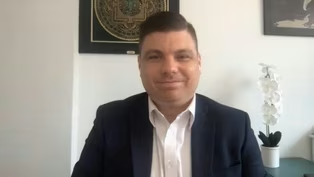
SPECIAL REPORT: AIR QUALITY IN NYC REACHES ‘HAZARDOUS’ LEVEL
Video has Closed Captions
SPECIAL REPORT: AIR QUALITY IN NYC REACHES ‘HAZARDOUS’ LEVELS DUE TO CANADIAN WILDFIRES (11m 45s)
Providing Support for PBS.org
Learn Moreabout PBS online sponsorship
- News and Public Affairs

Top journalists deliver compelling original analysis of the hour's headlines.

- News and Public Affairs

FRONTLINE is investigative journalism that questions, explains and changes our world.












Support for PBS provided by:
MetroFocus is a local public television program presented by THIRTEEN PBS