
MetroFocus: June 9, 2023
6/9/2023 | 28mVideo has Closed Captions
TRUMP INDICTED ON FEDERAL CHARGES, HEALTH IMPACTS OF EXPOSURE TO THE WILDFIRES SMOKE.
Tonight, our coverage continues on the Canadian wildfires smoke that engulfed our city. Dr. Jay Varma, a professor at Weill Cornell Medicine and a former senior adviser for public health under then-Mayor Bill de Blasio joins MetroFocus to discuss how the air quality will impact your health.
Problems playing video? | Closed Captioning Feedback
Problems playing video? | Closed Captioning Feedback
MetroFocus is a local public television program presented by THIRTEEN PBS
MetroFocus: June 9, 2023
6/9/2023 | 28mVideo has Closed Captions
Tonight, our coverage continues on the Canadian wildfires smoke that engulfed our city. Dr. Jay Varma, a professor at Weill Cornell Medicine and a former senior adviser for public health under then-Mayor Bill de Blasio joins MetroFocus to discuss how the air quality will impact your health.
Problems playing video? | Closed Captioning Feedback
How to Watch MetroFocus
MetroFocus is available to stream on pbs.org and the free PBS App, available on iPhone, Apple TV, Android TV, Android smartphones, Amazon Fire TV, Amazon Fire Tablet, Roku, Samsung Smart TV, and Vizio.
Providing Support for PBS.org
Learn Moreabout PBS online sponsorship>> Tonight, Donald trump made history once again last night, becoming the first former President to be criminally indientd federal charges.
We preview one of the stories that will dominate the airwaves next week and bring you part two of our special report on the smoke that consumed our city and put us all at risk as "MetroFocus" starts right now.
>> This is "MetroFocus," with Rafael Pi Roman, Jack Ford, and Jenna Flanagan.
MetroFocus is made possible by Sue and Edgar Wachenheim III.
Filomen M. D'Agostino Foundation.
The Peter G. Peterson and Joan Ganz Cooney Fund.
Bernard and Denise Schwartz.
Barbara Hope Zuckerberg.
And by Jody and John Arnhold.
Dr. Robert C. and Tina Sohn foundation.
The Ambrose Monell Foundation.
Estate of Roland Karlen.
Dr. P. Roy vagilos.
The estate of Smith.
>> Welcome to "MetroFocus" I'm -- Donald trump was indicted making him the first former President in U.S. history to face federal charges.
He's been charged with seven counts related to his mishandling of classified documents including willfully retaining state secrets in violation of the espionage act.
We'll be bringing you more on this story next week as it unfolds.
But tonight, our coverage continues on the biggest story impacting New Yorkers from this past week, the smoke that engulfed our city and turned our blue sky into an apocalyptic shade of orange.
Though the air quality is improving, questions remain about the long-term impact on lunes of smoke-filled air, what is the real impact on our bodies when we breathe in this smoke and what is the city and state doing to protect people from conditions like these and the inevitable future watt strosk weather events climate change will cause.
Here to answer those questions and more, as part of our peril and promise special reporting is Dr.
Flood.
He's a professor of population health signtieses -- scientists and director of the Coronel center for pandemic response.
Dr. Verma welcome to "MetroFocus."
>> Thank you for having me.
>> Yeah, let's just start with our lungs.
I feel like the past three years with the pandemic and then adding on this recent event, our lungs have been through quite a lot.
What is understood about breathing in this kind of toxic air?
>> It's a really great analogy you drew there between the breathing in of pathogens, viruses and bacteria, and now breathing in pollutants, things that come as a result of the wildfire smoke and obviously industrial pollution.
There's a lot of stuff that we know and there's a lot of stuff we don't know.
Let's focus on what we know.
What we know is that this type of air has a really complex mix of all different types of particles.
We don't actually what each of those particles do but we know one particular type, those that are the smallest, if you read about it they'll call it ph-2.5, particulate matter that's very, very small.
That we know from a lot of research in laboratories and looking at large populations is very dangerous to humans.
Basically you breathe it in through your nose and mouth.
It go into your lungs.
Then it goes from your lung into your airways.
Long-term exposure to this has been documented to be a cause of heart attacks, of strokes, and in some estimates around the world it's estimated to cause 10% to 15% of heart attacks are attributable to this type of air pollution.
Long-term exposure is what we're most worried about here.
>> I don't want to be alarmist in any way but this almost sounds a little bit like what we came to understand after the air pollutants in the air after 9/11.
It took several years to see the full effect of the impact because, again, those tiny particles, people were breathing those in and getting just horrifically sick and in some cases losing their lives.
I'm not saying that's what you're predicting for this situation, but is there something similar we can understand where the full understanding won't be maybe for a few years?
>> You're absolutely correct that there is a lot that we don't know.
Now of course, I spent a lot of my time working overseas.
I spent three years living in Beijing from 2008 to 2011, where the air quality, frankly, was very similar to what it has been in New York the past few days.
We know that people can live in this air.
But we also know that there are these longer term side effects and short-term side effects of difficulty breathe, eye and nose irritation.
But as you note there may be other risks as well too this is incredibly hard for scientists to actually tease apart.
You can do studies, for example, in the lab with animal models, but humans, if you think about it, we're breathing every moment of our lives, right?
And what you're breathing varies a lot depending on where you are.
It's hard for us to design studies because you don't really know what any individual is breathing at any given moment.
You can't randomize people to different groups like we do for, say, a drug trial or vaccine.
>> There was a lot of talk especially during the height of the smoky air, that was about people who were at high risk or people who were at risk in thesr importance of them to stay out of the, you know, open air.
Can you tell us more about who is at risk?
>> So we know that in the short term, that means like from the days you're breathing this, what happens to you, that anybody who has any type of underlying lung problem or heart problem, you know, those are two things that make it difficult to breathe, is going to be at a higher risk of having some type of complications.
Let's make that pretty straightforward.
Let's say you have a child with asthma or you're an adult with obstructive lung disease, we call it copd.
This is going to make it harder.
You're going to most likely have an increase in your cough.
Maybe an increase in your wheezing you might have a lot of difficulty breathing.
So what we worry about as physicians is people running out of their medications or even worse having so much difficulty breathing that they, you know, go to the hospital.
And I was just looking before we did this interview at the data from the health department.
They released E.R.
visit data, usually comes about 24 to 48 hours after it happen.
Sure enough, the peak day for asthma visits in 2023 was on Wednesday.
We don't have the data yet for Thursday or Friday, but from two days ago that's the peak.
That's the group we worry about.
Of course there are other people that may be at risk too.
Women who are pregnant.
You know, they often have difficulty breathing as a result of complex body changes.
This can make their breathing worse.
So the real advice out there is to make sure that if you fall into one of these groups or quite frankly, anybody, you may not know you have some underlying susceptibility.
Really wear one of those high quality masks any time you're breathing air outdoors.
It's meant to fit they are type of pollution like it's meant to filter small viruses and bacteria.
>> So that brings me to my other question.
I know that, you know, people were talking about masking up again, the city was giving out n-95 masks.
Should we consider masks, perhaps, to be an ongoing, maybe not every day, but an ongoing part of our future?
>> You know, again, I lived in Asia for -- in Beijing for three years and before that five years in Bangkok.
These are places that, number one, they have a long-standing problem with air pollution.
And number two, they been through bird flu outbreak, the first Sars outbreak, the COVID outbreak.
In a lot of those places it's common for people to wear masks.
Many of my colleagues did on a regular basis.
When there's an air quality event, whether it's due to an infection or pollution.
soy do think it's part of the sort of arsenal, you know that people need to have.
You move to a cold weather climate, you buy hats and gloves.
Move to an area that's going to be more polluted, think about having a mask available.
That doesn't mean we want to see people wearing masks all the time.
We're all humans.
We respond to facial cues.
These are important.
But it's something that people need to be not partisan or political about.
It's a basic safety measure you may need to use, whether it's during a surge of respiratory viruses or a surge related to pollution.
>> It's interesting that you bring up partisan or political because unfortunately, mask wearing during the pandemic became partisan, became very political.
And I'm wondering is there anything that, you know, government institutions can do to help mitigate, I guess, the long-term damage of, you know, dangerous air.
Dangerous water.
Things like that.
When there has been -- there is such a growing skepticism about some of the institutions that used to be trusted.
>> You make an excellent point about changing human behavior.
When those messages will largely come from government and there's a gap in how people trust their government officials.
So you know, in addition to all the things that we know that need to be done related to climate change, preventing these types of fires in the first place, the one area that's been underinvested in by governments and shouldn't be considered partisan is improving indoor air quality.
What I mean by that is, during COVID, I hope some people recognized the fact that, you know, one of the interventions that governments wanted to get people to do was to use indoor air pure fiers.
Either a filter in your central heating ventilation system or one of those standing room devices.
Of course the only people that can afford to do that are people with the money or institutions that have the ability to invest in it.
So really what this comes down to, like a lot of interventions is regulation.
Government putting out and enforcing standards on indoor air.
One of the great things that this, you know, that this White House and administration did in the past year was pull together a summit, there's now very clear guidance from C.D.C.
and from the E.P.A.
about how to improve indoor air.
That means getting these filters installed.
Getting air purifiers.
Starting with public spaces that government can do and moving on to commercial and residential.
That's snag, it's like clean water, right?
We don't have to fight about filtering the water because lock ago governments recognized that everybody deserves clean water now is the time for to us recognize that everybody deserves clean air, it doesn't matter whether you're a republican or Democrat or whether you believe in it or not, your air will be clean because it's there already.
That's the way it should be.
>> You know, you sort of mentioned, talked about how this kind of air quality issue happens all over the place and for people who are on social media, at least, during the height of the smoke coming over the metropolitan area, might have seen a lot of advice from people on the west coast who deal with this constantly trying to give advice about how to mitigate these problems, how to keep yourself safe.
Is there anything that we can learn from what states like, you know, California, Washington, Oregon, how they have dealt with these issues?
>> Yeah, absolutely.
I have many friends and family on the west coast that have been enduring this for many years.
I think that there's a couple of things.
The first is early warning systems.
Right?
There's been some criticism in the media about how the governor, the mayor should have responded.
My perspective on it is, you know, look.
The most important thing is to be forward-looking.
I think what we need is similar to the way in which, you know, New Yorkers are notified routinely about coastal storm, as they're emerging, in the Atlantic or in the south, you know, we stay on the ready like, maybe five or six days if now there may be a big storm.
We need to be thinking about how to do that with air quality.
I hope that at the state and city level they're thinking about how to help prepare the public nor.
Because you can't just suddenly say everyone wear masks today.
People need to stock up and have them available or if they happen to have air filters, knowing they can do that.
Number one Zehrly warning.
Number two is, I think there has to be thought about what to do for those people in the city and there's a whole lot of them in this city as we know who will not have access to clean air.
That particularly includes people who are unhoused, right.
So just like the city sets up cooling cents for the heat emergencies, it should invest in building the air fire case systems to also make those clean air facilities as well.
It's not that difficult to engineer a system where you put in these air filters on top of your air-conditioning to filter it out.
I think those are two types of very straightforward interventions thing, you know, city and state government can do to help prepare us for a future in which these events are unfortunately going to be more likely than no.
>> All right, doctor, I want to thank you so much for taking time to help give us some deeper understanding and perhaps assuage some fears.
Thank you for joining us on "MetroFocus."
>> Thank you for having me.
>> Absolutely.
>> Alzheimer's disease is the most common type of the men shah.
Right now more than six million people are living with it in the United States.
A number that is expected to double over the next two decades.
Earlier this year, the F.D.A.
approved a new drug that is offering hope in the fight against this devastating disease.
The drug, called leqembi, appears to slow Alzheimer's but in the without risks.
Patients are also finding it hard to get coverage for the treatment.
Than all comes amid a recent report from the Alzheimer's association warning that the national cost of caring for patients with Alzheimer's will rise dramatically over the coming years.
The report also reveals that too often individuals with memory concerns do not tell their doctors, missing a critical first step toward diagnosis and potential treatment.
Joining me now to discuss both the promising new treatment as well as the finds of the latest report on Alzheimer's is Dr. Nicole percell.
She's a neurologist and senior director for clinical practice for the Alzheimer's association.
Thank you for joining us.
>> Thank you for having me.
>> So let's, for some context for this conversation, let me go back to what I just mentioned here in the introduction.
And that is the numbers of people that we are finding who are suffering from Alzheimer's.
Your reaction to that.
Are you surprised at the numb we're talking about?
And then talk about what the projected numbers are in the near future.
>> So currently there's more than 6.7 million individuals living with Alzheimer's disease over the age of 65 in the United States alone.
And there are more than 11 million caregivers providing care to those affected individuals.
It's a staggering number.
When you look at the cost of that care, it's approximately $345 billion this year alone.
>> Were you surprised, again, you live in this world, and I've been involved in this with the Alzheimer's association for a number of years, yet I was Jarred by the numbers.
Are you, who are living in this world, who are dealing with this and trying to find cures and treatments, is that number surprising to you?
>> It is surprising.
And when you look at the projections that the number will increase to close to 13 million people by the year 050 it's even more staggering.
It's a tremendous amount of people in the United States and worldwide that have the disease.
>> Let's talk about one of the headlines here in the introduction.
And that is the approval for a new drug.
We called it leqembi, I believe, is the name that's being used for it.
Talk about what it's designed to do and what the find have been in terms of its efficacy.
>> New medications approved by the F.D.A.
for treatment of Alzheimer's disease are designed to reduce the amyloid plaques that accumulate in the brain and cause pathology for this disease.
There are currently two of them, Leqembi is the most recent as of January, 2023.
These medications are approve prd the indication of early Alzheimer's disease or mild cognitive impairment.
That means it's very important if you or a loved one are experiencing symptoms of memory loss or cognitive difficulty, talk to your primary care physician as soon as you notice the symptoms.
>> In terms of what this is, because I know that when you hear something being developed for Alzheimer's, most people's initial instinct is, is this a cure?
Have we found a cure here?
What's the answer to that in terms of the drug?
And what's the answer in terms of how close are we at all to a cure?
>> So these new medications are not a cure.
But they have been shown to slow the progression of cognitive decline.
We do know that there are other proteins that are involved with being deposited in the brain with Alzheimer's disease.
So it may be that it may take a combination of medications.
So there are new medications that are in the pipeline, on the horizon, undergoing clinical tries -- trials at this time.
It may be a matter of needing a combination of medications to attack this complex disease in multiple ways.
>> I'm going to come back in a moment to this drug and how accessible it is to patient, but let me come back to something you mentioned a moment ago that I think is very important.
And that is the reluctance that patients have to talk about the onset or at least questions that they might have about their cognitive ability with their medical providers.
Clearly there's no uniform answer to the question why, but generally speaking, what are you finding in terms of why patients are so reluctant to talk about it?
>> That was the other strike finding in our report of facts and figures this year is that individuals that are experiencing difficulty with their memory and cognition, they are not talking to their primary care physicians.
They feel more comfortable talking to their family or friends about their issues, they feel that maybe they can compare their symptom to what their friends are experiencing to see if they're normal or abnormal.
And individuals also expressed concern that if they do talk to their primary care physician they may get a diagnosis of dementia and that's not something they necessarily want or they may have a misdiagnosis.
They maybe get -- they May be told they have something else they don't have.
So they did report several things as reasons for why they aren't approaching their primary care physicians.
>> So how do you get, we lived through this, my mother-in-law had Alzheimer's before she passed away, my wife had always been very close, show saw -- she saw it yet my mother-in-law wouldn't admit to it.
What's the advice you can give to family members at this point if they see something happening, how do they communicate with their loved one to try to say to them, all right, we need to get to a medical provider and we need to accept that this is happening.
>> You bring up a very good point that many people experiencing difficulty with their memory don't have insight into it so they don't realize it.
We encourage, you know, loved ones or care partners, to discuss it with the individual that they're seeing the problem, and encourage them and actually attend the physician's visit with them.
It's very helpful on the physician's end to not only have the individual with symptoms but their loves one that's seeing changes or things going on with the person.
It gives up mutt -- gives us much better insight into what's going on.
I think the other thing that's important besides care partners or loved ones encouraging the individual, primary care providers also reported that they generally wait for the patient or a loved one to bring up their symptoms of memory concerns instead of making ate routine part of clinical care.
Buttic we need to reduce the stigma and make this a part of every clinical visit.
>> You mentioned stigma.
That is such a hurdle for so many different medical maladies and ailments.
This, I think, carries wit, carries with it fear.
Along with the stigma.
I think you start thinking, I can't remember where I left my keys today.
And then your next thought is, oh, dear, am I getting alz himmers or some other form of dementia?
So what do you say to, again, patients or family members and primary care physicians so they they can be invested in this, what do you say to them about how do we deal with the fear of a diagnosis that causes this reluctance?
>> It's been my experience with seeing patients that if I can assure them that they're not going to go through this process alone so that they do have a loved one there that's with them or they do have family and they have their physicians that will guide them through this.
Hopefully enabling them to develop a trust so that as they progress through the disease, they're trusting that their physicians and their care partners are going to act in their best interests always.
And I think it's very important for primary care physicians to just bring up memory concerns at every visit.
So just seems to be a normal part of routine care and the discussion and it'll help patients feel more at ease while trying to have these conversations with them.
>> Let me come back to Leqembi, the drug we talked about before you discussed what it's designed to do, what hopefully it -- it can do, but it's not a cure.
Sit readily available to patients?
>> It is not readily available as far as coverage goes for care.
Most of the patients over the age of 65 are Medicare beneficiaries.
Medicare is currently not covering the drug outside of experimental clinical trials.
Recently, the veterans health administration did release a report indicating that they are going to cover it for their beneficiaries that are qualifying for the medication.
>> I suspect people are going to have the same reaction I'm having right now, I'm say, I'm on Medicare, I'm that age.
So I'm especially concerned about the availability of drugs that might be more necessary for me as an older person.
And I suspect that viewers are watch, listening to this, and they're puzzled.
They're saying if the F.D.A.
approved this, why is Medicare who is supposed to be taking care of us in our older ages, where this is more prevalent, why are they not jumping in with both feet and applauding this and say, absolutely.
Let's get it to everybody we possibly can.
Is there an answer to that?
>> Part of the answer lies with the F.D.A.
approval.
So the medications were approved under an accelerated approval.
And so medicare has not agreed to cover this unless the medication received full approval.
It's my understanding that that information is sitting with the F.D.A.
currently and at some point they will review it in the near future.
>> Are there other drugs or treatments that are in the pipeline right now that you, the Alzheimer's association, are familiar with that at least have some potential for providing additional care?
>> There's approximately 140 medications that are in the pipeline, and these medications are effective at a wide variety of strategies.
Some of them are against the amyloid.
Some are against tau, another protein that accumulates in the brain with Alzheimer's disease.
Some are anti-inflammatory medications.
There's a variety of medications coming through the pipeline, so it's very hopeful.
>> We've got about Maine or so left.
For folks watching this, watching our conversation, say, this sounds frar, some of these symptoms sound familiar either for me or a loved one or a friend, where do they go to find information and guidance?
>> The first place they should go is their primary care physician and discuss their symptoms with their primary care physician to get an assessment and get a diagnosis.
And if there's additional information, certainly, come to the Alzheimer's website which is alz.org, and you can find information there.
We also have a help line and that number is on our website.
>> Dr. Nicole purcell thank you for sharing this information, giving us a better understanding and thank you to you and everybody at the Alzheimer's association for the wonderful work you're doing.
We'll check back with you soon to see what kind of progress we're making.
You be well.
>> Thank you.
>> "MetroFocus" is made possible by Sue and Edgar Wachenheim III.
Filomen M. D'Agostino Foundation.
The Peter G. Peterson and Joan Ganz Cooney Fund.
Bernard and Denise Schwartz.
Barbara Hope Zuckerberg.
And by Jody and John Arnhold.
Dr. Robert C. and Tina Sohn foundation.
The Ambrose Monell Foundation.
Estate of Roland Karlen.
Dr. P. Roy vagilos and Arlene T.vagi los.
Estate of Warren T. Smith.
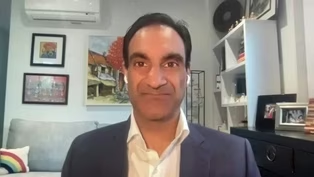
HOW SMOKE FROM THE WILDFIRES COULD IMPACT YOUR HEALTH
Video has Closed Captions
Clip: 6/9/2023 | 13m 15s | HOW SMOKE FROM THE CANADIAN WILDFIRES COULD IMPACT YOUR HEALTH (13m 15s)
Providing Support for PBS.org
Learn Moreabout PBS online sponsorship
- News and Public Affairs

Top journalists deliver compelling original analysis of the hour's headlines.

- News and Public Affairs

FRONTLINE is investigative journalism that questions, explains and changes our world.












Support for PBS provided by:
MetroFocus is a local public television program presented by THIRTEEN PBS