
MetroFocus: November 2, 2023
11/2/2023 | 28mVideo has Closed Captions
COLLEGES RESPONSE TO THE ISRAEL-HAMAS WAR; A PREVIEW OF HBO'S "THE STROLL"
Tonight, Reporter Melissa Korn of "The Wall Street Journal," joins us to discuss the struggle colleges are having with their response to the Israel-Hamas war. Then, Kristen Lovell and Zackary Drucker, the co-directors of the HBO film, "The Stroll," join us for a preview which focuses on the legacy of transgender sex workers in New York.
Problems playing video? | Closed Captioning Feedback
Problems playing video? | Closed Captioning Feedback
MetroFocus is a local public television program presented by THIRTEEN PBS
MetroFocus: November 2, 2023
11/2/2023 | 28mVideo has Closed Captions
Tonight, Reporter Melissa Korn of "The Wall Street Journal," joins us to discuss the struggle colleges are having with their response to the Israel-Hamas war. Then, Kristen Lovell and Zackary Drucker, the co-directors of the HBO film, "The Stroll," join us for a preview which focuses on the legacy of transgender sex workers in New York.
Problems playing video? | Closed Captioning Feedback
How to Watch MetroFocus
MetroFocus is available to stream on pbs.org and the free PBS App, available on iPhone, Apple TV, Android TV, Android smartphones, Amazon Fire TV, Amazon Fire Tablet, Roku, Samsung Smart TV, and Vizio.
Providing Support for PBS.org
Learn Moreabout PBS online sponsorship>> Tonight, death threats on college campuses and students planning to sue their schools were not doing enough to protect them.
I report on the divide at universities over the war in the Middle East.
Then HBO takes us to a place where transgender women solicited sex in the meatpacking district and created community the protected one another from harassment and violence.
"MetroFocus" starts now.
♪ >> This is "MetroFocus," with Rafael Pi Roman, Jack Ford, and Jenna Flanagan.
MetroFocus AIDS made possible by the endowment to fight anti-Semitism.
The Peter G. Peterson and Joan Ganz Cooney Fund.
Filomen M. D'Agostino Foundation.
Barbara Hope Zuckerberg.
And by Jody and John Arnhold.
Dr. Robert C. and Tina Sohn foundation.
The Ambrose Monell Foundation.
Estate of Roland Karlen.
Charlotte and David Eckert.
The tiger Baron foundation.
Nancy and Morris off it.
Josh Weston.
>> Good evening and welcome to MetroFocus.
I am Jenna Flanagan.
In just the latest incident of anti-Semitism on a college campus, a 21-year-old Cornell student was arrested for threatening to kill Jewish classmates, shoot up a kosher dining hall and slit the throat of any Jewish man he came across.
Governor Hochul as directed state police to increase security at colleges and universities across New York, but many Jewish students still feel their schools are not doing enough to protect them.
A group of Jewish students from elite schools like Cornell and Harvard are now planning to sue their universities, accusing them of turning a blind eye to the growing hatred.
Since the Israel-Hamas war began, there have been many reports on college campuses here in New York and across the country of violent threats, intimidation tactics, public doxxing, and assaults.
Student supporters of both Israel and Palestine have expressed fear for their safety in recent weeks, and joining us now with much more on the increased violence and fear that we are seeing on college campuses is Melissa corn, a reporter covering the story for the Wall Street Journal, and she joins us as part of our exploring hate initiative, examining the intersection of anti-Semitism, racism, and extremism in America.
Melissa, welcome to MetroFocus.
>> Thanks for having me.
>> I want to start with that story at the top about the student at Cornell University was been arrested.
Can you tell us what you know has happened thus far?
>> sure, over the weekend there were messages that were posted online threatening violence against Jewish students, against a kosher dining hall, and a great concern amongst students for their safety, just tell real threat -- just how real this threat was.
A 21-year-old student was arrested for allegedly making these threats and causing quite a panic on campus.
Jenna: of course, and I am also wondering -- excuse me, for the lawsuit two groups of students at least that we know of at elite colleges are planning to file.
Is this something that we have ever seen before?
Students suing their college campuses were not doing enough to keep them safe?
Melissa: I am not sure if there have been similar lawsuits in the past, but there is definitely a new level of concern among students, both Jewish students and Muslim students, students who are Palestinian or assumed to be Palestinian.
Students who are is really or are assumed to be is really are concerned that their schools are not protecting them enough, are not speaking up enough for them enough, and are not criticizing the other side if you will enough.
Jenna: of course, in speaking of that, college campuses have long been -- I do not want to say a hotbed, but a place where there have been protests and competing ideas and debates, and that is what a lot of college campuses like to pride themselves on.
Why is this a situation where this is causing much more friction than it seems to have in the past?
Melissa: right, this is going from indicative academic discussion to something that is really fueled by emotion, often times fueled by misunderstanding , and it is people shouting at each other rather than having a conversation and learning from each other, which as you said is something that campuses pride themselves on being able to do.
Provide a forum for that, and we have seen this step up.
The thing that I find perhaps most interesting about what we are seeing at the current moment on college campuses are these rather strange bedfellows of who is coming together to stage these protests and demonstrations.
Who is speaking out saying they are in support of Palestinians, that they are against Israel, and in some cases that they are against Jewish students more broadly.
And again, there seems to be a lot of complication around what terminology they are using when they are talking about supporting or opposing a particular group of individuals around the world.
So you have God students who are active in Black Lives Matter, students who are active and LGBT groups, climate change organizations who are now front and center in some of these demonstrations on campuses supporting Palestinians and calling for the end of Israel.
Jenna: wow, OK. For some of these universities, because we have also seen the University themselves as an institution get caught in the middle, where before perhaps people were able to -- especially I am thinking of university presidents, King able to walk the line of releasing a statement that perhaps condemns or acknowledges that this is a difficult issue and there are two sides, etc.
that a lot of university president seem to have an incredibly difficult time being able to walk that line of neutrality.
Is that even something that is possible anymore?
Melissa: for a number of years university presidents have been making statements about political topics, social justice issues, and they have increasingly seen it as their role.
We have a soapbox, we are going to use it.
We are a voice of reason and hopefully our statement will help set the stage or give context for what is happening in the world around us and provide some informed insight and opinion here.
The thing is, they cannot stop doing it all at once, right?
Even though this is perhaps a more divisive issue than some of the others on which they have spoken in past years, things like mass shootings, the devastation of natural disasters .
They come out with statements.
The current moment is a lot more complicated and a lot more tense, and for them to all of a sudden go quiet now in itself can send a message, that somehow this is deemed not to be worthy of their time, of their statement, of their words, but at the same time if they do make statements we have seen presidents at colleges across the country really face sharp criticism from pretty much everybody for whatever it is they do or do not say.
Jenna: we have spoken broadly about college campuses safer the incident at Cornell, so I want to speak specifically about an incident that took place in Harvard University.
As I understand it in the immediate aftermath of the October 7 attacks -- it not immediately, but not too long afterwards, a group of students on campus released a statement putting the sole blame for the Hamas attack on Israel or at least the government of Israel, and that created a significant backlash, correct?
Melissa: yes, a collection of student groups wrote this letter and said that this was -- what happened on October 7 was the fault of Israel's government, full stop.
And there was great outrage on campus at Harvard that these groups were blaming Israel for a massacre against Israeli civilians, and there were immediate calls for the President, the administration of the University to step up and denounce the student groups, to say that what they were saying was inappropriate, it was wrong, was not supported by the institution.
The challenge is the institution pride itself on being a champion of free speech, even when that speech is ugly, and you saw great criticism of the University for not coming up emphatically enough, quickly enough, aggressively enough against the student statements, and there was criticism that they did not call Hamas a terrorist group quickly enough, they did not say the students were in the wrong.
This piled on very quickly, the group driving around near campus with the truck showing the names and faces of members of these organizations whose leaders signed the letter, and it later came out some of the students who were members of these organizations, they were not the one signing the letter.
The president of these groups were speaking on their behalf and that put them in a tough position.
Jenna: I am also wondering, because as we have discussed and you have laid out a clear case of this, we have a lot of emotional reaction with regard to the Ward with Israel and Hamas -- war with Israel and Hamas, but college campuses are supposed to be a place of debate , so I'm wondering to your knowledge have there been any universities that have been able to use this as -- and I hate to use the phrase, but a teachable moment to fully lay out and help the students fully understand the wide breadth of the history and story that led to this moment, or are people in a very emotional reaction to replace still?
Melissa: I think we are still in that emotional reaction to replace for the most part.
There are exceptions.
There are some schools and some groups that are holding teach ins, panel discussions on the history of the region, on how we got to this moment, on the creation of the state of Israel, on humanitarian efforts, on the legal definition of terrorism, things like that.
Taking a very clear academic intellectual approach to the situation, but some efforts at that have been stymied by protests, by groups saying your take on this is skewed.
This is not really an academic discussion, so let's just shut it down entirely, but there have been some efforts at places like University of Chicago and a handful of other schools.
We are seeing faculty led efforts to have an honest, informed conversation.
Jenna: finally, speaking of the way that universities operate at what they are able to do, we have also seen that donors are playing a big part in the way universities react, do not react, statements they release and do not release.
Is that correct?
Melissa: absolutely, and that gets into presidents can seem to do no right in terms of what kind of comments they make.
You were seeing major donors, generally Jewish donors who are supportive of Israel coming out and saying to the president of their alma mater's or schools where they have given millions, tens of millions of dollars change over not saying enough, speaking strongly enough.
I am going to stop giving you money if you do not say something soon.
I am going to end this partnership that we have because you were not supporting Israeli students enough.
I think you step down.
We are seeing this at places like Harvard, University of Pennsylvania, Stanford University.
So these are schools with well-known, powerful donor sourcing now is my moment to take a stand, and my university should be doing the same.
Jenna: Melissa, I want to thank you so much for your reporting, and we look forward to more from you.
To better understand to this very difficult and complicated issue.
Melissa: thank you.
♪ Jenna: welcome to MetroFocus.
I am Jenna Flanagan.
For decades it was known simply as the stroll, a stretch of West 14th Street in Manhattan's meatpacking district where transgender sex worker set up shop.
For many of the transgender women who work there this was about more than business.
It was a community of people with a few other places to turn to for support.
In the face of violence and harassment from both customers and the police, they banded together and helped pave the way for today's new era of visibility.
HBO's the stroll is telling the story of these New Yorkers led by the codirector, who once worked the stroll herself.
Here is a clip.
>> Do you remember what we used to walk down here and all the neighbors would stare at us.
They would look at us like we were circus freaks, but you could tell they enjoyed it.
♪ >> The minute I got off on 14th St could hear the clickety clack of the hills -- heels.
>> Some people choose sex work because they wanted to be a trans woman in the 1980's.
A lot of us did not have a choice.
>> People were not hiring people that look like me.
>> Trans life in general it was difficult.
I wanted to make people understand the reality of our lives through storytelling.
>> The story today that obsesses New Yorkers, crime.
>> It was really a very bad situation.
>> They act like I am out your to murder people.
>> Everybody is a client.
>> After I was done doing his deed, he arrested me.
>> There was a lot of violence.
>> I almost got killed by a John who tracked me for half a block in his car.
We were on the front line with the gay and lesbian community but you are not doing anything to help me.
We knew we were freaks to them.
>> The things we got to do.
>> The trans community as been in survival mode forever.
It is important we get an opportunity to thrive.
>> We thought to be where we are.
>> The system never gave us resources.
We created the resources.
♪ >> You owe it to every trans woman before you.
>> You were pushed out of the neighborhood.
I was determined to make a film about the stroll before we are gone.
>> Are you making TikToks.
>> We are talking about our lives before this became this.
>> I remember that.
>> What is your name?
Jenna: we are joined now by the directors, Kristin Lavelle.
Welcome to MetroFocus.
>> Thank you.
Jenna: also Zachary Drucker.
Thank you for joining us and for this incredibly informative and I would say historical film.
Christian, I went -- Kristin, I want to start with you.
Why it was important for you to take control of and share this narrative from your perspective?
>> Because we really have the opportunity to be able to share our own stories.
We have outsiders come in and it's been a narrative of what trans life is like, so it was important for me after observing the process to have the ability to pick up the camera and take control of the narrative.
Jenna: Zachary, where do you come into the story, because I understand you had a different experience, but what made you want to be part of telling this story?
Zachary: working on this film with Kristen has been the honor of a lifetime.
I was also a young person in New York City and moved from Syracuse, New York in 2001, and I remember being a part of a trans and queer youth organizing effort that Kristin led at the time, which was mobilizing around the queer young people as they started to develop the Hudson River project, so that is kind of my entry point.
When I got the call and I knew that Kristin was looking for a copilot, I hopped on board.
I think the story of the trends six workers are crucial to the understanding of trans life, and it is really a universal story.
It is not only about the specific neighborhood in New York, but there are strolls all over the world in cities, and I think for centuries.
Jenna: Kristin, I am wondering if you could give us an idea of the unique sense of sisterhood you and so many other women found on 14th St?
Kristin: coming into the city as a young person, especially if you are coming out as trans or queer, sometimes you are pushed away, and it was important to go out and find people like yourself, right?
That you had things in common with for you to understand that you were not alone in this situation.
You were not the only one, and I ran into those people that became my chosen family, and we looked after each other.
There were times because we were so uncertain, we did not know where we would get our next meal from or whether the youth shelter we were in would kick us out at any given moment.
We had to stand together.
We were dealing with so much at that time as young people, and we built this family, and we built this cohesion of camaraderie, and you see it in the different groups, and the wonderful thing about the stroll is I was able to capture that.
There are the different groups of girls.
There were at the backstreet girls, the 14th and 9th Ave girls, and we all interacted with each other.
And the girls that were living in the shantytowns before they were torn down.
Seeing these groups of people and how they played out on the stroll, that is what chosen family is.
Jenna: at the beginning of our conversation, I did mention that I also found this film, this documentary to be historic in nature, and to be a lot of that was because you made it a very clear point to not just tell the story that you and so many of your contemporaries experienced, to also go back into the history of trans women existing in New York but also on 14th St.
I am wondering if you could tell us something specific or something unique about that history of perseverance about that, yes, we are here and we will not be pushed into the shadows.
Kristin: that is what it has always been about, especially being an out trans person and living unapologetically in your truth.
In those days the goal was to pass into society, and a lot of people got tired of that narrative and wanted to be ourselves and be free, so that is what we started to do.
Jenna: in the process of working on this piece, were there aspects of transit womanhood that you were unaware of that even you were learning in the process of making this film?
Zachary: Kristin and I are both history buffs and really sought out the story of trans people through film archives, and discovering our predecessors in the archive is just a magical process of discovery.
And I would not say that we were unaware of things so much as to encounter figures from the past and to let them speak through time to viewers today is the magic of film.
That we are eternal when we are represented and when we are documented, and this was a community that was well represented, because there were a lot of artists living in the neighborhood, so many photographers were photographing the trends community of the stroll -- trans community of the stroll, and it is an incredibly wonderful archival document of the history of New York, gentrification, white supremacy and policing, and late capitalism, and it is a real call to action in addition to being an archival, multifaceted documentary.
Jenna: of course, and I do want to say that the neighborhood itself does become almost a character as it goes through its own transformation and is virtually unrecognizable to the way that it was in the 1970's, 1980's, and 1990's, but I went to stay with you for a minute and just ask, one of the places the film touches on and that is trans women representation in pop culture.
This is airing on HBO, and so did another very popular show, Sex and the City, which did touch on this particular neighborhood.
How do you think pop culture change the way people viewed not just the girls on this role but also trans people in general.
Zachary: I would say it shaped it very negatively for the most part, and the dominant mainstream television and film narratives, trans folks have been the punchline jokes and have really been on the outskirts of stories at best.
We have been dictums and villains -- victims and villains, and that trans tipping point, there was an erasure of trans sex were, which is unfortunate because it is so crucial to the survival of our community.
If you look back at generations, trans people I've only ever survived by operating in the underground economy, so this was the reality of trans life.
Jenna: we only have a few moments left, if there was something people were misunderstanding about the trans community and sex workers, what is it you would want them to get, to really understand?
Kristin: they make it like a choice that we have or we chose to do these things, and, yes, we chose to live out unapologetically and to be ourselves, but we did not ask for the discrimination, the oppression that we faced, the murders that have happened for simply existing.
We just want the same thing, you know what I mean?
I went to go to work, and have relationships.
I went to walk down the street and not worry about getting attacked.
It is very simple what we ask, and people make it seem like it is the hardest thing to do.
>> MetroFocus is made possible by Sylvia and Simon Poyta endowment to end anti-Semitism.
Joan Ganz Cooney Fund.
Filomen M. D'Agostino Foundation.
Barbara Hope Zuckerberg.
And by Jody and John Arnold.
Bernard and Denise Schwartz.
Dr. Robert C. and Tina Sohn Foundation.
The Ambrose Monell Foundation.
Estate of Roland Karlen.
Charlotte and David Eckerd.
Tiger Baron foundation.
Nancy and Morris Offit.
Josh Weston.
♪
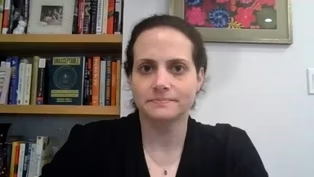
COLLEGES AND THEIR RESPONSE TO THE ISRAEL-HAMAS WAR
Video has Closed Captions
Clip: 11/2/2023 | 12m 38s | EXPLORING HATE: COLLEGES STRUGGLE WITH THEIR RESPONSE TO THE ISRAEL-HAMAS WAR (12m 38s)
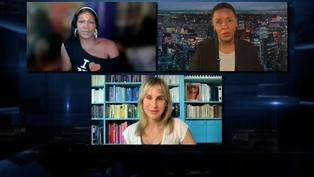
Video has Closed Captions
Clip: 11/2/2023 | 12m 51s | HBO’S “THE STROLL” LOOKS BACK AT THE LEGACY OF TRANSGENDER SEX WORKERS IN NEW YORK (12m 51s)
Providing Support for PBS.org
Learn Moreabout PBS online sponsorship
- News and Public Affairs

Top journalists deliver compelling original analysis of the hour's headlines.

- News and Public Affairs

FRONTLINE is investigative journalism that questions, explains and changes our world.












Support for PBS provided by:
MetroFocus is a local public television program presented by THIRTEEN PBS