
MetroFocus: November 6, 2023
11/6/2023 | 28mVideo has Closed Captions
THE ISSUES THAT MATTER TO NEW YORKERS MOST; MTA FARE EVASION CRISIS
Tonight, Siena College pollster Steven Greenberg, joins us to break down the numbers in his new poll, and discusses the issues that matter most to New Yorkers. Then, New York is facing a fare evasion crisis. Joining us to discuss their work & possible solutions to the crisis are the co-chairs of the Panel on MTA Fare and Toll Evasion, Rose Pierre-Louis and attorney Roger Maldonado.
Problems playing video? | Closed Captioning Feedback
Problems playing video? | Closed Captioning Feedback
MetroFocus is a local public television program presented by THIRTEEN PBS
MetroFocus: November 6, 2023
11/6/2023 | 28mVideo has Closed Captions
Tonight, Siena College pollster Steven Greenberg, joins us to break down the numbers in his new poll, and discusses the issues that matter most to New Yorkers. Then, New York is facing a fare evasion crisis. Joining us to discuss their work & possible solutions to the crisis are the co-chairs of the Panel on MTA Fare and Toll Evasion, Rose Pierre-Louis and attorney Roger Maldonado.
Problems playing video? | Closed Captioning Feedback
How to Watch MetroFocus
MetroFocus is available to stream on pbs.org and the free PBS App, available on iPhone, Apple TV, Android TV, Android smartphones, Amazon Fire TV, Amazon Fire Tablet, Roku, Samsung Smart TV, and Vizio.
Providing Support for PBS.org
Learn Moreabout PBS online sponsorship>> tonight, trending in New York voters speak out on issues that matter the most from the migrant crisis to crime to Israel.
Surprising numbers of a new state poll, then fare and total innovation cost the MTA a billion dollars last year but you know how much it may have been costing you?
Metro focus starts right now.
>> this is Metro focus with Rafael Pi Roman, Jack Ford, and Jenna Flanagan.
MetroFocus is made possible by The Peter G. Peterson and Joan Ganz Cooney Fund.
Filomen M. D'Agostino Foundation.
Barbara Hope Zuckerberg.
And by Jody and John Arnhold.
Bernard and Denise Schwartz.
Dr. Robert C. and Tina Sohn foundation.
The Ambrose Monell Foundation.
Estate of Roland Karlen.
>> good evening and welcome to Metro focus.
I am Jenna Flanagan.
The latest Siana poll of New Yorkers focuses on migrants coming into the state indicating the issue number and say top concern for most voters.
84 percent of voters view the influx of migrants as a serious problem.
Opal asks New Yorkers for perspectives on various other important issues including the war in Israel and Gaza, the state's current direction and the 2024 presidential candidates.
On the last question the findings reveal troubling numbers for Democrats and Joe Biden.
Joining us to discuss the poll is Siena College pollster Steve Greenberg.
Welcome to Metro focus.
>> thank you for having me.
>> let's start with the top issue and that would be the migrants coming into New York City and different parts of New York State.
What did the poll tell us?
>> one of the most important topline findings is 84% of New Yorkers think what is going on right now with the influx of migrants is a serious problem.
57% of New York workers say it is very serious and seldom do we see issues where we have four out of five Democrats, Republicans, independents, upstate, downstate, all saying this is a serious problem.
The other issue in relation to this was we pulled one of the statements that Mayor Adams recently made talking about how he see is the end of almost every problem but not this problem.
He thinks the migrant issue will destroy New York City so we asked voters if they agree or disagree with the mayor that this could destroy New York City and buy a 58-32% margin voters agreed with the mayor.
Here we do see a partisan divide.
81% of Republicans agree with the Democratic mayor, 60% of independent voters agreed, but Democrats are divided.
44 percent agreed, 42% disagreed.
>> what about Latino voters, how do they factor into this?
>> 60% of white voters, 57% of black voters and 51% of Latino voters all agree with the mayor that this could destroy New York City.
>> I think that is surprising for a lot of people.
>> absolutely and if we go back to the first question, well over 70% of Latinos say this recent influx is a serious problem for the state.
The other thing we did this asked voters to rate the job that the mayor of New York City is doing, the governor of New York and the Biden administration in Washington and rate the job that those three executives are doing to address this issue.
Voters give failing grades to all of them.
37% approve of the job she is doing, 52% disagree.
For Mayor Adams it is 37% approve.
And voters say they have the most wrath for the Biden administration.
Only 29 percent of voters approve of the job the Biden administration is doing to address the issue compared to nearly two thirds, 64%, who disapprove.
>> what do those numbers tell us?
A voter who might voice disappointment does not mean a votive who stays home or votes for the other party or does it?
>> certainly not and certainly not this far out from an election.
We still have more than 12 months until election day in 2024.
A poll is a snapshot in time.
This is how voters feel right now but if we go back one month, nobody thought at least not that I had heard that there is going to be a major Middle East war potentially.
Events change the way people think so we have one year until election day, a year worth of events to happen that will impact how the voters feel when they go to the polls next fall.
>> of course, of course.
So when we talk about the impact do we have any idea of where Latino voters in the snapshot are falling?
>> Latinos give Mayor Adams a disapproval rating, 44% disagree -- disapprove, 42% approve.
For the governor, 42% disapprove, 41 percent approve and for the Biden administration it is almost two to one, 60% disapprove compared to 33% who approve.
>> wow, OK. What did we learn about where the state is headed?
New York City being a very big part of the state but miss there apprehension about the state of New York State?
>> absolutely, the first question Siena asks is the same every time.
Do you think New York State is on the right track or headed in the wrong direction?
Right now only 34% of New Yorkers think the state is on the right track.
52% think we are headed in the wrong direction.
A serious partisan divide, 78 percent of Republicans, 58% of independents think the state is headed in the wrong direction but Democrats, a plurality but not majority, 47% think the state is on the right track but New Yorkers are not happy about the direction of the state and they are more negative about the direction of the country.
25 percent of New Yorkers think the United States is on the right track, nearly two thirds, 65% say the country is headed in the wrong direction.
>> speaking of how New Yorkers view where the country is headed I wonder what they think about international issues.
We are funding to international war fronts, Ukraine and Israel.
What to the polls say about where New Yorkers are with those big issues?
>> New Yorkers are supportive of aid for Ukraine and Israel.
We asked do you support or oppose more military and economic aid for Ukraine and then the same for Israel.
51% of New Yorkers support increased aid for Ukraine compared to 38% who oppose it.
For Israel it is even stronger, 57% support, 32% oppose.
Democrats are similar on both issues.
61% support aid for Ukraine, 57% support aid for Israel but Republicans by a 56-35 percent margin oppose increased aid to Ukraine but by a two to one they support aid for Israel.
>> what does that tell us?
People are fine with finding certain wars but exhausted by others?
>> I don't know that they're getting exhausted and a majority of New Yorkers including a strong majority of Democrats and Independents support increased aid for Ukraine and what we are seeing in New York is a lot of Republicans in New York like what we see out of Washington and the house Republicans, the former president has indicated he is not supportive of Ukrainian aid, so there is a lot of consternation we say from Republicans as to whether they want to support or oppose but a majority of New York Republicans oppose aid to Ukraine.
>> final question and speaking of consternation or concern, crime in New York, I understand that was a poll question.
How did that turn out?
>> for the last several years Siena would ask voters how serious a problem is crime in New York State and your community.
We had not asked in the last several months, we got tied up on other issues so when we went back to voters this month what we said was over the last year would you say the crime problem in New York State has gotten problem, stay the same, gotten worse?
Only 9% think the crime problem has gotten better, more than a quarter, 28%, think it stayed about the same.
59% of New Yorkers, a clear majority think the crime problem has gotten worse over the last year.
>> is interesting because you say in the state.
Where is there a difference between upstate and downstate or was that ubiquitous?
>> there is some difference but New York City voters, 51 percent of New York City voters think it has gotten worse, crime has gotten worse.
64% of downstate suburban voters and the same percentage of upstate voters think that the problem in the state has gotten worse.
>> just to bring that back to our original topic, the migrant issue, which I do not want to attempt to tied to what we were talking about but I wonder if there was a difference between the way upstate New Yorkers and New York Cityers, the difference between the way the influx of migrants is being viewed?
Not all parts of the state are feeling it equally.
>> that is true but what is interesting is when we look at the migrant issue we see on many of the questions very little variation between Democrats and Republicans.
So there is a strong feeling among all New Yorkers that this is a problem that elected officials are not addressing adequately and that they would like to see it addressed.
It is not unlike the crime problem if we go back one year and think back to the gubernatorial campaign between Hogle and this is Eldon, crime was that issue last year.
This year it feels like a migrant issue but when we asked about crime voters say it is getting worse.
>> wow, well for me the big take away is the little difference between Democrats and Republicans, one of the few times that we hear that phrase.
Steve, thank you so much for taking the time to break down the latest Siena College poll.
We look forward to hearing more snapshots of where voters are as we head toward the eventual 2024 presidential and congressional etc.
elections.
Thank you so much for joining us.
>> thank you for having me, we will be pulling almost every month between now and then.
>> we look forward to hearing about it, thank you.
>> good evening and welcome to Metro focus, I'm Jack Ford.
New York is facing a toll invasion crisis.
According to a panel appointed to study and combat the invasion threat.
The 16 member group found to be problem spiked after the pandemic threatening the transit systems financial stability and tearing up the social fabric of New York.
They have come up with recommendations to address the issue without aggressive policing which critics say unfairly targets the city's most vulnerable.
For more on possible solutions we are joined by the cochair of the panel, Rose Pierre who serves as Executive Director director at the Institute for poverty policy and research.
An attorney and the former president of the New York City Bar Association.
Welcome to both of you and thank you for joining us.
Lots to talk about so let's start with a sense of the magnitude of the problem.
Rose, let me come to you and give us what the panel was dealing with here?
>> as a panel we were looking at the issue of fair and told Eve Asian across the entire system so that includes buses, subways, commuter rails, bridges and tunnels.
What we learn from our work over the better half of one year was the issue of fair evasion is a serious problem for the MTA and certainly the impact is very serious for New Yorkers.
Looking in total across the system it is $690 million.
Again, that is a very serious problem for New Yorkers when we are seeing this literally tear the social fabric of our communities.
For example when you look at buses which have the highest rate of evasion, something like 380 $5 million of lost revenue due to evasion and we see the same to a lesser level on subways but across the system millions, hundreds and millions of dollars are being lost to this issue.
>> significant financial impact.
Talk about some of the findings of the panel.
Let me come to you and talk about it more.
If you ask anyone involved in the transportation system and they said fair evasion, what are we talking about?
People would say people jumping the turnstiles in the subway but it does not sound like that was the primary one that people suspected it to be.
What did you find?
>> when I was first approached by Jeremy to join the panel that was my reaction.
I thought how are you going to stop teenagers from jumping turnstiles without sending them to Rikers and the truth is that the subways where the main source of fair evasion is not jumping turnstiles, its emergency slam gates that are open by someone coming out, leaving the system opens the gate and then people who are lined up to pay their fares see the gate and stream through and it becomes like a conga line.
So among the recommendations to address fair evasion is to look for ways to replace the fair gate system in the subways so that there is no need to maintain the gates.
New gates will default to open so that in case of emergency you don't have to have a different exit, they will all be open and you can leave.
So among our recommendations was let's use technology to minimize the opportunities for fair evasion and maximize the sense that it is a friendly system, these new gates are ones that are clear, not corkscrews that you have to maneuver through to get out.
>> like jail cell doors.
>> exactly, exactly.
>> rose, let me come back to you to talk about some findings and possible remedies.
You mentioned before the fact that it was buses that provided a higher amount of evasion violations and dollars lost.
Roger talked about suggestions for the subway system, what about buses and how is it that buses are the ones because people who travel buses say I can't get on the bus and Lisette got a card, so how is it that buses and up being the most significant site of violations and what is the panel suggesting?
>> evasion happens a couple of ways.
You have people that literally come on the bus and either do not have -- cap through the Omni system where you can use a card or smart phone or literally put money into the box or use your Metro card, people are choosing not to pay at all or not putting enough in terms of the total fair to ride on the bus.
Also some people are literally just getting on on the back of the bus and if you recall in the report talks about during COVID for health and safety purposes, riders were directed to enter the bus from the back.
One of our recommendations in this regard to stem the tide of fair evasion is to ensure that there is the appropriate messaging but also we are calling for increased numbers of special investigators.
Part of the team that literally checked if you have paid your fare.
These are civilians that are part of the MTA and they have been focused on the express service.
But the recommendation is not only do we do it on SBS but also put that enforcement on the regular bus service.
>> Roger, let me jump in with you on this and that's the notion of how to we police this?
I suspect if you lined up 10 people who take the subways and said what should you do, many if not most or all would say more police.
How did the panel look at that and what did the panel come up with?
>> the panel was clear in terms of the composition and mandate that the solution was not policing.
In fact on buses, no police.
Civilian enforcement.
But even in the subways we do recommend enforcement and that police be involved.
Step one for enforcement by police officers is not police.
Give an official warning that is documented so there is no question that the warning will be consistent and applied.
Step number two is to issue a summons that is not criminal but a summons per our recommendations could be turned into a lesser fine for persons of fading because of lack of funds.
Increasing eligibility for fares, we've got a 50% subsidy on the affairs to persons within New York City who are at hundred percent of the federal poverty level, bringing hundreds of thousands of the working poor into the system in ways that they will be able to afford on the subways and buses.
The other component is to involve the community in whatever enforcement there will be.
We are recommending so-called no evasion stations where there will be announcements prior to actual enforcement saying this is what is going to happen and we will involve community members in educating the public.
In making applications for their fares available at the stations and we will make clear that what is going on is a desire to ensure everyone is paying their fares for two different reasons.
To sustain the system that is vital to maintain the economic engine of the tri-state area but also if you are someone paying your fare and you see a stream of people walking through the emergency gate, not paying, you ask yourself why am I doing this?
We need to instill a civic duty, a sense that I must pay this because it is required by law but as a resident and member of the community, the city, I should do so to support the system.
>> I've got about one minute and a half, so last question, Rose.
I mentioned that part of the focus of the panel was to look at whether there was a disparate effect on the black and Latino communities in terms of enforcement.
What did you find and any suggestions?
>> Roger just outlined it extensively in terms of enforcement.
What we talk about in the report is we want enforcement to be a firm and fair.
We acknowledge the work of our colleagues on the panel, David Jones with community services who was in the forefront in the highlighting the impact of enforcement actions on black and brown communities so in our report as Roger outlined, we want enforcement to be firm, yet fair and ensure enforcement efforts happen throughout all neighborhoods, all communities, that these actions are done equitably and in all neighborhoods throughout New York.
>> one last question, 30 seconds left so the panel did a lot of work, came up with a lot of findings and recommendations.
Are you optimistic that they will be implemented?
>> yes.
The MTA has committed to replacing fair gates in the subways.
Committed to increasing the numbers of actors, spreading them throughout different parts of the system.
There are many other recommendations such as increased eligibility for fares that will require legislative action but we have had good reactions from stakeholders including governmental stakeholders on these recommendations so we are very hopeful that many, not all >> >> will be enforced over time.
Good work by both of you in the entire panel.
I'm sure New Yorkers will be pleased to hear there will be a focus on all of this and that money can be utilized.
Thank you for the work on the panel and spending time talking to us.
Take care now.
>> thank you.
>> thank you for tuning in Metro focus.
Take our award-winning program wherever you go with Metro focus the podcast.
Listen and subscribe wherever you get podcasts so you never miss an episode.
Ask your Smart speaker to play Metro focus the podcast.
Available on Metro focus.org and on the NPR one act.
>> Metro focus is made possible by The Peter G. Peterson and Joan Ganz Cooney Fund.
Filomen M. D'Agostino Foundation.
Barbara Hope Zuckerberg.
And by Jody and John Arnhold.
Bernard and Denise Schwartz.
Dr. Robert C. and Tina Sohn foundation.
The Ambrose Monell Foundation.
Estate of Roland Karlen.

Video has Closed Captions
Clip: 11/6/2023 | 12m 50s | MTA LOOKS BEYOND POLICING AS FARE EVASION CRISIS APPROACHES $1 BILLION IN LOSSES (12m 50s)
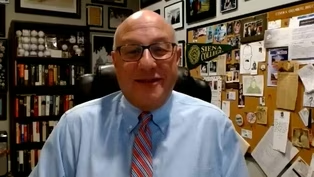
NEW YORK VOTERS SPEAK OUT ON THE ISSUES THAT MATTER TO THEM
Video has Closed Captions
Clip: 11/6/2023 | 12m 35s | NEW YORK VOTERS SPEAK OUT ON THE ISSUES THAT MATTER TO THEM MOST (12m 35s)
Providing Support for PBS.org
Learn Moreabout PBS online sponsorship
- News and Public Affairs

Top journalists deliver compelling original analysis of the hour's headlines.

- News and Public Affairs

FRONTLINE is investigative journalism that questions, explains and changes our world.












Support for PBS provided by:
MetroFocus is a local public television program presented by THIRTEEN PBS