
MetroFocus: November 8, 2023
11/8/2023 | 28mVideo has Closed Captions
2023 ELECTION RESULTS ANALYSIS; PRESERVING “THE BOSS”
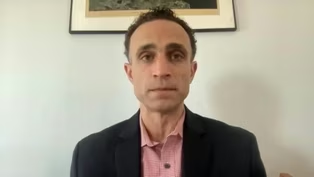
Tonight, the results are in! Journalist and host of the “Max Politics” podcast, Ben Max, joins us to breakdown the results of the 2023 Election. Then we pay a visit to the Bruce Springsteen Archives with Grammy Award-winning music historian Bob Santelli, the new executive director of the Bruce Springsteen Archives & Center for American Music.
Problems playing video? | Closed Captioning Feedback
Problems playing video? | Closed Captioning Feedback
MetroFocus is a local public television program presented by THIRTEEN PBS
MetroFocus: November 8, 2023
11/8/2023 | 28mVideo has Closed Captions
Tonight, the results are in! Journalist and host of the “Max Politics” podcast, Ben Max, joins us to breakdown the results of the 2023 Election. Then we pay a visit to the Bruce Springsteen Archives with Grammy Award-winning music historian Bob Santelli, the new executive director of the Bruce Springsteen Archives & Center for American Music.
Problems playing video? | Closed Captioning Feedback
How to Watch MetroFocus
MetroFocus is available to stream on pbs.org and the free PBS App, available on iPhone, Apple TV, Android TV, Android smartphones, Amazon Fire TV, Amazon Fire Tablet, Roku, Samsung Smart TV, and Vizio.
Providing Support for PBS.org
Learn Moreabout PBS online sponsorshipJenna: Tonight, the election results are in.
Who are the biggest winners, losers, it upsets?
What does it mean for the crucial 2024 race?
With the Bruce Springsteen archives set for a massive expansion, we revisit how the rock icon's biggest fans got the collection started.
MetroFocus starts right now.
♪ >> This is MetroFocus with Rafael Pi Roman, Jack Ford, and Jenna Flanagan.
MetroFocus is made possible by The Peter G. Peterson and Joan Ganz Cooney Fund.
Filomen and Gagis Tina foundation.
Barbara Hope Zuckerberg.
And by Jody and John Arnhold.
Dr. Robert C. and Tina Sohn foundation.
The Ambrose Monell Foundation.
Estate of Roland Karlen.
♪ Jenna: Good evening and welcome to MetroFocus.
I am Jenna Flanagan.
On a night when abortion rights fueled democratic winds across the country and hopes for 2024, the parties scored several victories in New York, but it was not all bad news for Republicans either.
In the most closely watched race in southern Brooklyn, Democrat Justin Brennan cruised to victory over two incumbents.
One of the biggest matchups where Republican Kirsty M armorato claimed victory over incumbent Velasquez.
Then, there is the exonerated Central Park five-member, Yusef Salaam, who has gone from wrongly imprisoned to representing central Harlem after running unopposed last night.
Outside the city, Republicans continue turning Long Island red, flipping the Suffolk County executive's office and what could be a bellwether race for 2024.
Joining us now to put it all in perspective is our go to expert on New York politics, journalist Ben Max.
Ben hosts Max Politics podcast, which is available on major podcasting platforms.
Welcome back to MetroFocus.
Ben: thanks for having me.
Jenna: Give us a sense of what the turnout was.
How broad of a swath was it?
Ben: I hesitate to talk about broad numbers in part because there will roughly be one-third of council races where the incumbent was not opposed or in the Democratic nominee in the case of Yusef Salaam was not challenged in the general election, so taking a broad approach of the entire city I don't think makes a lot of sense.
We know turnout was very low, somewhere roughly in the 10% range, but all eligible voters could have gone out to vote, because they could, of course, write in the candidate they wanted to.
There were the two state ballot questions.
With those questions did not apply to New York City directly.
In part, it is a challenge because there was not that much for some voters to really come out and turnout for peer we did see in some of these competitive races more turnout than others, and in some of the more competitive races, turnout was not great, so it varied across the city quite a bit.
Jenna: What do we know now about the balance of power in City Hall?
Ben: City Council has 51 seats, all of for election this year.
Some were not particularly competitive.
A lot of incumbents running for reelection.
It turned out in the end that just four incumbents won't be returning to the Council.
That is still significant in its own way, and there were a couple of upsets in the primary and now in the general.
But what is very interesting is even though you see the Republicans flip a seat in the Bronx that you mention, the way it is all turning out here, the balance of power in the city Council is going to stay basically the same, 45 Democrats, six Republicans.
There are two or three conservative Democrats who caucus with Republicans and mostly vote with them, but you still have this vast Democratic super majority in the New York City Council and the balance of power not really changing here via these elections could one of the most interesting races you mentioned was Justin Brandon -- Brannan, two city Council members ended up facing each other.
Brannan won by a far wider margin then anyone expected, including his own campaign.
Brannan is a member of leadership, chairman of the finance committee, a southern Brooklyn area where Republicans have won recent races for status and become a so that was an interesting bellwether that the Democrat meant -- Democratic incumbent was able to hold by a wide margin.
It speaks to some of the questions around balance of power, but overall, the city Council will stay about the same in terms of Democrats versus Republicans, 45-6.
Jenna: If city Council stays about the same, does this give us any indication of what we can expect legislation wise from City Hall?
We did not really see the mayor on the campaign trail with a lot of these Democrats.
Ben: One thing that is interesting is the city Council Adrian Adams, who did not face reelection her cell, and she will need to be reelected in January once the new council is seated, and that is all but certain to happen, she is more of the moderate, a liberal to moderate, in some cases more centrist Democrat, similar to Mayor Adams.
However, the city Council does have a fairly big progressive caucus of about 20 Council members does lean a little further to the left than the mayor.
I don't think we will see a lot of changes in those dynamics because things are pretty much staying about the same, so it will be probably about these next two years and a bit more still of this push and pull between the city Council that is a little more toward the progressive end of the spectrum and the more centrist mayor in Eric Adams as we get into 2025, where the mayor will be up for reelection, and the city Council fully be back on the ballot yet again because of how everything unfolds after the census and redistricting.
Jenna: Of course.
I want to circle back to 2025, but talking about things that might be staying the same or shifting, did we learn anything from two of the races that really focused on Latino voters and Asian votes?
Ben: One thing that is really interesting is most of the highly competitive races that were on the ballot here, there were only about a half-dozen, several of them were really focused in districts with large Asian-American populations, including this brand-new district in Brooklyn, the 43rd District, which was created based on census numbers as a "Asian opportunity district," in the Democrat Susan Zhuang won that seat.
She will be joining the City Council as a new member in this newly created seat.
But across the district, we did not see, seemingly, further movement toward the right, towards Republicans from Asian-American voters and others in the city.
There have been gains for Republicans in recent years, but it looks like, again, in a low turnout, off year election, there's not many things we want to conclude from this, but it looks like there was a bit of a ceiling hit, in terms of Republican gains.
There's also a big difference here, it seems, between when there is a major Republican candidate at the top of the ticket helping votes, so there are some differences, and in the city Council races, things become very localized and very dependent on get out the vote efforts and all of that, where Democrats have mostly big advantages.
Jenna: Circling back to your point about 2025, which I know his heart, because I know everybody is focused on the, 2024.
Is there any indication as to whether or not we can see a primary challenge to Mayor Adams, perhaps from City Council, coming from the left ?
Ben: I think the possibility of a challenge to Mayor Adams from his left, and that does not have to necessarily mean the far left, but it is a big section of Democrats, because he is a moderate to centrist, but I think some challenge from his left is almost inevitable.
Who it is going to come from is a big open question mark.
I recently wrote about the dynamics for "New York" magazine, talking to progressives, liberals, and moderates, and there is big dissatisfaction with Mayor Adams from the progressive left, but the question is, can people by a -- identify a candidate to unite a more liberal left and progressive left behind somebody who can run a big territory and unite all of those Democrats against an incumbent mayor who will be very, very powerful, most likely, come his reelection bid.
Now, obviously the FBI just raided his chief fundraiser's apartment, and we don't know where that is going to go in a number of scandals that could happen, so a lot change, there's a lot of discussion about trying to challenge the mayor from the left in 2025, but as you got at, one of the biggest questions is, who will actually step up to do it?
And there are major question marks around those possible names.
Jenna: Of course.
You know, I want to zoom out a little bit from the city and for a moment touch on what happened in Long Island, because it seems as if Long Island is red at this point.
Ben: Long Island, especially with the Suffolk County executive's office flipping from Democrat to Republican, the long-term Suffolk County executive was not on the ballot, he was term limited out.
That was an opening for Republicans to continue their gains, and they did.
This is one of the only areas of the entire New York state that has been moving more Republican in recent years, but it has been doing it in a pretty big way.
Long Island is going further red.
In some ways, it is a surprise that Democrats have been able to hold onto the County executive seat in Suffolk for as long as they did.
We are definitely seen some shifts there, while Westchester and some of the Hudson Valley suburbs have become more blue.
The trends of New York politics are always happening in some ways, and we've even seen some Republican gains, as we talked about, in parts of New York City.
But Long Island seemingly heading further and further to the right.
Jenna: I'm also wondering, because a few days ago we spoke with the Siena College poll, and they were telling us about issues they were finding that New Yorkers seem to be more concerned about, of course the migrant crisis, crime, and I'm wondering how much of those played out or if there is any way to tell at least as of right now, based on how campaigns are run, how heavily those issues weighed on voters who didn't -- who did turn out.
out.
Ben: So I think one of those, to me, surprising and most interesting aspects of the New York City Council raises are the migrant crisis, concerns about crime, which of course overall has been dropping for the last year or so, don't seem to have given Republicans the type of boost that they thought those issues would.
For example, there were a lot of high hopes among Republicans that these would help Ari Kagan win in southern Brooklyn or Ying Tan win in that newly-created Asian district of Admission.
Both of those candidates pull those out by wide margins, and that was more surprising.
In eastern Queens, it was an interesting race where councilmember Vickie Paladino, a pretty far right Republican, she barely beat Tony Avella in 2021, and she beat him by a wide margin.
Speaking to some of the localized issues, the power of incumbency, but it was really interesting to see in New York City that the migrant crisis does not seem to have given a huge boost to Republicans.
In the Suffolk County executive race, clearly Republicans and centrists and independents on Long Island have been moving further to the right, around issues like crime, maybe some concerns about the migrant crisis, though I don't think this has impacted Suffolk County in a big way at this point, but there are always discussions about what happens to New York City, moving on to Long Island, whether that is truly having or -- happening or not.
Jenna: All right, well, there's definitely a lot to follow.
Very quickly, everyone has been talking about the race in Harlem and the win of Yusef Salaam.
Ben: It is such a significant moment for him to start representing Harlem.
It will be interesting to see how he takes on criminal justice, especially to him as a member of the exonerated five.
Jenna: We have to leave it there, but I want to thank you for joining us again on MetroFocus and giving us much-needed context for election night.
Ben: My pleasure.
Thanks for having me, Jenna.
>> ♪ baby we were Born To Run ♪ Jack: Good evening and welcome to MetroFocus.
I'm Jack Ford.
If you know anything about music icon Bruce Springsteen, you know he is a Jersey guy, mostly the Jersey shore, to be precise.
So it may not be a surprise to learn that the risk seen archives have found a home they re at Monmouth University.
But you might be surprised at the extent of the archives, how they arrived at their home in Monmouth, and how they now have the Bruce Springsteen archives and Center for American music.
The archives and center provide a fascinating collection of artifacts, exhibits, and programs for fans, scholars, historians, and the simply curious.
Joining us now to talk about the creation of the archives in the center and what they have to offer is Bob Santelli, the Executive Director and Grammy award-winning music historian, producer, educator, and a friend of mine from many years back from our days at Point Pleasant Beach high school.
Bob, welcome.
Thanks for joining us.
Bob: Thanks for having me, Jack.
Jack: So how and why did the idea of gathering up the Bruce Springsteen archives, and placing them at a location, come about?
Bob: The Bruce Springsteen archives has its origin in Asbury Park.
There was an organization called friends of Bruce Springsteen that began to assemble photographs, newspaper articles, magazines, etc., and put them in Asbury Park Library.
The Asbury Park Library could not handle it in terms of the size.
Myself and my colleague, Eileen Chapman, decided this was too valuable to have it simply disappear or not have it at the disposal of people, so we moved it to Monmouth University.
Monmouth University was very receptive to the idea.
They gave us a place to store the materials, and from that point on, which was about eight or nine years ago, the collection has grown significantly, to a point now we are up to 37,000 pieces.
Jack: Let's talk a little bit about Monmouth University as the repository.
Why did that work as the location?
Bob: Jack, you know, Monmouth works for two or three reasons, number one is that Bruce Springsteen's early fan base, when Monmouth University was Monmouth College, that is where the fans came from.
A few blocks away from Monmouth University, Bruce wrote "Born To Run," maybe his most famous song.
When I was a student at Monmouth University, then Monmouth College, I probably saw Bruce Lee a couple of dozen times at the college at the time.
His roots are very strong there.
Plus, we wanted to be established with an academic institution.
Monmouth University on the Jersey Shore is it.
It just made total sense.
Jack: I should note, you mentioned you went there, you taught there.
I taught there in the past.
I was on the board for many years back, and it has grown, it has become a nationally recognized doctoral institution with so many facilities.
And this, obviously, is part of that.
I mentioned in the introduction that we have the Bruce Springsteen archives, which makes sense, but also the Center for American Music.
How did that component come about?
Bob: When we really began to be ambitious about what the Bruce Springsteen archives could be, I went to Bruce and said Bruce, you know, in addition to this collection that we have here, I have bigger, bolder, more ambitious ideas for this collection.
And I explained it to Bruce, what we wanted to do, and he was very silent, and I was talking to him, and I cannot tell whether he was receptive to the idea or not.
At the end, he said, well, you know, it's a great thing that you are doing, however, putting all the attention on me is not right.
I'm a chapter in the ongoing story of American music.
If we could enlarge this to make it more encompassing, make the story bigger, which I am a part, that would work.
Quite honestly, Jack, that is what I had in mind all along.
I always envisioned Bruce basically being the catalyst or the poster boy, if you will, for this institution on American music, because he represents so many aspects of it.
So we started to broaden the idea and included now exhibitions, not just collections but exhibitions, public programs, educational workshops, etc.
We are almost a full-blown institution now, the kind that we envisioned about six or seven years ago, when I first went to him with the idea.
Jack: I would suspect that when people hear that story, they would be surprised, especially at the element of somebody as big a star as Bruce Springsteen saying, no, no, I don't want this to be all about me.
I am a part of something bigger.
You know, you have been involved in the Grammy Museum, Rock and Roll Hall of Fame, as I mentioned, you are a music historian and educator.
Were you surprised to hear him say, "no, not just me, I want this to be much more expansive"?
Bob: I really wasn't, Jack, and the reason was I have known Bruce for a long time, I first got to know him many years ago.
I was first of the Asbury Park music critic.
He always came across as an amateur music historian, if you will, his knowledge of American music and his love of it is very strong, and he realizes he is a part of it.
He is a big part of it, especially the 20th century, of course.
When you look at the Titans and make icons of American music, Duke Ellington, Louis Armstrong, Woody Guthrie, Pete Seeger, Bob Dylan, Bruce's name is on there.
Having somebody that powerful say you know what, the story is bigger, I love to be a part of it, but the story is bigger.
Jack: I know Bruce a little bit, but if you know him, it might be surprising to the rest of the world, but if you know him, it is not surprising.
Let's talk about the process now of gathering up, as you said, more than 30,000 items and artifacts.
How did you go about doing that, and how did you go about positioning it, physically, at Monmouth University?
Bob: Many of the pieces that we have met nearly all of them, Jack, are basically donations.
Fans who have been collectors of Bruce Springsteen memorabilia or tapes or photographs, they get up there in age, they realized their collection has served them personally for a number of years, but now they are looking for a place to put it permanently.
They hear about us, they contact us.
What we do essentially is we review what they have, you know, we don't want to be a repository for someone's attic, right?
[Laughter] Yeah, I have all this stuff taken.
It is more formal than that.
In the early days, maybe that would work, but not anymore.
We are simply bursting at the seams.
We have so much, plus we have all of Bruce's archives as well .
When you add all of that up, it is a tremendous amount of material.
In addition to the actual three-dimensional objects, as we say, we have a very large digital collection of interviews and oral histories and tapes and performances, so it is a full-fledged institution, where it's not just about the of -- the collection of photographs and magazines.
It will require us to build and expand and find a home somewhere on the Monmouth campus, because I have to tell you if you were to walk into where we are right now, it is a home that we have basically transformed into an archival space.
We actually have collections in the bathtub.
[Laughter] Jack: I guess that is the good news and the bad news.
The good news is you have so much.
The bad news is you have so much.
Bob: Right.
Jack: Let me ask you about some of the other things that the archives and the Center do.
As I mentioned, a collection , an archival collection, but I also talked about exhibits and programs.
Tell us a little bit about that.
Bob: well, you know, we did not just want to be a collection, a repository, an archive, because, traditionally, an archive basically preserves and celebrates a particular artist, historical aspect, whatever.
We are going to put that to good use, and the idea that I presented to Bruce was, we want to be active, we don't want to be a passive institution, and that would mean having concerts, that would mean having seminars, symposiums, workshops, outreach with exhibitions, so, for instance, right now we have an exhibition on Bruce Springsteen in Los Angeles, called Bruce Springsteen Live, which celebrates Bruce as a live performer.
Next week in Boston, we will open up a Bob Dylan exhibit that the Bruce Springsteen archives curated.
It is a traveling exhibit on Bob Dylan, one of Bruce Springsteen's main influences.
Just this past weekend, we held a major symposium at Monmouth University, celebrating the 50th anniversary of Asbury Park, the night before a sold-out concert in Red Bank, featuring the original E Street Band pianist David Sancious.
We are not just in a collective phase but the experiential phase and educational phase as well.
Jack: I'm curious, and you and I talked about this briefly, but I'm curious about what drew you here.
You touched on it a little bit.
As I mentioned before, you are a Grammy award-winning music historian, producer, educator.
You were the Executive Director of the Grammy Museum, intimately involved in the creation of the Rock and Roll Hall of Fame, so you have done a lot around the country.
What made you come home to this?
Bob: My wife keeps asking me that as well, Jack, it is a pretty clear answer to me, number one, that I am a Jersey guy.
My whole life has been somehow, someway connected to New Jersey music, New Jersey culture.
I am a Jersey Shore guy, as you are, too.
Growing up in the Jersey Shore is a very special place for me, for you, and for Bruce.
I went to Monmouth University, then Monmouth College.
It is where I got my start as a journalist.
I won't forget that.
I taught there.
Quite honestly, I have to say, as a music journalist, I rode Bruce Springsteen's coattails, Jack, to be honest with you.
In the 1970's when I was just getting started, he made himself available.
I got the interviews, I wrote a book with Max Weinberg, the E Street band drummer.
I actually worked on Bruce's first book with him called "Songs," he has given me a lot of opportunities.
What I think it is my payback, my showing my appreciation for all of that, for the university, for Bruce, is to use my skill set, to create something that is long-lasting, that is beneficial to him, the state, the region, the University, and this is it.
It might be my swansong, so to speak, but it is the important one, maybe the most important one for me.
Jack: I'm going to ask you one important question, what is your vision for what this might become?
Bob: It's going to become a nationally recognized institution.
When I found out on Saturday that people came from Dublin, from London, California to attend this, I realized the potential is pretty incredible.
And, of course, with Bruce going on tour starting next month, the attention to him and the E Street Band will only elevate and accentuate what we are doing at the Archives.
Our hope is that we find a way on America's cultural landscape and make a contribution.
I want it to be useful.
I want it to be important for him and to future Bruce Springsteen fans and scholars.
Jack: I think it's there already and it is on the way to something bigger and better.
The Bruce Springsteen Archives, Center for American Music, located at Monmouth University, Bob Santelli, always good to talk with you.
Congratulations on what you are doing.
And we will keep an eye on it as it continues to grow.
You be well now.
Bob: Thank you, Jack.
You too.
Jack: Thanks for tuning into MetroFocus.
You can take our award-winning program with you wherever you go with MetroFocus the podcast.
Listen and subscribe wherever you get your podcasts, so you never miss an episode, or simply ask your smart speaker to play MetroFocus the podcast, also available at metrofocus.org, wliw.org/radio, and on the NPR One app.
♪ >> MetroFocus is made possible by The Peter G. Peterson and Joan Ganz Cooney Fund.
Filomen M. D'Agostino Foundation.
Barbara Hope Zuckerberg.
And by Jody and John Arnhold.
Bernard and Denise Schwartz.
Dr. Robert C. and Tina Sohn foundation.
The Ambrose Monell Foundation.
Estate of Roland Karlen.
♪
2023 ELECTION RESULTS ANALYSIS
Video has Closed Captions
Clip: 11/8/2023 | 13m | 2023 ELECTION RESULTS ANALYSIS (13m)
Providing Support for PBS.org
Learn Moreabout PBS online sponsorship
- News and Public Affairs

Top journalists deliver compelling original analysis of the hour's headlines.

- News and Public Affairs

FRONTLINE is investigative journalism that questions, explains and changes our world.












Support for PBS provided by:
MetroFocus is a local public television program presented by THIRTEEN PBS