
MetroFocus: November 9, 2023
11/9/2023 | 28mVideo has Closed Captions
“BROWNSVILLE IN VIOLENCE OUT;” KATHY IRELAND TEAMS UP WITH FORESEEABLE FUTURE FOUNDATION
Brownsville In Violence Out (BIVO) is an anti-gun violence initiative in which Brownsville residents respond to low level street crimes themselves, rather than the NYPD. Dushoun Almond, leader of BIVO, joins us to discuss the initiative. Super model Kathy Ireland, and founder of "The Foreseeable Future Foundation," Griffin Pinkow, join us to discuss their work together.
Problems playing video? | Closed Captioning Feedback
Problems playing video? | Closed Captioning Feedback
MetroFocus is a local public television program presented by THIRTEEN PBS
MetroFocus: November 9, 2023
11/9/2023 | 28mVideo has Closed Captions
Brownsville In Violence Out (BIVO) is an anti-gun violence initiative in which Brownsville residents respond to low level street crimes themselves, rather than the NYPD. Dushoun Almond, leader of BIVO, joins us to discuss the initiative. Super model Kathy Ireland, and founder of "The Foreseeable Future Foundation," Griffin Pinkow, join us to discuss their work together.
Problems playing video? | Closed Captioning Feedback
How to Watch MetroFocus
MetroFocus is available to stream on pbs.org and the free PBS App, available on iPhone, Apple TV, Android TV, Android smartphones, Amazon Fire TV, Amazon Fire Tablet, Roku, Samsung Smart TV, and Vizio.
Providing Support for PBS.org
Learn Moreabout PBS online sponsorshipJack: Tonight, the future of community policing might be in our own backyard.
A new initiative is 11 some Brooklyn residents rather than police to intervene with low-level crime.
The results are promising.
Kathy Ireland teams up with The Foreseeable Future Foundation to help visually impaired and blind New Yorkers live more fulfilling lives through the power of sports.
"MetroFocus" starts right now.
♪ >> This is "MetroFocus," with Rafael Pi Roman, Jack Ford and Jenna Flanagan.
"MetroFocus" is made possible by the Peter G. Peterson Fund, Barbara Hope Zuckerberg and by Jody and John Arnhold, Bernard and Denise Schwartz, Dr. Robert C, and Tina Sohn foundation.
Rafael: Good evening and welcome to "MetroFocus," I am Rafael Pi Roman.
In Brownsville, considered one of Brooklyn's most dangerous neighborhoods, community members are coming together to try a new approach to public safety.
Brownsville In Violence Out is an anti-gun violence initiative in which Brownsville residents respond to low-level street crimes themselves rather than having the NYPD make arrests.
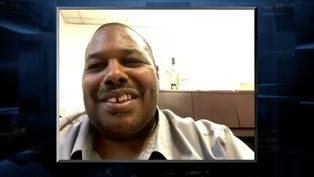
Joining us with more on what this looks like is anti-violence advocate and the leader of Brownsville In Violence Out Dushoun "Bigga" Almond.
"Bigga," welcome to "MetroFocus ."
Bigga: Thank you for having me.
I appreciate it.
Rafael: Why don't you tell us more about the goal or your mission of your organization beyond what I said in the introduction.
Bigga: Brownsville In Violence Out is an anti-gun violence program and we are aiming toward minimizing and mediating certain situations that the NYPD and certain other organizations might not be able to sit at the table and take part in a peaceful solution that leads to success.
Rafael: Tell us exactly how that works in practice.
For example, how often are you on the streets?
And how do you know when something is going on or there might be trouble brewing in the neighborhood?
How do you get word of it?
Bigga: They call us credible messengers.
We take our credibility and we use it as we have done time and time again in the streets.
Use our trust and loyalty in the community for people knowing we are the real deal.
You can trust us.
We come from this, as well.
As far as the times we come out, it does not even matter.
We are coming anywhere from 8:00 in the morning and leaves at 3:00 at night depending on the event or situation that happens.
We can be out there, coming home from work on Sunday in the morning.
It does not matter.
Rafael: How do you get the call?
Are 911 calls referred to you why the police?
Bigga: The Brownsville safety alliance, the 911 calls are divergent to us.
As far as the work we do in the community outside of that, we always have our own people, participants -- we call them the in-roads.
We say you need to get over here and there might be a brewing situation and you need to mediate is so it will be a peaceful outcome.
Rafael: Does the NYPD, plain-clothes officers always shadowing you or just sometimes?
Bigga: The NYPD does not shadow us at all.
Rafael: I thought the New York Times article made the reference to them being in the background.
Bigga: that is for the BSA.
That is a situation where the NYPD gives us a two-block radius to take care of ourselves and divert the 911 calls to us and we take care of the problem right then and there.
On the spot mediation.
It is happening right then and there.
Rafael: You talked about credibility and how that helps you enormously because people trust you.
What is that credibility look like?
How does one get that credibility?
Bigga: Back in the day when I was growing up, people became credible because they did what they said they were going to do and they stood for certain things that were outside of the normal practice of life.
Yes, we have all done things we are not so happy about.
At the same time, we were always trustworthy.
People trusted us to be exactly who we say we are.
Not just the timing but a standup individual at the same time.
Rafael: "Bigga," tell us about yourself, your transformation, your experience and why did you decide to become involved in this work for your community?
Bigga: First so long, when I was growing up, I was led to believe that everybody wants to be known as a gangsta.
I do not know why it is such a historic thing anymore.
The gangstas from my time took care of their communities and their families and the nature the community was right.
We sit here and say, in these days and times, we look at the youth and a lot of them are saying "I'm a gangsta."
You don't really know what that means.
We realize these young men and women are being taught the wrong way.
It is like the blind leading the blind.
I want to make it to heaven.
I don't know about anybody else.
I want to try to get the chance to right my wrongs.
For my family, grandchildren, children and everyone else's children, I want them to be able to travel peacefully without hearing a gunshot.
I want them to play in any part in the world and not be afraid, do not have the fear of being shot.
Rafael: You are talking about righting the wrongs, but you were on the others of the law for a while.
Bigga: Yes, I was.
Rafael: That turned you around.
Why?
How?
Bigga: Because I realized I was being part of a bigger problem.
I like to say, something that might grandmother, Helen Clark, God bless her soul, your ancestors did not die just for you to die, and I pass that on to the generations now.
Our ancestors did not fight just to sit back and watch us kill each other.
Rafael: That is a good message.
The New York Times article that I referred to, I think it came out in April, told a story about you personally intervening with a man who was going into a bodega with a gun and then he gave you the gun and went home.
It has an interesting twist at the end I want to get to.
What was his intention?
Was he intending to rob the bodega?
Bigga: Displaced honor and displaced manhood.
That was a situation where he saw somebody that he had a problem with.
In all actuality, you did not have a problem with this individual, you were just hungry.
I walked up to him because he knows where I come from and how I carry myself.
I asked him if there was anything I could do for you.
He said I want something to eat.
I got him something to eat, we went across the street, we ate it and he gave me the firearm.
Rafael: The twist of the story is he came back the next day and volunteered.
Bigga: He came back the next day and he broke up a fight with two pizza men at the Domino's down the block.
Rafael: That is a wonderful story and you have an incredible persuasive power, but is this the way you become a volunteer in your organization in Brownsville In Violence Out or is there something the paper left out about training and vetting?
Bigga: There is a lot with this.
We operate under the crisis management system.
There is a training you undertake to be a credible messenger.
Situations like that, that is just a normal thing that is supposed to happen in every community.
Every young man, every young woman has a duty to their community where they stand up, if you see something and you can peacefully negotiate it, do it.
Rafael: Most overwhelmingly, that is the way it goes with you guys from what I read.
You have been very successful at de-escalating all kinds of potential crimes and tough situations, but unfortunately they do not always go smoothly.
In fact, Tyrone Sloan, a member of your organization was shot in the chest after intervening in the situation involving a gun near where he lived.
What was the effect on your organization and fellow volunteers?
Did it change the way you conducted your business?
Has anything like that happened since?
Bigga: No, not with our team.
In the past, even when he came aboard -- I came aboard before him -- I started tapping into therapeutic services.
When you are part of the crisis management system, you have these resources at your disposal and he utilizes them.
After that, he needed more therapy.
A lot of us have been shot.
Me, myself, I have been shot.
Does it play in the back of my head?
Yes.
Is he working through it?
Yes.
He got right back to work.
He is doing all right.
Rafael: What kind of feedback are you getting from the community about the work you guys are doing?
Bigga: Well, it has been good.
There has been a lot of community members wanting to take part in our events.
We operate in one part of Brownsville and now we are moving to another part of Brownsville where the teams get bigger.
The response is good because C AMBA allows us to be ourselves and at the same time work and do what is best for the community.
Rafael: According to the New York Times article, which I quote maybe too often here, not everyone is on board.
There are some residents and storeowners say they prefer uniformed police officers and they feel safer with them.
What do you say to these folks?
Bigga: You know, I am not going to sit here and say -- everybody talks about defunding the police and things of this nature.
This is impossible.
Here at CAMBA, we look at the NYPD as a community partner.
We cannot keep saying these things to shut the police down.
It is unrealistic.
We need them to do their job, too.
We are trying to say we will take care of this part.
We will do this in the community with the people we know, that we are familiar with, and try to mediate certain conflicts that leaves you a better chance to take care of other crimes that are happening out there.
Rafael: We only have about 30 seconds left.
Do you think the model you are using in Brownsville is the model they can be replicated in other communities Bigga:?
Bigga:Definitely.
Without a question.
People have to do their part and not try to shut each other down.
Rafael: Thank you for the work you are doing in Brownsville and joining us today and giving you the latest on it.
Bigga: My pleasure and God bless.
Thank you for having me.
Rafael: Thank you.
Jack: Kathy Ireland is one of America's most successful self-made women.
.
A supermodel turned super mogul.
She is the ambassador for the visually impaired and blind community.
In New York alone there are hundreds of thousands of people with blindness or low vision.
Many obstacles still remain.
To help, Kathy Arland has partnered with the Foreseeable Future Foundation, a leading national nonprofit that has raised thousands.
The organization was started by Griffin Pinkow, whose Perseverance through slowly losing his sight has inspired many.
Foreseeable future recently honored Kathy Ireland.
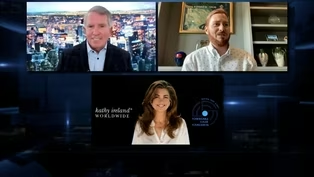
We are delighted to have both Catherine the -- Kathy Ireland and Griffin Pinkow join us.
Thank you so much for joining us.
Kathy: Thank you so much.
Griffin: Thank you so much for having me.
Jack: Griffin, let me start with you if I can because it is important to set the stage with what you are doing and what Kathy will be doing.
Briefly give us a sense of how you first discovered that you were losing your site and what you did about it immediately.
Griffin: Sure, Jack.
I learned about my loss of vision when I was a kid.
I made a travel baseball team when I moved to California.
I was in the outfield and one day the ball would be going one way and I would be running the other way and we realize there is something wrong with Griffin.
I could not see the ball in the sky and I could not track it.
We finally went back to my ophthalmologist in Princeton, New Jersey, where I am originally from and she said I think I see some pigment on the retina.
We said, what does that mean?
Four months later, I was diagnosed with a degenerative disease that my parents had to sit me down and say to their 11-year-old son, you will lose your vision, we do not know how much and when, but you will go blind and that will affect the rest of your life going forward.
At that time, I do not know if I really understood the severity of what was going on or it was just my mentality, how I have always been.
It did not really hit home that much because I thought, well, I will have to change some things that I do but I am still Griffin, I am still an 11, 12-year-old kid.
Processing that was challenging but once I understood it better, I realized it is nothing I can control so why would I have a pitty party for myself?
I just kept moving forward the best I could of that time.
That is how we found out about my visual impairment and that there was a challenge and that the rest of my life would be altered in some way.
Jack: I am going to come back to you in a moment and talk about that journey, especially through college and what you are doing now.
Kathy, let me ask you this question -- I mentioned in the introduction that you are an ambassador for the foundation.
You have had extraordinary success in your life in so many different dimensions and you have given so much of your time and energy and effort and resources to various causes and I am sure there are an awful lot reaching out.
Why did this organization become so significant to you that you said, OK, this is one of the ones I want to be connected with?
Kathy: Thank you so much for asking that question.
Griffin is my hero.
His story is so powerful.
My goodness, the strength and the courage and the fact that -- even at that tender young age of 11, the fact that this did not defeat him, that he is a man who is in solution mode and continues to be.
I just find that strength and joy so contagious.
What an amazing foundation that he has begun with Foreseeable Future Foundation and attracting incredible people who come alongside and support, including another hero.
This is something I believe in.
Throughout my life, I have had people I love dearly with visual impairments.
My dad and aunt both lived with macular degeneration.
I am one of the cofounders of a start up pre-k through college preparatory school and our Board of Directors hired a man, Dr. David Winter, who was a college professor in retirement and he was legally blind.
We hired him to be head of school.
Like Griffin, the man had such extraordinary vision.
I see that in this young leader of Foreseeable Future Foundation.
.
It is absolutely extraordinary what he is doing for people around the world, who are dealing with any kind of vision loss.
The solutions that he brings, the encouragement, it is absolutely empowering.
Jack: Griffin, back to you for a second.
I will ask you about your journey, especially in college.
People should know you have run marathons, you are training at the highest level for tandem cycling.
Let's go back to the foundation.
And how it came about and why it came about and what you are hoping it can do for others.
Griffin: Right.
I was involved in some other organizations and they are fantastic and they are research-based.
The end goal is to find a cure, for myself and others dealing with visual impairments and blindness.
At a younger age, in those college years, I thought what is going on now that can help these people, young adults, kids in the community, an opportunity to do something now?
Between however all they are and when hopefully in the future they can actually have vision and have vision restored.
From those experiences, there was not much going on in that intermediate or if there is a cure in 10, 15, 20 years, that is fantastic but I want to help people now in their day-to-day life.
That was the catalyst from one to do something and then figure out, I know I want to help out the visually impaired and blind community because I am part of it, sports is near and dear to my heart, that is something we can grow upon.
Athletes do not just do their sport.
.
There is so much you get out of it.
The team environment, the time management perspective, the interpersonal communication skills, accountability, leadership, everything you can get from being involved with sports and recreation.
Also, educating people and bringing awareness to visual impairments and blindness in what people can do, even dealing with a challenge.
That is how it started and we have been able to grow it over the past few years.
Now, we are expanding and seeing how we can help the individual as a whole.
Still focus with the sports and recreation component where refund individuals around the country to achieve athletic endeavors but also see what we can do on the recreation side.
We started a ranch program that we are doing in different states.
We started an advocacy curriculum.
We are doing a few other programs, like a literacy program in Massachusetts.
We are expanding and hoping to change the stigma and breakdown down the barriers between the sighted community and visually impaired.
We are all just people and it is OK to ask people if they need help or they don't.
That is where I see it growing.
Being able to expand and helping in those ways.
Jack: As you know, there can be very positive powers attached to celebrity, if they are utilized in the right way.
One of them certainly can be awareness.
If people recognize Kathy Ireland, they know what you have done and the successes you have added your life, the hope is they would pay attention to you.
In that regard and agreeing to become an ambassador for the foundation, what is your hope that you can do for those things that Griffin just mentioned, awareness, breaking down stigmas , making people more comfortable, what do you hope you can do?
Kathy: Oh my goodness, thank you.
My hope is to do whatever I can do to expand Griffin's great work.
This vision that he has that is already just changing lives in such powerful ways.
As a businessperson, as an entrepreneur, I see the entrepreneurial spirit in Griffin.
He is business savvy with how he is taking those skills, that brilliance he has and he is pouring it into this foundation that is having such an impact.
My hope is that we bring more awareness and that Foreseeable Future Foundation will scale and continue to scale to be all that it needs to be to reach people everywhere.
It is heartbreaking to recognize that there are people who are feeling isolated.
That they are feeling that because of what they are going through with their vision that they are not able to participate in a way that they would like to.
Griffin is a wonderful disruptor in just showing what people can do and making it possible.
That is powerful.
Jack: Griffin, I am going to give you the last word.
.
I have a minute or so left.
In looking at your biography, I was struck by the fact that it was in college that you were struggling to get comfortable with this, yourself.
What message would you give to people who might be listening to our conversation here, the message you would give to others about the importance of them getting comfortable with their conditions of the can move forward?
Griffin: I think, Jack, what I would tell 11 or 12-year-old Griffin, or even Griffin in college, except it sooner because if I did that, it probably would have been easier for myself to say, "OK, this is something I cannot fully control, so I can control my health, attitude, change the perspective of my peers of what someone with visual impairment or blindness can do."
That is the big piece for the individual to be more comfortable.
If you can -- it is different person-to-person -- accept it and own it and think of it as particle you are.
It does not define you but it is particle you are.
Whether someone views that as good or bad, that is their opinion.
As soon as I was viewing it in that way, it gave me the opportunity to be open to sharing and telling people what my visual impairment was and saying I do need more help.
Everything opened up from there in that light, and giving people the opportunity to show that I was comfortable with it so it was easier for them to be comfortable and ask me questions, or ask if I needed help.
They would tell me, "Hey, I was on the train the other day and saw someone with a cane and I asked if they needed help."
I took them back to their house and it was two hours away from where I was going but I was aware of it and I to help them.
If I had to share one piece of advice or information, or for people to digest, I think that would be the message.
♪ Jack: Thank you for tuning into "MetroFocus."
You can take our award-winning program anywhere you go with "MetroFocus: The Podcast."
Simply ask your smart speaker to play "MetroFocus: THe Podcast."
Also available on the NPR1 app.
♪ >> "MetroFocus" is made possible by the Peter G. Peterson Fund, Barbara Hope Zuckerberg, and by Jody and John Arnhold, Bernard and Denise Schwartz, Dr. Robert C. and Tina SOhn foundation, The Ambrose Monell Foundation, a state of Roland Karlen.
♪
BROOKLYN NEIGHBORHOOD POLICING ITSELF
Video has Closed Captions
Clip: 11/9/2023 | 12m 30s | BROOKLYN NEIGHBORHOOD POLICING ITSELF “BROWNSVILLE IN VIOLENCE OUT” (12m 30s)
KATHY IRELAND TEAMS UP WITH FORESEEABLE FUTURE FOUNDATION
Video has Closed Captions
Clip: 11/9/2023 | 13m 13s | FASHION MOGUL KATHY IRELAND TEAMS UP WITH FORESEEABLE FUTURE FOUNDATION (13m 13s)
Providing Support for PBS.org
Learn Moreabout PBS online sponsorship
- News and Public Affairs

Top journalists deliver compelling original analysis of the hour's headlines.

- News and Public Affairs

FRONTLINE is investigative journalism that questions, explains and changes our world.












Support for PBS provided by:
MetroFocus is a local public television program presented by THIRTEEN PBS