
MetroFocus: October 16, 2023
10/16/2023 | 28mVideo has Closed Captions
INSIDE THE PROTESTS; THE CHALLENGE AGAINST "RIGHT TO SHELTER"
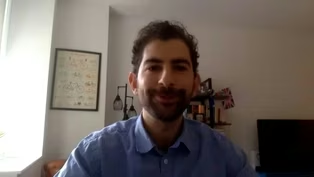
Steven Vago, a reporter for the "New York Post," was in the heart of Friday’s pro-Israeli and pro-Palestinian protests in Times Square, and joins us to share what he saw that day. Then, attorney Robert Hayes, the original architect of the right to shelter, joins us to discuss the city’s response to the migrant crisis.
Problems playing video? | Closed Captioning Feedback
Problems playing video? | Closed Captioning Feedback
MetroFocus is a local public television program presented by THIRTEEN PBS
MetroFocus: October 16, 2023
10/16/2023 | 28mVideo has Closed Captions
Steven Vago, a reporter for the "New York Post," was in the heart of Friday’s pro-Israeli and pro-Palestinian protests in Times Square, and joins us to share what he saw that day. Then, attorney Robert Hayes, the original architect of the right to shelter, joins us to discuss the city’s response to the migrant crisis.
Problems playing video? | Closed Captioning Feedback
How to Watch MetroFocus
MetroFocus is available to stream on pbs.org and the free PBS App, available on iPhone, Apple TV, Android TV, Android smartphones, Amazon Fire TV, Amazon Fire Tablet, Roku, Samsung Smart TV, and Vizio.
Providing Support for PBS.org
Learn Moreabout PBS online sponsorship>> Inside Friday's day of protests, a reporter captures the tensions of the crowds running very high at the demonstrations on the streets in New York City.
That as a MetroFocus special report starts right now.
>> This is "MetroFocus," with Rafael Pi Roman, Jack Ford, and Jenna Flanagan.
MetroFocus is made possible by The Peter G. Peterson and Joan Ganz Cooney Fund.
Filomen M. D'Agostino Foundation.
Barbara Hope Zuckerberg.
And by Jody and John Arnhold.
Bernard and Denise Schwartz.
Dr. Robert C. and Tina Sohn foundation.
The Ambrose Monell Foundation.
Estate of Roland Karlen.
>> Good evening and welcome to the special edition of MetroFocus.
Thousands of protesters across the globe took to the streets to show their support for Palestine and Israel.
>> Free Palestine!
Jack: The NYPD was out in full force.
Tensions were high.
There were no reported acts of violence in New York City.
Stephen Viggo, a reporter for the New York Post was in the heart of New York's protests and counter protests.
He joins us to tell us what he saw.
Thanks so much for joining us.
>> Think so much for having me.
Jack: Let's set the stage for this a bit.
I'm sure people have been following all of this.
There was heightened concern on Friday because of the declaration that has been made -- had been made from a former representative of Hamas.
>> So, a former leader of Hamas, he declared Friday to be a day of rage.
He wanted Palestine supporters to hit the street and support and express rage.
The NYPD heighten their security and they were out in full force all across the city.
But, especially so around Times Square and synagogues, and anywhere there was a protest.
Jack: So, when we get to Times Square in a moment.
In light of that, where there any indications by public officials of any real hard intelligence suggesting the distinct probability of violence in New York City?
Steven: It did not seem like there was going to be and the incidents.
But they were just doing it for security and safety.
Jack: Let's start off and talk about what went on in Times Square.
Set the scene.
Steven: Sure.
Thousands of people came out to support Palestine.
It first started with a few hundred marching from Farouk.
By the time I got there at around 3 p.m., the crowd swelled to thousands.
The pro-Palestine side was between 40th to 42nd Street.
Thousands and thousands of them in the streets.
The pro-Israel side, they were just in one pen.
There were about 150 of them.
Both sides were screaming at each other.
But the cops had it all under control.
They were all surrounded by barricades, all the supporters were surrounded.
In time -- anytime one protester crossed to the other side, the police separated them.
It was kind of like a game of cat and mouse, with the police chasing them.
So, there was not much mayhem from what I saw.
Jack: Were there speakers?
Let's start with the pro-Palestine side, where their actual speakers, or was it a collection of folks protesting?
Steven: It was a combination of speakers and thousands of people protesting.
I focused more on speaking to the individual people at the protest.
So, there was one woman I talked to.
She has friends in Palestine.
She wanted the end of Israel's occupation, as she said.
She also said it is fine if people want to apologize for what Hamas did.
If there apologizing for what Hamas did, then people should also apologize for Israel.
That was one of her arguments.
Jack: Did you hear anybody offering up approval of what Hamas had done.
We have seen in some protests around the globe that there was applause when mentioned of the Hamas attack's?
Did you come across any of that in your conversations?
Steven: From what I saw, there was nobody who came across as a Hamas supporter.
They were more pro-Palestine and they wanted Israel out of the area.
Jack: It wasn't a protest where there were demands of the extermination of the state of Israel, at least from what you heard?
Steven: Some people wanted -- well, I saw people towards the end of the protest, like this, I would argue yes they want the extermination of the state of Israel.
Jack: was not visible?
The act of lighting fire to the flag, was not visible to the pro-Israeli folks?
Steven: This was at night.
Yet the keep in mind that this is Friday night -- you have to keep in mind that this is Friday night.
That is probably why there were so many rally supporters, it was Friday night.
This was when they marched to the U.N., this was towards the end of the protest.
There was no Israeli supporters at this point.
The crowd was leaving.
And a handful of supporters lit Israeli flag on fire.
Jack: Let's go back to Times Square.
In terms of the Israeli protesters, what was going on there?
Steven: They were yelling shame, shame.
Hamas is Isis, out them.
This one woman I spoke to, a lawyer, her parents are Holocaust survivors.
She was saying what Hamas did, their attack over the weekend, was reminiscent of the Holocaust .
She has two sisters in Israel.
She's worried that there will be more violence towards Jews.
Jack: I mentioned in the introduction that there were protests that took place in Brooklyn, what did you learn about your reporting that took place there?
Steven: After the protest in Manhattan, I believe it might've been moments after that protest ended, they protested outside of Chuck Schumer's Park slope home, and police arrested dozens of them including lawmakers.
But that protest was actually led by a Jewish organization I believe.
Jack: When you say protests led by Jewish organization, do we know what the organization was, and what the point of the protests in front of Senator Schumer's home, what the point was?
Steven: The point was they are concerned about Israel committing possible genocide.
They want -- Chuck Schumer was going Israel -- they wanted him not to support the war.
Jack: What about during the course of the weekend?
What else have you learned about what is taking place in New York City with regard to any other protests in the city or any of the boroughs in Manhattan?
Steven: Over the weekend on Saturday, it rained, there were no protests.
There were some protests outside of the city.
Both on Sunday.
But I believe they were all peaceful.
Jack: There was also a report about a Republican member of the city Council being arrested Friday.
The charges had to do with carrying a firearm.
Apparently it was a licensed firearm, she was licensed to carry.
But in New York, it is a concealed carry, as opposed to an open carry.
Can you fill us in on any of the details surrounding that?
Steven: Sure, she showed up to a protest with a gun visible in her waistband.
I believe images of it spread on social media.
Then the next day she showed up at the present and got a desk appearance ticket.
You're not supposed to show up to a school with a gun.
Jack: Right.
Do we know why she was there, what position she was supporting, and what her explanation, if there has been any, about the presence of the weapon?
Steven: She is on the pro-Israel side.
I believe she might have said she brought it for protection for safety because she was scared.
But I not entirely sure she has made a statement -- I am not entirely sure she has made a statement.
Jack: I mentioned there was not any reports of actual violence.
Certainly agitated confrontation, that is a term that may fit what was happening.
What about arrests being made?
What have you learned?
Steven: Sure.
In midtown, there were two arrests at the college.
The cops told me that the protesters got into each other's faces and started jumping one another.
It was two arrests.
One pro-Palestine, one pro-Israel supporter.
A few hours later, police arrested a woman who was trying to trip and kick cops.
They said at the time she was resisting arrest.
Jack: So, last question for you.
I've got about a minute and a half left.
Based on what you have been seeing and hearing, what would you anticipate we might be seeing and hearing in New York City, the surrounding environment over the next few days, anymore protests?
Steven: I would expect there to be more protests, as Israel continues to enter into Gaza, as the war rages on.
I was surprised with the amount of pro-Palestine supporters.
I feel like that's probably going to continue in the city.
But, it will be interesting to see if on the other side they come out in equal numbers.
Like I said, Friday, I believe the numbers of pro-Israel were smaller because it was only hours away from the services.
Jack: it may be different the next few days.
Steven Vago, from the New York Post, you have done wonderful reporting.
We thank you for joining us to help us understand this.
Perhaps we will get you back and talk more as this continues.
You take care.
Steven: Thanks so much.
>> Good evening and welcome to MetroFocus.
Just over 40 years ago, 26-year-old attorney Robert Hayes took on a pro bono case that turned into the biggest legal victory in history for homeless New Yorkers.
That victory, the right to shelter is once again being challenged by Mayor Eric Adams.
His argument, that the city does not want to nullify, but modify the law in response to the asylum-seekers crisis New York is experiencing.
So, does the mayor's position have merit?
What are his chances of actually winning in court?
What will be the consequences if the law is indeed overturned?
Joining us now to help answer these questions is Robert Hayes, the original architect of the right to shelter court order.
Welcome to the problem -- program.
In 1979, you are a young lawyer.
You called it one of the most white shoe law firms in Wall Street.
I don't think most people would associate that kind of person in that kind of place with a home -- as a homeless advocate.
But that is what you became, that is what you're known for.
Robert: A lot of tolerance.
In other words the firm left me alone.
I still had to do my day job which was working for big corporations and antitrust and securities law.
But, I lived in Washington square, in law school lived a couple of blocks away, as a brand-new lawyer.
Then I got to talk to people on the streets.
What I learned was I was as wrong as most other New Yorkers in believing that homelessness was a lifestyle choice.
I found out, conversation after conversation, there was no one ago.
I did want to get involved.
Rafael: You took on the city in the Callahan versus Kerry lawsuit.
The original right to shelter case and you won.
What argument's did you use to win that case when at the time there was no city in the country that had such a thing.
There still is no other thing in a city.
Robert: New York was coming, in retrospect I understand it better, with its brush with bankruptcy in the 1970's.
It struck me that the city officials learned what I learned, that there was no way for these homeless men to go, there would be some voluntary response.
It was New York.
We had come through a period of difficulty financially.
I thought there would be some reason to help.
I think it is fair to say nothing interested city officials less in 1979, then helping homeless people.
So as a lawyer, I was probably too young a lawyer to know better.
I went to the library and started digging.
Rafael: what did you find?
You found something in the Constitution written during the depression that I found fascinating.
Robert: There's so many provisions we went through.
Really, the foundation is a provision in the New York State Constitution that effectively says the aid, care and support of the needy is a public obligation.
Courts looked at that over the years and said, that is aspirational, it is something we can do but don't want to do.
That is what the mayor wants to do.
He wants to shelter people if he wants to.
He does not want to have a right to shelter.
We dug deeply.
It turned out this constitutional provision was introduced at a convention in 1936 at the height of the Great Depression.
The proponent said, no matter how hard times get in the future, this will be a very unshakable message, the relationship between the state of New York and the people of the state.
We just did what lawyers did, we shall provide.
Shall means hall -- shall.
Rafael: I want to get into what Mayor Adams is seeking.
The right to shelter has evolved over the last 40 years, as he said.
It pertained only to homeless men, correct?
Now it has gone beyond that?
Robert: Well, it has been French warfare from the get-go.
We finally got a settlement for the case only after the court ruled, the right to shelter, that was ferment.
When the lawsuit began in 1979, homelessness among men was a big problem.
Three years later, the shelter run out of beds for women.
The mayor refused the right to shelter to women.
That became a second case.
A couple of years ago, families.
The fact that we have a mayor in 2023 who is being asked about meeting the obligation.
Rafael: Let's get to that.
Mayor Adams has asked the courts to modify, to shelter.
He's requesting the state court absolving the administration of the mandate to find shelter for homeless adults " should the city's homeless service department lack the necessary resources to shelter them" elaborate on why you think that is not reasonable?
Robert: That is not a modification.
It is a destruction of the right to shelter.
A government can do many different things, when it is used, when it decides it wants to spend money on that, whether it wants to assign staff.
There's thousands of things like that sitting at City Hall every day.
A right to shelter, a right to vote, there are fundamental things that are very important, that are not optional for the executive branch.
In this case the mayor's office, to meet.
What the mayor is asking for is not really a modification.
He is saying we only have to do it when we can, when we feel like it, when it is easy.
The right to support during the greater portion was created during a hard time -- during the Great Depression was created during a hard time.
It's not so extraordinary that we should walk away from rights during hard times.
Rafael: You recently had the Congresswoman here on the program.
She said that the right to shelter, the original right to shelter court order, which you should know about, cannot possibly be interpreted to mean the city is compelled to find shelter from -- for everyone outside the country documented or undocumented because that would mean that everybody in the planet has the right to shelter in New York City, and the city is obliged to shelter them.
She says that makes no sense.
How do you respond?
Robert: I don't know the Congresswoman.
I don't know how much she knows about the right to shelter.
But this kind of problem was envisioned even back in 1981.
There are pages, not just saying there is a right to shelter, but what it has to look like.
We fought eight months for negotiations, to make the shelter that was to be provided that is minimally decent.
There is also an appendix to the court order that says in cases of unexpected emergency, we're not going to eviscerate the right to shelter.
But we will shift and have discussions about what kind of conditions have to be met.
That's happening.
The current generation of lawyers have been very understanding that they will not -- there will not be a shower at all of these newly opened refuges for asylum-seekers.
We're following that.
It makes what could be an undoable task feasible.
The mayor has options rather than just ruining the right to shelter to meet this current, short-term surge in demand.
Rafael: for example, what are those options?
Robert: If I were a Republican member of Congress, the first thing I would do is fight to get more work permits for these folks.
Please asylum-seekers are not much different -- these asylum-seekers are not much different than immigrant groups.
Virtually all of us are immigrants.
These are folks who are willing and able, almost in all cases, able to get jobs.
I have run health centers in New York City, they are desperate to hire people.
Some of these asylum-seekers in need of shelter are nurses.
They will not be licensed in New York right away but they can get to work.
They can support the needs of the people of New York.
That is true of many, many, an overwhelming majority of these folks, they will not be in shelters wants to get to work.
Congress and the Biden administration should listen.
Rafael: Do you think the city will always have an option besides modifying or canceling the right to shelter?
Or will there be a time at some went where it will have to happen -- point where it will have to happen?
Robert: I don't think it will happen.
There are generations of judges.
This mayor should be demanding that Governor Hochul impose a state constitution obligation throughout the state.
I had a court order against the County were Newburgh is.
They declared a state of emergency, nobody remembered in 1980 something, they were under this right to shelter court order.
The governor should step up on that front as well.
It is not just a legal issue.
This Congresswoman, does she really want tens of thousands of people living on city streets?
Rafael: That would be one of the results.
People are still going to be coming.
Robert: You and I have been at this for a long time.
I'm glad there is a legal right to shelter that is enforceable.
But I think more important is over the 40 years since this litigation began, there has been a shift in how people understand homelessness.
Like other New Yorkers, I thought they lived out there by choice.
Now the legal cases have emerged with a cultural consciousness that recognizes New York is a better city, because we don't have mass encampments.
We have to many people on the streets but it is in small numbers, compared to other major cities around the country in the world.
We are different, we are better, we should not turn our backs on the.
Rafael: You have said that there is a legitimate concern as to whether or not the right to shelter court order has actually helped to subvert what people really need, which is housing, permanent housing.
And you ask "does it kick the housing can down the road, does it hide the problem" That is a concern you have had, what is the answer?
Robert: There is no simple answer.
On the one hand, I can recognize the right to shelter.
That is something that has not just made the city better for everyone, but I saved countless lives of people who were able to survive with a not great life as a homeless person who gets shelter.
During one administration, the right to shelter was used as a cudgel to force a development of affordable housing in low income neighborhoods that were basically abandoned.
The city owned a lot of these show buildings.
We agreed long after he stepped down that may have been the best contribution we each made to the city.
But it is really hard for governments to do two things at once in the immediate.
I would like to think we have a better system in that.
We have a very large audit housing business with too many vacancies.
The mayor should get the Bureau cats out of the rooms -- bureaucrats out of the rooms and into shelters.
We have failed miserably but we made some contributions.
Jack: Thanks for tuning into MetroFocus.
You can take our award-winning program anywhere you go with MetroFocus the podcast.
Listen for every get your podcast so you never miss an episode.
Ask your smart speaker to play MetroFocus the podcast.
Also available at MetroFocus.org and on the npr one app.
>> MetroFocus is made possible by the Peter G. Peterson and Joan Ganz Cooney Fund.
Filomen M. D'Agostino Foundation.
Barbara Hope Zuckerberg.
And by Jody and John Arnhold.
Bernard and Denise Schwartz.
Dr. Robert C. and Tina Sohn foundation.
The Ambrose Monell Foundation.
Estate of Roland Karlen.
Video has Closed Captions
Clip: 10/16/2023 | 11m 29s | INSIDE THE PROTESTS (11m 29s)
Providing Support for PBS.org
Learn Moreabout PBS online sponsorship
- News and Public Affairs

Top journalists deliver compelling original analysis of the hour's headlines.

- News and Public Affairs

FRONTLINE is investigative journalism that questions, explains and changes our world.












Support for PBS provided by:
MetroFocus is a local public television program presented by THIRTEEN PBS