
MetroFocus: October 18, 2023
10/18/2023 | 28mVideo has Closed Captions
FUTURE OF POLICING: CRIME-FIGHTING ROBOTS?; “NAMING GOTHAM"
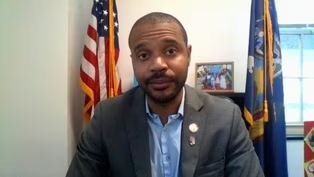
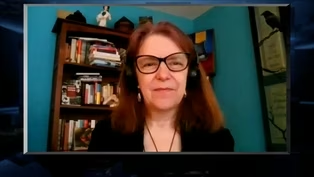
In September, Mayor Eric Adams and the NYPD unveiled a new subway-patrolling robot called K5. New York State Senator Jabari Brisport shares his thoughts on these new robotic technologies. Then, City University of New Yok law professor Rebecca Bratspies, joins us to discuss her new book, “Naming Gotham: The Villains, Rogues, and Heroes Behind New York Place Names."
Problems playing video? | Closed Captioning Feedback
Problems playing video? | Closed Captioning Feedback
MetroFocus is a local public television program presented by THIRTEEN PBS
MetroFocus: October 18, 2023
10/18/2023 | 28mVideo has Closed Captions
In September, Mayor Eric Adams and the NYPD unveiled a new subway-patrolling robot called K5. New York State Senator Jabari Brisport shares his thoughts on these new robotic technologies. Then, City University of New Yok law professor Rebecca Bratspies, joins us to discuss her new book, “Naming Gotham: The Villains, Rogues, and Heroes Behind New York Place Names."
Problems playing video? | Closed Captioning Feedback
How to Watch MetroFocus
MetroFocus is available to stream on pbs.org and the free PBS App, available on iPhone, Apple TV, Android TV, Android smartphones, Amazon Fire TV, Amazon Fire Tablet, Roku, Samsung Smart TV, and Vizio.
Providing Support for PBS.org
Learn Moreabout PBS online sponsorshipRafael: Tonight, welcome to the future where robots are joining the NYPD.
It is questionable whether the cops should have access to technology that could be used to invade privacy.
Have you ever wondered how the city's bridges, roads and tunnels got their names?
You'll learn more about the heroes of some of our most iconic structures as MetroFocus starts right now.
♪ >> This is "MetroFocus," with Rafael Pi Roman, Jack Ford, and Jenna Flanagan.
MetroFocus is made possible by The Peter G. Peterson and Joan Ganz Cooney Fund.
Filomen M. D'Agostino Foundation.
Barbara Hope Zuckerberg.
And by Jody and John Arnhold.
Bernard and Denise Schwartz.
Dr. Robert C. and Tina Sohn foundation.
The Ambrose Monell Foundation.
Estate of Roland Karlen.
Rafael: Good evening and welcome to MetroFocus, I am Rafael P Romano.
Are we in New York City or in Star Wars?
A question New Yorkers might be asking themselves when they see some of the new robots the NYPD has been rolling out.
In a recent event held at Times Square, the mayor announced the return of digidog, the controversial robot canceled in 2021 after serious backlash from a number of civil rights groups.
The robotic unit and other policing related technologies have become the latest tension point in the fight over police spending and public safety.
The State Senator is one of the elected officials who has been arguing against the NYPD's use of robots for surveillance and crime prevention.
And he joins us now.
>> Thank you for having me.
Rafael: The mayor has introduced several new pieces of technology which will be used by the NYPD.
There is digidog, we have two of those, they will be used in high-risk circumstances like bomb threats or hostage situations.
There is star Chase, a GPS tracker that can be shot at take fleeing vehicle -- at a fleeing vehicle, and a Roman robot shooting and taking video footage and otherwise acting as a kind of deterrent to crime.
Before we get into the specifics of each of these technologies, you have been critical and admonished the use of these technologies for policing purposes.
Generally, could you tell us why, could you summarize your position?
>> The police and NYPD are overfunded and they abuse the tools that they have already.
They abuse them for surveillance and other means already.
Any expansion of tools that they have under their belt we can assume that they will abuse as well.
Rafael: OK, we'll get back -- into the bigger picture.
But let's talk about these three technologies specifically, one at a time.
As I said, this dog has been here before, it was first used during the de Blasio administration, where it was deployed in housing to the great display of digital rock -- civil rights advocates, including you.
What was the problem?
>> The problem was that this was a way to engage in surveillance of public housing residents which did not make them feel safer and did not make them safer.
If you want an investment, the thing that they want is better lighting.
Infrastructure investments into their community as opposed to robotic surveillance dogs.
Rafael: >> But that's not how it is going to be used now.
The intention now, is to use it in emergency situations much like the fire department, who has its own Digidog, recently after the collapse of that parking garage in lower Manhattan.
The mayor has said that it will be used in those emergencies where otherwise the lives of officers might be at risk.
Under these circumstances, do you accept it?
>> I think we should consider this an attempt to get ready for a wider usage of these robots.
And these surveillance techniques.
Even something as innocuous as a camera, police have used them to do illegal surveillance of Muslims after 9/11.
I don't think we should take it at face value that these will be limited in scope.
Rafael: You feel like there will be a slippery slope, that if you introduce this technology, inevitably they will veer off and perform other functions, nefarious or sinister functions, that they were not intended to be used for initially?
Ask you know, we have this propensity from the mayor to engage in technical solution is him -- technosolutionism, you robots to address issues that have more community-based solutions.
Rafael: Let's move onto star Chase, something that really sounds like its out of Star Wars.
This is a new GPS tracker that can be shot at a fleeing vehicle, either through a handheld or vehicle mounted launcher.
The expectation is that it will significantly reduce the speed -- high-speed chases, which have also caused civilian fatalities.
What's the problem with that?
Rafael: The NYPD is, in surveillance -- well-known to engage in surveillance of people who have not been convicted of a crime or engaged in anything illegal, and they profile people.
What is to stop them from surveilling cars is the simple fact that there proof -- from the civil fact that they profiling the driver?
Rafael: You fear that they will shoot this GPS at innocent bystanders or civilians and their cars.
I'm guessing I can guess what your response to -- will be two K5--- K-five, that robot that will roam the subway station taking video footage.
But it does not have facial recognition cap abilities.
Does that make a difference?
Rafael: -- >> The biggest issue with engaging with police budgets, its similar to putting more police agents into the subways when the actual meat of investment is faster service, reopening the public bathrooms and reducing fairs and making them free.
It is a misplaced use of funds to do not address the root cause or needs in our communities.
Rafael: But the funds paying for this are going to be the assets, the funds from the assets of convicted criminals are those funds already dedicated for these kinds of purposes or policing purposes >> You know, I would say that with this NYPD budget, this is a real opportunity for people to see what they actually do.
That they engage in tech toys to fight for deeper surveillance of people who, and we are talking about innocent people, who are being recorded and surveilled by the NYPD.
And who knows what they will do with that information.
For small children, they have used these game trucks to collect DNA from children.
I think people should be wary, of any increases of the NYPD to engage in deeper surveillance of innocent civilians.
Rafael: Times Square subway station is a public space, and it already has a lot of cameras recording, some people would argue that these are just more cameras.
What is the difference between the cameras that already exist in Times Square and these cameras as far as collecting information?
>> It is an expansion that is unnecessary.
It has not been clear what these out onto already have -- add on to all the things we have, and how it will make people safer.
Rafael: You've touched on it a number of times briefly in our conversation so far, could you explicitly tell us where you think your money should go to the NYPD or policing that is going to this instead?
>> I think the general NYPD budget should be decreased.
So that we can allocate that money into things that make us safer like education, affordable housing, mental health services.
Rafael: Earlier this year, you introduced a bill in Albany that deals specifically with the issues we are talking about, not the specific technologies but things used by the police around the state.
What does that entail, that legislation, and how does that affect the things we have been talking about?
>> That went band police departments from using any robots that are armed and can be armed or that engage in surveillance.
We introduce it shortly after the first Digidog started patrolling in development's a couple years ago.
We have introduced it and are promoting it now in the wake of the new announcement from the mayor and the NYPD.
Rafael: Are you getting a lot of people to sign off on it or do you expect that it will pass and that there will be a law?
>> We have gotten a lot of interest in the bill and expect to pass it before the end of the legislative session.
>> In 2020, the city Council passed the police oversight surveillance technology act to ensure transparency in police use of technology.
Where is that lacking in why is that not sufficient to do with the issues we are talking about?
>> The passage of that bill was critical to knowing what surveillance the NYPD is currently engaging in, and now that we know we can work to stop surveillance of our communities.
Rafael: So in the minute and a half that we have, what are some of the critical steps that you believe we should take and the city government should take, that Albany should take, in order to invest in policing and in public safety in the right way.
>> There are many things that come to people's minds when they think of what would make them safer.
For one thing I hear people wishing that they had better lighting on their block.
That is a straight up investment that everyone agrees on.
But then in terms of quality of life people wish that we were doing more for the homeless and making sure that they have supportive housing and that we have more mental health beds and helping mental health in our communities.
People strongly believe in education and ensuring that more social and emotional training and education is done in our schools.
And jobs, can't find enough jobs, especially youth jobs, so that people have a livelihood that they can depend on.
Rafael: All right, we have to ended there.
Thank you so much for joining us and sharing your thoughts with us on this issue.
We hope to see you again soon.
>> Thank you so much, Rafael.
Rafael: Good evening and welcome to MetroFocus.
I am Rafael Paramount.
-- P Romano.
You have probably passed of the Holland Tunnel, and if you are a long-time Mets fan, you have attended a game at Shea Stadium.
Do you know where this land marks got their names?
That is the subject of Rebecca Paretsky's new book, naming Gotham.
She joins us now.
Thank you so much for joining us.
>> Thank you for having me.
Rafael: You're not a historian, you are a law professor and most of your previous work has focused on environment of justice.
What moved you to write this book?
>> Is a combination of, its related to my specialty because so many of the rows -- roads in New York City where placed through black and brown communities and they are an ongoing environment of justice issue.
What prompted me to write this book was that I used to get stuck on the highway all the time.
I'm not good in traffic so I would start to complain and whine and I went I would wind up saying who was that major deacon anyway, I hate him.
And my husband said why don't you find out?
So I did.
Rafael: You wrote about him at a bunch of others.
There are many pieces of info structure, neighborhoods and landmarks named after people, how did you choose the subject that made it into your book, what was the criteria?
>> To be honest, its not historically justifiable or scholarly justifiable at all, it was who caught my interest.
I have a list of many other people I would have loved to have written about.
Rafael: You have a lot of people in there.
The handful that we will have time to talk about today I picked because I think that our viewers might be less knowledgeable of them and because I found some -- some of them very interesting.
One thing that stood out for me first of all is that your subtitle accurately points out that villains or robes made it and had their names on important landmarks in the city.
One of them, perhaps, is Henry Bruckner.
Who is he, how shady was he, why was he known as the soda pop can, why was it that his name was attached to such an important expressway?
>> He was the cofounder, with his brother of Bruckner brothers soda.
During Prohibition they made a fortune selling soft drinks to New York City.
And he was also a politician, a Tammany Hall politician, elected to Congress multiple times where he rarely showed up for votes.
He was then elected Roxborough president.
In that role he really saw his shadiness.
He did not show up for work often.
When he did was visit safe-deposit boxes a lot.
He and his son had safe-deposit boxes at eight different banks.
Over a five-year stretch they visited them more than 180 times, storing more than $300,000 of the 1920's dollars in these safe-deposit boxes.
And that came out in the big corruption investigation, which same LC very chair during walkers and ministry should.
Rafael: How does a guy like that get his name put on an expressway?
>> While he was a Tammany Hall politician.
He was an important figure in New York, very very close with the Tammany Hall leaders.
He was also a very nice guy.
People liked him a lot.
Even after he got caught up in the corruption scandal, nobody removed him from office.
A week after he died, they named a road after him and went -- Rafael: It expanded and so on.
Is he the only guy in New York City public history to have thousands of children march in protest against him?
>> At least in protest about the price of soda.
We had youth marches about other things.
Rafael: OK, let's turn now to the individual who started all this, major deacon-- guigan.
Not everyone got put on that -- a landmark, even though he was friends with a corrupt mayor, he was a straight shooter.
Tell us his story.
>> He was an architect and training, and in World War I he was in the expeditionary force, except he never left New York.
He searched the entire war here the fortifications.
He used his rank for the rest of his life he never looked bigger.
He started the American Legion, that's his claim to fame.
And he was the chair of the Chamber of Commerce for a while.
Mayor Walker appointed him to the tenant -- to be tenant Commissioner.
He did a pretty good job at that.
One of his major claims the same ones that he declared war on pitching cubes.
When she was convinced spread polio.
They don't.
But they were definitely barking fire is six -- blocking fire exits.
He died young of appendicitis.
Rafael: A lot of these people died young, I noticed.
One thing about deacon was that even though he was the mayor's close power, once he got that job he took it seriously and he went after those landlords who were violating every single law, much to the, you know, that did not help Walker, because the C. Commission had him testify.
But they stay friends.
I thought that was very interesting.
I got a run on because time is short.
Clifford Collins.
This is a man who deserves the honor of having a big structure named after him, Holland tunnel.
Tell us about him.
>> He was the chief engineer and he designed most of the subway tunnels across Peace River East River which are still in use.
His engineering was so great that when they were taking the Holland tunnel from New York to New Jersey and they connected it they were off by less than a millimeter.
It was a really gifted engineer.
Unfortunately, the decompression and the stress got to him.
He died young.
He died at Kellogg's senatorial.
Rafael: Very young because of that.
And I learned from the book 13 workers died also in the construction of the Holland tunnel.
That was Iraq.
-- heroic.
He came up with a bunch of new engineering things that became commonplace after that.
Really significant guy.
Somebody who was different from all of these people we have talked about and most of the people you've talked about was William shape.
-- Shea.
He was powerful, but the kind of powerful person that worked behind the scenes, a wheeler dealer.
Those people like to stay behind the curtain.
They seldom become public.
But this guy, he not only became public but they named his -- this huge sport venue after him, in his lifetime.
How did that happen?
Rafael: People try to get him to run for office and he said no no, I want to be behind-the-scenes.
He was the unofficial chairman of the unofficial government of New York, a group of white men who would get in a room and decide what policy would be.
When the daughters live New York, the mayor at the time appointed him to be the chair of the committee to get National baseball back in New York.
That is where he became prominent in the public eye.
His strategy was to threaten to start a new league, and he got Richard Whitney's knees, fabulously wealthy related to the Vanderbilt family to back the continental leak, his proposed alternate league.
And the threat work.
We got the mats.
-- the mats.
Rafael: The stadium was demolished in 2008 and replaced by Citi Field.
Citi Field is named after Citigroup, because they paid $400 billion for naming rights.
That has now become commonplace.
In the future, will books like yours be impossible or nested -- unnecessary because we will all know that the landmark was named after the highest bidder?
>> Is a real change in the way we think about naming rights.
That continued to be true for commercial entities like stadiums.
But roads and bridges, New York is somewhat unique in naming our roads and bridges after people, as opposed to I-87, that's a New York thing.
But I don't see that happening.
I don't think we will have Citibank expressway.
I hope not.
Rafael: I thing some cities to have that.
But I'm glad you think we will.
As you have written and as we have seen, most of the people you write about our white men because most of the landmarks are named after white men, but not all.
And you do feature women and people of color who have made a difference in New York.
And they have things named after them.
The one that caught my attention, Shirley Chisholm.
The late Congresswoman from Brooklyn.
Give us a couple quick highlights of what she meant to the city and beyond.
>> Not only was she the first black woman to serve in Congress but she shook things up the moment she walked in.
They tried to Sideline her on rural agriculture and she fought back against that, but she also took the advice of one of her constituents to make lemonade from this appointment.
That is how we got food stamps and women -- in the wake program, because she was on this committee and she paired with Bob Dole and said we can really help poor urban kids and make a difference.
She did that.
She was a true fighter for New York and for women and for children.
Rafael: Shirley Chisholm state park is named after her, there will be more as the future rolls on.
Robert Moses is somebody who works in the background of a lot of your Vindman yet -- vignettes.
He was the premier shaper of the look and architecture of the city.
But in the process of doing that, he demolished some vibrant communities of color, which makes them more of a villain than a hero in most people's eyes.
As we have seen, that has not stopped people will -- and forgetting things named after him.
He has a few things around the state, but no big thing that fits the kind of impact that he had, why?
>> He did not die on.
If he had died -- he outlived his glory days.
By the time he died he was already the villain.
We don't tend to name things for people who are the villain in the moment or at least perceived as a villain in the moment.
Rafael: One final question.
Sometimes you move beyond New York City, for example, you write about Yonkers.
Is Yonkers the only city in the world named after her nickname?
[LAUGHTER] >> I don't know, it might be.
But it was a fascinating character.
Rafael: We don't have to much time to talk about him, he was the first lawyer in what became New York City, and even despite that, they named Yonkers after him.
[LAUGHTER] >> I take that personally.
Rafael: I'm sorry, I did not mean to do that, but I did.
They do so much, its a fun book, great way to know about New York history, reading this book, I recommend it.
Thank you for joining us.
It has been a pleasure talking to you.
>> Thank you, I really enjoyed it.
>> Thank you for turning into MetroFocus.
You could take our award-winning program wherever you go with MetroFocus the podcast.
Listen and subscribe wherever you get your podcasts so you never miss an episode.
Or civilly ask your smart speaker to pay -- play MetroFocus the podcast.
Also available at metrofocus.org and on the NPR one app.
MetroFocus is made possible by The Peter G. Peterson and Joan Ganz Cooney Fund.
Filomen M. D'Agostino Foundation.
Barbara Hope Zuckerberg.
And by Jody and John Arnhold.
Bernard and Denise Schwartz.
Dr. Robert C. and Tina Sohn foundation.
The Ambrose Monell Foundation.
Estate of Roland Karlen.
FUTURE OF POLICING: CRIME-FIGHTING ROBOTS?
Video has Closed Captions
Clip: 10/18/2023 | 12m 29s | FUTURE OF POLICING: CRIME-FIGHTING ROBOTS? (12m 29s)
Video has Closed Captions
Clip: 10/18/2023 | 13m 3s | “NAMING GOTHAM: THE VILLAINS, ROGUES, AND HEROES BEHIND NEW YORK PLACE NAMES” (13m 3s)
Providing Support for PBS.org
Learn Moreabout PBS online sponsorship
- News and Public Affairs

Top journalists deliver compelling original analysis of the hour's headlines.

- News and Public Affairs

FRONTLINE is investigative journalism that questions, explains and changes our world.












Support for PBS provided by:
MetroFocus is a local public television program presented by THIRTEEN PBS