
MetroFocus: October 31, 2023
10/31/2023 | 28mVideo has Closed Captions
THE NYPD’S HEAD OF INTELLIGENCE AND COUNTERTERRORISM; “MY PARTNER, MY ENEMY"; "MONSTROUS"
Tonight, We meet the new NYPD Deputy Commissioner of Intelligence and Counterterrorism, Rebecca Weiner. John Michael Leventhal, a retired New York State Supreme Court judge and the author of "My Partner, My Enemy," joins us to discuss his book. Finally, It's Halloween. Tonight ghoulish vampires, werewolves and zombies abound as we look at “the lore, gore, and science behind your favorite monsters.
Problems playing video? | Closed Captioning Feedback
Problems playing video? | Closed Captioning Feedback
MetroFocus is a local public television program presented by THIRTEEN PBS
MetroFocus: October 31, 2023
10/31/2023 | 28mVideo has Closed Captions
Tonight, We meet the new NYPD Deputy Commissioner of Intelligence and Counterterrorism, Rebecca Weiner. John Michael Leventhal, a retired New York State Supreme Court judge and the author of "My Partner, My Enemy," joins us to discuss his book. Finally, It's Halloween. Tonight ghoulish vampires, werewolves and zombies abound as we look at “the lore, gore, and science behind your favorite monsters.
Problems playing video? | Closed Captioning Feedback
How to Watch MetroFocus
MetroFocus is available to stream on pbs.org and the free PBS App, available on iPhone, Apple TV, Android TV, Android smartphones, Amazon Fire TV, Amazon Fire Tablet, Roku, Samsung Smart TV, and Vizio.
Providing Support for PBS.org
Learn Moreabout PBS online sponsorshipCity safe, from domestic terrorism to world terrorism, the NYPD's head of counterterrorism joins us.
Then, he was called the judge of abuse.
Recent awareness on domestic violence.
Retired New York State judge speaks out about what courts should do to protect victims.
"MetroFocus" starts now.
>> This is "MetroFocus," with Rafael Pi Roman, Jack Ford, and Jenna Flanagan.
"MetroFocus" is made possible by The Peter G. Peterson and Joan Ganz Cooney Fund, Bernard and -- Filomen M. D'Agostino foundation Bernard and Denise , Schwartz, Barbara Hope Zuckerberg, and by Jody and John Arnhold, Dr. Robert C. and Tina Sohn Foundation, The Ambrose Monell Foundation, Estate of Roland Karlen.
Jenna: Good evening and welcome.
After 9/11, the and YPG -- the NYPD created a new counterterrorism unit to avert another attack.
The focus then was on international threats from groups like ISIS and Al Qaeda.
However, since then, the threats facing New York have evolved now there is a growing focus on domestic terrorism, like the mass shooting in Buffalo last year for recent attacks on synagogues across the region.
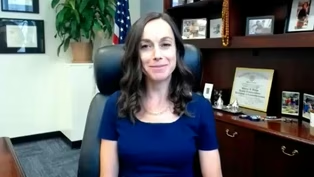
Rebecca Weiner appointed as the Deputy Commissioner of intelligence and counterterrorism, the first woman to serve in that role.
She is a 17-year veteran of the NYPD.
She joins me to talk about the threat environment in New York City and what led her to a career in law enforcement.
Welcome.
>> Glad to be here.
First off.
What exactly is your role?
Deputy Commissioner Weiner: I oversee a Bureau that was created most nine a lesson -- post 9/11.
We had some resources exist to before, some we brought to the table after whose job it is to fight crime and protect people, events, and infrastructures the city.
It is to make New York City safe by preventing complex acts of violence, in particular those associated with terrorism.
Jenna: There has been a shift from concerns about international terrorism, which I do not want to minimize, but definitely toward right wing extremists, like the shooting in Buffalo.
How do you begin to address that when we are talking about acts that an individual who may have no record decides to get up one day and commit?
Deputy Commissioner Weiner: Excellent question.
I have been here for 17 years.
The threat environment has changed considerably over that time.
Like to describe it as a shift, which implies moving from one place to another.
Actually, what we are dealing with is a diversification of the threats we face.
We do not have as much of the complex, externally directed plotting that we had immediately post 9/11, but we still have a robust presence of individuals inspired by Al Qaeda, ISIS, that ideology.
The most recent example of that in New York City was New Year's Eve last year in Times Square, just outside.
An attack carried out against some of our officers by somebody motivated in part by that kind of ideology.
At the same time, over the last few years, we have seen them respond to a concerted increase in what you are just describing.
Others describe it with various acronyms but the label we use is racially and ethnically motivated extremism.
That encompasses not sees, white supremacist.
The Buffalo attack is an unfortunate and apropos reminder of what that threat can look like.
There was an attack recently in Jacksonville.
You have also seen the rise in antigovernment extremism and over targeting of individuals who are associated with or semblance of government.
We are seeing an increase in conspiracy theory-driven violence.
We had a mishap last spring on our subway system.
An individual shot 10 people on a subway train, motivated in part by least raised conspiracy theories.
The threat is broad, diverse, unpredictable.
However, the good news is the machinery we put into place in the post 9/11 era to mitigate it, which combines a deep understanding of what is happening on our streets, a granular knowledge, with intelligence that we are getting from partners, information from international partners, the private sector, open source analysis that you mentioned earlier paired with investigators working cases.
That is a combination they can mitigate a threat whatever the ideology.
It is a machine we built in a way that can be deployed as the threat environment shifts.
Jenna: I also want to bring up the fact that you are overseeing a division that a few years back, after 9/11, was criticized for the controversial way it monitor the Muslim community.
I am wondering what you think of those criticisms and how do you address that with yourself at the home now?
Jenna: -- Deputy Commissioner Weiner: It is another important point and an interesting history that we have -- as a city have gone through.
There are certain strengths that NYPD brings to counterterrorism.
In particular, the diversity of our own personnel is extraordinary.
We became a majority minority in 2006.
We speak dozens of languages as a department.
Our officers hail from all over the world and reflect the diversity of our city.
Tapping into that diversity is a strength and helping us understand what is signal, what is noise has been a key hallmark of our program.
Also, the domain knowledge.
Nobody understands the streets of the city better than the officers who patrol it.
Post 9/11, the NYPD had to adapt quickly to a new threat environment that we did not understand all that well at the time.
We learned a lot over a short period of time.
We learned about what a threat looks like here.
That learning process has some bumps along the road.
It was an incredibly important process as a Bureau, is a program.
Alongside our law enforcement partners as well, trying to make sure we are governed by a consent decree, which is probably not of great interest to your viewers accept lawyers among you that governs activity in this realm where political activity is at the root of some of the threats we are investigating.
This consent degree -- decree is incredibly important.
As part of the settlement of the losses, we had the appointment of a civilian representative, somebody from the outside who would look at our cases not from the perspective of a police officer charged with protecting the city, but to make sure that our sense of what was justified come appropriate, necessary for public safety was shared.
That has been an incredibly helpful addition to our team.
We also enshrined into policy certain practices we had been taking voluntarily as part of that summit.
Learned on the way.
The biggest take away is as we have shared the secret is that we need to keep a murder to keep the public safe with outside observers -- we need to take in order to keep the public safe with outside observers, some of them have been taken with the gravity of the threats we are dealing with.
The main take away for as is the importance of transparency, that the more you are able to communicate with the public, the safer we all are and the happier everybody is with the protection we are affording to civil-rights and civil liberties.
Jenna: I also want to dig into your personal story.
You are the first woman to hold this position.
I understand your grandfather actually left Poland under political strife in the 1930's.
He became a part of the Manhattan Project.
I and wondering how the influence of someone who saw a different set of challenges politically in his country affected the way you approach your job now.
Deputy Commissioner Weiner: My grandfather was living in what is now part of Ukraine.
He was a mathematician.
He did the with his family.
A couple numbers.
The others were killed.
It is a Jewish family.
We thought the Nazis and came to the U.S.
He married my grandmother, who was French.
They were early inhabitants of Los Altos during the wartime years.
My grandmother was newly pregnant with my mother at the time.
They went to work on the Manhattan project and state and worked on additional projects -- the development of the hydrogen bomb, mathematical applications at the root of the Monte Carlo method.
He very much believed in using the power of signs and intelligence come in that cognitive status, not the disciplinary sense, to affect national security and public safety outcomes.
Very different context, the feet -- fleeing the war, building the desert, working on this project in secrecy, but that commitment to Nationals to to public safety was a beauty in me and invite my parents growing up.
Unfortunately, he asked away when I was little but I was taken with the family history and how they chose to contribute , when it was they had to contribute, to a mission of vital importance at the time.
9/11 became another defining moment for me in my path to come to this field and department, but it was always with the background of wanting to use what I have to bring to this important site.
Jenna: We have a few seconds left but as the first woman to hold this position, what does that mean to you?
Deputy Commissioner Weiner: I feel extremely fortunate.
I have been helped by many, men and women.
To be able to pay it forward and encourage younger women who might think I do not know about policing our national security, during want to embark upon this and to say yes, you should is too honor -- is an incredible honor.
Jenna: We will leave it there but I would like to thank the deputy Commissioner for joining us.
We look forward to hopefully, perhaps, not hearing from you.
I do not know if it is good or bad news to speak.
But thank you for joining us on MetroFocus.
Deputy Commissioner Weiner: Thank you for having me.
Jenna: Absolutely.
Jack: For generations, violence at home is something families kept private but only recently has it, to light as a social justice issue.
Domestic violence does not discriminate.
One in four women and one in 79 will be a victim of domestic violence or abuse.
New York is one of many states that to the issue head on.
We had the creation of the first felony domestic violence court in 1996.
John Leventhal made it his mission to bring more attention to the issue, which he has called an epidemic and he details his experience behind the invention what needs to be done to end domestic violence in his book, called my partner, my enemy justice Leventhal joins us now.
What prompted you to write a book about this?
Justice Leventhal: for 12 years, I did this important book.
I thought it was important because once O.J.
Simpson came, I think a lot of people thought, domestic violence just came about.
I used to these statistics prior to the O.J.
Simpson case is to so that this was while -- was of epidemic proportion prior to that.
Jack: I was a prosecutor in the late 1970's in New Jersey.
It was difficult to prosecute domestic violence cases then.
Why was it so much harder than?
-- then?
Justice Leventhal: Society viewed it as a private matter.
Police would go to a scene, maybe deliver the has been to a local bar.
Or of woman was injured, doctors and nurses would interview her and take care of her in front of the batterer.
They would not separate them.
It was no surprise that when they came to court and the judge would say, what do you want to do?
She would say I want to drop the charges and they would be dropped.
Once it became a societal issue, it empowered women and to disempower them.
It was in the hands of the prosecutor, then, not the hands of the woman to decide whether to proceed with the case.
Jack: Let's say a little about the domestic violence court.
How did that come about?
What was the concept behind it?
Justice Leventhal: When Galina Coumo was killed, that changed things.
The governor and Mayor Giuliani called for impeachment of the judge.
A judge cannot be impeached for discretionary reason.
But they found he had an antiwoman, and to prosecutor by is they needed a change.
Jack: You are taking this out of the regular court system and creating, literally and figuratively, a separate venue for these cases.
Why?
Justice Leventhal: Traditionally, courts want to be efficient.
Any domestic violence court, you want to ensure not only the rights of the defendant but the safety of the complaint, even after the case is over.
What I decided to do was bring back those who are lucky enough to get six months in jail, five years probation.
And I would bring them back every three months to ensure they would succeed.
Jack: You were keeping an active handle on all of this?
Justice Leventhal: Yes.
And we had 50% less violations than the general population.
The key was judicial monitoring and supervision.
Jack: Are we seeing progress being made in combating domestic abuse?
Justice Leventhal: Let me tell you historically.
Economically, women were at the bottom trend.
The rule of thumb was you could hit your wife with a switch not larger than the thumb.
After 1994, the violence against women act, statistics show that with the availability of shelters, primary aggressor statutes, with the prosecution of batterers, the intimate partner homicides -- and a lot of men's brief criticize these specialty courts, but they should know that intimate partner homicides of men has gone down 75%.
That is women killing men.
Allegedly in defense of being battered.
Of women, it is only going on 25%, but it has gone down.
But I think the availability of these things -- we have to do better, because we have shelters that do not accept teenage boys.
Women have to decide whether to stay where they are or leave their children.
Jack: Because he teenage boys cannot come with them.
Justice Leventhal: We have made more progress than any other country but we have far to go.
Jack: Thanks for joining us.
Justice Leventhal: Thank you for having me.
This is an important issue and close to my heart.
Jenna: It is the hunting season of Halloween.
Have you ever wondered why vampires prefer red or white you would do if attacked taxpaying werewolf or zombie?
Can you tell if that footprint in your backyard belongs to Bigfoot?
And what kind of dinosaur is Godzilla?
Any new book, monstrous, provides a fun and somewhat educational dive into monsters.
Its author is here with the details.
Welcome.
First, to help me, what was your inspiration behind this book?
>> I was the kid who is scared of everything when I was a child.
I approached this book by asking why we do the things that we do.
It turns out fear is a primal instinct.
I wanted to empowered leaders to examine which monsters are real, which are not and give them survival plans to survive the zombie apocalypse.
What happens if a vampire attacks, you have blood loss?
Jenna: These seem like the kind of things that would help you feel calm.
I know what to do if the monster from my bed comes to get me.
What are some of the suggestions that readers can get from your books?
>> One of my favorites is a picture of the werewolf.
It says how to communicate with a werewolf so you do not get the.
-- do not get eaten.
All of the tips are for dogs a dog will reset stale and wake it , that is a sign of aggression.
This is a tongue and cheek way to save the werewolf is going to attack, it will do these things, but if a dog does that, you also better stand back.
Jenna: Does this mean if a werewolf were to come upon me and I had bacon in my pocket, the werewolf is not happy?
>> Bacon is always good for werewolves.
Jenna: These are the helpful Halloween details that can help anyone with a vivid imagination, not just kids.
The book was also written intentionally so it is not just a child's reading.
A child at heart could also appreciate it.
>> That is my hope.
There were some complex subjects.
I talk about why King Kong is impossible.
Most kids do not really gravitate towards math as much as, say, monsters, but I hope I could make math and science so ridiculously fine that -- so ridiculously fubun.
Jenna: How much back research did you have to do?
>> So much, five years and I had to use a lot of expert readers, because some of the subjects are over my head.
The zombie chapter talks about the zombie praying.
I am not a neuroscientist, just a writer.
I had to consult with those people.
There is a lot of medical background so I had to consult to make sure I was getting it right what happens if an artery is pierced?
I spoke to coroners, because there is a chapter on decomposition versus vampires, how to tell the difference.
Jenna: The all-important difference between the living dead and the un-dead.
>> You need to know, kids, if you see reddish-brown at the corners of the mouth, that could be purge fluid, not vampire feeding.
That person is dead.
You do not need to worry.
Jenna: Good to know.
I can wondering who, even though children of all ages can appreciate this but who is your target audience?
This feels like something that the early teen, perhaps 7 to 10-year-old would eat up.
>> There is a saying that children's book authors write the books that they wish they had as children.
I was a child who gravitated towards science.
My ideal reader is that child saying I do not want to learn about science, certainly not neuroscience.
My objective is for that reader to make these subjects so interesting that they will learn and not realize that they are learning.
Everybody loves monsters.
Jenna: I think we all prefer the ones who are of lore as opposed to a real life.
I am wondering if there's any one story from researching this book or your own history with monsters that stays with you the most, that is your favorite?
Carlyn: Good question.
The Godzilla chapter was interesting.
I did not know the story, did not know it came out of this tragedy of the atomic bombs being dropped.
I wrote that chapter last because it says to me you have the amazing ability to distract.
We have the ability to be monsters.
I thought it was apropos, maybe a philosophical way to end.
This is all fun and games, but nuclear fallouts could actually happen.
Jenna: This is such a great book , friendly users guide for the season.
Anyone who has questions about monsters, thank you for joining us.
Carlyn: Thank you for having me.
>> "MetroFocus" is made possible by Jody and John Arnhold, Bernard and Denise Schwartz, Dr. Robert C and Tina shown foundation, The Ambrose Monell Foundation, Estate of Roland Karlen.

Video has Closed Captions
Clip: 10/31/2023 | 6m 52s | “MONSTROUS: THE LORE, GORE, AND SCIENCE BEHIND YOUR FAVORITE MONSTERS” (6m 52s)
Video has Closed Captions
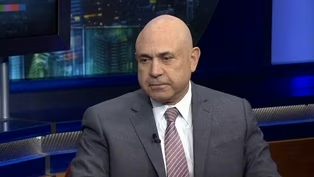
Clip: 10/31/2023 | 6m 9s | “MY PARTNER, MY ENEMY: AN UNFLINCHING VIEW OF DOMESTIC VIOLENCE" (6m 9s)
THE NYPD’S NEW HEAD OF INTELLIGENCE AND COUNTERTERRORISM
Video has Closed Captions
Clip: 10/31/2023 | 13m 3s | MEET THE NYPD’S NEW HEAD OF INTELLIGENCE AND COUNTERTERRORISM (13m 3s)
Providing Support for PBS.org
Learn Moreabout PBS online sponsorship
- News and Public Affairs

Top journalists deliver compelling original analysis of the hour's headlines.

- News and Public Affairs

FRONTLINE is investigative journalism that questions, explains and changes our world.












Support for PBS provided by:
MetroFocus is a local public television program presented by THIRTEEN PBS