
MetroFocus: September 28, 2023
9/28/2023 | 28mVideo has Closed Captions
SENATOR ROBERT MENENDEZ INDICTMENT; “TEEN RACE OF HOPE.”
Tonight, Briana Vannozzi of “NJ Spotlight News” on NJPBS joins us to discuss the indictment of Senator Robert Menendez and his wife Nadine. Then, New York City high school student Hayden Lucas and Louisa Benton of the Hope for Depression Research Foundation, join us to discuss the “Teen Race of Hope,” which took place in May.
Problems playing video? | Closed Captioning Feedback
Problems playing video? | Closed Captioning Feedback
MetroFocus is a local public television program presented by THIRTEEN PBS
MetroFocus: September 28, 2023
9/28/2023 | 28mVideo has Closed Captions
Tonight, Briana Vannozzi of “NJ Spotlight News” on NJPBS joins us to discuss the indictment of Senator Robert Menendez and his wife Nadine. Then, New York City high school student Hayden Lucas and Louisa Benton of the Hope for Depression Research Foundation, join us to discuss the “Teen Race of Hope,” which took place in May.
Problems playing video? | Closed Captioning Feedback
How to Watch MetroFocus
MetroFocus is available to stream on pbs.org and the free PBS App, available on iPhone, Apple TV, Android TV, Android smartphones, Amazon Fire TV, Amazon Fire Tablet, Roku, Samsung Smart TV, and Vizio.
Providing Support for PBS.org
Learn Moreabout PBS online sponsorship>> Tonight, the embattled New Jersey Senator pleads not guilty to bribery charges.
A chorus of Democrats calling on him to resign.
A "MetroFocus" report from New Jersey.
Then we continue our weeklong series focusing on student mental health issues with a teenagers race for hope.
Meet the local high school student who is awareness about teenage depression one mile at a time.
"MetroFocus" starts right now.
♪ >> this is MetroFocus with Rafael P Ramon, Jack Ford and Jenna Flanagan.
"MetroFocus" is made possible by the Peter Peterson fun.
The Filomen M. D'Agostino Foundation and Mutual of America.
Barbara Hope Zuckerberg.
Bernard and Denise Schwartz.
The Ambrose Monell foundation.
Estate of Roland Karlen.
Rafael: good evening and welcome to MetroFocus.
Last Friday, for the second time in his career, New Jersey Senator Bob Menendez was indicted on federal corruption charges, federal prosecutors accused Senator Menendez, his wife, and three others of conspiracy to commit bribery.
Thus a cuter say Menendez used his influential position in Washington to obtain hundreds of thousands of dollars in lavish gifts, gold and cash in exchange for aiding the government of Egypt, and for his efforts to disrupt federal and state prosecutions on behalf of to New Jersey Associates.
In light of the charges, a growing number of Democrats in New Jersey and Washington have been calling on the editor to resign.
Monday, Menendez described the charges against him and his wife as baseless and denied any wrongdoing.
>> I recognize this will be the biggest fight yet, but as I have stated throughout this whole process, I firmly believe that when all the facts are presented, not only will I be exonerated, but I still will be New Jersey senior senator.
Rafael: on Wednesday, Senator Menendez and his wife were arraigned at a federal courthouse in Manhattan where they both pleaded not guilty.
Joining us with more on the charges on the potential political far house both in New Jersey and on Capitol Hill, is the danger of an Chai's but -- NJ Spotlight News on PBS.
First of all, I wonder if you could elaborate on the charges against Senator Menendez, what exactly are they alleging that he did?
>> this was an astonishing indictment, 39 pages written for the public to read and digest.
The allegations are pretty brazen.
They range from Senator Menendez and his wife Nadine working with three businessmen in New Jersey.
One of those, his name is well Hannah, he has ties to the Egyptian government.
The indictment lays out how Menendez, through his wife, and we'll Hannah, set up meetings in which they discussed a number of interests in the injection government ranging from U.S. a to weapons and military aid to be signed off by this senator, using his very high-ranking position as the head of the Senate Foreign Relations Committee to help in those interests.
In exchange, according to prosecutors, he and other associates patted the pockets of Senator Menendez and his wife.
In the indictment we saw photos of envelopes stuffed with cash, hundred dollar bills, $20 bills, adding up to half a million dollars inside the jacket gets of Senator Menendez coats bearing his name, bearing the symbol of the Hispanic caucus in the Senate.
A safety deposit box of Nadine, his wife, carrying about $70,000 of cash.
What's notable there is that the envelopes and cash had fingerprints of these associates.
Go bouillon bars with serial numbers also link to these associates.
There was a level of concealment , prosecutors allege, because these items were hidden throughout their home and discovered in June 2022 when they executed a search warrant.
In addition, there were ties to a luxury car, a 2019 convertible Mercedes-Benz in which it's alleged that the associates set up means, handed off cash to help for that car.
It goes on to exercise equipment and an air purifier during the height of the pandemic.
So it's extensive, and it was a real bombshell here, the ties that they were able to make with text messages deleted emails, a number of communication methods.
Rafael: regarding that cash that was found in his home, the envelopes inside the gets of his jackets.
On Monday, Senator Menendez said that there was a very innocent explanation for that.
We have a clip of that.
Let's take a look at what he said.
Senator Menendez: For 30 years I have withdrawn thousands of dollars in cash from my personal savings account, which I have kept for emergencies and because of the history of my family facing confiscation in Cuba.
This may seem old-fashioned, but these were drawn from my personal savings account based on the income I have lawfully derived over those 30 years.
Rafael: what do you make of that explanation?
Do you think most New Jerseyans will find it convincing?
Briana: that's not for me to decide.
Menendez has sharp elbows.
This is a man who has spent his entire life since he was 20 years old holding elected office.
He came up through the ranks in Hudson County, which we all know here in New Jersey is as rough and tumble as you can get going up against party bosses and the Democratic machine.
This is also not his first rodeo.
He has to trial before, which ended in early 2018 after a nine week jury trial in a hung jury.
So, he's been here before, he is shrewd, he is known to be extremely intelligent, politically savvy.
So, he humbly asked, if you will remember from that press conference, he humbly asked the lick to let the facts play out, to allow the justice system to be able to do what they do.
Rafael: has he tried to explain -- you mentioned it, he says, as we just saw, that the money -- that he brought that money from the bank to his house, has he tried to explain how the fingerprints of the alleged drivers got on those envelopes that he brought from the bank?
Briana: that was noticeably missing from his pretty lengthy statement that he made.
It wasn't really a press event.
He didn't take any questions, he laid out what he sees as the case from his perspective, but no, he did not address the fingerprints.
He also did not address the gold bars.
As we heard there, he asserted -- he sort of tied this to his Cuban roots to government overreach, keeping that amount of money on hand for emergencies.
As prosecutors have duly noted, he makes $174,000 a year with his position in the Senate.
So, to withdraw that money over 30 years, he and his defense is going to have to show the receipts for those transactions.
Rafael: I have to say, I'm a Cuban, as you know, and I don't remember ever hearing that that was a tradition, that you put money in your house, hundreds of thousands, new to me.
But, as you mentioned, Senator Menendez has been through this before, in 2015 he was indicted for corruption as well.
I won't go into the details.
But, a doctor friend of his, the allegations were that he got very lucrative gifts and favors in exchange for a number of things, including getting visas for foreign girlfriends into the United States.
As you said, the jury was hung on that trial.
After which the judge acquitted him of some of the charges and then the prosecutors dropped all the wet -- all the rest.
There are no connections between any of that in the current charges, correct?
Briana: in the indictment it alleges that all of these acts started up really one month after that mistrial.
So, the indictment came down in 2015, the trial didn't happen until two years later in 2017 and prosecutors allege that Senator Menendez and his wife conspired to commit these schemes really a month after that jury was hung.
So, to that effect, it seems as though the investigations never really stopped.
And, we heard from the U.S. attorney the Southern District, the investigation is very much ongoing.
So, what we are looking to see as how much Menendez new about the dealings with the Egyptian officials, how much exactly of a role his wife played.
But, a lot of the accusations do rain similar.
Taking lavish gifts from a rich friend.
The difference here is there are a lot more direct lines being drawn.
As one prosecutor told me this week, the effort to conceal it is really damming.
Rafael: another big difference is that, after Senator Menendez 2015 indictment, most of his fellow Democrats, both in Washington and in New Jersey, stood by him.
They strongly supported him.
This time, most of those Democrats have called for him to resign.
Why the difference?
Briana: pretty Lee.
Friday at 5:00 Governor Phil Murphy put out a statement.
After that it was a day lose of statements from top ranking Democratic officials.
There's two big differences.
One, the charges in 2015 were a lot harder to prove.
They were much less salacious.
The second period difference is the fact that we had a Republican governor.
Governor Chris Christie, who if Menendez resigned, would have been able to appoint a Republican to replace him in the Senate.
We now have a Democratic governor who could appoint a Democrat to replace him and, you know as well as I do, Senate Democrats are trying like hell -- trying to hold onto their razor thin majority.
This is a seat that should be safe.
Democrats don't want up or millions of dollars into a race, should Menendez hold onto his seat.
And survive -- hold onto his seat and sofa -- survive a primary.
Rafael: one of the biggest supporters he had in 2015 after the indictment was Senator Booker.
Editor Booker on Tuesday came out himself and called for his resignation.
What specific reason did Senator Booker give for his change of attitude?
Briana: I don't know that it was a change of attitude, he was silent.
I think for those of us that have covered both of them for years, they have a very close relationship.
Menendez was a mentor -- a mentor to Booker.
They were friends, they appear at just about every event together, they are tight.
You can really feel the anguish that Booker had in writing this statement.
He couched it with the integrity of the office, that he was having a tough time reconcile these allegations with the Bob Menendez he's known over the years, with a guy who's out there for the middle class.
He couched it in for the good of the office.
But that was notable.
He's highly influential.
Once Booker said this, that's when we saw all these other high-ranking -- the flight gates opened.
-- floodgates open.
Rafael: not only the Washington Democrats called for his resignation, almost every high-level New Jersey Democratic politician has done that as well.
In a speech on Monday, he almost implied -- he said he would not quit and almost implied that he's going to run again next year.
With the charges over his head in the full power of the Democratic Party in Washington and in New Jersey against him, do you think that he can run and win?
Briana: that's the million-dollar question.
He's got a lot of support from the Latino base in New Jersey.
Again, these allegations are so different this time around, but he is confident that he will be exonerated and Rafael: remain the senior U.S.
Senator.
Rafael:-- and remained the senior U.S.
Senator.
Rafael: I have to end it there.
Thank you so much.
We will follow the story with you.
Briana: good to talk to you.
Jack: Welcome to "MetroFocus".
The state of teen mental health across the nation is urgent.
Last year the Surgeon General declared a national emergency in teen mental health.
More than one and three high school students reports feeling persistent hopelessness, a 40 percent increase since 2009.
Suicide is the second leading cause of death for adolescents.
To raise awareness of these issues as well as to raise money for research into depression, more than 275 teenagers and their families recently took part in a 5K run along the west side Highway in New York City, the first to be held in the city and apparently the first in the nation to focus on youth.
Joining me to talk about the race and what's nests -- next to treat depression, the executive director of the hope for depression research foundation and 17-year-old Hayden Lucas, a New York City high school junior who came up with the idea to hold the teen race of hope and is ambassador.
Thank you so much for joining us.
This is such an important topic.
Let me ask you first, to get a backdrop for our conversation, the talk about your organization, how did it get started and what's its mission?
>> The hopeful depression research foundation is a nonprofit that is fighting depression by gathering together the top neuroscientists around the world, to work together to find answers to treating and preventing depression.
We've been around for 17 years.
It was found in 2006.
So, we've been focused on finding answers for depression for a long time.
Longer than we've actually been talking about it in society.
Jack: 17 years ago, you look at the numbers that I mentioned in the introduction, and they are stark and they are troubling.
Is there some type of an explanation that you folks and the experts are looking to you as to why we have seen such a dramatic increase?
>> oh my goodness, well, of course your question is a very complex topic and we do known -- we do know that the number one risk factor for developing depression is stress.
And certainly, we have created a world where there are a lot of stressors in our environment.
Jack: Especially for our children.
>> exactly.
Jack: Hayden, what got you invested in this area?
Hayden: Well, I would say that when I first even heard about hope for depression and the work that they were doing, it really opened my eyes to the more global issue of mental health as a whole.
I think that when -- well, before I was introduced to hope for depression research foundation, I always saw mental health as almost like a gray area where it's OK to talk about, but at all costs, you really want to avoid talking about it just to avoid the awkwardness.
However, I think that's really what we are addressing out hope for depression research foundation.
Going back to the question of the cause and increase in these past years, I definitely believe it has something to do with that stigma surrounding it, which is the main area we try to address.
Jack: Let me follow up on that.
I did a story a number of years ago on wooded warriors coming back from combat, having suffered serious combat injuries and how they would re-have of those.
And I interviewed a young man who lost both of his legs in Afghanistan, and he came back and couldn't wait to start his rehabilitation.
He talked about and others talked about how he would do more than anybody wanted him to do.
He told me, at one point in our conversation he could not recognize in himself and share his mental and emotional turmoil that came from this.
And his answer was, it is not part of the warrior eat those.
Talk about the notion of people your age, and that unwillingness to open up about these mental and emotional difficulties.
Why do you think that is?
Hayden: Absolutely, yeah.
Thank you.
Addressing your question, I think it's institutionalized, almost.
The stigma surrounding mental health and even discussing depression is so, as I said before, awkward to uncommon listeners that whenever it's discussed, immediately red flags go up.
I feel like the example you just described of that soldier who came back and discussing his mental health issues was not possible for him.
I see it all the time, especially throughout social media.
And there's one specific trend that really addressed this issue and really brought light to it, which is, I will get on it later.
However, the blessing and curse of what social media does to mental health.
This trend was called core court.
It was seen on the social media app TikTok, and people were really discussing the lack of -- they weren't so much discussing, however, they were highlighting the lack of mail open is to talk about mental health and mental well-being through popular media.
And clipping popular media together and posting that into videos and then posting it onto to the greater app.
What I'm getting to with this is that, when people were clipping the specific segments of popular media and them into videos, they were really highlighting how mental health isn't addressed in popular media and how that stereotype of strongmen never tell their feelings.
Even though that isn't encouraged anymore, it still hinted throughout.
And even though people feel as though this generation is the one to change it, which it definitely could be, we are still fighting the issue of the stigma and trying to be over that strongmen type of mentality.
Jack: How do events like this help?
You talk about research, but also increasing awareness, not just awareness, but a better understanding of this circumstance.
Hayden's idea and the rays and other things you are doing, how do they contribute to increasing that awareness?
>> that's a great question, thank you.
A lot of people might be surprised to know that teenagers don't reach out when they are struggling with mental health issues.
This statistic is, less than 50% of teenagers reach out.
Here's a place where we can make impact immediately on a problem that's complex and there are long-term solutions and short-term solutions.
The short term solution is, my goodness, if we can start life-saving conversations by getting kids together in a way that's festive and fun but also serious, we could really make a difference.
We can plant a seed in 18's head that, there might be a reason for me to go speak to a trusted adult.
I might not feel comfortable going to my parents, so I will find that teacher at school that I can confide in.
So we feel raising awareness can make an immediate impact in so many lives.
Jack: Let's talk about the race.
Give me a sense of how did it go , the planning that went into it and what did you feel came out of it?
Hayden: Of course, thank you.
The race was fantastic, it was an amazing turnout.
We had over 200 runners and we were able to raise -- I just laugh at it -- over $31,000.
It's amazing to say out loud sometimes.
Jack: Good for you, well done.
Hayden: Really, there was so much planning going into this race, but mostly the planning required recruiting, fellow teens who I knew would be interested in reaching out to schools to promote the race, reaching out to possible sponsors, all of this was made so easy with the guidance of what Luisa, Catherine, Megan, just other people who work at hope for depression research foundation.
But addressing that third-party your question, what was the result, I believe it was a really great afternoon -- sorry, a really great morning, but I feel like the people who attended really were able to understand what it means to be open about mental health and really what's going on with teenage mental health specifically.
Just referring back to the first time I ran the race and what I took away from it and connecting it to the people who ran this time.
When I first went, I -- my eyes were opened by the statistics and I was able to run that day and really think about, I'm not alone.
In that sense, it has so many meanings behind it.
Mental health as a whole.
However, I'm not alone as in, this is an awkward topic.
However, everyone thinks of it as an awkward topic.
When I was there for the day, saying, I'm not alone, if we all think of it as that awkward topic, is to stigma.
If we address the topic and say, it might be a little awkward, the ratio for -- the ratio response of being able to make that first step of saying, hey, this is what I'm going through, that's so important.
That is what saves a life and that's but that run really taught me that day.
And it taught me how mental health is OK to talk about.
And I really hope that's what people learn during the day of the race.
Jack: It certainly sounds like it.
We could go on forever.
But such good work by Luisa, your organizations, Hayden, you and the people that work with it.
You're not alone, especially it's OK to talk with people about it and you are doing wonderful work, both of you and all the folks working with you.
We will check back in with you and see how you are doing down the road.
♪ Jack: Thanks for tuning into MetroFocus.
You can take our award-winning program with you wherever you go with MetroFocus a podcast.
Listen and subscribe wherever you get your podcast so you never miss an episode.
Sibley ask your smart speaker to play "MetroFocus" the podcast.
Also available at "MetroFocus" .org and on the NPR one app.
>> MetroFocus is made possible by the Peter G Peterson fund.
The Filomen M. D'Agostino Foundation and Mutual of America.
Barbara Hope Zuckerberg.
Bernard and Denise Schwartz.
Dr. Robert C and Tina foundation.
The Ambrose Monell Foundation.
Estate of Roland Karlen.
♪

SEN. BOB MENENDEZ PLEADS NOT GUILTY TO BRIBERY CHARGES
Video has Closed Captions
Clip: 9/28/2023 | 13m 19s | SEN. BOB MENENDEZ PLEADS NOT GUILTY TO BRIBERY CHARGES (13m 19s)
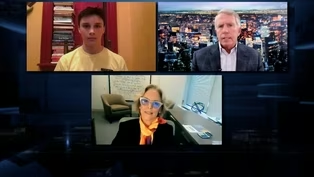
SPOTLIGHTING THE STIGMA AROUND YOUTH DEPRESSION
Video has Closed Captions
Clip: 9/28/2023 | 11m 59s | “TEEN RACE OF HOPE”: SPOTLIGHTING THE STIGMA AROUND YOUTH DEPRESSION (11m 59s)
Providing Support for PBS.org
Learn Moreabout PBS online sponsorship
- News and Public Affairs

Top journalists deliver compelling original analysis of the hour's headlines.

- News and Public Affairs

FRONTLINE is investigative journalism that questions, explains and changes our world.












Support for PBS provided by:
MetroFocus is a local public television program presented by THIRTEEN PBS