
MetroFocus: September 5, 2023
9/5/2023 | 28mVideo has Closed Captions
BACK TO SCHOOL SPECIAL
Baldwin school district on Long Island is transforming its traditional library space into a collaborative hub outfitted with 21st century tech. Baldwin Superintendent Dr. Shari Camhi discusses this next-generation library. Then the co-founders of "he Ideal School of Manhattan," join us to discuss the challenges of inclusive education in New York City.
Problems playing video? | Closed Captioning Feedback
Problems playing video? | Closed Captioning Feedback
MetroFocus is a local public television program presented by THIRTEEN PBS
MetroFocus: September 5, 2023
9/5/2023 | 28mVideo has Closed Captions
Baldwin school district on Long Island is transforming its traditional library space into a collaborative hub outfitted with 21st century tech. Baldwin Superintendent Dr. Shari Camhi discusses this next-generation library. Then the co-founders of "he Ideal School of Manhattan," join us to discuss the challenges of inclusive education in New York City.
Problems playing video? | Closed Captioning Feedback
How to Watch MetroFocus
MetroFocus is available to stream on pbs.org and the free PBS App, available on iPhone, Apple TV, Android TV, Android smartphones, Amazon Fire TV, Amazon Fire Tablet, Roku, Samsung Smart TV, and Vizio.
Providing Support for PBS.org
Learn Moreabout PBS online sponsorship>> The school library get a 20% for makeover.
How a traditionally quiet space is trans-warming into a collaborative hub.
And the mother she wanted a school for their children with down syndrome.
That as Metro focus starts right now.
>> This is Metro focus with Raphael, Jack Ford and Jenna Flanagan.
Metro focus is made possible by the Peter G Peterson and Joe Ganz Cooney fund, Barbara hope Zuckerberg and by Jodi and John on hold, Bernard and -- Bernard Andy's Schwartz.
The state of Berlin:, the GP foundation.
>> Good evening and welcome to Metro focus.
I am Jenna Flanagan.
The days of school libraries being a place for only books and getting shushed are a thing of the past.
At least in some communities.
Baldwin high school is among them, transforming its traditional library space into a collaborative hub with 21st century type.
Dubbed the learning collaboratory.
This base is geared toward preparing students for the real world of work.
If you know Baldwin, that shouldn't come as a surprise.
The district has pioneered a specialized school to clear program with seven distinct academies focusing on everything from medicine to business and tech.
We visited Ballwin several years back to see what makes their approach to learning so unique.
Here is a quick look.
>> What industry is looking for, and critical thinkers, communicators.
They are for creativity.
If we want our students to gain the skills, we have to create opportunities when they learn them and use them.
Place recruiting education is a passion of the superintendent of Baldwin public schools.
Ever since she joined the district in 20 14, she has worked to make the education experience more meaningful for students.
>> We as a team have visited Google, Mashable, we works.
Our students will be working in those environments.
If they are going to be working in those environments, we really felt compelled to make sure that our environment inside the walls of our schools mirrors what the world looks like.
>> Dr. Kami sat down with her district teachers and asked them what they needed to make their classrooms feel less institutional and more adaptable to their teaching style.
They also implemented the Academy system which allows students to test out fields of study and even careers while they are still in high school.
>> It emphasizes learning rather than schooling.
We thought our kids go from high school or college and they go from college to career.
And where they actually get the opportunity to learn about careers?
>> This is part of our chasing the dream coverage.
The Baldwin superintendent who led the push to transform the district high school library.
It is so good to see you again on Metro focus.
>> Are nice to be here.
-- it is so nice to be here.
Jenna: Tell us about the school collaboratory.
This goes against everything that so many of us knew about our high school experiences.
What is this brand-new situation you've created?
>> We recognize that schools in 2023 need to look different than they looked in 1893.
As we have been redesigning our physical spaces, one of the spaces that really stood out was this idea of a library.
Do we believe in books?
Yes.
Do we still have book collections that our students can reserve and take out?
Of course but given the need for space and looking at what we really need the space for, we decided that what Baldwin needed is what we are calling a learning collaboratory and that really is exactly as it is described.
It is where learning happens, is where collaboration happens, it is a laboratory where kids work together.
The space is beautiful.
When you are in a beautiful space, you feel ready to do amazing things and ultimately that is what we hope for our students.
>> This sounds kind of like a student led co-working space that adults might be familiar with.
>> You are absolutely getting warm.
It is kind of funny.
We consider ourselves future focused here in Baldwin.
I don't think we could have realized when we started the plans for the learning collaboratory that in 2023, the world of work would have changed.
That many people are either working from home, office space has been reduced.
If you are not coming into work every day, you certainly don't need the space you need a before and you need space where you can collaborate, space where you can have quiet time and do some work and ultimately our learning collaboratory is exactly that.
I feel that we helped to invent the future of work before industry invented the future of work.
>> Going against so many remember of our library.
>> There is no shushing going on here.
This is about young people getting together to solve problems, to work together.
You can't work together in quiet.
There are spaces where if you need quiet, you can have quiet but the idea is all about discussing and collaborating and working together with your colleagues.
>> How does this enhance Alban's already existing academies programs?
>> One of the things we pride ourselves on in Baldwin is the curriculum we have developed and continue to develop his all-around essential questions.
Big questions that don't have a yes or no answer.
They generally don't have a right answer.
This is become the physical space where you can do the work that the curriculum is -- has been designed around.
You talk about the way we think or thought about a library.
You can probably for the word classroom in there.
The way to think about classes, there would be thought about classrooms.
If your curriculum is very frontal based and lecture based, you can do it in a traditional classroom.
If it is really all about kids working together, the physical space needs to change as well.
This is a place where learning comes alive, where thinking comes alive, where if you walk into that space, you can't escape the energy.
You can't escape the collaboration amongst our students and the excitement.
We have a group of students called YC LC.
It is a youth collaborative and they have identified really important topics in our world that need some problem-solving.
For example, the environment.
The students have mentors in the field of business that are working with them to solve some of those problems.
They meet in the YC LC every afternoon.
They know exactly where to go.
They are thinking and going on what we would think as video conferencing their mentors.
They are doing their research, speaking to experts in the field and ultimately they are presenting forward what they considered to be a plan for a fix to a current problem.
>> The word energy is not a word I think most people would associate with traditional library.
Why was it important to not only redesign but more importantly rebrand it so it is not the library, it is the collaboratory?
>> Words matter.
We know that.
Words inspire thoughts and when you use old words, they inspire old thoughts.
We spent a lot of time talking about what the space would be called.
When we think about the learning collaboratory, the two essential components to that learning and collaboration are in there.
That is essentially what we are hoping for, not only in that space but in our schools in general.
If we are thinking about what we want to call it, we have to represent what we expect to be happening in it.
We think about a library as you point out, you think about shushing, books, quiet.
You probably think about wood furniture and maybe even a darkness.
That has been my experience.
When I think about libraries, I think quiet and dark.
This is the exact opposite.
It is bright and airy.
Lots of technology.
It has less stuff in it.
That is kind of interesting.
It has access to information.
It doesn't really have the information right there.
>> I am also wondering if this was something you guys of Baldwin came up with on your own or were there other libraries you look to for inspiration?
Did you just draw your inspiration from the adult co-working spaces that seem to be popping up everywhere?
>> We have a lot of our thinking inside.
I think we are inspired by things we see outside but it really does come from a place of problem-solving.
If we want to do this type of work in a learning environment and the physical space is not allowing us to really maximize that, we look for a solution to that problem and in this particular case, doing what was the library into the learning collaboratory was the solution that we came up with.
I can give you another example.
Next year in 2324 school year, we are introducing a new course called the senior experience.
We are merging English, the study of English, social studies and business together where our seniors will be working on curriculum projects that merge those three areas.
Much like the YC LC.
Those students will be working in the learning collaboratory.
They will have a problem in front of them.
Essential questions in front of them.
It will be very much student directed.
A lot of work outside school.
Branded with internships.
If I am studying the field of medicine and maybe something's -- on the specific, I will spend some of my time in courses in the learning collaboratory and I will spend the rest of my time in the field of medicine.
>> For people who might be seeing the segment but aren't in the Baldwin school District and their thinking this sounds so great, where are they doing this at kids school?
What advice would you give to someone who is hearing what amazing things are going on at Baldwin?
What if they are not sure it is even possible?
Is that too big to drink?
>> I would say it is -- nothing is ever too big to dream.
The minute we stop dreaming big, we stop progressing.
That is number one.
Number two we have lots of houses for sale here in Baldwin.
We are happy to welcome you.
We have embarked on this topic that -- there are four areas that need to get together to maximize the kinds of things we are doing in other places.
Industry, K-12, higher education and policy, we need to get together in order to fundamentally rethink what learning looks like in the future for us in the present and how we support one another.
How does higher education support the training of teachers so that the people we hire are prepared in this area?
What does industry need?
How does Clayton -- K-12 support what industry needs?
How does policy support innovative work as opposed to living in the past and having policies in place that force you to live in two worlds at once?
That is where we find ourselves right now.
For people thinking about their public school systems and what they could do, I think just raising the level of conversation, creating opportunities, opening up dialogue, dreaming big and thinking about what is possible, that is certainly one way to go.
My national organization is always hosting big thinking events that bring together people who want to think differently, who want to expand.
You need to take the first step and provide specific examples of what is happening, what is possible and do it in a way that allows people to hear your message.
If you are thinking about dreaming big for the purpose of your kids, no one is going to shut you out.
They are going to listen.
>> Tonight, we welcome the cofounders of a unique school providing a model for inclusive learning in the city.
The ideal school of Manhattan is New York city's only K-12 independent inclusion school.
School was founded some 17 years ago by three mothers out of specific need, a truly inclusive diverse school with small class sizes where students of all abilities can learn together in the same classroom.
The school has grown over the years and is now moving to a new and larger home in the financial district and here to talk about the school as part of our chasing the dream initiative focusing on solutions to structural inequities, the cofounders of the school of Manhattan.
Thank you so much for joining us.
>> I gave a brief background in the introduction.
We learned just how and why the decision is made to create this approach and learn.
>> Sure.
Back in 2005.
Michelle and I both had young children with down syndrome.
And we were looking for a school setting where children could be included with their peers.
They could go to school with their peers of the same age.
They had been included in everything that we did in our lives.
We thought this is New York City.
There are so many school options.
We ended up coming up against a lot of roadblocks in this process.
Many in the public school settings could not provide the resources or would not provide the resources to support our students in the way we knew they needed to be successful.
The private schools were interested in taking students with down syndrome.
Many in special education schools were not inclusive or they really focused on a particular have disability.
We thought this is crazy.
It is New York City.
How could this be possible?
We should not need to leave the city we love and want to raise our children and just to find an inclusive educational setting.
We got together with another family and we started to say to each other let's try this.
Let's try to start a school where students of all abilities can learn together in one place, be accepted for who they are, have a curriculum that meets each student where they are in the learning process and can replicate the beautiful community of New York City itself and the diversity of New York City itself.
>> Let me ask you to expand on that a little bit.
For some clarity of our viewers, >> I am sure you have an into this.
Some people might have a misperception.
Or they just don't fully understand it.
They might say if they are putting everybody in one classroom, does that mean they're going to get all of the emphasis and the others will not?
What is the answer to that in terms of the balance.
A our answer to that in our classrooms is co-teaching.
Everybody is met with how they learn.
All the kids, typically developing children that are not typical are having individualized education learning plans to meet them where they are.
If math is being taught, math is directed the weight needs to be directed for that student.
Nobody is being dragged down, it is a myth.
Nobody is left behind that might be learning at a different pace.
Our answer to it was creating a co-teaching model to differentiate the instruction for that particular learner.
Crisis has access common sense.
We are in the same structure, the same room, everybody's together.
But we have teaching tailored to the group.
Why was not being done in New York City before you did it?
>> It is a great question.
It does require some additional resources.
One way resources are important is the co-teaching model.
There is training involved.
I think the bigger issue that you come up against when you're talking about inclusion is prioritizing and having a diverse educational environment.
It is inclusive from the top-down and bottom-up.
If you are trying to convince the education -- the leader -- leaders of the school, you are in a different situation.
What we would love to see in other schools, public, private, a belief in our children.
The belief that all children can learn.
That everybody brings something to the table and that all students are teachable.
It is OK if one student struggles.
>> Help us understand.
What does a classroom in the ideal school look like and sound like?
>> Quite honestly, it looks like every other classroom in America.
Our classrooms don't look different.
In fact, often times you are not even going to be able to know which students are receiving extra support in the school.
Not everybody has a visible disability.
What you might see that is different is there are smaller class sizes.
You will see more instructors in the room but you are not going to know which teachers are focusing on which students.
Everybody working with everybody, you might see flexible grouping.
You might see students altogether in a classroom learning about a subject at one point and then breaking off into smaller groups, receiving differentiated instruction, doing different projects related to the same topic in small groups.
I think we are overly proud of this work that we do.
We don't pull students out of the classroom.
One student might be going to an art elective.
One might be going to a music elective.
When might be getting occupational therapy.
There is no stigma or difference.
>> Here is what you feel.
When you walk in that school and you watch these human beings, teachers, admin and -- they feel respect.
You feel complete immersion.
This is my friend Dylan.
That is what you feel.
You see and this really feel how if we started teaching human beings at young ages that differences are OK, they are not scary, we all have to adapt, we all have to coexist.
It is a remarkable social study to watch and feel.
>> How did your own children do?
How did they benefit from this?
>> I can tell you that my son Max who is now 23 years old, he started the school, he was in first grade when we opened it.
He was in the first graduating class in 2018.
He is proud of the fact that he has down syndrome.
He doesn't think that as a negative.
It is just a part of his identity.
Just part of who he is.
That is something we worked very hard to cultivate at the school with intentional identity curriculum with the social justice work we do.
It is not a student with disabilities, it is all of our students.
We have an incredibly diverse population.
They are celebrating one another's unique aspects of their identity from the beginning.
It is also the fact that I think he did reach his potential in all the subject areas he worked on at school because he felt safe, he felt accepted and he was taught to access the curriculum at the level where he was at each stage.
>> Yes.
Our model tackles bullying without having to say tackles bullying.
My son did not get bullied.
Kids with down syndrome can be targets.
Kids with differences can be targets.
Kids without disabilities can be targets.
This model -- school is a pioneering movement.
The issues we are seeing now with bullying and the differences and just a harassment is inclusion solves the problem.
This coexist concept from a young age -- it is in the DNA of everybody and everything, we have word of the mouth ideal.
We are all about civil rights, civil justice, social justice.
This is an answer to one of the most systemic problems we are seeing in youth.
>> The idea school of Manhattan, a marvelous idea that has been put into play and has accomplished everything we could hope for and we just need more of it.
Our thanks to both of you for joining us.
We look forward to talking down the road.
Be well, take care now.
Thank you for turning into metro focus.
You can take our award-winning program with you anywhere you go with metro focus, the podcast.
Simply ask your smart speakership like metro focus the podcast.
Also available on metro focus.org.
And on the NPR one app.
>> Metro focus is made possible by the Peter G Peterson and Joan Ganz Cooney fund, Barbara hope Zuckerberg and Joni and John Arnold, Dr. Robert he and Tina's own foundation.
The GPD foundation.
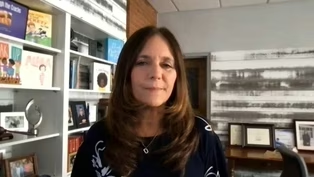
HOW LIBRARIES ARE GETTING STUDENTS READY FOR THE REAL WORLD
Video has Closed Captions
Clip: 9/5/2023 | 13m 37s | HOW NEXT-GENERATION LIBRARIES ARE GETTING STUDENTS READY FOR THE REAL WORLD (13m 37s)
Providing Support for PBS.org
Learn Moreabout PBS online sponsorship
- News and Public Affairs

Top journalists deliver compelling original analysis of the hour's headlines.

- News and Public Affairs

FRONTLINE is investigative journalism that questions, explains and changes our world.












Support for PBS provided by:
MetroFocus is a local public television program presented by THIRTEEN PBS