
Michael Martin Murphey Salutes America's Farmers
Clip: 6/8/2026 | 4m 52sVideo has Closed Captions
Singer/songwriter Michael Martin Murphey takes to the stage to salute American agriculture.
Singer/songwriter Michael Martin Murphey meets us in Colorado and takes to the stage to salute American agriculture.
Problems playing video? | Closed Captioning Feedback
Problems playing video? | Closed Captioning Feedback
America's Heartland is presented by your local public television station.
Funding for America’s Heartland is provided by US Soy, Sustainable Agriculture Research and Education, Rural Development Partners, and a Specialty Crop Grant from the California Department of Food and Agriculture.
Michael Martin Murphey Salutes America's Farmers
Clip: 6/8/2026 | 4m 52sVideo has Closed Captions
Singer/songwriter Michael Martin Murphey meets us in Colorado and takes to the stage to salute American agriculture.
Problems playing video? | Closed Captioning Feedback
Where to Watch America's Heartland
America's Heartland is available to stream on pbs.org and the PBS app.
Providing Support for PBS.org
Learn Moreabout PBS online sponsorship>> Let's head for the American Southwest and another musician who champions the cause of agriculture.
Michael Martin Murphey sings our America's Heartland theme song each and every episode.
He's also a man whose family once farmed the open plains of rural Texas.
He's best known today for his cowboy songs and bluegrass music.
Our Akiba Howard takes us along to New Mexico and Colorado where Murphey's words and music tell of a commitment to the land.
♪ There's a love for the country ♪ ♪ and a pride in the brand.
>> On this late summer afternoon, singer-songwriter Michael Martin Murphey has brought his award winning music to this high mountain meadow in southeast Colorado.
♪ In America's heartland, close to the land.
♪ It's a performance that taps into his country roots, and his admiration for people who make their living on the land.
>> I kind of grew up more in the piney woods of Texas and saw people clear the land and work really hard.
That piney woods country to get a pasture, you got to really work hard to clear it.
>> Murphey's rendition of "America's Heartland" has been the show's theme song from its beginning.
Performing keeps him on the road, but he works his schedule to spend a significant amount of time here in the rolling hills and mountains of northern New Mexico and southern Colorado.
♪♪ Off stage, Murphey can often be found in the saddle, keeping horses for himself and his family near his summer home in Red River, New Mexico.
>> So how did you start riding?
>> Well my grand-daddy was a cowboy in east Texas.
He was from Kentucky.
He moved from the coal mines of Harlan Kentucky to east Texas to be a cowboy, and that's all he ever wanted to do is run cattle.
So he taught me how to ride.
[Clapping] ♪ >> There's a lost river that flows... ♪ ♪ and a valley where no one goes, ♪ ♪ where the wild wonders close, ♪ ♪ close deep in the... >> The settings here allow Murphey to perform in some unique venues, sharing his favorite songs at chuck wagon and campfire concerts on an outdoor stage in the tall pines of the Southern Rocky Mountains.
>> A lot of our cowboy songs don't come from people that look like me or look like Clint Eastwood.
Right.
Or Roy Rogers.
Right.
They come from the Indians, The come from the ex-black slaves, the ex-slaves from the south.
They come from the Spanish people.
(Steam Engine) >> But the summer concert on this day begins with a train ride.
Onboard the San Luis and Rio Grande Railroad.
>> All Aboard The San Luis and Rio Grande takes audience members up some 9 thousand feet to Colorado's La Veta Pass.
♪ On a dark flat land she rides, ♪ ♪ On a pony she named wildfire... ♪ >> With sidemen Gary Roller and Pat Flynn, concert goers are entertained, with music, >>♪ On a cold Nebraska night.
and some tongue in cheek country humor.
>> For a great farm to run or a great ranch to survive, it takes a couple.
Boys, when you're dating, date anybody that you want and have a good time, but when you get married, you make sure that you marry a woman who can run a Bobcat and back a trailer.
>> There's a theme that runs through the music Murphey's written, and the songs he performs.
A celebration of those who provide the food, fuel and fiber we enjoy as a nation.
>> Working hard is something that I just really respect and you don't find harder workers that people who work the land.
♪ You can see it in the eyes ♪ ♪ of every woman and man.
>> Every single day that you get to ride in the saddle and every single day that you get to get out there and work on your tractor on a good day is a fantastic experience."
♪ In America's heartland, living close, ♪ ♪ close to the land.
>> Railroads revolutionized agriculture in America, making it easy to ship commodities like corn and wheat great distances in a short amount of time.
A steam engine nicknamed "The Best Friend" lays claim to being the first American built engine.
It rolled into service in 1830.
It had a short career however.
A boiler explosion took it off the rails in 1831.
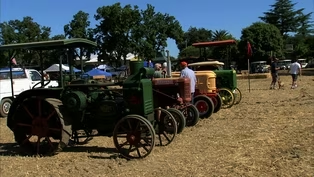
California Historic Tractors Take to the Field
Video has Closed Captions
It’s old-time harvest days in California…bringing in the crop with a 30-mule team hitch. (4m 33s)

Farm to Fork: Mini Zucchini Pies
Video has Closed Captions
On Farm to Fork, discover how to add some zing to your zucchini. (6m 58s)
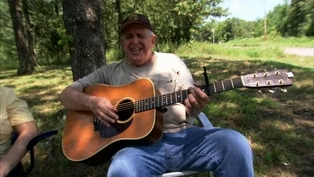
Rodney Dillard - Famous Musician and Farmer
Video has Closed Captions
We’ll sit with Rodney Dillard, who is now returning to his farming roots. (5m 49s)
Providing Support for PBS.org
Learn Moreabout PBS online sponsorship
- Food
Christopher Kimball’s Milk Street Television
Transform home cooking with the editors of Christopher Kimball’s Milk Street Magazine.


 Recently Added
 New Episode


Support for PBS provided by:
America's Heartland is presented by your local public television station.
Funding for America’s Heartland is provided by US Soy, Sustainable Agriculture Research and Education, Rural Development Partners, and a Specialty Crop Grant from the California Department of Food and Agriculture.