One-on-One
Michele Acito; Eric Boehlert; Rosanna Scotto
Season 2022 Episode 2508 | 27m 20sVideo has Closed Captions
Michele Acito; Eric Boehlert; Rosanna Scotto
Michele Acito discusses the long-term impact of COVID on the nursing profession, and the importance of vaccine education; Eric Boehlert talks about the long-term implications of the January 6th insurrection and the 2020 Presidential Race; Rosanna Scotto discusses the biggest lessons she learned during the pandemic and the role of social media in public broadcasting.
Problems playing video? | Closed Captioning Feedback
Problems playing video? | Closed Captioning Feedback
One-on-One is a local public television program presented by NJ PBS
One-on-One
Michele Acito; Eric Boehlert; Rosanna Scotto
Season 2022 Episode 2508 | 27m 20sVideo has Closed Captions
Michele Acito discusses the long-term impact of COVID on the nursing profession, and the importance of vaccine education; Eric Boehlert talks about the long-term implications of the January 6th insurrection and the 2020 Presidential Race; Rosanna Scotto discusses the biggest lessons she learned during the pandemic and the role of social media in public broadcasting.
Problems playing video? | Closed Captioning Feedback
How to Watch One-on-One
One-on-One is available to stream on pbs.org and the free PBS App, available on iPhone, Apple TV, Android TV, Android smartphones, Amazon Fire TV, Amazon Fire Tablet, Roku, Samsung Smart TV, and Vizio.
Providing Support for PBS.org
Learn Moreabout PBS online sponsorship- [Narrator] Funding for this edition of One-On-One with Steve Adubato has been provided by New Jersey Institute of Technology.
NJIT makes industry ready professionals in all STEM fields.
Valley Bank.
Johnson & Johnson.
The Robert Wood Johnson Foundation.
PSE&G, committed to providing safe, reliable energy now and in the future.
The Healthcare Foundation of New Jersey.
New Jersey Sharing Network.
The Russell Berrie Foundation.
Making a difference.
And by Delta Dental of New Jersey.
Everyone deserves a healthy smile.
Promotional support provided by NJ.Com, keeping communities informed and connected.
And by BestofNJ.com, all New Jersey in one place.
- This is One-On-One.
- I'm an equal American just like you are.
- The way we change presidents in this country is by voting.
- I'’m hopeful that this is the beginning to accountability.
- Life without dance is boring.
- I don't care how good you are or how good you think you are, there is always something to learn.
- I did do the finale, and guess where my trailer was?
A block away from my apartment, it couldn'’t have been better!
- People call me 'cause they feel nobody's paying attention.
-_ It'’s not all about memorizing and getting information, it'’s what you do with that information.
- (slowly) Start talking right now.
- That's a good question, high five.
(upbeat music) - Welcome everyone.
I'm Steve Adubato.
We kick off this program talking about nursing in 2022 and beyond.
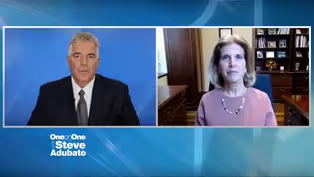
We're joined once again by Michele Acito, Executive Vice President Chief Nursing Officer at Holy Name.
Good to see you, Michele.
- Good to see you, Steve.
- Do this for us.
I asked you right before we got on the air we're taping in February 2022, seen a little bit after that.
You can't predict the future but you can tell us what you're seeing right now.
What are you seeing?
- That's right, Steve, you cannot predict the future.
We've learned that over the last two years, better than ever before.
What we're seeing today are single digits of patients in the hospital, zero patients on ventilators, zero patients waiting in the emergency room with COVID.
A very different picture than over the holidays when we had nearly a hundred patients in house, and between 15 and 20 on ventilators and 20 to 30 waiting in the emergency room, we're in a much better place than we were just a few weeks ago, and we're looking forward to a future with the same progress.
- Michele last time you joined us, we talk talked about nursing at that time, nurses at that time, what do you believe the longer term impact of COVID will be on the nursing profession?
- You know, I think the impact is going to have a lot of effect on what people remember, how bad it was during 2020, and then the two waves that followed it.
But I also think it's going to have a positive impact on our profession.
People learned early on that we could make a difference that we were there to provide the care, to be the stand in family member and knowing how you can make a difference to your own community and to your own peers really makes a difference.
Immediately, after the first wave in 2020, we saw a significant increase in our number of students enrolled into our school.
100% increase in applications and that made us feel real good.
While we wait for these student nurses to graduate, we do struggle.
We struggle with the people who have retired, the people who thought they could work a few more years but realized during the pandemic this may have been too much for them at the end of their career.
So while right now we struggle with staffing.
We struggle with burnout.
We do look forward to the future when these nurses graduate and can join the ranks.
- Michele, we've talked also about this before.
I do a lot of leadership development in my other life, and I talked to a lot of nurses and physicians and Holy Name is in fact, one of our underwriters at the Caucus Educational Corporation.
But this is the issue that I want you to talk as candidly as you, you can about.
And it's burnout.
I've been struck in, struck in my leadership coaching about how many physicians and nurses who are close to tapping out, that they just can't take it anymore.
And so my question is this, in terms of taking care of, it's one thing everyone was celebrating.
"You're heroes."
That was then, that has stopped.
How are, forget about physicians for a minute, nurses, how are they maintaining their wellbeing?
- It really isn't easy.
With the inability to celebrate together, to gather, to allow us to have that time to decompress, doing it via Zoom has helped.
And we did a lot of that after the first wave, people talked about it, talked it out, but when you can't gather and you can't celebrate and you're always concerned, "Am I going to catch the disease?
Am I gonna bring the disease home to my children under the age of five who can't get vaccinated yet?
Am I gonna bring it home to my elderly parents?
Am I going to be the one who spreads it in the house?"
It is a lot.
And the burnout is very heavy.
In addition to not gathering, people weren't able to take vacations and decompress with their family and let loose and have a good time.
So until we can reach that point, this burnout is going to weigh heavy.
And not only the burnout of not being able to gather but having seen what we saw, it was a lot, it was a lot to handle.
It was a lot on our minds.
And then the added pressure of not having visitors, we wanted visitors more than anybody but we knew that wasn't safe.
So when you're not only the caregiver but now you're the family member, that added burden of the FaceTime and the sad goodbyes and the sad family gatherings, perhaps for the last time.
Those are things that you don't forget.
Those are images that you bring with you every day when you come to work.
And the burnout is difficult.
We try very hard to talk to staff, to work with staff, to make sure that they have, have everything that they need.
But at the end of the day these are scars that will last for a long time.
- You know, Michele as people watch "NJ Spotlight News" every night or "Metro Focus" on the other side of the river, but covering the region, but particularly on "NJ Spotlight News" there have been a whole range of stories with nurses and nursing leaders, let's say, in your profession who have spoken out against vaccine mandates for healthcare professionals.
What is the level of resistance at this point that you can sense in your organization and in the profession across the board of nursing to the vaccines?
- At Holy Name we did not fire people who did not get the vaccine.
We made sure that they still wore the proper PPE as everyone does.
They had weekly testing and we talked to them.
We helped them to understand the things that they may have been misinformed about.
And that route really helped us.
What it did was it gave them a sense of trust that we weren't just going to fire an unvaccinated person 'cause that didn't help anybody.
That put an unvaccinated person on the street in the community without a job.
Our approach really helped a lot of people understand the need for the vaccine.
And we saw a lot of people turn the corner and get vaccinated and then get boosted.
And I really think that having those conversations and not taking a hard line on the other side is what brought Holy Name to the a very high vaccination rate.
- But hold on, Michele.
There are a whole range of other healthcare organizations, individual hospitals, and groups of hospitals networks, if you will, who did mandate it.
University Hospital being one of the first with the former Commissioner of Health, Doctor Elnahal who is their CEO right now, they mandated it.
I'm not gonna get into who was wrong and who was right.
But you're saying there's more than one approach to this vaccine resistance as opposed to mandating it, which has been the case with a lot of healthcare organizations, a lot of hospitals.
- Mandating it, I was glad that the mandate came into place because it really had us open the conversation with employees who may have been misinformed.
When people are misinformed and then they're fired, they're still misinformed, they're still unvaccinated.
They're still in the community, but having the opportunity for an infectious disease doctor to work with these employees and help them understand the benefits and how they could help themselves and their family really worked.
We saw a large turnaround from the number of employees that were unvaccinated.
- Michele, help me on this.
I have something wrong in my mind here.
There is a government mandate that everyone who works in the hospital be vaccinated but there's not one at your hospital.
- There is.
And for the people who did not get vaccinated, they went through the proper channels for either a medical or religious exemption.
But we wanted to make sure even those employees understood that if that was their belief, we respected it and we did not make them get vaccinated.
But for the other employees before the mandate, who did not wanna get vaccinated, we wanted to make sure we worked with all of them to ensure that they got vaccinated.
For the people who aren't vaccinated now, they have a medical or a religious exemption.
- Before I let you go.
This pandemic has affected all of us in one way or another but you're much closer to it than those of us in broadcasting.
30 seconds or less.
How has this pandemic impacted not just you as a person, but you as a nursing leader?
- Really has impacted the way I appreciate life, every single day and every, every single nurse and that the work that they put in, the work and how much effort they've put in to come to work every day and not say, "I can't do it.
I didn't sign up for this."
Because we did sign up for this.
And they rose to the occasion and the appreciation I have for every one of them, it cannot even be measured.
They're all heroes to me.
- Well said, Michele.
And for those who think that time passed in 2020, 2021 to say our nurses are our heroes and physicians, that time will never get old.
It's never inappropriate.
Thank you to you, and all of the nurses who are making an extraordinary difference everyday.
Thank you very much, Michele.
We appreciate it.
- Thank you, Steve.
Have a great day.
- You got it.
Stay with us, we'll be right back.
- [Narrator] To watch more One on One with Steve Adubato find us online and follow us on Social media.
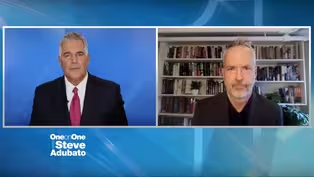
We're joined once again by Eric Boehlert, who's editor and founder of Press Run Media.
You'll see their website out throughout this segment.
Check it out.
Great stuff about we in the media, how we're doing, how we're not doing things we should be doing, et cetera, et cetera.
Hey, Eric, thanks for joining us again.
- Sure.
My pleasure.
- We're taping this at the end of January, 2020.
What is your view of how we in the media, whether it's public broadcasting, or anyone else who is a responsible journalist trying to do the right thing, what should our focus be, as it relates to making sense and covering January 6th, the anniversary of it/the hearings around it?
Loaded question, I know.
- Yeah, it's a big one.
I mean, you know, democracy is in danger.
There's no question about that.
Look, I think there's been some really good investigative reporting, in terms of what happened January 6th.
There's been excellent documentaries.
But if you wanna understand what happened that day, there is ample ways to find out, and there's just been, I think, really good reporting on the groups that were involved, the organizing.
And I think a lot of that is thanks to the January 6th Commission, which has interviewed hundreds of people.
They say they're gonna have public hearings.
And I think we're gonna find out a lot more in 2022 than we ever thought.
And it's a hugely important story.
But I think the problem with the press, though, is it's the January 6th investigation, the big lie, in terms of, Trump's claim about a rigged election, it's kind of in a silo.
And so there's this investigation, insurrection coverage, it's bad.
You know, the Department of Justice is looking into it, but then you look at the Trump coverage on a daily basis.
The insurrection often isn't even mentioned.
You see stories about Trump's rebranding in 2022, who he's going to endorse, what's his fundraising like?
We see long reports, and there's no mention he's trying to destroy free and fair elections in this country.
There's no mentions that he led a deadly insurrection.
So, for me, those two things have to be, those two stories have to be told.
He clearly wants to run for reelection.
It's gotta be the first or sentence paragraph in every single story about him.
- Okay.
But here's the part that perplexes me, and your perspective is valuable on this.
PS, Press Run Media, Eric's own words, he is a liberal, as if that's something bad.
He's a progressive.
But this is the question I'm curious about.
Even for the so-called progressive media, or for those of us in public broadcasting, who, as I said in our last segment we did with you, do not have a horse in this race.
We try to play it straight, and try to make sense of things.
Regardless of where people are, do you think across the board in the media, we miss and want Donald Trump in the game, even though he called us, quote, "The enemy of the people"?
- I really do.
And it's really frustrating, 'cause when he left office, I didn't think that was gonna be the case in 2022, but the way I see it, absolutely.
Now, do I think the press wants Trump to be president again?
No.
I think they, as you say, they want him in the game.
- Why?
- Good point.
So, last summer there was reporting about how the press was bored with Joe Biden.
This is just an effective, efficient, this is back to the no-drama Obama approach to government.
This is boring.
You know, we had Trump for four years.
For four years, there wasn't one political reporter in this country who went to work and said, "What am I gonna write about today?"
It rained news for four years.
Often chaotic, often startling.
Biden comes in, says, "Hey, we're not gonna do that."
There hasn't been a single leak out of the West Wing in a year.
And so I think they looked at Trump and said, "You know what?
That was kind of fun."
And my take is they really, I think they're really trying to drag down Biden to keep the playing field level for at least to give Trump shot in 2024.
So it'll be close.
So it'll be fun.
They see it as entertainment- - What fun?
Timeout, timeout, timeout.
The graphic says Democracy at a Crossroads.
Democracy in danger.
We're in trouble.
Where's the fun in the chaos, and the insanity, and the scary rhetoric that could cause action, January 6th, all of it?
Where's the fun?
What am I missing?
- I think people, particularly in the Beltway, they see this as entertainment, and they see, to a degree.
I'm not saying 100%.
CNN does very good stuff on the insurrection, "The New York Times," "The Washington Post."
But there's also an element of, "We miss his spotlight.
We miss the limelight.
Yes, he insulted us every chance he got, but we were in the game.
We all got book deals.
We are all on TV.
A lot."
I'm telling you, careerism is a big part of Beltway media.
And unfortunately, I think it drives too much of this.
- But Eric, before I let you go, that makes us in the media, and not across the board, and not everyone.
I'm not gonna paint with a broad brush, but too many of us in the media, it makes us part of the problem with why our democratic, small D, system of government, that we all say is so important to us, that we are contributing to democracy being in danger, and at a, way past the crossroads.
Go ahead.
- I think that's a problem.
And I think the press needs to address it.
Yes, they are talking about democracy, and elections, and the big lie, but there's still a part of that engine from the Beltway media, that wants to see fireworks, and wants to see the chaos.
And that is very troubling.
- Eric Boehlert is the editor and founder of Press Run Media.
Every couple of days, I get an e-blast because I subscribed, let me disclose, I do, from Eric, and it gets me thinking.
It doesn't mean I agree with everything he says, sometimes I don't even know whether I agree or not, but it gets me thinking, and how dare we in 2022 be thinking.
Thank you, and you're guilty of making me think, which is a good thing.
Eric, thank you so much.
I appreciate it.
- I appreciate it.
Thanks for your time.
Thanks for your time.
- You got it.
That's Eric.
I'm Steve.
We'll be right back.
- [Narrator] To watch more One on One with Steve Adubato find us online and follow us on Social media.
- She's back.
She's back by popular demand right here on public television.
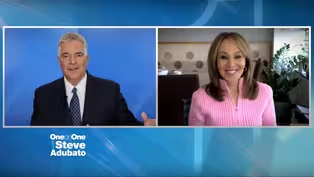
My good friend, colleague, Rosanna Scotto, Emmy Award winning co-host of "Good Day New York", seen every day starting at a ridiculous time in the morning, but, what is it 4:00 or 5:00?
- I'm on at 7:00.
I get to sleep in until 7:00 am.
- 7:00 to 10:00?
- 7:00 to 10:00 am.
(Rosanna laughing) - And also the restaurateur and co-owner of a terrific restaurant, one of my favorites in New York, Fresco by Scotto, over on East 52nd Street.
- 52nd Street.
- Good to see you.
What did I have?
Did I say 52nd or 53rd?
- 52nd.
- Just wanna get it right.
- Yeah.
- Listen, I know that the mayor, Mayor Eric Adams, found the restaurant.
We're gonna show some video right outta the box.
Let's do this because if you haven't been there and we're not gonna make this a commercial for Fresco by Scotto, but other than the food being great and I love it there, there's like a, there's a party going on.
And the mayor was there recently, for what?
To dance or eat?
- He came, you know, the mayor has been trying to get around to various restaurants in the city to support them.
When he came, it was back in December before like, you know, everything kind of shut down again because of Omicron and people getting scared and getting sick.
But he was there before and we have a DJ on Friday and Saturday nights.
And at that time, it was a mild Saturday night in December, we had the DJ outside and when he came out from eating, we played 'Native New Yorker'.
Everybody went wild when they saw him and the mayor jumped in the crowd and he started dancing with all of us.
- Well, I'll tell you, one of the things I like about the restaurant is that it's a family and old school Italian Americans from let's say, Southern Italy.
For me, that means Naples.
And I believe it's similar for you.
You were on with us at our Tisch WNET studio with your mom talking about the restaurant but it's not, it's you, your mom, your sister.
Who else is involved in the restaurant?
- So, it's my mom, my sister and I, and my brother, Anthony, also helps manage.
It is a family affair.
My son started working underneath my sister now.
He's learning the ropes as well.
So now the next generation's getting involved.
But you know mom's there all the time, greeting everybody and we've had to reinvent Fresco.
Let's face it, we're in Midtown Manhattan, people are not back to work, it's very quiet in the city and we had to make it a place where you wanna go.
A destination place, place to have fun, to put a smile on your face because we have all been through hell in the last two years.
- You know, the other thing is from a business point of view many restaurants have closed in New York and across this country.
From one third of all small businesses in New Jersey closed since the pandemic.
We're doing this two years, two years plus into the pandemic.
What's the biggest lesson you have learned as a business person, not just, we'll talk about media in a second and work at FOX 5.
As a business person, the biggest lesson you learned from COVID.
- The biggest lesson is to be flexible because, you know, just when you think things are going well, like in December, the next thing you know, you're hit with another variant and having to adapt again.
We completely recreated our restaurant.
We kept our delicious staples, you know, on the menu.
And of course we still have mom in the front, but we had to-- - By the way, mom is Marion.
We should make it clear.
- Yes.
That's Marion, okay?
- Marion.
But my sister and I what we decided to do was to make it a party because basically we thought like this was the roaring twenties.
You know, they had to deal with an epidemic during that time.
And once it was over, everybody wanted a party.
So we wanted the same kind of party atmosphere.
We hired a party planner, Larry Scott, and we, uh... we make it a happy place.
We change the environment every four months.
At first we started with a lemon grove like we were in Capri, Italy.
Then we went into harvest.
Then at Christmas time we had the best holiday decorations and wait till you see what we're gonna do in the spring.
Can't give it away yet.
- Well, I will be there.
I promise we're doing media in a second.
Can you, do you had Barry Manilow come by?
- Yes.
- And there's we, I have Chris Christie coming in to talk about Republican and national politics in just about a half an hour but why is there a Chris Christie component to this?
- Okay, so, the former governor, Chris Christie, he comes into Fresco by Scotto pretty regularly.
- Yep.
- He just happened to be there the night Barry Manilow came.
We had gotten a heads up that Barry was coming and my sister, Elena, and I said, "What are we gonna do when Barry comes?"
So, we enlisted a lot of the people in the restaurant to get up and do a conga line to Copacabana.
- Of course.
- We have a big.
(Rosanna laughing) We have, you know, a lot of music in the restaurant and we didn't ask Chris Christie to do it because we just thought you know maybe he would feel funny doing it but he got into the spirit of things and Barry noticed.
- Okay, we'll leave it at that.
I'm gonna ask the governor about that.
The first question outta the box will not be about Trump or the Republicans but the conga line.
(Steve laughing) Hey Rosanna, pivoting, evolving.
We're doing our program, obviously remotely.
You're in the studio right now, over at Fox.
We look forward to being in our studio at the Tisch WNET studio and our New Jersey studio, NJ PBS.
Biggest, dare I ask, lesson for you other than pivoting and evolving from a media perspective on the show, on 'Good Day'.
- You know, Steve, it was really scary in the beginning.
Let's face it.
We always were in the studio.
My TV partner and I were rotating who was in anchoring every other day.
And we had minimal staff.
And, you know, we learned how to do Zoom and to be flexible and to do our own hair and makeup, which we're still doing, and just basically to stay calm and to make sure that we assure our audience that we will get through this together.
And we have not without any scars or wounds, but we have.
- Rosanna, again, we've done so much together.
Both of you've been joined us and I've been fortunate enough to join you on your show.
But I do sometimes think or wonder about the future of traditional local media.
Do you think it has changed forever?
- Oh, totally changed forever.
I think, you know, the social media aspect is such a large component now of what we do, engaging with our audience.
That part is great that we can really get immediate feedback to some of the interviews that we're doing live on the air.
But you know, I do feel, you know, the rating system is not great and it doesn't really, truly measure what's going on in our city and our area, because now, we're not just the local station because of streaming.
We're seen nationally, if not, internationally.
And so I don't think that they have any way of knowing what our audience truly looks like.
Before I let you go, got a minute left, you've been involved in broadcasting for a couple of years, Rosanna.
- I don't have enough fingers on my hands to count.
I've lost.
I've used my fingers and my toes so.
- And, you still, I gotta do this before I let you go.
I still love, and by the way, at PBS ratings to not matter as much.
We care, but we don't have to be a slave to them, dare I say.
I need to ask you this.
You still have tremendous passion for what you do every morning, 30 seconds, because?
- I love it, I love the minute-- You know, listen, it's not easy to get up at 4:30AM everyday.
But the minute I get out of bed I say, thank you, God, I have the most wonderful job.
I'm on the front lines of history.
I get to interview the most fascinating people in the country and I'm blessed.
- That's another thing we have in common, other than our heritage.
We have that in common as well.
It's a real blessing to be able to do this.
Rosanna, all the best to you.
- Steve, thank you so much.
Continue doing what you're doing.
We appreciate it.
- You got the best of the Scotto family and the team over at 'Good Day'.
All the best.
- Thank you.
- See you soon.
- Thank you, Steve.
- That's Rosanna Scotto I'm just Steve Adubato.
We'll see you next time.
- [Narrator] One-On-One with Steve Adubato has been a production of the Caucus Educational Corporation.
Funding has been provided by New Jersey Institute of Technology.
Valley Bank.
Johnson & Johnson.
The Robert Wood Johnson Foundation.
PSE&G, The Healthcare Foundation of New Jersey.
New Jersey Sharing Network.
The Russell Berrie Foundation.
And by Delta Dental of New Jersey.
Promotional support provided by NJ.Com, And by BestofNJ.com.
- Hi, I'’m Joe Roth.
In New Jersey there are nearly 4,000 residents in need of a life saving organ transplant, and one person dies every three days waiting for this gift of life.
One organ and tissue donor can save eight lives and enhance the lives of over seventy-five people.
You have the power to make a difference and give hope.
For information or to become an organ and tissue donor visit www.njsharingnetwork.org, and be sure to talk with your family and friends about this life saving decision.
The 2020 Presidential Race and Its Long-Term Implications
Video has Closed Captions
Clip: S2022 Ep2508 | 7m 27s | The 2020 Presidential Race and Its Long-Term Implications (7m 27s)
The Long-Term Impact of COVID on the Nursing Profession
Video has Closed Captions
Clip: S2022 Ep2508 | 10m 18s | The Long-Term Impact of COVID on the Nursing Profession (10m 18s)
Social Media's Role in Public Broadcasting
Video has Closed Captions
Clip: S2022 Ep2508 | 10m 1s | Social Media's Role in Public Broadcasting (10m 1s)
Providing Support for PBS.org
Learn Moreabout PBS online sponsorship
- News and Public Affairs

Top journalists deliver compelling original analysis of the hour's headlines.

- News and Public Affairs

FRONTLINE is investigative journalism that questions, explains and changes our world.












Support for PBS provided by:
One-on-One is a local public television program presented by NJ PBS