State of Affairs with Steve Adubato
Michele Acito on the vital role of nursing & public health
Clip: Season 9 Episode 30 | 9m 51sVideo has Closed Captions
Michele Acito on the vital role of nursing & public health
Steve Adubato speaks with Michele Acito, DNP, Executive Vice President & Chief Nursing Officer of Holy Name, about the vital role nurses play in the healthcare ecosystem and in building trust in public health.
Problems playing video? | Closed Captioning Feedback
Problems playing video? | Closed Captioning Feedback
State of Affairs with Steve Adubato is a local public television program presented by NJ PBS
State of Affairs with Steve Adubato
Michele Acito on the vital role of nursing & public health
Clip: Season 9 Episode 30 | 9m 51sVideo has Closed Captions
Steve Adubato speaks with Michele Acito, DNP, Executive Vice President & Chief Nursing Officer of Holy Name, about the vital role nurses play in the healthcare ecosystem and in building trust in public health.
Problems playing video? | Closed Captioning Feedback
How to Watch State of Affairs with Steve Adubato
State of Affairs with Steve Adubato is available to stream on pbs.org and the free PBS App, available on iPhone, Apple TV, Android TV, Android smartphones, Amazon Fire TV, Amazon Fire Tablet, Roku, Samsung Smart TV, LG TV, and Vizio.
Providing Support for PBS.org
Learn Moreabout PBS online sponsorship[INSPRATIONAL MUSIC STING] - We have her back by popular demand.
She's Michele Acito.
She is the Executive Vice President, Chief Nursing Officer at Holy Name, one of our longtime underwriters to fully disclose.
Michele, good to have you with us again.
- Thank you, Steve, great to be back.
- Great, hey, Michele, where are we as we we're actually doing this right before Thanksgiving and be seen later.
How are we doing with the nursing shortage?
- You know, Steve, we are in a much better place than we were five years ago during the pandemic.
And I think part of it was the pandemic.
People realized that nursing was a very important career, one where you could help people when they were struggling.
And we saw a significant enrollment in our Sister Claire Tynan School of Nursing.
And as those classes have graduated, we have found ourself in a much better place.
- Michele, I know that's not an easy answer because there are all types of people who go into nursing, but from your experience, who's going into nursing post-pandemic kind of folks?
- The people who are going into nursing post-pandemic are those who understand that there is more to life than just yourself in taking care of just yourself.
These are the people who know that they have something to give to society, that they have something to give to the people who need the most at the most vulnerable time in their life.
- Yeah, Michele, the other thing about nursing and nurses are clearly the backbone, if you will.
I do a lot of leadership coaching with physicians, and physicians will often make it clear that without nurses it doesn't work.
In that spirit, I'm curious about this.
Nurses are a key to creating greater trust in the public health system.
There's gonna be a graphic that comes up, Trust in Public Health.
Here's the question.
To what degree do you believe, Michele, and you've seen this for a few years in your profession, to what degree do you believe there's been a loss, a significant loss in trust in the public health system?
- You know, I really believe that part of that is people not trusting the evidence or trusting the science.
And I think that that's really something that we always have to remember, that evidence-based medicine and science that proves it is what we should always use as what leads us.
Nurses have always followed evidence-based practice.
And I believe that's why nurses have always, year after year, been nominated as the most trusted healthcare professional.
And we are very proud of that because we follow evidence-based practice.
We know that there are people out there doing research that makes sure every decision we make, every treatment we provide is the one that has balanced out as the most important.
And when you follow that, you can never go wrong.
- Along those lines.
I know all kinds of folks who are questioning our vaccines.
The efficacy, if you will, the safety, the effectiveness of vaccines, the graphic will come up, graphic will come up, Vaccines: What You Need to Know.
Please go to the New Jersey State Department of Health website.
It's got a special section on vaccines, which Michele knows well.
Talk to folks right now who are questioning, who have concerns, particularly about the MMR vaccine, with small children.
Talk to those folks, Michele.
- You know, the one thing I will say about vaccines is that vaccines save lives.
Vaccines save communities.
Vaccines are probably the greatest invention we've had in this country's lifetime.
And I suggest that anybody who has a small child meet with their healthcare provider and make sure you understand from that provider why they should or should not get the vaccine.
My theory has always been get vaccinated.
- How the heck did public health become political?
- I don't know, but it's really a shame that it has become political.
Because without vaccines that we have available today, literal communities would be wiped out.
And we know that from history, smallpox, chickenpox, flu, these are the things that we can prevent.
So it's important that we vaccinate our children and that as adults we remember to get vaccinated ourselves.
- As I said before, I'm a student of leadership.
Again, a lot of work in physician leadership, but nursing leadership, I'm curious about this.
Nurses are natural leaders, trained leaders, but they're either way, they're leaders.
How the heck do most nurses become the great leaders they are, Michele?
- I think we've become leaders because our patients rely on us and we quickly realize they look to us for advice and education.
And those are the two things that leaders can do.
So we advise them on the proper health during their hospitalization when they go home and we know that that's really important that they understand.
So we become educators at the same time.
- Partnerships are key.
And you have a variety of partnerships.
One of them is with Rowan University.
Talk about that.
- It's really important to us, you know, that enables our nurses to seamlessly obtain a Bachelor of Science degree.
It is well known that nurses with Bachelor of Science degree, those patients that they care for have a lower mortality and a better outcome.
So for our nurses to have the ability to obtain that Bachelor of Science degree and virtual is very important to us and to our nurses.
- You know, the other, other than partnerships is money.
No money, no mission.
Mike Maron, your CEO, we talk about this all the time.
You know it as well.
There is a grant, a gift, if you will, for scholarships that was created by the Sisters of St.
Joseph of Peace.
Are they nursing scholarships?
- Yes, these are nursing scholarships and they are named for the Sisters of St.
Joseph of Peace, who were themselves nurses, some of them leaders here at Holy Name, very well respected.
Our school of nursing, as a matter of fact, is named after one of our Sisters of St.
Joseph, Sister Claire Tynan.
And so, you know, they know the importance of nursing and caring for patients.
They were the founders of our hospital.
So to honor those nuns who were once with us and practice nursing here through scholarship was a great honor for all of us.
- So those nurses gave to these future nurses for their scholarships?
- The Sisters of St.
Joseph gave to Holy Name School of Nursing for the scholarship, yes.
- They continue to give back, even those who are no longer with us, but help provide those dollars.
Before I let you go, I'm curious about this.
I've asked you this before in previous interviews.
Go back on our website, SteveAdubato.org.
Look at previous interviews we've done with Michele.
I'm curious about this.
Your commitment to the nursing profession comes from where?
- My commitment to the nursing profession comes from the patient.
Everything stems to the patient.
If we can't do what's right by the patient, then we have completely failed as a profession.
And so every day we come into this organization and it's the patient first and foremost every day.
- When did you know you wanted to be a nurse?
- I knew I wanted to be a nurse while I was in high school.
As sophomore year as a matter of fact, I very distinctly remember thinking, "This is the profession that I wanna take."
- Was it, I'm curious.
I'm running out of time, but I wanna get this.
Was there someone in your life who was a nurse or where'd that come from?
- You know, it wasn't a family member.
It was really just learning about it.
And I thought, you know, this is exactly what I wanna do.
I wanna be there to help people through the good times and the bad.
Help them learn about good health maintenance.
And then when they did become a patient to help them through that, and then help with the discharge and the education so they knew how to move forward.
- Michele Acito, Executive Vice President, Chief Nursing Officer at Holy Name, one of our longtime underwriters.
Michele, I wish you and the team at Holy Name all the best and we look forward to future conversations about the nursing profession and the way you and your colleagues serve every day.
Thank you for the work you do.
Thank you, Michele.
- Thank you, Steve, thank you.
- You got it.
Stay with us, we'll be right back.
- [Narrator] State of Affairs with Steve Adubato is a production of the Caucus Educational Corporation.
Funding has been provided by The Russell Berrie Foundation.
EJI, Excellence in Medicine Awards.
A New Jersey health foundation program.
PSE&G.
Valley Bank.
Kean University.
New Jersey Board of Public Utilities.
The New Jersey Economic Development Authority.
The New Jersey Education Association.
And by Robert Wood Johnson Foundation.
Promotional support provided by BestofNJ.com.
And by CIANJ, and Commerce Magazine.
- (Narrator) Since 1903, PSEG has worked to keep our commitment to customers and communities, to keep your lights on and homes warm.
We’re there when challenges strike like storms or economic uncertainty.
We're preparing for tomorrow by working to replace aging infrastructure, provide carbon free nuclear energy, and deliver energy efficient options to customers.
PSEG, powering progress.
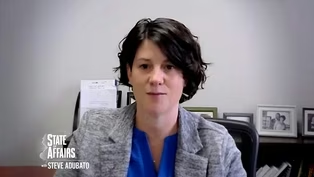
Examining funding for students with special needs in NJ
Video has Closed Captions
Clip: S9 Ep30 | 7m 51s | Examining funding for students with special needs in NJ (7m 51s)
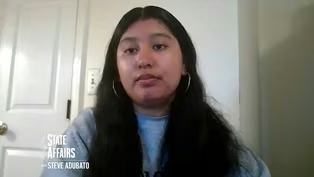
Immigrant rights activist discusses uplifting her community
Video has Closed Captions
Clip: S9 Ep30 | 10m 33s | Immigrant rights activist discusses uplifting her community (10m 33s)
Providing Support for PBS.org
Learn Moreabout PBS online sponsorship
- News and Public Affairs

Top journalists deliver compelling original analysis of the hour's headlines.

- News and Public Affairs

Today's top journalists discuss Washington's current political events and public affairs.












Support for PBS provided by:
State of Affairs with Steve Adubato is a local public television program presented by NJ PBS