One-on-One
Michele Adubato; Robert Clark; Diane Gutierrez-Scaccetti
Season 2023 Episode 2632 | 27m 56sVideo has Closed Captions
Michele Adubato; Robert Clark; Diane Gutierrez-Scaccetti
Jacqui Tricarico speaks with Michele Adubato, CEO of The North Ward Center and Founder of The Center for Autism, at the Night of Hope 2 Event; Robert Clark, Founder of Newark Opportunity Youth Network highlights his organization’s commitment to reducing violent crime; Diane Gutierrez-Scaccetti, Commissioner of NJ Department of Transportation, discusses congestion pricing.
Problems playing video? | Closed Captioning Feedback
Problems playing video? | Closed Captioning Feedback
One-on-One is a local public television program presented by NJ PBS
One-on-One
Michele Adubato; Robert Clark; Diane Gutierrez-Scaccetti
Season 2023 Episode 2632 | 27m 56sVideo has Closed Captions
Jacqui Tricarico speaks with Michele Adubato, CEO of The North Ward Center and Founder of The Center for Autism, at the Night of Hope 2 Event; Robert Clark, Founder of Newark Opportunity Youth Network highlights his organization’s commitment to reducing violent crime; Diane Gutierrez-Scaccetti, Commissioner of NJ Department of Transportation, discusses congestion pricing.
Problems playing video? | Closed Captioning Feedback
How to Watch One-on-One
One-on-One is available to stream on pbs.org and the free PBS App, available on iPhone, Apple TV, Android TV, Android smartphones, Amazon Fire TV, Amazon Fire Tablet, Roku, Samsung Smart TV, and Vizio.
Providing Support for PBS.org
Learn Moreabout PBS online sponsorship- [Narrator] Funding for this edition of One-On-One with Steve Adubato has been provided by The Port Authority of New York and New Jersey.
Moving the region through air, land, rail, and sea.
The Healthcare Foundation of New Jersey.
Prudential Financial.
The Russell Berrie Foundation.
Making a difference.
PSE&G, committed to providing safe, reliable energy now and in the future.
RWJBarnabas Health.
Let'’s be healthy together.
New Jersey Institute of Technology.
NJIT makes industry ready professionals in all STEM fields.
PSEG Foundation.
And by NJM Insurance Group.
Serving New Jersey'’s drivers, homeowners and business owners for more than 100 years.
Promotional support provided by Insider NJ.
And by Northjersey.com and Local IQ.
Part of the USA Today Network.
- This is One-On-One.
- I'm an equal American just like you are.
- The way we change Presidents in this country is by voting.
- A quartet is already a jawn, it'’s just The New Jawn.
- January 6th was not some sort of violent, crazy outlier.
- I don't care how good you are or how good you think you are, there is always something to learn.
- I mean what other country sends comedians over to embedded military to make them feel better.
- People call me 'cause they feel nobody's paying attention.
-_ It'’s not all about memorizing and getting information, it'’s what you do with that information.
- (slowly) Start talking right now.
- That's a good question, high five.
(upbeat music) - Folks, you are about to see an interview that my colleague Jacqui Tricari did with my sister Michele Adubato.
Not about being my sister, but my sister Michele is in fact the CEO of the North Ward Center and founder of the Center for Autism.
There was an event at the North Ward Center, a night of learning and celebration, Night of Hope 2.
All about autism, about who's dealing with autism, not just those who are facing it individually, but their families as well.
Michele Adubato knows the issue well and Jacqui Tricarico had an in-depth, compelling conversation with her.
Let's check it out.
- Hi, I'm Jacqui Tricarico on location at the North Ward Center here in beautiful Newark.
And I am joined by Michele Adubato who is the CEO of the North Ward Center and the founder of the Center for Autism.
Michele, we're here for a really important event tonight.
It's called The Night of Hope 2.
Describe it for us.
- Wow.
Night of Hope.
Night of Hope 1 was huge.
And we did that about seven years ago and we changed policy.
We changed the stars to many people with autism changing the way funding comes down for people with autism on the state level with the statewide transition plan.
So when we thought of what we should do it was immediately clear to me and Suzanne Buchanan that it needed to be healthcare.
Okay?
So Night of Hope 2 is a celebration also because here's the thing about hope.
Hope needs to be a verb.
We can't just stand around and sit around and say, oh I hope something's gonna happen.
We have to make something happen.
So you hear the music, you hear the crowd.
We also wanna bring energy to this.
Okay?
And celebrate our community because it's a very difficult there's a lot of difficult things that people with autism and their families have to deal with and so one night, let's come together.
Let's come together and say we are together.
- Right.
And, and you mentioned healthcare as the major theme here.
There's been a lot of studies that have reported that healthcare professionals just aren't given the resources, the proper training to be able to effectively and efficiently take care of people with autism.
When they're coming into any healthcare setting really; dentist, eye doctor, or whatever it might be.
What do you think really needs to be done to make it an industry standard for healthcare professionals to be trained the proper way?
- So I think, unwittingly, the healthcare profession has created a situation like every other situation where people that are different don't, it doesn't actually work for and that's probably most people.
So what happened with healthcare especially after the pandemic and during the pandemic, we saw this, just getting vaccines we're just so hard.
People take for granted a shot.
Okay?
How hard?
It's very hard.
- There needs to be trust there, right?
- Trust.
There needs to be consistency.
There needs to be, you know, faith in this is gonna be okay.
And also when you have cognitive, a cognitive disability it's also about the understanding of what's happening to you.
And so Night of Hope 2 is about purpose and joy.
The purpose being that we really do want to ignite a seat change of how our professionals think about how to deal with people with autism.
I'm gonna give you an example.
Last night, one of our members from Hope House needed to go to the hospital and - (Jacqui) Hope House is?
- Hope House is the first permanent group home for people with autism in Newark.
And we opened it and we're very proud of that and going on to Hope House 2.
So we're very excited.
- (Jacqui) Great.
- And so she needed to go to the hospital.
- She's fine.
- (Jacqui) Good.
- I called the doc.
I said, listen Doc, we need help.
Please don't have her wait.
She's nervous.
They took her right in Clara Maass, wonderful hospital.
- (Jacqui) Yeah.
- Took her right in, made her feel comfortable.
And she was home within two hours.
Don't take that for granted.
That was a huge thing that happened.
- (Michele) And - Not always the usual circumstances.
- (Michele) Right.
Yes.
- And is that where tonight too, this Healthcare Pledge, or you're asking everybody to sign, the legislative leaders, the healthcare leaders, you're asking to sign this Healthcare Pledge.
What does that mean?
- The Healthcare Pledge is simply saying, listen there's autism friendly practices that I think that are easy to do.
It doesn't cost any money.
It's about changing perception and changing the way you may do certain things.
We actually have a doctor that's one of our Hope Heroes tonight.
- Yeah.
Dr. Jennifer LeComte.
- Absolutely.
She does that with their practice.
And even Billy the Barber.
- (Jacqui) Yes.
- Who is part of this, our community, has changed his entire practice to work with people with autism.
These are the kind of things and these are the kind of things we wanna celebrate.
- And you're celebrating both of them tonight with the Hope Hero Award, and I know they're really looking forward to that.
- (Michele) Yes.
- Talk about too, Michele, you know, autism has been such a passion of yours to give back to the autistic community, but things really shifted and changed for you and your family when Sebastian was born into the family.
- A hundred percent.
- Talk about Sebastian and how that's really changed the way you're doing things here.
- (Michele) I thought I knew a thing or two about autism.
- Yeah, of course.
- Sebastian came along and taught me again.
So, I mean, I have been an autism advocate for over 30 years.
And a lot of people would say, Michele, why?
Why?
I said, listen, I was a special ed teacher, social worker, principal.
Really just understood and loved our community because they're just so authentic and they needed our help and needed and it's just something I attached to.
When Sebastian came along, it was an eye-opening experience because until you experience that from a from a family perspective, which I thought I knew because I could go home on the weekends.
So I did my thing and I was able to relax on the weekends.
With Sebastian, who we love so much, it's a 24/7.
Even he's here tonight and he wanted an ice cream cone.
We gotta get that to him first.
And and there's certain regiments that he's into that we have to recognize.
So really the reason why healthcare came about was because of Sebastian.
Because he got sick, he got strep throat something that you take medicine for, right?
So you take antibiotics, Sebastian wouldn't take the antibiotic.
And he got sicker and sicker until I said, listen we need to take him to the hospital.
We took him to the hospital.
I got my little, you know, you need to see him.
- (Jacqui) Yeah.
- They got him right in and instead of taking a pill they gave him an injection.
Okay.
Now that injection was tough, but it was one injection and - And done.
- (Michele) He was good for two days.
- He knew he was gonna get better.
- These are the small changes.
- (Jacqui) Right.
- That and you know what the doctor said to us which I thought was wonderful, he looked at us and he said, okay, he's not doing this, how can we help?
And we kind of work together with the doctor - Which is so important.
Cause you've said before that the healthcare industry, legislative leaders even, they need to stop putting it back on the parents and the caregivers.
Because what we really need is them to take the initiative, them to take the steps to make it easier for the caregivers and the families who too are a big part of this equation.
- So I say Disney, right?
- (Jacqui) Yeah.
- Disney makes all types of accommodations for families with autism, but we don't do it in our healthcare system.
And Disney has it right, because you know what, it's not about cutting that line.
It's about helping that young person who can't wait, who does, who does not have the ability to say, wait I'm gonna wait, you know, a couple hours to be seen.
And if we could just make those shifts it's almost inhumanity and how we treat each other, and I think we're gonna be a better community for it.
That's what this night is about.
- Definitely.
- Thank you Michelle.
We're really looking forward to the rest of the evening.
Thank you for letting us be a part of it.
- (Michele) Absolutely.
- Thanks Michelle.
- [Narrator] To watch more One on One with Steve Adubato find us online and follow us on Social media.
- We're joined by Robert Clark, Founder and CEO of Newark Opportunity Youth Network.
Good to see you, Mr. Clark.
- Good to see you, Mr. Adubato.
- You are, in fact, a Russ Berrie Making a Difference winner, one of the many folks that we have featured who are making a difference in the community.
But, as we put up the website for Newark Opportunity Youth Network, tell everyone what it is and the impact that you're making every day.
- Well, thank you, Steve.
The Newark Opportunity Youth Network is a network or a collective of organizations in the city of Newark who are all committed to ensuring that young people have second chances and opportunities to participate in the local economy through earning their high school diploma, earning a workforce certification, joining the workforce, and living a healthy life.
And many years ago, we decided that it was not enough just for us to run a program.
We wanted to support other organizations who were trying to do so as well, so that any door a young person walked through in Newark, it would be a door of quality and of opportunity.
- Now, you were named...
The Obama Foundation named you My Brother's Keeper initiative model.
Tell everyone what that means.
That's a national distinction that is very significant.
Please, Robert, if you could.
- Well, the MBK Alliance, through the Obama Foundation, recognized Newark as one of four cities that they named Model Cities for the implementation of Milestone Number 6 in the Cradle to Career milestones that the Obama Foundation has laid out as the six milestones that are the greatest indicators for success of a community.
Newark was named for Milestone Number 6, which is keeping young people safe from violent crime.
Newark has a 20-year low reduction in violent crime.
They reduced violent crime in the past 10 years by about 55% from...
There were 112 homicides maybe 10 years ago.
Last year, that was reduced by 55%, and that's really, really significant.
But the distinction for the city of Newark, which I think we should be really, really proud of as a city, the mayor, and all of local law enforcement, and the community-based infrastructure has really sort of galvanized around this idea of public safety and community violence intervention.
And so, it's an honor.
However, the real importance of the Obama distinction is an opportunity for us to realize Milestones 1 through 5 as a city, which are really, really important.
So imagine a Newark where all young people are taking advantage of early childhood education, imagine a Newark where all young people are reading by the third grade, imagine a Newark where young people are graduating from high school prepared for post-secondary opportunities, imagine a Newark where young people are earning secondary certifications, and imagine a Newark where people are gainfully employed by having benefited from a robust education system.
That is the opportunity that the MBK Alliance distinction affords the city of Newark, and we really look forward to partnering with the city and many stakeholders in this endeavor.
- Robert, why is this so personal for you?
- Steve, as we talked about many years ago when I was with you, this is personal for me because there were a group of concerned adults who did this for myself and many of my peers many, many moons ago.
And we believe that young people are the greatest resource available to the survival of any community.
And young people will... Young people in these communities will likely be the economic heartbeat of this community in their future.
They're the young people who will likely have the jobs in this community, and we want them to be healthy and to have every opportunity afforded to them as was afforded to me.
And so that's why it's personal, and it's actually really fun too, Steve.
- I'm curious about this because I remember when you won the Russ Berrie Award for Making a Difference, you were surrounded by others who are making a difference in their own way in a variety of different areas because there's so much need out there.
I'm curious about this.
What was it like for you not just to win the award for Making a Difference, but to be around others who are doing such positive, impactful things?
What was that like for you, Robert?
- In many ways, it was surreal, Steve, and it continues to be humbling to be recognized for something that I love to do.
I was given counsel by a wise mentor many, many years ago that basically said that, "In order to keep what I had found, I had to give it away."
And so- - What does that mean?
- That means a life of service.
That means a life of the voice that I was given, the opportunities that I was given, the grace that I was given should be afforded to every interaction that I have.
Every young person that I interact with, every parent that I interact with, I approach that with the level of humility that doesn't take for granted the opportunities that I was given, and to make sure that I remember what it felt like to be in need.
And as long as I stay close to that, I think that the work kind of speaks for itself, but that's what centers me, right?
And to be surrounded by other people who are doing that, it gives me life, right, it gives me hope, and it makes me proud to be able to deliver on the promises that I made to myself and to many others who supported me when I was a younger man.
- What's it like for you, Robert, to see, to experience firsthand a young person in Newark doing impactful, positive things and beginning to reach their potential when they're facing so much incredible adversity and challenges in their own community?
What's that like for you?
- Umm, it is, it is... - It is often rewarding to watch young people sort of participate in the transformative process of beginning to realize that they can transcend circumstance for themselves, and in turn their families, and realize that that has a true sort of impact on their community.
That's a process for young people who are facing what may seem like insurmountable odds to realize that just because you were born into poverty doesn't mean you need to stay there.
And through hard work and high-quality education, networking, and taking advantage of your social network, you can transcend those things.
- With a helping hand.
- With a helping hand.
And so it's humbling for me to watch young people sort of in this transformative process and to be there to support them through discovery, relapse, and discovery again, 'cause it doesn't always happen when we want it to.
And so the grace that's needed to kind of support them through that is important.
- Hey, Robert, it's humbling for us to feature leaders like you.
Robert Clark, Founder and CEO of Newark Opportunity Youth Network.
Thank you, Robert.
Keep doing important things, and we'll keep featuring you.
All the best.
- Thank you, Steve.
- You got it.
Stay with us, we'll be right back.
- [Narrator] To watch more One on One with Steve Adubato find us online and follow us on Social media.
- We're joined by the commissioner of the Department of Transportation, Diane Gutierrez-Scaccetti, who is dealing with a very complicated set of transportation issues.
Commissioner, good to have you with us.
- Thank you.
Nice to be here, Steve.
- Could you do the New Jersey Transit situation first?
You're not the head of New Jersey Transit, but you're engaged and involved, correct?
- Right, I'm the chair of the board of directors of New Jersey Transit.
- How are we doing there?
- As you know, we're facing some financial issues that are consistent with our transit peers across the country.
As one of the few statewide transit agencies, our problem is a little bigger than others, but we are going to work hard in the next several months to come up with a plan, hopefully to help cut some of our costs and tighten our belts, and then look at new ways to find revenue streams that are sustainable for New Jersey Transit.
But again, facing a very similar issue as many transit agencies across the country as the federal COVID relief money kind of runs out and that program comes to an end.
- Commissioner, as you talk about COVID money from the federal government, the impact of COVID on mass transit has been extraordinary.
Please talk about it.
- It has.
Riders are still not back to normal schedules.
Partly due to the fact that I think there's still some hesitancy to use the public transit system, but also because offices are now working much more of a hybrid schedule.
So folks aren't going to their offices every day like they once did, and then in turn not using the mass transit system.
We're not sure how that will play out long term, but part of our activity now will be looking at how we provide a service realignment that better matches up with the demand that has been created post-COVID.
- When you say realignment, are you talking about what?
- Well, looking at where our higher demand lines are versus some of our lower lines.
Not cutting service, but perhaps suggesting service to make sure that we're in the right place at the right time for those who really depend on New Jersey Transit every day.
And certainly looking towards perhaps the ability to use some other mechanisms like micro-transit where we have a little lower ridership and we can perhaps provide transit through a different mechanism.
We think it's really time for us to take a hard look at that.
And some folks have said, why haven't you to date?
But if you think about the time that's passed, the five and a half years, when Governor Murphy came in we were entirely focused on PTC.
- PTC meaning?
- Positive Train Control.
If you remember, at that time, positive train control and the federal deadlines was really the biggest focus that we had because of the impacts of not meeting the federal deadline.
We've gotten through that just as COVID came on.
COVID changed our world exponentially.
And now as we are back into some what I'll call some relative normalcy, we're adjusting to what are the new hybrid schedules people are working and the new demands of businesses to just have a different model.
Stores are open different hours.
They don't stay open as late.
They may open later in the morning.
Businesses, offices, a lot of them have hybrid programs, so we have to adjust with that.
- Commissioner, to what degree do you have conversations with the transportation officials in New York City as it relates to congestion?
You know where I'm going.
I mean, you got folks in northern New Jersey, central Jersey who go across whatever, whether it's the tunnel, the bridge or whatever it is and they're thinking, "Are you kidding me?
"Are you serious?
"You're gonna hit us and it's congestion pricing?"
And you've got Josh Gottheimer, Congressman Gottheimer, who we'll have on soon talking about it and others, do you talk to them and say, "Hold on, time out.
"Can we have a conversation?"
Or is it that's what they're gonna do 'cause they can do it?
- Well, as far as relationships in New York go, I'm very happy that I have what I consider to be good relationships with members of Governor Hochul's team.
Congestion pricing is really being driven by the MTA and regrettably- - Metropolitan Transit Authority?
- Correct.
- Yeah, but respectfully doesn't that board answer to the governor?
- It does, but I also think some of this started before Governor Hochul came into office and the legislation for congestion pricing was certainly passed before that.
But, so it makes it a little complicated, Steve.
A lot of things happened under Governor Cuomo.
There's a piece of legislation in New York that mandates congestion pricing and regrettably, it mandates it based on a revenue target as opposed to congestion relief.
And so, the toll piece, the congestion pricing piece is being driven to meet that target.
I do hope over the course of the next 20 days or so we can have some substantive conversations with New York that the Traffic Mobility Review Board, who will be the board that actually sets the pricing policy, we have written to them and ask them to consider our concerns for New Jersey Transit buses, for our riders, for toll credits to be provided.
But time will tell and the best way for us to handle this is to continue to make New Jersey's case.
The governor has been very clear that he's not going to sit still for this, for raising money for New York MTA on the back of New Jerseyans.
And we will do what's necessary to make sure that our voices are heard.
- Speaking about raising money, in the minute we have left, the 2024 budget, right?
The budget moving forward struck on the last day of June, we're taping this at the end of May.
Highest priorities from a transportation perspective in that budget are, Commissioner?
- Really just the continued support of the Capital Transportation Trust Fund and the department's capital program.
We have significant program based on the federal IIJA funding that we've received.
- What's that?
- The IIJA is the Investment and Infrastructure Jobs Act.
That was part of the bipartisan infrastructure law passed by Congress and signed by the President in November of '21.
And we are in our second year of that.
It gives New Jersey about 300 million more a year in capital investment for our traditional road projects.
And then we have another 200 million that is specifically dedicated to bridges.
And so the department is working very hard to program every dollar of federal money to make certain that we can spend everything we get in addition to applying for grants.
So the continued support that transportation gets from the governor specifically and also from the legislature is incredibly important to New Jersey making certain that our state of good repair on our roadways makes our economy go, makes our quality of life better.
And you know lots of people are gonna be heading to the shore over the weekend for the start of the summer season.
- We're doing this right before Memorial Day Weekend.
Go ahead, I'm sorry.
- Yeah, right before Memorial Day.
So, we wanna make sure our roads and bridges are always in good condition.
People get a smooth ride.
Our commercial traffic has access to the ports and airports that they need to continue to make New Jersey economically successful.
And so, that capital plan that they approve for us is meaningful.
We'll be going to them with some other legislation.
We hope to really improve safety.
Fatalities is a huge issue that DOTs across the country is facing.
We had a real pivot in COVID with high speeds, but I have to give a shout out to New Jersey State Police.
In my travels I see them out on the road really doing speed and enforcement, which is critical to the success of any safety program.
So, working in partnership with them, I believe that New Jersey can really improve safety for our motorists and for our pedestrians and bicyclists, as well.
- Commissioner, thank you.
We appreciate your time.
- You're very welcome.
- I'm Steve Adubato.
That's the commissioner.
We'll see you next time.
- [Narrator] One-On-One with Steve Adubato has been a production of the Caucus Educational Corporation.
Funding has been provided by The Port Authority of New York and New Jersey.
The Healthcare Foundation of New Jersey.
Prudential Financial.
The Russell Berrie Foundation.
PSE&G, RWJBarnabas Health.
Let'’s be healthy together.
New Jersey Institute of Technology.
PSEG Foundation.
And by NJM Insurance Group.
Promotional support provided by Insider NJ.
And by Northjersey.com and Local IQ.
NJM Insurance Group has been serving New Jersey businesses for over a century.
As part of the Garden State, we help companies keep their vehicles on the road, employees on the job and projects on track, working to protect employees from illness and injury, to keep goods and services moving across the state.
We're proud to be part of New Jersey.
NJM, we've got New Jersey covered.
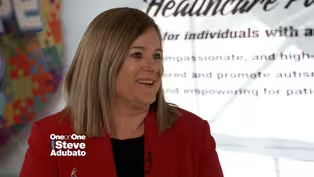
Michele Adubato Talks About Supporting the Autism Community
Video has Closed Captions
Clip: S2023 Ep2632 | 9m 2s | Michele Adubato Talks About Supporting the Autism Community (9m 2s)
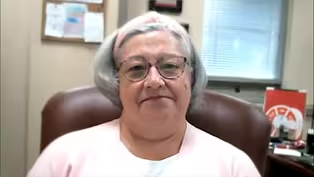
NJDOT Commissioner Talks Congestion Pricing
Video has Closed Captions
Clip: S2023 Ep2632 | 9m 38s | NJDOT Commissioner Talks Congestion Pricing (9m 38s)
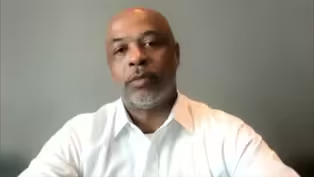
Reducing Violent Crime for Youth in Newark
Video has Closed Captions
Clip: S2023 Ep2632 | 9m 39s | Reducing Violent Crime for Youth in Newark (9m 39s)
Providing Support for PBS.org
Learn Moreabout PBS online sponsorship
- News and Public Affairs

Top journalists deliver compelling original analysis of the hour's headlines.

- News and Public Affairs

FRONTLINE is investigative journalism that questions, explains and changes our world.












Support for PBS provided by:
One-on-One is a local public television program presented by NJ PBS