One-on-One
Michele N. Siekerka, Esq.; Shell Bobev; Ginny Hill
Season 2024 Episode 2774 | 27m 46sVideo has Closed Captions
Michele N. Siekerka, Esq.; Shell Bobev; Ginny Hill
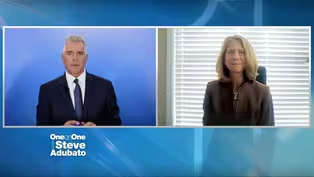
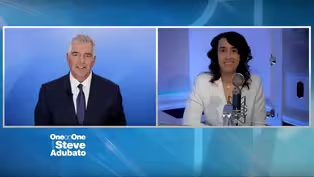
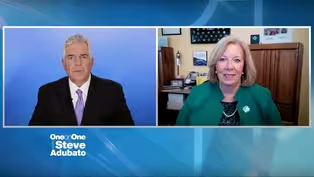
Michele N. Siekerka, President & CEO of the NJBIA, discusses the 10th Annual Women Business Leaders Forum. Shell Bobev, founder of Disrupt The Gap, discusses the gender pay gap and equitable hiring practices. Ginny Hill, Chief Executive Officer of the Girl Scouts Of Central & Southern New Jersey, discusses how Girl Scouting prepares young women to become leaders.
Problems playing video? | Closed Captioning Feedback
Problems playing video? | Closed Captioning Feedback
One-on-One is a local public television program presented by NJ PBS
One-on-One
Michele N. Siekerka, Esq.; Shell Bobev; Ginny Hill
Season 2024 Episode 2774 | 27m 46sVideo has Closed Captions
Michele N. Siekerka, President & CEO of the NJBIA, discusses the 10th Annual Women Business Leaders Forum. Shell Bobev, founder of Disrupt The Gap, discusses the gender pay gap and equitable hiring practices. Ginny Hill, Chief Executive Officer of the Girl Scouts Of Central & Southern New Jersey, discusses how Girl Scouting prepares young women to become leaders.
Problems playing video? | Closed Captioning Feedback
How to Watch One-on-One
One-on-One is available to stream on pbs.org and the free PBS App, available on iPhone, Apple TV, Android TV, Android smartphones, Amazon Fire TV, Amazon Fire Tablet, Roku, Samsung Smart TV, and Vizio.
Providing Support for PBS.org
Learn Moreabout PBS online sponsorship- [Narrator] Funding for this edition of One-On-One with Steve Adubato has been provided by New Jersey Institute of Technology.
NJIT makes industry ready professionals in all STEM fields.
NJM Insurance Group.
Serving New Jersey’s drivers, homeowners and business owners for more than 100 years.
PSE&G, powering progress.
IBEW Local 102.
Lighting the path, leading the way.
Hackensack Meridian Health.
Keep getting better.
The New Jersey Economic Development Authority.
The Turrell Fund, a foundation serving children.
The North Ward Center.
And by The Port Authority of New York and New Jersey.
Moving the region through air, land, rail, and sea.
Promotional support provided by New Jersey Monthly.
The magazine of the Garden State, available at newsstands.
And by BestofNJ.com.
All New Jersey in one place.
- This is One-On-One.
- I'm an equal American just like you are.
- The way we change Presidents in this country is by voting.
- A quartet is already a jawn, it’s just The New Jawn.
- January 6th was not some sort of violent, crazy outlier.
- I don't care how good you are or how good you think you are, there is always something to learn.
- I mean what other country sends comedians over to embedded military to make them feel better.
- People call me 'cause they feel nobody's paying attention.
_ It’s not all about memorizing and getting information, it’s what you do with that information.
- (slowly) Start talking right now.
- That's a good question, high five.
(upbeat music) - Hi everyone, Steve Adubato.
Welcome to a very special program where we feature, talk about, and focus on women business leaders.
And we kick off with our partner and friend, Michele Siekerka, President and CEO of New Jersey Business and Industry Association.
Michele, good to see you.
- Great to see you again, Steve.
- We're taping late in October, but at the end of September, there was the 10th annual NJBIA Women Business Leaders Forum.
What was it?
Why does it matter?
And frankly, why is it everyone's business?
- Well, first of all, it was amazing.
The energy in the room was exhilarating.
We had over 400, you know, women leaders from across the state sharing ideas, opportunities, challenges, lifting each other up, you know, looking how we reach back and bring the next generation forward.
There were a lot of young women in the room who were inspired by the role models that they saw.
It was a great two days.
- And right after Michele, we're gonna have two other women business leaders who were part of that important event, Shell Bobev and Ginny Hill, both important leaders that we need to learn from.
So, Michele, let me ask you this, the whole question of C-suite.
You and I have had many conversations, and BIA, their magazine is a media partner of ours, "New Jersey Business Magazine."
But you and I have had many conversations about women in the C-suite.
You have said that the numbers have dropped of women in the C-suite, A, and B, it is especially concerning for women of color.
Explain this.
- Well, it's true that while we're, you know, we continue to make strides, the strides are slow and steady.
I'd say too slow and not steady enough.
And that's why over the last year, actually, the numbers went down a little bit.
And it's not just the C-suite, it's also the boardroom.
We follow the data on both, and both are equally important.
Why is this important?
Diversity of voice and diversity of thought leadership in these critical areas in the C-suite and the boardroom.
These are where the big decisions are made and we know that the more diverse the thought leadership around those tables are, the better the outcome.
- Well, Michele, in all candor, there has been some blowback around DEI, diversity, equity, and inclusion on the part of some.
To what extent do you believe that pushback has hurt, particularly women of color getting into the C-suite as well as those boardrooms?
- Well, I think there's a few factors at play.
I don't want to lose sight of the fact that even though we're four years post COVID, women coming back into the workforce were delayed because of childcare issues.
I'm gonna continue to repeat that 'cause it's still an issue, right?
The accessibility and affordability of childcare continues to be an issue and many women wind up stepping off their career path in order to fill that void.
And we saw that significantly over the past few years.
You know, is this anti DEI movement having an impact?
Might be.
Might be.
But I will say to you, Steve, this is all about having a pool of diverse candidates always at the ready.
So when you have an opportunity to advance someone, be it from a middle level to a high level, from a front level to a middle level, or to a boardroom, right?
Having that diverse pool of qualified candidates when you go swimming usually means you'll come out with a diverse candidate, you know, to be considered for that position.
So you can't take the day you're filling the position to the time to say, "I want to go find diversity," and then go out in the world, and say, "Where are all the diverse people?"
This is a process.
- Go back to childcare.
We've had this conversation with you before as well as with other leaders, our longtime programming trying to create greater public awareness around the childcare crisis.
We've often had people on talk about the economic impact.
Make it clear what the economic impact is of the childcare issue and how it disproportionately affects women.
- Again, when women can't come to work, because they don't have a safe place to put their children, that has an impact on the productivity of our companies.
And we saw that over the last few years.
It goes right to the bottom line.
And we saw the inability to bring those women back to work early in COVID.
And that had a hangover.
That had a tail effect.
Because what also happened during that time is our childcare facilities were struggling and they were challenged.
And therefore, if we don't have enough seats, we don't have enough place to put our children.
- For younger women, and you had 400 women business leaders at this event, Michele, there are video clips on there, right?
- Yes, we videoed all the different breakout sessions.
They're powerful.
Take the opportunity to take a look at them.
They're on YouTube.
- Even if you were not there, you can pick up a lot of important information there for younger women.
I mean, our production team, we have younger women, some with children, some not at this point, do you find that younger women business leaders are looking for anything, want anything different than those who are a bit older?
- Well, they want flexibility and many of them are getting it.
And again, just by nature of the difference in how we are doing work these days, the flexible hybrid work environment is definitely assistive to the next generation.
And I'll be fair, it's women and men.
I do see men stepping in.
But it still defaults to women, you know, 80% to 90% of the time.
- It's interesting how you said that for men and women.
Do you genuinely believe, Michele?
Because you've been at this for a few years, you-- - Ten.
(Michele laughing) And before that, very involved.
And let people know by way of background, your background is in the corporate and government world.
- Well, I'm an attorney by trade, so I started as a young lawyer raising a family.
And then I spent time, you know, in government, outside of government.
I spent time in the corporate world and I did all that while raising my children.
And it's not easy.
- For those who would make the devil's advocate argument, come on, are things really that much different in 2024, going into 2025 as we tape this program?
Are things that much different for women in business versus men?
"Come on, we've made great progress."
You say what to them?
- Well, the environment's changed.
The environment changes.
It's all generational also.
I mean, we're affected by a world.
We're in a totally different environment today relative to everything we do, Steve, you know, economics, political, social, social media, news, all these things drive our behaviors.
We behave as a society in a totally different way than, you know, when I was coming up as a young professional for sure.
- As a student of leadership, and we've done we many programs with Michele around leadership and my fascination with it, one of the questions I'm often fascinated by is, do you believe women in positions of leadership lead in any significantly different way than men?
I still have no idea.
You say?
- I say absolutely.
You know, women tend to be, you know, multi-taskers, right?
Case in point-- - Hold on one second.
Just so everybody knows, we were getting on the air with Michele this morning and she was texting, doing eight different things, and then switch gears.
Do you think that's more of a challenge?
I talk to my wife about this all the time, who's a woman in business, who's a mom, and juggling everything else.
Do you think women have to juggle more than us?
- Yes.
I think just by pure nature, you know, you can go back, you know, historically, the men were focused... Go back to prehistoric time, right?
The men, they were the hunters.
They went up, they went out, they had one focus, one thing to do, go get the dinner and bring it home, right?
And then the woman's home doing the 10 other things that have to get done.
So when the guy comes home with the food, she can cook it, right?
I mean, you know, in some ways that hasn't changed so much.
- Come on, Michele, seriously?
You don't think it's changed?
Okay, you think basically men have a narrower role.
- Agree.
And, you know, line up 10 women and talk to 'em about their life experiences.
This is not a knock on men.
I love men.
I work with men every day.
(Steven laughing) Okay?
Some of my best mentors, Steve, are men, okay?
I've adapted wonderful leadership behaviors from the men I've been surrounded by in my entire family, and I highly respect my husband and the role he played raising our family.
- There's a but coming, Michele.
- But at the end of the day, line up 10 women and talk to 'em about their experience, and you're going to hear that they juggled many more tasks and many more plates in the air than men do on any given day.
- PS, I was purely playing devil's advocate.
My wife was telling me this morning as she was doing 10 different things and going out to run her business, "Do you have any idea how much more challenging "my day is than yours?"
So I just want, on that note, I just want to make sure I don't get in trouble.
Michele, thank you.
And by the way, stay tuned for two more important, compelling interviews with women business leaders who are part of that 10th annual NJBIA Women Business Leaders Forum.
Thank you, my friend.
- Thank you.
You have two amazing women coming up.
Thanks so much, Steve.
- You've got it.
Stay with us, we'll be right back.
- [Narrator] To watch more One on One with Steve Adubato find us online and follow us on Social media.
- We continue talking to women business leaders with this very special program with Shell Bobev, who is the founder of an organization called Disrupt The Gap.
Shell, good to have you with us.
- Thank you so much.
- What the heck is that name and what does it mean?
- So Disrupt The Gap is a wage equality platform, and it's a play on the idea of a pay gap.
So think of Disrupt The Gap as a multi-front attack on pay gaps, serving the different stakeholders involved with the employment ecosystem.
- How'd you get interested in this?
- So I had a personal journey.
Like many people, I was in the corporate world, I encountered a pay gap.
I spent many years trying to fix it on my own, doing all the things we tell people to do.
And after that didn't work, I had to have the fortitude to hire a lawyer and I spent several years in court to pursue justice.
And on the other side of that, I realized that there was a calling to create systemic change.
- What's the gap?
I mean, make it clear because as a kid growing up I remember there were these buttons that people had and I think it said 59 and it was 59 cents, women earned 59 cents to every dollar a man earns.
I know it's not 59 cents, what is it?
- All right, so let's address this because there's a very common stat that's being circulated, which is that women are making 80 cents for every $1 that men are being paid.
I wanna address that.
So that very common stat is not looking at two peers in the same job, that stat is looking at annual median earnings across any job.
So, for example, here in New Jersey for men that's about 76,000, for women it's about 63,000.
However, I am much more focused on looking at peer-to-peer comparisons.
There are some studies that look at what that looks like.
And in general, the gap could be even smaller than that 20% mark, but there are absolutely occasions where it could be even wider - Talking to our producers, you shared something that I really need to understand better.
You said the phrase, quote, "Know your worth, and women should know their worth", is a problem.
- I think it's a problem.
Well, here's the thing, there's a beautiful intention there.
- Sure.
- However, I think the danger of that being circulated is it's being positioned as a way to close a pay gap, and it's being positioned as the individual, the woman taking the onus of closing the gap.
And I don't think it's appropriate to continue to tell individuals to that they need to bear the burden of fixing what's really a systemic issue.
And furthermore, when they try to close the gap personally and fail, they're then internalizing that as a personal failure and then probably having shame around that too.
So it's a beautiful message when one done appropriately, it has a place, but it's not the way that we're gonna fix a systemic issue.
- But Shell, by inference what you're clearly saying is that this is largely a male problem that men need to, if they are in a position of leadership to make decisions about compensation, it is on us, men, to make that change, or women who are in positions to dictate compensation, which is part of the problem we talked to Michele about is number of women business leaders isn't what it needs to be.
So my question is, is it on men largely?
- I think it's on people in a position of leadership, which historically has been men, but I do wanna offer this another angle to think about.
So often we frame pay gap conversations around gender, but beyond that and when we widen the lens, pay gaps are happening for all sorts of reasons beyond gender bias.
For example, you could have somebody doing the same job for 10 years getting a little increase every year and then their company hires somebody from the outside who just starts at a higher rate of pay and there's a pay gap right there.
So men experience pay gaps as well, I don't think that's right.
So to answer your question, we absolutely need people in a position of leadership to understand the business case for pay equality, and I do a lot of education around that, but I'd also like to add my voice to widening the lens that men experience pay gaps as well.
- So, Shell, if people go to your website, which is up right now as we're talking, what will they find and how would it be helpful to them?
- Well, they'll find a few things.
They'll see the vision of what Disrupt The Gap is all about and the long-term goals there, they'll be some resources for individuals and employers alike.
So, for example, one resource that's been pretty popular, I call it Hidden Gems For Salary Research.
It's a collection of databases.
- Hidden Gems, say it again.
- Hidden Gems For Pay Research.
- [Steve] Okay.
- Because a lot of the databases, the popular databases that people are using, they rely, so for example Glassdoor relies on self-reported data.
We don't know if that data is completely accurate, so what I've curated is a list of databases that are real data points that you might not know exist.
I'm gonna give you one example.
There's a work visa type called H-1B.
There's many people here that are in tech jobs that are working on that visa and all of their records are public information.
So for example, somebody could run a query and say, "You know, this tech company, software engineer, New York City, go," and then they will see real data points and not have to rely on self-reported data.
And obviously we have information on the services available, especially for employers.
- I appreciate what you said about know your worth is a complex, even though for the intent is a positive one, complex, which I often think about this, Shell, that money and compensation isn't just money and compensation.
- Yes.
- It is, in fact, a very strong message that an organization and the leader of that organization, and I'm a student of leadership, I try to understand this and we have a very strong group of disproportionately women who run our company every day.
It is a message that the organization and the leader of that organization is sending to those women and other employees about the value they believe they bring.
- Yes.
- That's heavy stuff.
- It's heavy.
I'm gonna offer you this.
In 2022, the US Surgeon General included transparent, equitable wages in a framework regarding psychological safety at work because it's recognized how damaging and destructive it is to human health when there are inequities in the workplace, so thank you so much for bringing attention to that.
- You're saying compensation related issues can impact one's mental health?
- Absolutely, absolutely.
It's incredibly distressing.
You know, often I teach what's the business case for equal pay, but really we shouldn't need a business case for something that is objectively ethical, moral.
And, you know, getting back to this know your worth paradigm, when we tell individuals that they have to bear the burden of preparing all this talking points and going in there, having the conversations with leaders, that can be a very challenging process that plays out over time and impact their wellbeing.
And I would say also people in the same household as well and financially and emotionally.
- Shell Bobev is the founder of Disrupt The Gap.
Important conversation part of our Women Business Leaders' special.
Shell, thank you so much.
It will not be the last time you join us.
We appreciate it.
- Thank you so much.
- You got it.
Stay with us, we'll be right back.
- [Narrator] To watch more One on One with Steve Adubato find us online and follow us on Social media.
- We're now joined by Ginny Hill, Chief Executive Officer of Girl Scouts of Central and Southern New Jersey, part of our Women Business Leader series.
Ginny, great to have you with us.
- Thanks Steve.
It's great to be here.
- You got it.
Website's up right now.
The organization makes a big difference in the lives of younger women and girls, largely around leadership.
Is that a fair assessment?
- That's a fair assessment.
I mean, girl Scouts is seen oftentimes as an activity and is measured often by parents, by what they see girls doing.
You know, whether it's arts and crafts or camping or stem.
We have a wide variety of options, but all of the programmatic experiences are intentionally designed so that girls have opportunities to build courage, confidence in character, which in turn builds leadership.
- You know, I'm curious about this.
For those who are saying the Girl Scouts, Girl Scouts still relevant?
We're moving it to 2025.
Be seen, you know, for the next several months.
This program.
Still relevant because?
- Because girls still need support and helping to build that inner voice of self-confidence, social-emotional learning is still critical for young people.
And what we do, what we have done for more than 100 years we've been around is adapt what and how we do that to meet the contemporary times.
So right now is one of those pivotal moments.
You know, we're coming out of COVID, we know families and parents are rolling differently in how they live their daily lives, and the girls need different things.
And we're in the midst of the journey to make that next adaptation.
- What's the DreamLab?
- The DreamLab.
Oh, I'm so excited to ask about that.
So the DreamLab is a really cool facility concept that started in Girl Scouts over the last year or so.
We were really excited.
We opened the third DreamLab in the nation in East Brunswick, right here in New Jersey.
And it's an experiential learning space.
And so we're doing Girl Scout activities and programs in there.
It's open to all youth, so not just Girl Scout members can come in and climb the rock wall or, you know, do another kind of an activity.
And it's really a way for us to not only have more spaces that are engaging for our youth members, but also to bring the community into Girl Scouts.
- Hey, Ginny.
This phone, not my phone.
Any phone social media.
- Yeah.
- Young girl and Girl Scouts.
Go.
- Yeah, go.
Alright, so, well, one thing we know is technology is ubiquitous with our kids, right?
And we aren't trying to fight that to a large degree because it's really interwoven into all of their lives.
At the same time, we're giving girls plenty of opportunities to unplug and get away from that technology.
And so whether it is attending Girl Scout Camp or doing an activity together in a group in the DreamLab or some other place.
And then on the other hand, you know, we have lots of cool technology programs in our STEM offerings.
Things like cybersecurity and robotics, which are really workforce skills that they're gonna need for the future.
So it's a balanced approach, but it can be, you know, it can be challenging at times.
I hear you.
- Clearly, especially with the young daughter having dinner.
We're right here.
- Yeah.
- We're not on the phone.
- Yeah.
- That's not every, everyone's dealing with that.
Hey, Ginny, how the heck did you get so connected to the Girl Scouts?
What's the connection for you?
- So, I've been a nonprofit executive now for more than 25 years.
All of my career has been in women and girl-focused missions.
I believe really strongly in the power of women's leadership.
And, you know, I'm old enough to remember when maybe some of the rights and privileges that our young women have today in the workplace, we didn't have when I first started working.
And so, I'm very passionate about the issues.
I see my role at Girl Scouts really as helping to ensure that the girls are not growing up in the same kind of world that maybe I did or my mother did, or my grandmother did.
So really, instilling the change in them.
I'm super passionate about that.
And, you know, it's a privilege to do the work I do, really.
- So the other part of it is service giving back, not just rhetoric, it's real.
Talk about it at the Girl Scouts.
- It's real.
Well, our Girl Scouts in our organization, we estimate donate about a quarter of a million hours of service every year.
And that's probably low 'cause that's the only, that's the stuff I can count officially.
But we really teach girls that, you know, to serve and to give and to make the world a better place.
Our core character values, we think that's really important.
It's core to who we are.
And there are so many ways girls can do that individually.
They do it when they design projects for their gold, silver, or bronze Awards.
They can do it as a troop, you know, gathering, you know, supplies for an animal shelter or a homeless shelter, and then they can do it as part of big initiatives.
Right now, we have national initiative, the Girl Scout Tree Promise, where, you know, girls are trying to give a positive impact on climate change and plant trees all around the country.
And so they have multiple ways they can get involved.
- Awesome.
I would be remiss if I did not ask about the connection between selling cookies and entrepreneurship, which I'm fascinated by.
Please.
- Yeah.
Well if you, I would venture to guess that if you asked any room of business women, how many of them were Girl Scouts, lots of hands would go up.
And what we know is that girls find their voice of confidence and their voice of selling and marketing at, by participating in the Girl Scout Cookie program.
And so while folks see the Girl Scouts out front of the store, you know, or get hit up to buy cookies online, behind that is a really robust curriculum.
We run a program called Cookie University where girls come ahead of when they're selling to learn sales skills, to learn how to take a no, you know, all the things that we know build business skills and entrepreneurship skills.
- And confidence.
- And confidence.
Absolutely.
- Yeah.
You know, Ginny, I appreciate you joining us and being part of this Women Business Leaders program.
And I'm glad you know, we had corporate folks on, Michele kicked it off.
We have a not-for-profit leader.
Making a difference in the lives of young women and girls is huge.
And I cannot thank you enough for joining us on this very special program, celebrating, recognizing, and promoting women in business and women in New Jersey and across the nation, leading.
Thank you so much, Ginny.
I appreciate it.
- Thank you, Steve.
- You got it.
I'm Steve Adubato, thank you so much for joining us.
We'll see you next time.
- [Narrator] One-On-One with Steve Adubato is a production of the Caucus Educational Corporation.
Celebrating 30 years in public broadcasting.
Funding has been provided by New Jersey Institute of Technology.
NJM Insurance Group.
PSE&G, IBEW Local 102.
Hackensack Meridian Health.
The New Jersey Economic Development Authority.
The Turrell Fund, a foundation serving children.
The North Ward Center.
And by The Port Authority of New York and New Jersey.
Promotional support provided by New Jersey Monthly.
And by BestofNJ.com.
NJM Insurance Group has been serving New Jersey businesses for over a century.
As part of the Garden State, we help companies keep their vehicles on the road, employees on the job and projects on track, working to protect employees from illness and injury, to keep goods and services moving across the state.
We're proud to be part of New Jersey.
NJM, we've got New Jersey covered.
The 10th Annual Women Business Leaders Forum
Video has Closed Captions
Clip: S2024 Ep2774 | 10m 21s | The 10th Annual Women Business Leaders Forum (10m 21s)
Founder of Disrupt The Gap talks equitable hiring practices
Video has Closed Captions
Clip: S2024 Ep2774 | 9m 6s | Founder of Disrupt The Gap talks equitable hiring practices (9m 6s)
How Girl Scouts are preparing young girls to become leaders
Video has Closed Captions
Clip: S2024 Ep2774 | 8m 51s | How Girl Scouts are preparing young girls to become leaders (8m 51s)
Providing Support for PBS.org
Learn Moreabout PBS online sponsorship
- News and Public Affairs

Top journalists deliver compelling original analysis of the hour's headlines.

- News and Public Affairs

FRONTLINE is investigative journalism that questions, explains and changes our world.












Support for PBS provided by:
One-on-One is a local public television program presented by NJ PBS