
Michele Siekerka; Jonathan G.S. Koppell; Kelly Browning
9/17/2022 | 26m 21sVideo has Closed Captions
Michele Siekerka; Jonathan G.S. Koppell; Kelly Browning
Michele N. Siekerka, Esq., President & CEO, New Jersey Business and Industry Association, sits down with Steve Adubato to examine the state of small-business in New Jersey; Jonathan Koppell, President, Montclair State University, highlights affordability in higher education; Kelly Browning, Ph.D, Executive Director, Impact Teen Drivers, discusses the prevalence of distracted driving.
Problems playing video? | Closed Captioning Feedback
Problems playing video? | Closed Captioning Feedback
Think Tank with Steve Adubato is a local public television program presented by NJ PBS
Michele Siekerka; Jonathan G.S. Koppell; Kelly Browning
9/17/2022 | 26m 21sVideo has Closed Captions
Michele N. Siekerka, Esq., President & CEO, New Jersey Business and Industry Association, sits down with Steve Adubato to examine the state of small-business in New Jersey; Jonathan Koppell, President, Montclair State University, highlights affordability in higher education; Kelly Browning, Ph.D, Executive Director, Impact Teen Drivers, discusses the prevalence of distracted driving.
Problems playing video? | Closed Captioning Feedback
How to Watch Think Tank with Steve Adubato
Think Tank with Steve Adubato is available to stream on pbs.org and the free PBS App, available on iPhone, Apple TV, Android TV, Android smartphones, Amazon Fire TV, Amazon Fire Tablet, Roku, Samsung Smart TV, and Vizio.
Providing Support for PBS.org
Learn Moreabout PBS online sponsorship- [Narrator] Funding for this edition of Think Tank with Steve Adubato has been provided by The Turrell Fund, supporting Reimagine Childcare.
TD Bank.
The Fidelco Group.
University Hospital.
One goal, one passion, every patient, every time.
The New Jersey Economic Development Authority.
Choose New Jersey.
Operating Engineers, Local 825.
New Brunswick Development Corporation.
And by NJM Insurance Group.
Serving New Jersey'’s drivers, homeowners and business owners for more than 100 years.
Promotional support provided by NJ.Com, keeping communities informed and connected.
And by New Jersey Globe.
[MOTIVATIONAL MUSIC] - Hi, Steve Adubato here.
It feels like she's bordering on my co-host.
She's been with this so many times, but so many important things to talk about Michele Siekerka President and Chief Executive Officer of the New Jersey Business and Industry Association, will put up the website for BIA in just a moment.
Michelle, thank you so much for joining us.
- Always a pleasure, Steve.
- Michelle, as I was reading same here.
When I was reading about your comments regarding the budget that was struck the $50.6 billion budget, the spending plan the end of June we're taping later in the summer, you said that small business was ignored.
Be specific, make that case.
- Well, in all fairness, there's no direct relief to New Jersey's small business, right?
There was an additional $50 million put into the Main Street program in all fairness.
And there are some other pockets of things, money to manufacturing, so important, workforce development et cetera, no wholesale comprehensive direct relief to New Jersey's small business.
And we have been screaming from the rafters about the need for this, right?
The governor was excited about the anchor program.
Direct property tax- - Property tax relief, right?
- Go ahead, I'm sorry.
- Yes, to property tax owners, guess who owns 50% of that responsibility across the state of New Jersey for property tax, New Jersey Business, no relief for New Jersey Business on property tax, right?
So Steve, we truly felt in the business community we put a lot on the table, the Unemployment Insurance Trust Fund, don't start me.
That was the opportunity, - No, no.
I'm going to start you.
Michele, it's exactly what I was gonna ask you.
What is the Unemployment Trust Fund A and B what's the concern you have about it?
- So the Unemployment Insurance Trust Fund is the fund that affords people on unemployment who work to the opportunity to get money.
The employee and the employer both pay into that fund, okay?
What happens during COVID, obviously the world was on unemployment.
So we had to take a loan, right?
Companies were told to send their employees home and they stayed at home longer than imagined.
The employers, New Jersey Business did not create the break in the Insurance Trust Fund, right?
They didn't cause it to be overrun by the need.
The fact that everybody had to go home for COVID caused it.
We were the first closed and the longest closed.
What did we ask for?
We asked, please use some of our federal dollars or our super surplus.
All this money we have in the state in New Jersey right now, right?
- Hold on Michele, well, Michele, hold on, sorry for interrupting.
Michele's referring to the billions of dollars sent from the federal government to the States in connection with COVID relief.
Use some of that money, plus the surplus money, more income tax revenue et cetera, et cetera, to the state to do what?
- To replenish that fund so that New Jersey businesses would not have to see a tax increase for three years to replenish the fund.
Now, the governor has said for the last year, no new taxes right?
Guess what?
New Jersey businesses got a new tax, July 1st, 2021, right?
The first increase in order to help replenish, they got another one, July 1st, 2022, and they're gonna get another one, July 1st, 2023.
The obligations being placed on New Jersey businesses to increase their cost of doing business, to pay more money into that fund when it wasn't their fault, that that fund was overrun.
We said- - What did the governor and as people say about that?
- We're looking for the most bang for our buck.
Okay?
We wanna make sure that when we bring money to New Jersey business, we're getting the most bang for our buck.
Our business community said that's what they wanted and what they needed.
And all we asked for, we didn't ask for the billion dollars Steve, we asked in this last bill for 330 million, 330 million to bring direct relief to New Jersey's small business, companies that employ a thousand employees or less, not even the large corporations.
We compromised, we said, okay, the large corporations will get cut out, this was the most compromised bill.
Thank you to the New Jersey legislature, the assembly that passed that bill.
And in the 11th hour unfortunately the governor directed the sponsors in the Senate to pull the bill and that's public, I'm not saying anything out of turn, right?
They're going to take it up in the fall.
Why does the New Jersey business community have to wait for relief to be considered in the fall, when we have a ton of surplus money in the 51 billion budget that was just passed?
- For those of you wondering, hey Steve why don't you ask the governor about that?
We will in fact be having the governor on.
This, I guarantee you, will be a topic of conversation giving the governor a chance to respond.
Let's talk childcare.
You know our series, the graphic will be up as we speak right now, Reimagine Childcare it's a longstanding series we're doing on greater public awareness around the affordability, accessibility, quality childcare.
The initiative that you and your colleagues at the business and industry association has supported, Thriving by Three.
It provides more dollars to licensed childcare organizations, more state money into Head Start, et cetera, et cetera, et cetera.
It's a huge initiative.
We'll have Senator Teresa Ruiz, a leader of that sponsor of that bill on talking about it.
What does that have to do with the economy of the state and the business of the state Michele Siekerka?
- Well, we learned crystal clear during COVID that when our childcare facilities were not open or were open with limited capacity, that our working parents couldn't get back to work.
Now we had a childcare crisis in New Jersey before COVID, COVID only unleashed the next level of that crisis.
So we have advocated tirelessly for more money to be put into the industry, also to be put toward parents for accessibility and affordability, right?
So there was a 10 bill package, thank you, Senator Ruiz, NJBIA worked hand in hand with the senator and her colleagues to see that bill package go through, shout out to Alexis Bailey, who's our lobbyist on this issue.
She did a fantastic job working with the Senator on this relief that's desperately needed.
- And the governor signed off on that.
- Yes.
- Just to be clear.
So this is an example of Bipartisan Cooperation, the business community working with other organizations to get this done.
- So Michele my question is it can be done meaningful public policy with Democrats Republicans, the unions, labor, business community coming together.
It can happen, no?
- It can be done, but I do wanna point out one challenge here, okay?
- Sure.
- The bill was signed and that's go forward now, and those are excellent programs.
Again, we advocated tirelessly on the policy.
There was a $700 million appropriation made last October, October 2021 to the childcare industry hardly a penny that money's made it out on the street yet.
It's in the regulatory process program still being stood up on how they're going to get that money out to the industry.
Steve, where are we when this is being aired?
Right?
Okay, October 2021, $700 million, not out on the street to that industry.
In the meantime we don't have the seats, the staff, all right?
And the needs filled in the childcare industry that we could have been working on the last six months.
- Sorry, Michele, before I let you go real quick 30 seconds or less.
Netflix, New Jersey Production Hub.
Go ahead, go 30 seconds.
- Oh wow.
We did a great editorial that we hope that Netflix can come to Fort Monmouth, The Fort Monmouth Economic Revitalization Authority.
There's this huge swath of property that was before, right?
Fort Monmouth.
And now we have the opportunity for great redevelopment plan there.
Netflix put in an RFP, they're gonna create thousands of jobs, they're gonna stimulate the economy, and we have some good tax credits to help them to do it.
So fingers crossed on that project.
It could be great for New Jersey.
- Michele Siekerka, President and CEO of New Jersey Business and Industry Association, New Jersey business is their publication.
We have a media collaboration together with them.
Michele, thank you so much for joining us.
We appreciate it - As always Steve, thanks so much.
- You got it.
Stay with us.
We'll be right back.
To watch more Think Tank with Steve Adubato, find us online and follow us on social media.
- We're now joined by the president of Montclair State University, my alma mater.
We are joined by Jonathan Koppell.
Good to see you, Mr. President.
- Good to see you, Steve.
It's always a pleasure to meet with our distinguished alumni.
- Well, there are a lot more distinguished alums than me.
Good thing I paid my library fines so I could graduate.
Hey, listen, one year under your belt as we, as we do this program at the, in the summer of 2022.
- Oh, almost I'm a, I'm a month out, but.
- What is, what is the biggest thing, biggest challenge you face right now in the summer of 2022 as president?
- Well, look, I mean higher education's in a moment of adaptation, right?
You know, all of us are sort of trying to figure out what universities are gonna look like five years from now.
And, and so that's, that's the sort of big picture challenge.
Honestly, this is gonna be a funny one because, 'cause a lot of universities have the opposite problem.
We're looking at a larger number of students enrolling for their first years in the fall than we've ever had before.
- Why do you think that is?
- And so, so that's exciting.
Obviously it's a good problem to have, but I think what's what's happening is students are discovering just how much Montclair has to offer.
And, and so they're, they're eager to come to an institution where our students graduate.
They have success after graduation.
They have a great experience while they're here.
And so now we need to, we need to scale up to accommodate them.
- You know, we've talked to other, many of your colleagues, presidents of universities on the public side, on the private side, independent, et cetera.
The question of affordability, Jonathan, talk about it.
College affordability, for many it's just not affordable.
Talk about A, how, how serious that problem is in spite of the enrollment numbers you're talking about and B what needs to be done.
- It is, it is a real issue.
You know, the, the way that we, the way that we provide higher education in this country has shifted dramatically over the last 30 years where we used to as a society embrace the idea that higher education is a public good.
And therefore the taxpayers are gonna invest in it.
And that allows the universities to keep the tuition down.
That's shifted.
So now, as you know, the percentage of the budget that comes from this state has steadily gone, steadily gone down.
That's not a New Jersey thing.
That's all over the country, new Jersey's, you know in the lower half, but it's not, not the lowest.
What that has meant is that in order to pay the bills, the burden has shifted to students.
And so tuition has, has crept up.
We are really proud at Montclair to have managed the tuition burden as well as anybody.
We're at the bottom of the list in terms of cost to students and one of the most efficient universities in New Jersey.
But there's no doubt that for for folks who are struggling to make ends meet, particularly in an inflationary environment, it's, it's a lift.
I would say this.
There's no better investment that somebody can make, right?
So we can, we should talk about student loans and debt 'cause I know that's on a lot of people's minds.
It's a great investment.
It's better than buying a car.
It's better than buying stocks.
The ROI on a college education is second to none and, and that remains the case.
So, so we do our best to manage costs but the most important thing is to make sure that students are getting value for their investment.
- Let me follow up on this.
Actually two of our top executive producers came from Montclair State University.
I happened to teach a course about a decade, a little more than that I'm realizing now.
And both of those producers were in that class.
They were the best students.
They are two of our best producers.
The reason I'm asking is not about my teaching at the university all those years ago, but it's this.
Montclair State has made a big investment on the media side, studio production, media production, journalism, et cetera.
While the industry has changed dramatically, how has the university adapted to have the, not just the course offerings but the entire program around media changed?
- And that's, that's part of the answer to my, to, to the previous question as well, right?
So you've gotta make sure that you are constantly updating yourself so that the students are getting the skills and the tools that they need to be successful post-graduation, so our school of communications and media is a perfect example because we are at the cutting edge, both from a technology point of view, our students are working on the same equipment that your team is using today.
So when our student graduates from Montclair, they are ready.
They're not working on 30 year old, 30 year old equipment.
They're at the edge and we are constantly pushing.
So we just launched as far as we know, the first university streaming service in the country.
So, you know, like a Hulu or whatever, like we have our own Hawk Plus, and our students are learning how to deliver media in that way.
Our Redhawk sports network have students producing content on an, on a daily basis on their own.
- That's Montclair State University sports, but go ahead.
- It's our Redhawk sports network.
They're covering all Montclair State, but they, they produce their own shows.
They do, you know, their own, their own game day.
And they're doing, they're doing the technical aspects.
They're doing the play by play.
Our students are ready, post-graduation to be employed and, and they know how to do their jobs because hands-on learning is part of our educational process.
That's true if you're in communications, it's true if you're in theater, it's true if you're in business.
That's a, that's the philosophy, right?
Which is make college work for the students while they're in school but also when they graduate and that's gonna make that investment worthwhile.
- Yeah.
You're talking about Montclair State sports.
I'm embarrassed to say this, I'm sure.
Has anyone ever mentioned to you my time playing football at Montclair State University?
- It's legendary.
- I didn't think so.
I didn't think so.
It's all right.
It's not about me.
It was undistinguished.
That's all I'm gonna say.
So how about this real quick before I let you go.
Being involved in the community, I happen to live in Montclair, Montclair State University just up the road if you will.
Being involved in the community is challenging because you're dealing with all these issues.
But I know that there are relationships in the community including with one of our partners, Montclair Film.
Details have to be worked out but that being said, why is it so important for a university in a community to be involved and engaged in the community?
- It's absolutely essential, Steve.
My view is that we're a public university.
Not because we get some money from the state, that's important, but because our job is to serve the public, right?
And I've always been excited that universities have this amazing potential to address needs and to help communities achieve their aspirations.
And so we are engaged in Montclair.
We're really excited about the things that we're doing in Paterson.
We have a long history of working in Newark, our program to, to encourage and support young people in Newark to go and be school teachers in their own neighborhoods in Newark.
It's gotten national attention.
A university that doesn't serve the public interest isn't really fulfilling its mandate as a public university.
And we should be judged by how well the communities we serve are thriving.
- That is president of Montclair State University, Jonathan Koppell.
Mr. President, thank you so much for joining us Jonathan.
Well done.
- Thank you for having me.
I hope we have other opportunities in the future.
- We will.
All the best.
I'm Steve Adubato, stay with us.
We'll be right back.
To watch more Think Tank with Steve Adubato, find us online and follow us on social media.
- We're now joined by Kelly Browning, who is executive director of Impact Teen Drivers.
Kelly, great to have you with us.
- Thanks for having me on your show, Steve.
- We will put up the website of Impact Teen Drivers.
Tell us what the organization is and why it's so critically important with all the distractions around us, with teen drivers, with all of us, but particularly teens.
- Absolutely.
Impact Teen Drivers is a nonprofit organization dedicated to stopping the number one unintentional injury for young people, which are car crashes.
In particular, we look at car crashes caused by reckless and distracted driving.
You just noted your cell phone, which certainly is our newest nemesis and the one that our, most of us, our brain goes immediately to when we talk about distracted driving.
But I think it's really important to recognize that this has been the number one killer of young people long before cell phones came out.
There are many different types of distractions.
We have visual distraction, which is anything that really takes our eyes off the road.
Manual is anything that's taking our hands off the wheel.
And one that most of us don't think about is that cognitive distraction takes our mind off of our driving.
And then of course, even auditory distraction.
If you can't hear, your ears aren't alert, that's a distraction.
So there's four primary types of distraction.
I always tell the young people that for us older folks that know the YMCA songs still, you can just change the "Y" to a "V" and you have the Visual, the Manual, the Cognitive, and the Auditory distraction.
We have a lot of fun with that.
So young people can think about it less as the tool that's the issue and more about the behavior.
- So it's so interesting.
We have a 17-year-old and a 19-year-old.
By the time this airs, they'll be 18 and 20 'cause it's a couple weeks, it's gonna sit in the can if you will.
But I realize that those are our two boys, and I realize that when we talk to them about this issue, it doesn't have the impact of watching what we do, meaning, it ain't what we say, it's what we do.
Is it not, Kelly?
- That's exactly right.
We always say the, "Do as I say, not as I do" didn't work for us, it certainly isn't gonna work for our kids.
A large component, significant component, of the program work that we do that's team-centric is working with parents and talking to parents about being the driver they want their child to be.
So Steve, if you and I are driving down the road, and we're doing five miles over the speed limit while we're slugging back a latte and talking on the phone, we can't wonder why our young people are gonna turn around and do 15 miles over the speed limit while they're live streaming and eating a double-decker taco or something.
So our behaviors are significantly influencing our young people.
They've been watching us since they were forward-facing in a car seat for the past 15 years.
- Has social media and the obsession that many have, not just young people, but let's talk about teens right now.
The constant engaging on social media.
I don't mean just texting, but beyond that, has it made the situation on the roads more treacherous, Kelly?
- Absolutely.
I think that's a big part of what we do is focusing less on that particular issue.
Let me say that different, less on what's the flavor of the month.
So whether it's texting or social media, etc., and more trying to get young people to understand it's about the behaviors.
Again, those distraction behaviors.
And I'll give you a real concrete example.
A few years ago, we did a focus group and a young person came in and said, "You know, I'd never text and drive.
That's just dumb."
But three questions later, he said "I would never have to text and drive 'cause I can just look at my Apple Watch."
And he flipped his watch up.
And we had another young woman that did it with taking a selfie while the car's moving with the driver, but she would never text and drive.
So if we just focus on that one thing versus really understanding how our behaviors and our lack of focus behind the wheel can become lethal, we're really missing the boat.
- What about the alcohol piece of this?
- Yeah.
Alcohol is really, really important.
Impaired driving from an alcohol or drug standpoint is something we need to continue to message on.
However, 75% of all fatal teen driving crashes actually don't involve alcohol and drugs.
Steve, they're doing a better job than our generation did.
They understand it.
It doesn't mean there's still lot of people doing it and that we shouldn't continue to educate and enforce against it, but the vast majority of young people in car crashes don't involve impairment.
They're just making better decisions behind the wheel about impairment right now.
- Let me ask you this.
Our friends at NJM, New Jersey Manufacturers, have talked to us about this issue, pushed it for a long time.
It's obviously a part of what they care about, and so I understand a lot of their motivation.
What's yours?
- I have worked for years on behavior change with young people because I honestly have more confidence in young people to change the culture, in this case, the culture around driving and safe driving so it's distraction free, then I do people my own age.
And what I mean by that, early 1980s, 10%-13% of us were wearing our seat belts.
Today, in most of our states, people are wearing their seatbelt and have seatbelt compliances 90 to 94%.
So we changed the culture, right?
We stopped seeing it as government telling me to wear my seatbelt and started recognize it as, "Gosh, this is actually a necessary safety device that could keep myself and my family safe."
And that's really what I see with young people.
I believe that young people can truly change this culture.
Without NJM support in our Northeastern states, we wouldn't be able to offer our programming free to schools and communities.
So we're really grateful for those public/private partnerships.
- Yeah, but again, how did you get in- For you getting into this, I'm curious.
- So my background is in criminology.
That's what my PhD is in.
And I've always been interested in getting affect to get effect, regardless of what the issue is.
I worked in homicide, suicide, substance abuse, and mental health.
And this issue is the one issue that I really feel affects every single one of us.
If we're a roadway user, whether we have kids or not, doesn't matter.
If you ride bikes, if you walk on the sidewalks, this issue affects us.
So it's something that I feel we can- We know car crashes are preventable.
We know what we need to do to prevent them.
We just need to make those choices and decisions behavior change to make that happen.
So I love anything that's "it's a winnable battle", and I believe this truly is a winnable battle.
- Hmm.
Kelly, P.S., before I let you go.
Do you have direct conversations with peers of yours about this, whether in the car with them or not, in terms of what they need to do?
- Absolutely.
We have to remember, adults, we are some of the worst.
My kids will always say, "My parents are the worst.
They're the worst distracted drivers."
What we try and talk to 'em about is how they can encourage their parents, their family members, Steve, we didn't start talking to kids about wearing seat belts when they were 16.
We started when they were in car seats.
So we actually have elementary programs and middle school programs.
And we talk to our colleagues.
We have policies at my organization.
We don't do any business while anybody's on the phone, whether they work for us or not.
It's just safety first.
- Kelly, I have a feeling you just helped a lot of people.
Kelly Browning, executive director of Impact Teen Drivers.
Their website has been up.
Follow up, find out more.
Kelly, I thank you for joining us and providing an important public service and public safety message.
Thank you, Kelly.
- Thank you, Steve.
- I'm Steve Adubato.
Thank you so much for watching.
We'll see you next time.
- [Narrator] Think Tank with Steve Adubato has been a production of the Caucus Educational Corporation.
Funding has been provided by The Turrell Fund, supporting Reimagine Childcare.
TD Bank.
The Fidelco Group.
University Hospital.
The New Jersey Economic Development Authority.
Choose New Jersey.
Operating Engineers, Local 825.
New Brunswick Development Corporation.
And by NJM Insurance Group.
Promotional support provided by NJ.Com, And by New Jersey Globe.
- I'm Tim Sullivan, CEO of the New Jersey Economic Development Authority.
Since joining the NJEDA, I've been struck by the incredible assets and resources that New Jersey has to offer.
The NJEDA is working every day to grow New Jersey's economy in a way that maximizes the values of those assets to benefit every single New Jersey resident.
This includes more support for small businesses and a focus on reclaiming New Jersey's position as a leader in the innovation economy.
Visit njeda.com to learn more about how NJEDA is building a stronger and fairer New Jersey economy.
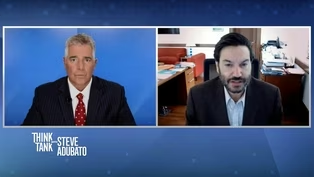
Montclair State President Talks Affordability in Education
Video has Closed Captions
Clip: 9/17/2022 | 8m 39s | Montclair State President Talks Affordability in Education (8m 39s)
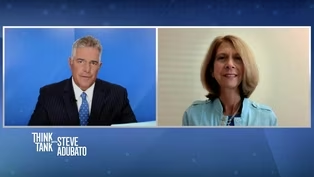
The Need for Small-Business Relief in New Jersey
Video has Closed Captions
Clip: 9/17/2022 | 9m 44s | The Need for Small-Business Relief in New Jersey (9m 44s)
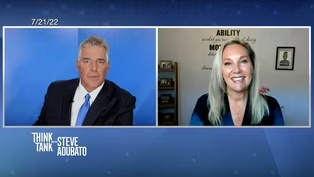
The Prevalence of Distracted Driving Accidents
Video has Closed Captions
Clip: 9/17/2022 | 8m 47s | The Prevalence of Distracted Driving Accidents (8m 47s)
Providing Support for PBS.org
Learn Moreabout PBS online sponsorship
- News and Public Affairs

Top journalists deliver compelling original analysis of the hour's headlines.

- News and Public Affairs

FRONTLINE is investigative journalism that questions, explains and changes our world.












Support for PBS provided by:
Think Tank with Steve Adubato is a local public television program presented by NJ PBS