
Michele Siekerka; Tim Sullivan; Ashley Sbarra, BSN, RN, CPN
5/31/2025 | 26m 24sVideo has Closed Captions
Michele Siekerka; Tim Sullivan; Ashley Sbarra, BSN, RN, CPN
Michele Siekerka, President & CEO of NJBIA, tackles the proposed tax hikes and tariffs for businesses and priorities for NJ's next governor. Tim Sullivan, CEO of NJEDA, talks about tariff uncertainty and investing in NJ’s childcare system. Ashley Sbarra, Clinical Resource Nurse for General Pediatrics at Hackensack University Medical Center, discusses the effectiveness of childhood vaccines.
Problems playing video? | Closed Captioning Feedback
Problems playing video? | Closed Captioning Feedback
Think Tank with Steve Adubato is a local public television program presented by NJ PBS
Michele Siekerka; Tim Sullivan; Ashley Sbarra, BSN, RN, CPN
5/31/2025 | 26m 24sVideo has Closed Captions
Michele Siekerka, President & CEO of NJBIA, tackles the proposed tax hikes and tariffs for businesses and priorities for NJ's next governor. Tim Sullivan, CEO of NJEDA, talks about tariff uncertainty and investing in NJ’s childcare system. Ashley Sbarra, Clinical Resource Nurse for General Pediatrics at Hackensack University Medical Center, discusses the effectiveness of childhood vaccines.
Problems playing video? | Closed Captioning Feedback
How to Watch Think Tank with Steve Adubato
Think Tank with Steve Adubato is available to stream on pbs.org and the free PBS App, available on iPhone, Apple TV, Android TV, Android smartphones, Amazon Fire TV, Amazon Fire Tablet, Roku, Samsung Smart TV, and Vizio.
Providing Support for PBS.org
Learn Moreabout PBS online sponsorship- [Narrator] Funding for this edition of Think Tank with Steve Adubato has been provided by The Turrell Fund, a foundation serving children.
IBEW Local 102.
Celebrating it’s 125th Anniversary.
Congress Hall.
A Cape Resorts property.
New Jersey’s Clean Energy program.
Lighting the way to a clean energy future.
Robert Wood Johnson Foundation.
Working for a more a healthier, more equitable New Jersey.
EJI, Excellence in Medicine Awards.
A New Jersey health foundation program.
PSE&G.
Powering progress.
Rutgers University Newark.
And by The Adler Aphasia Center.
Promotional support provided by NJ.Com.
Keeping communities informed and connected.
And by ROI-NJ.
Informing and connecting businesses in New Jersey.
[MOTIVATIONAL MUSIC] - Hi, everyone, Steve Adubato.
We kickoff the program with a longtime friend and colleague, Michele Siekerka, President and CEO of New Jersey Business & Industry Association.
Good to see you, Michele.
- Great to see you again, Steve.
- Let's talk about the proposed tax hikes that you and your organization representing... How many businesses do you represent?
- Oh, thousands, thousands across the Great State of New Jersey.
- And the greatest concerns about Governor Murphy's proposed "revenue enhancers," which ones are they, and why are they a concern?
- So the Governor's proposed budget includes $1.2 billion of new sales tax on things that are going to directly impact New Jersey residents across the State of New Jersey.
For example, the Governor now wants to tax participatory sports.
That means, when you take your children bowling, or to the amusement park, or you go out and play golf, these are the things we want to tax, right?
In addition, we have increased taxes on Realty Transfer Fee.
Let's talk about this for a minute, this is really important.
Some would call it a mansion tax, where we already have 1%, but I gotta tell you, a million dollar home in New Jersey isn't too far off from where the median is today, we're a very expensive state, right?
And I want you to think- - What's the proposed increase?
What's the proposed increase?
- Another percent.
So we wanna put 2% tax on a home of a million dollars, and 3% on 2 million or more.
Now, let's focus on the million dollar though for a minute.
Think about someone who the only asset they have in their portfolio is their residence that they bought when they were a young person, a young couple, a family, right?
Now they're ready to retire, or they're ready to go into assisted living perhaps.
This is used oftentimes to fund the next phase of someone's life, and we wanna go in and we wanna grab that money away from them.
And then see if we have the sin taxes, taxes on alcohol, cigarettes, gambling, cannabis, right?
Particularly, when we talk about gambling and cannabis for a moment, let's just talk about new emerging industries here in the State of New Jersey, right, where we're actually doing well in generating revenue.
So what's our answer?
Let's take advantage of them and tax it even more, and perhaps drive people back, for example, in cannabis to the black market, we don't wanna do that.
- But, Michele, what about if the Governor and his team were to say, "Look, we need revenue, because the revenue from the Federal Government that largely came in the last several years based on this federal COVID money, it ain't there anymore, and we need more revenue to balance this budget, which has to be balanced, again, based on the constitution of New Jersey."
You say what to that?
- Well, I say we shouldn't have overspent for the last four years, to be honest, okay?
We knew this fiscal cliff was gonna come.
Look, we're going from a $37 billion budget seven years ago to a $56 billion budget, all right?
That's like an almost 70% increase, that is not sustainable.
And we said all along, "Let's be careful about how we're using that federal money."
Remember, we had an additional $10 billion in this state for quite some time, $6 billion from the Federal Government that was COVID relief, and 4 billion of borrowings, the only state to borrow during COVID.
- Okay.
Now you've mentioned the Federal Government several times, I started the conversation talking about federal COVID money drying up, it's not there anymore.
The other thing is that there are things happening on the federal level that clearly impact the state.
Again, we are taping on the 22nd of April, don't know exactly how things are gonna play out.
But let's just say, right now, and for the foreseeable future, the proposed tariffs, on the part of the Federal Government and the Trump administration, has real impact on certain businesses, maybe all of us.
What are your greatest concerns about those tariffs, which seem to be, the policy seems to be, changing on a regular basis, but they're not going away?
What do you say to business leaders and others?
- The big challenge is uncertainty, for sure.
Businesses can't make investments if they don't have predictability and certainty.
So these businesses have frozen their hand on the wallet right now, and we see that.
The biggest concern, look, let me be honest, we have manufacturers that are on both sides of this issue.
I have manufacturers who are saying, "Bring it on, because I can compete," and that's the, you know, manufacturers saying, "I'll take the short-term pain for the long-term gain of bringing opportunity and jobs back to America," that's a real voice out there.
However, the short-term pain has unintended casualties built into it, like, small companies who today are sourcing 100% of their product from China, and can afford to do so at 145%.
I've been working with one such company recently who only has enough inventory for about three months, we need to find them a pathway, so they don't go out of business.
- So what do you think that business, and, again, it's 145% now, as we speak on the 22nd of April, we don't know what's gonna happen moving forward, whatever deals are gonna be cut, negotiations, what do you believe that business owner would say to President Trump and those, like, Peter Navarro and the administration who are proposing and pushing for those tariffs, particularly higher in China?
- Yeah, so that business owner said, "If I could only have five minutes with President Trump, what I would tell him is that, 'President, I believe in your long-term vision, however, it's gonna take time for us to get there, and, in the meantime, you need to give us relief.
So if I have a window of opportunity of a year, or 18 months to move my supply chain, I could probably do that, but I can't do it on the flip of a dime.
I need you to give me that relief, I need you to give me that time, so that I could plan and organize.'"
- Michele, new Governor comes in in January, 2026.
Number one action the new Governor, be that Governor a Democrat or Republican, that they should take from a policy perspective as it relates to promoting and supporting the business community of New Jersey would be what?
- Oh, create a Department of Commerce on day one.
Now, when I say "Create a Department of Commerce," it doesn't have to specifically be that, right?
But business needs a seat at the immediate table, not the kids' table, and not the table in the kitchen, okay?
We need to be at the big dining room table sitting front and center, it needs to be cabinet-level position where business has a voice in the everyday decision-making of the next administration.
- But, respectfully, Michele, right after this segment with you, we have a conversation with Tim Sullivan, who's the CEO of the Economic Development Authority in the State, which is of the government, but not an agency, it's a quasi, if you will, entity with its own board.
Isn't that that entity?
- No, it's not.
Tim is fantastic, I'm giving huge props and shout outs to Tim Sullivan and everything he does at the NJEDA, they are the bank, they're the bank, right?
They bring programming, however, they do not engage in policy.
We need a business policy person sitting at the big table on day one.
- And there is a Secretary of Commerce in the Federal government, to be clear, correct?
- Correct.
- Okay, last question.
Real quick, we did this Gen Z Q&A in front of a great group of leaders, disproportionately younger, but you and I were talking about leadership, number one takeaway, 30 seconds or less from that conversation, that should give us hope about the leaders of tomorrow.
- Yeah, I was really jazzed up, not just at who was in the room, but how they engaged and participated.
I saw amazing leadership in this next gen coming up, and I left that room saying, "Wow, I have hope in tomorrow."
You know, we get caught up in this perception every day of Gen Z and, you know, challenges, and work ethic, and blah blah, blah, right?
That day, who was in that room and the award winners, what an amazing group of future leaders for our Great State of New Jersey.
- Reason to be hopeful.
And, also, let me just say that we have a media partnership with New Jersey Business, which is the business publication of NJBIA.
Michele Siekerka, President and CEO of NJ, New Jersey Business & Industry Association.
Thank you, my friend, we'll talk soon.
- Thanks so much, Steve.
- You got it.
Stay with us, we'll be right back.
- To watch more Think Tank with Steve Adubato, find us online and follow us on social media.
- We're joined once again by Tim Sullivan, CEO, of the New Jersey Economic Development Authority.
Their website is up right now.
Tim, good to see you.
- Great to be with you, Steve.
- You got it real quick, 30 seconds or less for people who may not know what the EDA is.
What is it?
Particularly in these challenging times of 2025.
- Economic Development Authority, now in our 51st year, part of the state government, part of Governor Murphy's team, advancing economic growth, economic diversification, supporting small businesses and innovation all throughout the state of New Jersey.
- Is it fair to say Tim, I know Michele Siekerka referred to the head of the Business and Industry Association in a previous segment referred to as the... Are you a bank, if you will, for businesses... - Certainly one of the things we do, we make loans.
We can issue bonds, but we also issue grants.
We issue tax credits, we make all kinds of investments in New Jersey's economic competitiveness.
So we are certainly a source of financial support for the business community.
- You've done this before.
Hey Tim, let's play word association.
It is April 22nd, we're taping, be seen in May and beyond.
I say tariffs, you say what.
- Depends on which day it is, I suppose.
It remains to be seen as it's all gonna play out, but it's certainly an important factor driving New Jersey's economy forward and the global economy.
- What are you hearing from the business leaders you deal with regarding tariffs?
- Yeah, even more broadly than with regards to tariffs.
I'm old enough to remember being lectured by the business community that stability and predictability is really important, and that's certainly something Governor Murphy has done his best to advance here in the great state of New Jersey for the last seven plus years.
And uncertainty is bad for investment.
It's bad for confidence in knowing what the future holds.
And so, I think predictability and stability are really important.
- It's interesting you and your colleagues that there have been several missions, economic development related.
Folks that choose New Jersey together with the EDA and others involved.
South Asia, you and your colleagues went.
How much different do you think the conversation would be or the meetings about potentially bringing business here, businesses here, doing business there impacted greatly by tariffs, correct?
- It's certainly gonna be a factor.
It's less of a factor in New Jersey versus North Carolina versus California as much as it is, you know, am I gonna set up manufacturing in the states or in some other country or keeping it in the home country?
And we see tons of opportunity and that, you know, with or without tariffs, we see huge opportunities to continue to expand manufacturing in New Jersey.
That's something Governor Murphy been focused on since day one, long before there was you know, national tariff discussion.
- Let's talk about expansion in New Jersey, particularly around innovation, discovery.
Our mutual friend Chris Paladino over at Devco and the folks at the Helix, and we'll put up the Helix website right now so people can find out more.
What is the New Jersey AI hub and how is it connected to innovation and discovery in the state?
- Yeah, really exciting new project and initiative that if you're judged by the company you keep, this is a great one for the state of New Jersey and the EDA.
So this is the EDA on behalf of the state, Princeton University, Microsoft and Core Weave, which is a homegrown success story now, a publicly traded company in the AI space.
And so, this is gonna help drive and position New Jersey as a global leader in the research and development and acceleration of innovation at startups in the AI space.
Both pure play AI companies that are, you know, in the data center and the compute and large language model business, but also the application side of the world.
How is this gonna transform drug discovery?
What's it gonna mean for clean energy?
And I don't know the answer to those questions, but I know it's gonna mean something.
- You know, it's interesting Tim, you mentioned clean energy.
Is it clear in your mind?
You folks at the EDA don't do public policy, but you're a bank for a lot of folks and provide economic resources to make things happen.
But offshore wind as it relates to the governor, Governor Murphy's clean energy initiative.
Is offshore wind, are our offshore wind projects dead?
- Well, I'd say, you know, you certainly to have offshore wind work in the United States and certainly in the northeast, you need to have really strong alignment between the federal government, state government, and the local government.
Whether that's the state of New Jersey or any other state.
We very clearly do not have that right now, which is disappointing.
We had that for four years during the Biden, Harris administration.
Because I think, and this has I think less to do with clean energy and more to do with economic opportunity than anything else.
- Explain the economic part of that, Tim, for folks who say it's purely an environmental policy and energy policy, but it is more than that.
- Yeah, it's an opportunity, Offshore wind represents an opportunity for tens of thousands of new manufacturing jobs, particularly in South Jersey.
And, you know, if you don't like offshore wind, I think it behooves you to have a plan B for 10 to 20,000 manufacturing jobs in South Jersey in a place that could surely use it.
And right now I'm not aware of one.
If there is one, I'll work like hell on it on behalf of the governor and everybody else.
But there's not opportunities like offshore wind to manufacture the turbines and the components that go into 'em.
There's thousands of supply chain components that go into an offshore wind turbine, that debate about, you know, how and where and when.
It is obviously, of course a robust debate, but we got, you know, the governor's offshore wind target for New Jersey is 11 gigawatts of power.
That's a lot of power.
- Translate that Tim.
- 11 gigawatts enough to power every home in New Jersey.
- Okay, all right.
- We're not there yet, we don't have any installed.
There's also a misperception out there about how many wind turbines have been installed off the coast of New Jersey.
If you listen to some folks, they would tell you that we're already sort of full, at full capacity.
There's not a single wind turbine off the coast of New Jersey.
- Not a single wind... - No, and that's irritating and frustrating because that's a huge opportunity to generate clean renewable energy and power, you know, the south Jersey economy.
But there's none in yet.
- Elections do have consequences.
So how about this, - Gimme a minute or less on NJ Cool.
What is the $15 million pilot project?
What is it?
- Yep, that's exactly right.
And it's one of our energy efficiency initiatives and one of the things that's most important and we think about cost of energy, obviously on everyone's mind these days.
The least expensive energy is the energy you don't use.
So whether that's retrofitting old buildings, or thinking about new ways to generate, you know, to do your HVAC system in a building that is more energy efficient, it's a huge opportunity.
Also create a lot of jobs, retrofitting buildings, creating energy efficiency is a huge opportunity.
- We've been involved in a childcare initiative.
We've talked to you about this before.
The first 1000 days policy coalition will come up right now, a group of folks very involved and interested in creating an environment in the state where quality, affordable, accessible childcare improves.
Right?
Connect once again, I've asked you this question 10 times, but it keeps evolving, particularly in these days.
Connect the childcare challenge slash the opportunities to improve it to the economic vitality of our state and our workforce.
- Yeah, I mean, forget for a second that childcare is extremely important.
Quality childcare, early childhood education is incredibly important for the development of our kids, which is, you know, the most important thing in the world you could focus on.
It's also economic infrastructure.
And we saw that during the pandemic it loomed largely.
When the childcare system wasn't working, it was like not having electricity coming outta the walls, or the roads not working.
People can't go to work if their kids don't have someplace safe and reliable and affordable to go during the day.
And that's born outta data all across the country, again during the pandemic and now after.
And so investing in New Jersey's childcare, infrastructure and capacity and quality is a win-win both from early childhood education perspective, but also from an economic infrastructure perspective.
Folks can't go to work, and show up at the office or show up at the job site if there's not someplace for their kids to be that's safe and reliable.
- Thank you Tim.
And PS to disclose a long time underwriter of our economic development programming.
Thank you Tim.
- Great to be with you Steve.
Thanks for having me as always.
- You got it.
Stay with us, we'll be right back.
- To watch more Think Tank with Steve Adubato, find us online and follow us on social media.
- As part of our Vaccine Awareness Initiative, we're pleased to be joined by Ashley Sbarra, who is Clinical Resource Nurse for General Pediatrics, Hackensack University Medical Center, part of HMH Health, and underwriter of our program, Healthcare Programming.
Ashley, great to have you with us.
- Hi, Steve.
How are you?
- I'm doing great.
Listen, Vaccines: What You Need to Know.
The graphic is coming up right now.
What do we need to know and particularly talk to parents out there.
You have two girls, 5 1/2, 2 1/2 as we do this program.
- Yes.
- What do most... What should parents know right now about vaccines from your perspective?
- So, I think it's important for parents to understand that this is a tool that can be utilized for their kids to build a healthy immune system and provide the best defense possible for their kids.
And I think it's really important for them to always look for factual sources of information and speak to their pediatricians.
- So let me ask you something.
You see parents all the time in your work, right?
- Yes.
- Do you sense vaccine resistance, Ashley, vaccine confusion, what?
- I think it stems from confusion.
I think you have to remember that parents' fears and concerns are coming from a place of love.
And when they're cautious, it's because they want the best decision possible for their kids, right, we all do.
So I think it's really important as healthcare providers to be able to empathize with them, understand where they're coming from, and be able to kind of provide them with the appropriate education and information to help them navigate any of these concerns that they may have.
- Now, we're doing this on the 22nd of April, to be seen later.
So the measles situation, we don't know what's gonna happen.
What information do you believe, as a clinician, as a nurse, and a mom, what do you believe parents need to know about the measles vaccine?
- I think it's important for them to realize that the measles is something preventable and that there is a vaccine available to help us prevent these illnesses in children.
And working here in the hospital, you know, we see kids hospitalized for all different reasons and it's really important for them to realize that the point of vaccines is to help their kids build a healthy immune system so that they can lessen the severity of symptoms and provide them, hopefully, make it manageable and they don't end up in the hospital with, you know, severe complications.
- You've seen patients with the flu, obviously.
- Yes, so, you know, for the flu in the...
I'm sorry.
- Let's talk flu vaccine?
- Yes, flu vaccine.
So here in the hospital, we always offer the flu vaccine from October to March during flu season.
We always are encouraging our patients to stay up to date with their flu shot annually, making sure that they're getting it every year.
And the whole purpose is, is that once they get the flu shot in a controlled, safe environment, this will help build their body's natural defenses to the flu.
So that this way, if they become exposed, they'll have less symptoms.
Hopefully, it's more manageable and they can kind of manage it at home and keep them out of the hospital as best as we can.
- Interesting.
Our team has been putting up the New Jersey Department of Health website.
There's a section that deals specifically with vaccines.
Go on the website, check it out.
- Do you find people who say, "I read such-and-such somewhere," and you know instinctively, as a clinician, they picked up that information from someplace other than a credible source.
Do you ever deal with that?
- Sometimes, I mean, there's all different reasons that parents have, and, you know, they see information everywhere.
- Is this a good source or not?
- Yes.
No, that is a bad source.
So I'm always calling- - Oh, oh, tell folks why.
- Yes.
No, no (indistinct).
- Why is that a problem?
Why?
I do listen, Ashley, I'm not gonna lie.
I've gone on the internet to check, "Oh, I got this muscle with..." That's one thing.
- Yeah.
- That's dangerous enough.
- Yes.
- The internet, social media, and vaccines.
Your turn, go ahead.
- Yes.
I would not use that as a valid, trusted source.
I'm always telling our parents here, and as a mom of two, that your trusted source should be your pediatrician.
That's who you should consider a factual resource for information.
And especially, you know, with young kids, because your pediatrician has probably been with your child since birth.
So they know them, they know you, they know your family, and this is who we should be seeing for information.
- What else other than the vaccines that you're supposed to be getting and keeping, quote, up to date on the vaccines.
What else do children need to be doing or we need to be doing for our children to keep them as healthy as possible?
Please, Ashley.
- Yeah, so we're always encouraging patients and families that they see their pediatrician and that they're instilling healthy habits in their children all the time.
You know, so good hand hygiene, eating a balanced diet, all of these things in conjunction with vaccine.
- What about exercise?
Exercise.
- Exercise, fresh air, getting outside.
But all these things in conjunction with vaccination is gonna be the tools that you need to provide your child to have a good, healthy immune system.
- But if someone were to say, let me play devil's advocate, Ashley, "You know, I do the hand washing, our kid does hand washing exercises, eat right vitamins, right?"
- Yeah.
- "And then we lead a healthy lifestyle.
We don't need the vaccine."
Talk to those folks.
- So, you know, I usually say, as a mom of two little girls, that I'm always personally conscious of what my kids are exposed to, what they're putting in their bodies.
And I can relate to parents.
And as a healthcare provider and a parent, I'm usually telling them that this is the best tools that we can provide them.
So, you know, you wanna just use all the tools that we have available to us.
And getting vaccinated is a safe and effective way to help our kids.
- It's not an either/or proposition.
- No- - It's not, "Oh, I'm gonna go this way."
I don't know about the vaccines.
It's not either/or.
- No, it shouldn't be.
It should be, you know, doing everything that we can to provide them with the best defense.
So it's all of these things working in conjunction together that's gonna give you the best immune system and the best way to stay healthy.
- And if you go on our website right now that our team will put it up, it's steveadubato.org, and I'm pretty sure... Yeah, we have a section that actually has past interviews that we've done with epidemiologists, with healthcare professionals, with the Commissioner of the Department of Health, Dr. Baston, and others talking about Vaccines: What You Need to Know.
Meaning all the previous interviews we've done, we'll be doing public service announcements and working that out with Ashley and other folks who are in the field so that it's an entire public awareness initiative.
That's what we're involved in.
We're not advocating a point of view.
It's accurate, credible health and medical information about vaccines.
That's our role, and more importantly, Ashley Sbarra has done a great job.
Ashley is a Clinical Resource Nurse for General Pediatrics.
- Correct.
- Right, Hackensack University Medical Center.
Ashley, thank you so much.
Really well done.
- Thank you, Steve, have a good day.
- Yeah, keep educating and informing parents and others what they need to know.
For Ashley and everyone involved in our Vaccine Awareness Initiative, thanks for watching, we'll see you next time.
- [Narrator] Think Tank with Steve Adubato is a production of the Caucus Educational Corporation.
Funding has been provided by The Turrell Fund, a foundation serving children.
IBEW Local 102.
Congress Hall.
A Cape Resorts property.
New Jersey’s Clean Energy program.
Robert Wood Johnson Foundation.
EJI, Excellence in Medicine Awards.
A New Jersey health foundation program.
PSE&G.
Rutgers University Newark.
And by The Adler Aphasia Center.
Promotional support provided by NJ.Com.
And by ROI-NJ.
- The EJI Excellence in Medicine Awards was established in 1939, shining a light on New Jersey's health care leaders.
Current awards include the Excellence in Medicine, Research, Medical, Education and Community Service.
EJI also funds annual scholarships to medical, dental, pharmaceutical and physician assistant students throughout the state.
Learn more at EJIAwards.org.
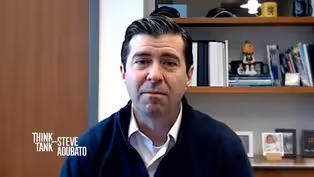
CEO of NJEDA talks about the uncertainty of tariffs
Video has Closed Captions
Clip: 5/31/2025 | 9m 27s | CEO of NJEDA talks about the uncertainty of tariffs (9m 27s)
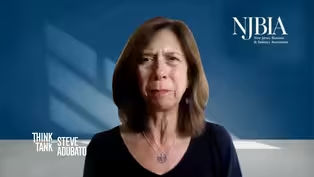
President of NJBIA addresses tax hikes on NJ businesses
Video has Closed Captions
Clip: 5/31/2025 | 9m 13s | President of NJBIA addresses tax hikes on NJ businesses (9m 13s)
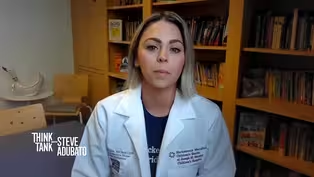
The safety and effectiveness of childhood vaccines
Video has Closed Captions
Clip: 5/31/2025 | 8m 23s | The safety and effectiveness of childhood vaccines (8m 23s)
Providing Support for PBS.org
Learn Moreabout PBS online sponsorship
- News and Public Affairs

Top journalists deliver compelling original analysis of the hour's headlines.

- News and Public Affairs

FRONTLINE is investigative journalism that questions, explains and changes our world.












Support for PBS provided by:
Think Tank with Steve Adubato is a local public television program presented by NJ PBS