
Michigan exonerees’ fundraiser, The Yunion 20th anniversary
Season 51 Episode 40 | 26m 46sVideo has Closed Captions
The barriers of re-entry for the wrongfully convicted and The Yunion’s 20th anniversary.
In recognition of International Wrongful Conviction Day, explore the barriers and challenges faced by men and women returning to society after a wrongful conviction and learn about an upcoming fundraiser to support their re-entry. Plus, The Yunion marks 20 years of service to Detroit youth. Learn about The Yunion’s 20th anniversary gala and state-of-the-art youth development center in Detroit.
Problems playing video? | Closed Captioning Feedback
Problems playing video? | Closed Captioning Feedback
American Black Journal is a local public television program presented by Detroit PBS
Michigan exonerees’ fundraiser, The Yunion 20th anniversary
Season 51 Episode 40 | 26m 46sVideo has Closed Captions
In recognition of International Wrongful Conviction Day, explore the barriers and challenges faced by men and women returning to society after a wrongful conviction and learn about an upcoming fundraiser to support their re-entry. Plus, The Yunion marks 20 years of service to Detroit youth. Learn about The Yunion’s 20th anniversary gala and state-of-the-art youth development center in Detroit.
Problems playing video? | Closed Captioning Feedback
How to Watch American Black Journal
American Black Journal is available to stream on pbs.org and the free PBS App, available on iPhone, Apple TV, Android TV, Android smartphones, Amazon Fire TV, Amazon Fire Tablet, Roku, Samsung Smart TV, and Vizio.
Providing Support for PBS.org
Learn Moreabout PBS online sponsorship- Coming up on "American Black Journal."
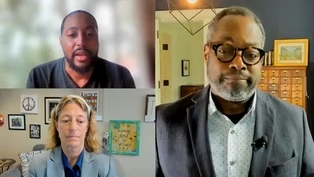
We're looking at efforts to help the innocent men and women who were incarcerated for crimes they didn't commit.
We're gonna tell you about a fundraiser bringing awareness and support to the wrongly convicted.
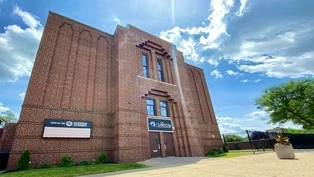
Plus, a Detroit nonprofit is celebrating two decades of transforming the lives of young people.
Stay right there.
"American Black Journal" starts right now.
- [Announcer 1] From Delta Faucets to Behr Paint, Masco Corporation is proud to deliver products that enhance the way consumers all over the world experience and enjoy their living spaces.
Masco, serving Michigan communities since 1929.
Support also provided by the Cynthia & Edsel Ford Fund for Journalism at Detroit Public TV.
- [Announcer 2] The DTE Foundation proudly supports 50 years of "American Black Journal" in covering African American history, culture, and politics.
The DTE Foundation and "American Black Journal" partners in presenting African American perspectives about our communities and in our world.
- [Announcer 1] Also brought to you by Nissan Foundation and viewers like you.
Thank you.
(upbeat music) (upbeat music continues) - Welcome to "American Black Journal."
I'm your host, Stephen Henderson.
A study by the National Registry of Exoneration shows 2% to 10% of all convictions in the United States are wrongful convictions.
Throughout the month of October, awareness and fundraising events take place all around the world in recognition of International Wrongful Conviction Day.
Here in Detroit, the Organization of Exonerees is holding a fundraiser to help support and empower the men and women who were unfairly incarcerated.
I spoke with the group's president, Kenneth Nixon, who spent nearly 16 years in prison for a crime he did not commit.
And with Valerie Newman, Director of the Conviction Integrity Unit in the Wayne County Prosecutor's Office.
So, Kenneth, I wanna start with you, but I wanna start, I think, with giving you just the opportunity to talk about your story a bit, the thing that happened to you, and then how that shapes and influences all the work that you're doing right now to help other people who are in the same kind of position.
- I was wrongfully convicted in 2005 of two counts of felony murder, four counts of attempted murder, and one count of arson.
A friend of mine's home was set on fire and two children perished in that fire.
I was immediately arrested, and get charged, and eventually convicted of those crimes.
Crimes which I knew nothing about and had no knowledge of prior to my arrest.
I would go on to spend almost 16 years incarcerated for that crime that I did not commit.
And eventually, with the help of Thomas Cooley Innocence Project at the Wayne County Conviction Integrity Unit, my innocence was proven.
And I walked out of prison February 18th, 2021.
I am Valerie Newman's 27th exoneration out of that unit.
- Wow.
- That traveling through that journey of incarceration and wrongful conviction has conditioned me for the work that I do now.
I spent a lot of time reading and educating myself on the laws and how things operate on the outside, but the natural education came from how I was treated while I traveled through the system and learned the failures of just how wrong our system could be sometimes and just how much human error takes place when we're operating a system such as the justice system.
- Yeah, yeah.
Valerie, of course, it's impressive, beyond impressive, that Kenneth points out that he was the 27th person that you were able to help in this way in 2021.
Talk about why this is important in the context of where you work.
You work for the Wayne County Prosecutor, the office that's ultimately responsible for holding people accountable for crime.
Why is it just as important to make sure that people who have been falsely accused and convicted of crimes are found and exonerated?
- Great question, Stephen.
So people often say, "You work for the Prosecutor's Office.
Your job is to put the bad guys away."
And I say to that, "Absolutely not.
Our job is justice."
A prosecutor's job, first and foremost, is always justice.
And when an innocent person has been convicted of a crime that does injustice on many, many levels, obviously the individual level, can serve time for a crime he didn't commit.
It does an injustice to him.
It does an injustice to his entire family: his son who had to grow up without him, his mother who did not get to celebrate birthdays with him and other celebrations, and people who passed who he wasn't there to be able to support his family.
And in a myriad of other ways that Ken was taken away from his family and his community.
It does an injustice to the victims because the victims deserve to have the person who committed the crime, especially in a case like this, such a heinous crime.
A firebombing of a home where multiple people are living in that home.
And two people perished.
That mother and those children who survived deserve to have the person who did that to them taken off the streets.
So they can't do it to another family.
And it does an injustice to the entire community because oftentimes, people in the community know that the wrong person was convicted.
We had one case where the victim's sister stood up in court and said in open court, "You have just convicted the wrong person.
This man did not kill my brother."
She knew it and the whole community knew it.
And it left a very dangerous predator out on the streets to commit additional crimes.
So this work, I would say to any naysayer, is an integral part of any Prosecutor's Office because we have an ethical obligation to do justice, and justice is not served when you incarcerate the wrong person.
- Yeah, yeah.
Kenneth, tell me a little about what it's been like to be free again, but also what it's been like to try to put your life back together, the challenges that exist for folks who find themselves in that situation, and then talk about what you're trying to do to help other people.
- It was very difficult at first, and I faced a lot of hurdles that, to me, just were unnecessary and burdensome, just basic stuff with gaining proper identification, proper documents.
These were huge, huge hurdles that I had to overcome.
And they're all connected.
You can't get a birth certificate without a Social Security card, can't get a Social Security card without a birth certificate, you can't get a ID without having one of the other.
So the process itself, it was very difficult and extremely burdensome.
And one of the bad assumptions is that when you're exonerated, your record is immediately clear.
That is not a true statement.
I still had that conviction on my background check for two years.
It was just recently removed in January of this year.
And that's hard.
It's hard to have to repeatedly explain to an employer why this error shows up on your background check, or when you're trying to get housing, or just trying to feed your family, right?
These are all hurdles and barriers that create a level of instability in a person.
It creates an insecurity because you're doing your best to be a citizen and try to reintegrate as much as possible.
But there's so many systemic barriers that have been erected by society that it causes hardship for people, it causes unnecessary hardship.
And a person in my position, I came home and I had a lot of help, right?
Everybody doesn't have access to Valerie Newman.
Everybody doesn't have access to very good-quality attorneys, or access to state representatives, or business leaders throughout the state of Michigan.
I had all of that and it still took me months to gain just the basic information to become a citizen.
I mean, let's look at the reality of things, right?
Without an IE, You're not even a citizen of the state of Michigan.
Without a birth certificate, you're not even a citizen of the state of Michigan.
So I couldn't go anywhere without those documents.
Literally nowhere.
So it's hard for you to try to make a smooth transition when there's so many hurdles and barriers in place.
The work that I do now, we try to highlight those systemic injustices because they are injustices, especially for people that have been wrongfully convicted.
First, you take everything from me, and now I have to re-prove to you that I'm the person that you've had in custody all this time in order to become a citizen of the community that you took me away from.
So it gets very, very hard.
But we try to bring as much awareness as possible and we do that by building relationships with stakeholders and key players that make these decisions.
And we try to bring to their attention just how difficult these barriers can be for someone returning to the community.
- Yeah, yeah.
Valerie, it says in the statistics that two to 10% of all convictions in the United States are wrongful convictions.
I mean, that may not sound like a big number, but it represents a lot of people.
- Yes, it's a lot of people.
- That's a very high error rate.
Talk about how we bring that number down in addition to helping people who were wrongly convicted to get their lives back together.
- Absolutely, I think a big part of Conviction Integrity Units is not only to get the people who are wrongly convicted or innocent out of prison, but also figuring out: What went wrong?
How do we figure that out?
And what can we put in place to make sure it doesn't happen?
So Stephen, I liken this to: Would you get on a plane if out of every 100 planes that took off, 10 of them crashed?
Nobody would fly.
It would not be an acceptable error rate.
So why do we have that as an acceptable error rate when we're taking people's liberty away?
And most of the people that have gotten relief through this unit, my unit in particular, were sentenced to die in prison.
They were sentenced to mandatory life sentence.
So we are not just taking their liberty away, we are literally taking their life away.
So I think it's very critical that people understand these are not one-offs.
"Oh, I read about this in the paper.
There's been thousands of convictions.
Here's one that went wrong."
No, that's not true because there's so many cases.
So right now, we're working in this office to bring in an expert to do what's called a sentinel review.
Similar to when there's a plane crash, all these agencies come in and they determine what went wrong and how to prevent it from going wrong again.
We wanna do the same thing here in Wayne County and we wanna figure out how to do that, how to bring all the stakeholders to the table, and everything from police training, which one of the things Ken hasn't had a chance to talk about, but he has gone around and done training with police officers.
And so that's a very critical component because that's where every case starts with the police.
So I think the more awareness we can create with the police about wrongful convictions, how they occur, implicit bias, tunnel vision, confirmation bias, the things that we see over, and over, and over with a wrongful conviction, we can stop it before anyone even gets charged, right?
And then once they get charged, working with prosecutors to be open-minded, to think critically, to be able to reevaluate information as new information comes forward, to think critically about what the police are bringing to them.
So there's a lot of work to do on our end, as well as when we welcome people home.
Like Ken said, imagine if you're paroled after committing a crime.
You have a year within the Michigan Department of Corrections to get yourself together, and reach out to family, and maybe get a job and all that help coming at you.
If you're exonerated, you're in prison one day.
- Just out, yeah.
- And you're just out with the clothes on your back and the $5 you had in your prison account, and basically left to fend on your own if you don't have all the resources, like Ken said.
He had a good, strong foundational family and community support for him, but what about people who don't?
So that's really...
I started the Organization of Exonerees 'cause I saw how...
It became apparent to me that getting people out was really just a baby step in the process.
And there's so much more work that needs to be done.
And then Ken, since he's been out, has stepped up, he's taken control and grown the organization, and I think we're doing great things, which is why we're having this event on October 10th.
- Yeah, let's talk about the event before we run out of time in the interview.
Ken, this fundraiser on October 10th is a big part of your work too.
- It is.
This fundraiser is designed for us to give people an opportunity to really show their support in a way that we haven't traditionally, not that we haven't allowed, but we just haven't had access, right?
The foundation of the Organization of Exonerees is pretty new, right?
There was no lane for what we're doing prior to a few years ago.
So we've built a lot of support in the community and across state lines.
So we hear from a lot of people that they want to help.
So we wanted to figure out a way for them to help monetarily.
Yeah, and the money will go towards helping people, right?
The things that we've talked about, those struggles, there's so many other struggles that we haven't had an opportunity to discuss.
Mental health is real, right?
Transportation, quality healthcare, those things are real.
That stuff is things that we actually deal with on a regular basis.
Just having the ability to eat what you want when you want, having quality housing when necessary.
Not everyone comes home and has a relative to go to.
Some people, we have to put up in a hotel for a couple of months at a time because they don't have anywhere to go.
Or if they do have a place to go, their family isn't equipped with the ability to give them what they need to necessarily live a quality life, right?
We had a situation where we were under the assumption that someone's family was taking good care of them, only to find out this person was sleeping in the basement on a box spring because they couldn't afford a mattress.
The reality is that most people that are wrongfully convicted come from a very impoverished background, which means their family is also in a very impoverished area.
So some of these families might include it... Like, some of them were struggling, were struggling check to check.
So now you add an additional mouth to feed, an additional person that needs the car, an additional person that is using heat and water, bills start to add up.
Like, we have to figure out a way to be supportive of that until that person has time to get themselves on their feet.
So this fundraiser will allow us an opportunity to do that.
It allows us an opportunity to stand in that space and really make sure that that person has everything necessary to make a smooth transition back into society.
We cannot rely on our government to fill that gap for us.
They have traditionally failed us in that space.
So we are taking on this task on our own, and this fundraiser is indicative of that.
- This year marks the 20th anniversary of the Detroit nonprofit known as The Yunion.
Over the years, this organization has changed the lives of more than 17,000 young people through its prevention programs, workshops, and conferences, which are designed to uplift and empower young people.
The Yunion's anniversary celebration includes a gala and the recent unveiling of a new state-of-the-art Youth Development Center.
Here's my conversation with the founder and CEO Jason Wilson and with Executive Director Nicole Wilson.
So Jason, congratulations on the anniversary this year of The Yunion, 20 years.
Can you give me a sense of how you got this started and what gave you the idea to do it?
The Yunion actually started as a record label because of my background in music.
And in Detroit, I was a part of a rap group called Kaos & Mystro.
We were really popular here.
And to make it real short is that when I finally gave my life over to God, I saw that the music that I was creating prior to that was countering really His mission for my life.
And so that's when I transformed what I was originally doing the music for to something that was more purpose-driven that could help young kids find their way through the darkness instead of helping them stay in it.
And so I started The Yunion Records and then it became a nonprofit when Nicole and I realized that after the music stopped, our kids still needed help.
And that's when we went after our nonprofit status and the rest has been history.
- Yeah, yeah.
Nicole, you're the Executive Director at Yunion.
There are so many groups and organizations in the city that work with young people.
Yunion kind of stands apart as different.
Tell us about some of the things that you guys are doing.
- Well, I think one of the reasons is specifically because of our background in the arts, and so much of what we do is rooted in the arts, rooted from that base vision that Jason created back in 2003.
And so we offer our students, I call them our babies, it's hard for me not to say that, we offer our kids an alternative, right, to counter the negative messaging that they're bombarded with.
And so giving them those technical skillsets in the arts, and technical skillsets in martial arts, and technical skillsets in things like workforce development, but also driving home the message of life skills application.
I call it teaching them how to be good little people.
And so while there are so many wonderful youth-serving organizations in the city, I'm just really proud of the work that The Yunion has been able to do with over 17,000 youth and families in our history of service.
- Yeah, yeah.
Jason, I wanna talk about young people today and the kind of things that you guys are seeing with young people and their needs, which I think are very different than they were five or 10 years ago, but they're even different than they were just three or four years ago 'cause of the pandemic.
And I'm always curious about organizations that work with young people, what they're seeing and what the needs look like now.
- That's a great question.
We were just talking about in The Cave of Adullam just last week how so many of the boys are holding on a lot of pressure.
So you have a 12-year-old boy who has the pressure of a 40-year-old man.
- Wow.
- So when you have social media, when... Like, Stephen, when we went to school, we left whatever happened at school at school.
Now, it follows them because of their phones and social media.
And I've had boys...
I would ask them do some of the simplest training techniques.
And because they feel this pressure to perform that they can't make a mistake, they'll break down crying on the mat because we give them a safe space to really express how they're feeling.
But think about all the boys who can't really release the emotional heaviness or the trauma that they've experienced.
And thus, we have poor performance academically or they end up doing something that lands them in the juvenile detention center.
And so they're holding on to a lot of anxiety.
Again, just the pressure of trying, like having adult responsibilities, and I just tell our boys, "Be 12-year-old Eric, or 12-year-old David, 11-year-old John," and they look at me like a light finally clicks on.
And that's what I believe that the boys and our girls are dealing with is just unrelenting pressure in society for them.
- Wow.
Nicole, I wanna talk about this new youth development center that Yunion is involved in and how exciting that is.
- We are.
We are so excited.
It's certainly been a labor of love.
We purchased a building in 2019, did about seven or eight months of renovation, moved in the building in January of 2020, moved out of the building in March of 2020 due to the pandemic.
And our staff worked remotely for almost a year and a half, or a little more than that, in providing services with our school partner sites and in our community collaborative sites.
And so we came back into the building in October of 2022 and started back up our renovations process, our second phase.
We are just so excited to be able to finally open it up full service to the community.
So the building is equipped not only to provide our Cave of Adullam classes to our students, but also provide workforce development training classes.
We have a multipurpose classroom; we have a Health and Wellness room where we provide counseling and case management services to our youth and families; a brain training center in that Health and Wellness room, which is a wonderful technology that Jason serves as the ambassador of neuroptimal that helps the brain to deal with trauma.
We have our performing arts studio for Keys 2 Life program, where we offer dance and beat-making production, songwriting.
We have a computer lab or tutoring and homework assistance.
We really wanted to make it a comprehensive youth development center that is beautiful because our kids deserve that.
And so we're just super excited about having it open to the community.
- Okay, I should also mention you guys have a gala coming up to celebrate 20 years, right?
- Yeah, we are very excited about that.
We're excited about being able to not only honor the work, but one of the key purposes of the gala on October 5th, which is at One Campus Martius, we hope everyone can join us, is to empower the work of The Cave.
And so our waiting list for The Cave almost exceeds 800 boys.
- Wow.
- And this is a growing waiting list that more than likely... We've always had a waiting list, but it has certainly expanded now that there is a documentary on The Cave of Adullam that is streaming now on ESPN+.
It was purchased by ESPN after it won Best Documentary at the Tribeca Film Festival in 2022.
And so we have to meet that demand.
And so we're utilizing our 20th anniversary to bring light and awareness to that need to expand the work of The Cave.
It is such a monumental service offering that we provide to our young men in the community on a local level.
But even past that, there's a national demand to scale The Cave, and we are working really hard to meet all of those needs.
- That's gonna do it for us this week.
You can find out more about our guests at americanblackjournal.org and you can connect with us anytime on social media.
Take care, and we'll see you next time.
(gentle music) - [Announcer 1] From Delta Faucets to Behr Paint, Masco Corporation is proud to deliver products that enhance the way consumers all over the world experience and enjoy their living spaces.
Masco, serving Michigan communities since 1929.
Support also provided by the Cynthia & Edsel Ford Fund for Journalism at Detroit Public TV.
- [Announcer 2] The DTE Foundation proudly supports 50 years of "American Black Journal" in covering African American history, culture, and politics.
The DTE Foundation and "American Black Journal" partners in presenting African American perspectives about our communities and in our world.
- [Announcer 1] Also brought to you by Nissan Foundation and viewers like you.
Thank you.
(uplifting music)
Exonerees' fundraiser supports the wrongfully convicted
Video has Closed Captions
Clip: S51 Ep40 | 15m 42s | Explore the barriers of re-entry to society for people who’ve been wrongfully convicted. (15m 42s)
The Yunion marks 20 years of service to Detroit’s youth
Video has Closed Captions
Clip: S51 Ep40 | 8m 39s | Learn about The Yunion’s 20th anniversary gala and youth development center in Detroit. (8m 39s)
Providing Support for PBS.org
Learn Moreabout PBS online sponsorship
- News and Public Affairs

Top journalists deliver compelling original analysis of the hour's headlines.

- News and Public Affairs

FRONTLINE is investigative journalism that questions, explains and changes our world.












Support for PBS provided by:
American Black Journal is a local public television program presented by Detroit PBS