
District Detroit, ‘Noura’ play
Season 7 Episode 24 | 26m 46sVideo has Closed Captions
Political lame duck sessions, new downtown Detroit developments, “Noura” by Heather Raffo.
BridgeDetroit reporter Malachi Barrett provides updates on the new “District Detroit” development plans. Plus, a look at the new play “Noura,” by internationally acclaimed Iraqi American playwright Heather Raffo at the Detroit Public Theatre.
Problems playing video? | Closed Captioning Feedback
Problems playing video? | Closed Captioning Feedback
One Detroit is a local public television program presented by Detroit PBS
District Detroit, ‘Noura’ play
Season 7 Episode 24 | 26m 46sVideo has Closed Captions
BridgeDetroit reporter Malachi Barrett provides updates on the new “District Detroit” development plans. Plus, a look at the new play “Noura,” by internationally acclaimed Iraqi American playwright Heather Raffo at the Detroit Public Theatre.
Problems playing video? | Closed Captioning Feedback
How to Watch One Detroit
One Detroit is available to stream on pbs.org and the free PBS App, available on iPhone, Apple TV, Android TV, Android smartphones, Amazon Fire TV, Amazon Fire Tablet, Roku, Samsung Smart TV, and Vizio.
Providing Support for PBS.org
Learn Moreabout PBS online sponsorship- [Will] Just ahead on "One Detroit..." As lame-duck sessions get underway in the Michigan legislature in Congress, "One Detroit" contributors, Nolan Finley and Stephen Henderson, debate what they would like to see happen.
Plus, Detroiters get a chance to voice their opinions about the revised development plans for the District Detroit.
And we'll take a look at the Detroit Public Theater's powerful performance of "Noura," written by Michigan native Heather Raffo.
It's all coming up next on "One Detroit."
- [Voiceover] From Delta faucets, to Behr Paint, Masco Corporation is proud to deliver products that enhance the way consumers, all over the world, experience and enjoy their living spaces.
Masco, serving Michigan communities since 1929.
Support for this program is provided by the Cynthia & Edsel Ford Fund for Journalism at Detroit Public TV, The Kresge Foundation.
- [Voiceover] The DTE Foundation is a proud sponsor of Detroit Public TV.
Among the state's largest foundations, committed to Michigan-focused giving, we support organizations that are doing exceptional work in our state.
Visit DTEfoundation.com to learn more.
- [Voiceover] Nissan Foundation and viewers like you.
(energetic music) - [Will] Just ahead on this week's "One Detroit," Olympia Development's overhauled plans for the District Detroit are getting the once-over by Detroit residents who will ultimately want to know how it will benefit them.
Plus the Detroit Public Theater puts on a production of "Noura," by noted playwright and Michigan native, Heather Raffo.
We'll look at the meaning of the play through the eyes of Raffo, one of the actors, and the theater's Co-founder.
But first up, lawmakers in the state legislature in Congress are wrapping up a year that saw big changes take place after the midterm elections.
The traditional lame-duck sessions may also look different in the coming weeks.
"One Detroit" contributors, Nolan Finley, from the "Detroit News," and Stephen Henderson from "American Black Journal," sat down to talk about what might happen at these sessions.
(soothing music) - Stephen, we're entering the most dangerous season of all, lame-duck political sessions, in both the legislature and in Congress.
And that you head into these last few weeks of the session, it'll run to January 1st, but for all practical purposes, it'll be over by Christmas.
We're, you know, politicians who are past the elections try to get a lot of things they couldn't get done in the previous two years.
And let me preface this discussion by saying, I am absolutely opposed to lame-duck.
I don't think politicians who are no longer accountable to the electorate should be doing big legislation, and big earth-changing bills, like they always try to do.
And sometimes they do.
This year, both congress and the state legislature, have some ambitious plans.
- Yeah, so I mean, this is one thing that we absolutely agree on, I hate lame duck.
I think some of the worst legislation of all time comes out of these sessions, where people are just trying to ram stuff through before they walk out the door.
I do think that we're not in for much of a troubled period now, at the state level.
Because, you know, you've got Republicans, who are now in charge, they're leaving, Democrats are coming in.
You've got a Democratic governor, I mean, she's not gonna sign anything that they do- - That's right.
- that's too crazy.
I would love, I would actually love, if they would take a look at ethics and transparency legislation, which they they've tried a couple times, and come up short.
But we have this new constitutional amendment that does talk about more transparency in Lansing.
- Yep.
- Even as just a gesture, it'd be nice to see them say, "All right, well, here's what that could look like."
You know, at the federal level, I do think that if they could get more things done, to try to deal with the economic situation, that wouldn't be the worst thing in the world.
- And I would agree with you, at the state level, if they could get ethics and transparency legislation finally done, they all say that's what they want.
The governor said, "Oh gosh, yes, I'm all for it."
And yet she's finished four years and it didn't happen.
She didn't push it.
And the lawmakers, most of the lawmakers who controlled the levers in Lansing, didn't allow it to happen.
But there's some important things that need to be done there.
In Congress, of course, you know, as much as you say, "Oh gosh, I don't like lame-duck," we all got things on our wishlist.
I mean, I think one thing they could do, and maybe get some traction on, is normalizing marijuana laws.
Particularly fixing the part of the federal code that won't allow legal medical marijuana businesses, or recreational marijuana businesses, in states where it's legal, to access the banking system.
They're a cash-only business.
You got, these guys walk around with big wads of cash in their pockets, they're sitting ducks.
They can't, you know, they can't move their money through the legal banking system, through financial institutions.
You know, it's rife for continuing to have this quasi-legal environment, when it comes to marijuana in the states.
They need to fix that.
There's proposals to do so, seem to have bipartisan support, but for everything else, they think they're just better off leaving it alone, and letting this new Congress work it out.
- And then the question is, you know, what are we gonna see from these folks, come January?
And I think in both cases, you know, there's gonna be a lot of uncertainty about what was was done.
You know, at the state level, Democrats will have majorities, but they're slim.
And holding everybody together will be a challenge.
And tempering the demands of, you know, Democratic interests that have been pent up for a really long time, 'cause they haven't had control.
You know, you can't give everybody everything, so what becomes a priority?
That will be really interesting to watch.
And at the national level, whether Republicans can kind of hang together in the House, given the strife over politics in that party.
And the question's still about whether Kevin McCarthy can even get the votes to be Speaker.
- He may not.
- Yeah, he may not.
And so what is that going to look like?
What is opposition look like, when the opposition is not unified?
- What I'm wishing for from Congress and the new year is gridlock.
I think we're all better off, after two years of really dramatic lawmaking, if we could cool off a little and let this economy try to normalize.
I don't think they need to be spending any more money, or passing any big, expensive new proposals.
Let's let this rest, and let the economy, and everybody else, recover from the pandemic, and see where it leads us.
- Yeah, well, I mean, we're starting to see the economy turn around, third quarter GDP grew by 2 points, 2%.
That's more than it has grown all year, it didn't grow the rest of the year.
We'll see another bump, I think, in the fourth quarter.
But there are some things that I think the President still has on his agenda, that he should try to work with Republicans to try to get, right?
Some of those things are good for everybody.
And if you can pick off enough Republicans, you know, guys, and the set of guys and gals in the center, and make the case, you can actually get some stuff done.
I think two years of gridlock is too much, given all the problems that we have.
And Biden would be right to try to keep pushing, keep going forward.
- Well, it's gonna take some wheeling and dealing, and I don't know how prepared he is to do that.
And I don't think Republicans are in the mood to give this President any victories.
I mean, that may be good or bad, but it's the reality.
- I think that's bad, yeah.
(laughs) - Everybody's pointing to 2024, so- - Yeah, they are, all right.
- Well, it's gonna be- - Well, we'll see how- - an interesting couple of years.
- Yeah, three more weeks in the year.
- There we go.
- [Will] The Ilitch family's Olympia Development of Michigan is holding formal presentations for Detroiters to learn about the revised plans for the District Detroit project.
The proposal includes hotels, office buildings, restaurants, and housing.
I sat down with "BridgeDetroit" reporter, Malachi Barrett, to get an update on how residents are feeling about the planned development, and its impact on the community.
(soothing music) - Malachi, for those of us who may or may not be super familiar with the area, what is the District Detroit, where exactly is this happening?
Maybe give us some familiar landmarks so people can orient themselves.
- Largely what people envision, when they think of District Detroit, is kind of this no man's land, in-between downtown Detroit, and the area that folk kinda refer to as Midtown now.
A lot of empty parking lots, a lot of kind of vacant land that's been, you know, there's been some decisions on what to do with it, that have been kind of cooking for a while, as we'll kind of get into.
- As we're talking about this, what is being developed?
Who are the players in this, and what stage are we at?
Are we planning, or has the ground been broken?
Where are we at with that?
- Yeah, so in a lot of ways, we are kind of right back at the beginning of where we started with District Detroit.
This is a new vision for the area that has long been kind of under the control of the Ilitch family.
Their development firm, Olympia Development, and Stephen Ross, of the University of Michigan fame, and, you know, a pretty influential developer in New York City.
His development firm, related companies, are kind of teaming up to release this new vision for the District Detroit area.
As far as where we're at right now, I mean, things haven't really progressed very far.
We have some renderings of what they would like to do in the area.
You know, we have designs for hotels and office buildings, and some of the restaurants, and things like that, but no shovels are in the dirt yet.
They haven't secured any of the public financing that they'll likely rely on, to make this happen.
- As these developments are being proposed, as plans are being made, the companies who are doing this development have to interact with, you know, the local communities and the residents that they're building these things, and doing all this construction, around.
So where is the process at with that?
Have there been talks with any community organizations?
And how is that panning out so far?
- Yeah, so Detroit, like some other large cities, but kind of unique in Michigan, we have what's called the Community Benefits Ordinance.
Which kind of outlines a process where developers, if they're gonna seek public money to finance their projects, if they're gonna seek tax breaks incentives, these kinds of things, that we usually give large developers when they're working on, you know, big downtown projects like this.
Before they are approved for that financing, they have to go to the community, and they have to meet with a council of community members.
And talk with them about, you know, what is the impact of this development gonna be on the area?
How can they negotiate some things that create some positive benefit?
- And thinking about that relationship that has to be developed, have you gotten a chance to speak with any of the residents, any of the people who are gonna be in these impacted areas?
And if so, what is the general sentiment?
Because a lot of times, when developments are happening in Detroit, a big concern is making sure that, A, yes, it does benefit the community.
But that the community who is currently there has the ability to remain and have a voice in that.
So what have you heard from the residents in the area?
- Well, first off, I think it's important to note that this announcement kind of landed with a a collective eye-roll in Detroit.
You know, folks have, as we've alluded to in this conversation, you know, heard this before from the Ilitch family.
You know, these big aspirational projects, for shiny buildings, and you know, new restaurants, and new hotels; sounds great on paper.
People have kind of heard similar things before out of the Ilitch family, when it comes to this part of the city, and don't have much to show for it over the last decade.
So I think there's a lot of skepticism just, you know, at a starting point, and that's gonna be something developers will have to work through.
- What specifically are you going to be keeping your eye on as these developments develop?
- Well, we talked about the community benefits, so I think that's a big piece.
What is the community gonna ask for?
And how is that going to be formalized in an agreement?
And how is that agreement going to be enforced long-term?
If development plans change, will the city hold developers to, you know, their commitments there?
In the larger context, too, of just Detroit talking about the merits of giving tax breaks to some of these more wealthy developers.
Obviously, the Ilitch family has quite a bit of capital and resources to work with, right?
So, you know, do they, is it justified that they ask for the taxpayer to provide some help?
You know, the city had this huge conversation over the summer about Dan Gilbert, and the Hudson site, and I think we're going to go through a similar kind of process, right?
People are really kind of keyed in now about what do we get out of these agreements?
And, you know, particularly for the neighborhoods that are maybe touching this area, but certainly for neighborhoods further outside of the downtown, people are really wondering, like, "What is the benefit for us?"
This seems to be kind of concentrating the economic impact within the downtown area.
There's not as much spillover, you know, to some of these commercial corridors, or other areas where, you know, Detroiters, long-time residents, locally-owned businesses, are really in play.
People are going to look for that kind of access in these new developments, in the District Detroit.
You know, okay, you say you're going to allow some retail space, does that mean local retailers are going to be able to take advantage of that opportunity?
Or does that mean, you know, businesses from the outside of the community are going to come set up shop here?
So, you know, as always, with these things in the public arena, there are winners and losers.
And finding out who those winners are gonna be, and who maybe won't benefit as much from this, is really kind of the meat of what we're gonna be tuned into.
- [Will] And finally, the play "Noura" is showing at the Detroit Public Theater.
It's written by internationally-acclaimed, Michigan-born playwright, Heather Raffo, who also stars in the title role.
The play tells the story of an Iraqi woman and her family, who fled their country several years ago.
As they celebrate Christmas in their adopted home of New York, a surprise visitor shows up and forces them to confront their past.
(soothing music) - I know you want the sponsor every Iraqi orphan, once we open that door, you know it'll never close.
- Not every orphan, one from Mosul, from my grandfather's church.
- You can't bring Mosul back!
- Hey, she's lucky to be alive.
The least we can do is help with school.
- Theater really is a tool to create empathy, we're telling stories, not to an audience, but with an audience.
- She's gonna stay a week, at most two.
She's got school in California.
- You see these stories, that maybe you don't know personally, but you can watch and say to yourself, "Oh, I know what that's like."
- I'm just saying, if you want to hold on to what Iraq was, maybe you need to remember who you were.
- Hey, who was I?
Who?
- "Noura" is about an Iraqi family that has immigrated to the United States, and are really examining kind of what it means to be Americans, what it means to be Iraqi Americans.
And they're celebrating Christmas, and so just like any family as they come together to celebrate their Christmas, a lot of things start, you know, feelings start coming out, and a lot of things happen.
- Right, it's the language.
This dinner in Arabic, how different would it be?
Circling each other for hours, gossip underneath each word.
- Heather Raffo is an internationally-acclaimed playwright and performer, whose work we have loved and admired for a long time.
And so this is a play that we wanted to produce for a long time, and the moment was finally right.
- What inspired me to write "Noura" was the convergence of many things.
One being when ISIS overtook Mosul, and just that sense of, I had Iraqi family in Iraq through multiple wars.
For thousands of years, my family had been rooted there, but that felt like the last straw, in a way.
So since that time, and in the last 10 years, I've had family now scattered in diaspora across the world.
And "Noura" is hugely about family.
You know, it's a refugee family living in America, living an immigrant life, but very attached to back home.
And questioning if they're still Iraqi anymore.
That once you leave, and if you leave in a particularly harrowing way, do you still have the root system?
- I won't say anything.
- You're a doctor, why not just lecture me on smoking, rather than my obsession with my dying identity.
And another inspiration was I had been working for four years with a Middle Eastern and Arab American community throughout New York City.
The stories they told were ones of strength and resilience, but all of them felt torn between culture.
And the real pull between what America offers, which is a focus on rugged individualism, and what Middle Eastern culture offered, which was a focus on community.
And we all kept saying, in this workshop, like, "Why isn't there something a little bit more in-between?"
And that's a line that "Noura" says in the play is, "I need a country in-between."
She wants something that can find the good of both and uplift that.
Do we live for each other or for ourselves?
I need a country in-between.
- Heather Raffo is incredible, she is such an inspiration.
What drew me to the play, "Noura," was the fact that it was such a great representation of my culture.
I read her words when I was in Michigan, and she was all the way in New York.
And I couldn't believe how seen I felt, by a person I had never met before.
So I think she is just incredibly powerful, and she has an amazing ability to draw people in with her empathy, and creativity, and warmth.
And I think it does a great job bringing awareness to the refugee crisis.
And it also does a wonderful job preserving our culture.
(man on radio speaking in foreign language) - Please turn it off, I can't stand this propaganda.
Not on Christmas.
- No, they're the only ones praying for the refugees today.
- Noura, that channel's not even Iraqi!
It's evangelical out of Texas.
- What, you don't care, how many in Erbil, trapped in malls, freezing on Christmas?
- Of course I care, but can't I have a day?
My whole year is saving other peoples' lives.
I would like a chance to live mine, for once.
- [Amanda] Noura came here with her husband, Tarek, and their son, Yazen, eight years ago.
They live in New York City, and they've been sponsoring an Iraqi refugee named Maryam, who lives in California currently.
And they're going to fly her out for Christmas dinner.
And their friend, Rafa'a, also lives in New York.
I believe it sparks a lot of conversations about what it's like to live here now and be an American, and what they left behind from their past.
- No, you could live amongst Arabs, or Christians, or Iraqis, anywhere in the world.
It would never be the community it was; not again.
- But don't you feel a great loss?
- Yes.
- [Heather] The play, "Noura," honors that tremendous weight of leaving home in two ways.
It, it allows some of the characters in the play to want to leave home, to want a new life, to want to forget.
And it allows other characters in the play to struggle with feeling like they have to forget, and they have to move on.
It allows for a feminist, female central character, to be the one who doesn't wanna have to move on.
And yet realizes that she is being forced to, in a way, just for her own survival.
And she gets to speak a monologue in the end, that I would say the entire play was written, in order to be able to speak this monologue in context.
- No wonder so many of us are drowning.
The responsibility, it's impossible to bear.
It's just a way to be erased.
- I think all audiences can relate to what it feels like to search for a place to call home.
There are so many moments, and Heather writes this beautifully, where we are fighting for the love.
And then we might have a moment where we lose the love, but then we recover, and we try and find love again.
And I think everyone has experienced moments like that.
- Who do I love?
- Me.
- Who else do I love?
- Dad, Nana, all of our family all over the world.
- Who the most?
- Me.
(audience laughs) - I mean, I think what is most touching about this piece is the way this family navigates love.
There is a really beautiful scene, between Noura and her son, that just speaks volumes of, you know, how close this family is.
There's also an incredible scene between Noura and her best friend from childhood.
He is Muslim and she's Christian, and they are discussing both just what it was like, growing up back home, how well they know each other, but also the divisions that feel like it's shaping their older lives.
That didn't used to be when they were young.
And then there's, of course, this incredible relationship between this married couple, that has weathered so many things, and finally begins to talk about some of their history.
And I think that in each of those respects, audiences will feel like they are both getting to eavesdrop on very intimate moments in peoples' lives, but also recognizing things very true to their own experiences.
- Of course she doesn't know who the father is.
She should have saved everyone the trouble, most of all, the tortured kid.
- Why can't she want a child?
- When you're a 20-year-old orphan, running from medieval madmen, whisked off to an American university, the last thing you want is a burden.
- You know, I've never heard you so spiteful.
- She has a hold on you, I hate to seeing you attached, to someone I don't trust.
She could hurt you.
- How?
- It's a huge honor to be bringing, telling this story in the largest Arab American community in the country.
It was also really important to us that this cast in this community be Arab American.
- [Heather] There's a specificity to this cast, in that we have two Kalbains in the cast, playing Kalbains.
We have an Assyrian playing Kalbain, so those are three Iraqi Christians playing Iraqi Christians.
We also have Kal Naga, who's an Egyptian movie star, a Muslim, playing the role of the Muslim best friend.
It's just everybody is bringing their own cultural specificity, and mixing that with how they see the characters.
You know, we really got to experiment with this play, in a really fresh and interesting way.
And for that, I feel really fortunate.
- I hope that the Iraqi American community can come and see this show, and see themselves in it.
I want them to feel the way that I felt when I first read this play, that it felt like home, it felt like being seen.
- As playwrights, I'll just speak for myself, I bare my soul, I bare my heart.
I say the bravest things I can possibly say.
When I'm performing, I try to do my bravest work by embodying that.
And all of that means that I would never tell anyone what to think of it.
But I think that in this piece, if I did have a wish, it's just that they go forth with their family, with a stranger, with their neighbor, into a deeper conversation.
- I don't know how to let go and hold on at the same... - [Will] You can see "Noura" at the Detroit Public Theater through December 18th.
That will do it for this week's "One Detroit," thanks for watching.
Make sure to come back for "One Detroit Arts and Culture" on Mondays at 7:30 PM.
Head to the "One Detroit" website for all the stories we're working on, follow us on social media, and sign up for our weekly newsletter.
(soothing music) - [Voiceover] From Delta Faucets to Behr Paint, Masco Corporation is proud to deliver products that enhance the way consumers, all over the world, experience and enjoy their living spaces.
Masco, serving Michigan communities since 1929.
Support for this program is provided by the Cynthia & Edsel Ford Fund for Journalism at Detroit Public TV.
The Kresge Foundation.
- [Voiceover] The DTE Foundation is a proud sponsor of Detroit Public TV.
Among the state's largest foundations, committed to Michigan-focused giving, we support organizations that are doing exceptional work in our state.
Visit dtefoundation.com to learn more.
- [Voiceover] Nissan Foundation and viewers like you.
(upbeat music) (happy piano)
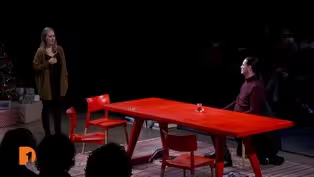
‘Noura,’ an Iraqi American story at Detroit Public Theatre
Video has Closed Captions
Clip: S7 Ep24 | 9m 53s | "Noura” tells the story of an Iraqi American woman family after fleeing their Iraqi home. (9m 53s)
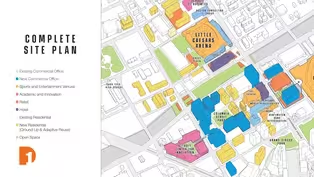
Residents weigh in on District Detroit development plans
Video has Closed Captions
Clip: S7 Ep24 | 6m 7s | BridgeDetroit’s Malachi Barrett gives an update on the District Detroit development plans. (6m 7s)
Providing Support for PBS.org
Learn Moreabout PBS online sponsorship
- News and Public Affairs

Top journalists deliver compelling original analysis of the hour's headlines.

- News and Public Affairs

FRONTLINE is investigative journalism that questions, explains and changes our world.












Support for PBS provided by:
One Detroit is a local public television program presented by Detroit PBS