
Michigan Primary, Hudson's Tax Break, MRCC Training Center
Season 6 Episode 51 | 26m 46sVideo has Closed Captions
Michigan primary election results, the Hudson's site tax break and MRCC's training center.
One Detroit contributor Nolan Finley and Deadline Detroit’s Greg Bowens discuss the results of the hotly contested Michigan primary election races across the state. Senior Producer Bill Kubota learns more about a $60 million tax break given to the development at the former Hudson's store site. Plus, the Michigan Regional Council of Carpenters opens a new training center in Northwest Detroit.
Problems playing video? | Closed Captioning Feedback
Problems playing video? | Closed Captioning Feedback
One Detroit is a local public television program presented by Detroit PBS
Michigan Primary, Hudson's Tax Break, MRCC Training Center
Season 6 Episode 51 | 26m 46sVideo has Closed Captions
One Detroit contributor Nolan Finley and Deadline Detroit’s Greg Bowens discuss the results of the hotly contested Michigan primary election races across the state. Senior Producer Bill Kubota learns more about a $60 million tax break given to the development at the former Hudson's store site. Plus, the Michigan Regional Council of Carpenters opens a new training center in Northwest Detroit.
Problems playing video? | Closed Captioning Feedback
How to Watch One Detroit
One Detroit is available to stream on pbs.org and the free PBS App, available on iPhone, Apple TV, Android TV, Android smartphones, Amazon Fire TV, Amazon Fire Tablet, Roku, Samsung Smart TV, and Vizio.
Providing Support for PBS.org
Learn Moreabout PBS online sponsorship- [Narrator] Just ahead on One Detroit, the results are in and we'll break down the winners and losers in Michigan's primary election with One Detroit contributor, Nolan Finley and Greg Bowens of Deadline Detroit.
Also, we'll examine Detroit City Council's 'yes' vote on a huge tax break for Bedrock's development at the Old Hudson site.
Plus, a long-awaited skilled trades training center opens in Detroit.
We'll take you to the ribbon cutting.
And the Latin sounds of Armando Vega's Salsa Band.
It's all coming up next on One Detroit.
- [Commercial Narrator] From Delta faucets to Behr paint, Masco corporation is proud to deliver products that enhance the way consumers all over the world experience and enjoy their living spaces.
Masco, serving Michigan communities since 1929.
Support for this program is provided by the Cynthia & Edsel Ford Fund for Journalism at Detroit Public TV, The Kresge Foundation.
- [Woman Narrator] The DTE foundation is a proud sponsor of Detroit Public TV.
Among the state's largest foundations, committed to Michigan-focused giving.
We support organizations that are doing exceptional work in our state.
Visit DTEFoundation.com to learn more.
- [Commercial Narrator] Nissan Foundation, and viewers like you.
(upbeat music) - [Narrator] Coming up on this week's One Detroit.
After several delays, Detroit's City Council approves a 60 million dollar tax abatement for Dan Gilbert's massive downtown development on the old Hudson's site.
One Detroit teams up with Bridge Detroit for a closer look at what turned out to be a surprise vote.
Plus, our series on the future of work takes us to the grand opening of a training center for carpenters and millwrights.
We'll get a look inside the state-of-the-art facility located in a Northwest Detroit neighborhood.
But first up, Michigan's hotly contested primary election is over.
Voters have made their decisions in a number of crowded congressional and state legislative races.
Plus, we now know which Republican candidate will face off against Democratic governor Gretchen Whitmer in the fall.
One Detroit contributor, Nolan Finley and Deadline Detroit's Greg Bowens sat down to discuss the winners and losers in the primary, and, to look ahead at the November election.
(soft electronic music) - Greg Bowens, thanks for being with us today.
Primary's over, and this governor's race is on, as well as a lot of other races.
So far, it's been one bizarre political year in Michigan, particularly in the Republican gubernatorial campaign, but they appear to have settled on a choice.
Tudor Dixon will represent the party in its challenge of Governor Whitmer this fall.
I described her in a column yesterday as perhaps the longest shot gubernatorial candidate I've seen in 40 years of doing this.
I don't know if you would agree or not.
- But longer than Geoffrey Fieger?
(Bowens laughs) - I think so, because I was asked that.
I think Fieger was not so long because he had name ID.
Everybody knew who Geoffrey Fieger was.
He had both money and he had a voter base in Detroit.
I don't see Tudor Dixon with any of those things.
- Yeah, that's a good point.
Yeah, she's a total newcomer and she doesn't have that sort of aw, shucks kind of appeal that Rick Snyder had when he popped up on the scene, if you recall.
- Yeah.
- And so it should be interesting, how this works out.
I mean, wow.
Just, you know, from James Craig to, you know, the guy, Kelly, Kelly Ryan, is that his name?
- Ryan Kelly.
- Ryan Kelly who got arrested and who now won't concede the race, you know.
(Bowens chuckles) - Even though he finished almost last.
Yeah, it's bizarre.
I mean, we had the first tier, most of the first tier of this race got wiped out for invalid signatures.
And Tudor Dixon turned out to be the best of what was left.
I do think she's an engaging candidate.
She's charismatic, I think she connects with people.
I do think she has to hone her message, have a stronger message.
And you know she has to also unite this Republican party.
It's, you know, still, despite her endorsement by Donald Trump and the DeVos family.
Still, a lot of people in this party perpetually unhappy and she's gotta bring them together.
She's gotta raise a lot of money.
She's gotta raise her own profile.
She's gotta do a lot of things in a short amount of time and she's gotta get it all exactly right.
- Nolan, I don't know.
We might, you remember the Tea Party people?
- Absolutely.
- And how they, they stormed through Michigan?
- Yeah.
- And that kind of thing?
This seems like a real, you know, extreme version of what had occurred with the Tea Party, not so long ago.
And the politics of grievance has turned on the Republican party itself.
I'll be honest with you, I've missed, you know, establishment Republicans.
May disagree with them on a lot of issues, but at the same time we could, at least, have those discussions.
You can't have discussions with people who are caught up in QAnon and, you know, these crazy conspiracy theories.
And, Nolan, I don't know if you heard this, but part of the reason why 63 of the 83 counties' election returns were delayed, was because you had some of these MAGA folks all up in these clerk's offices, insisting that cops, you know, ride behind people who had to hand deliver the tabulations from the precincts.
- Well, we also had a lot of computer problems, modem problems, that Secretary of State Jocelyn Benson's office should have gotten well ahead of before people went to the polls and the local clerks shouldn't have had to deal with this.
But we got a gubernatorial candidate, two women running in a year when abortion's gonna be a major issue.
Gretchen Whitmer is all in on the pro-choice side.
She supports this ballot measure, which would make abortion an unregulated environment in Michigan.
Tudor Dixon is all in on the other way.
She says no exceptions for anything.
And I think once again, on this issue, the majority of Michiganians won't be heard, won't be represented because I think they're somewhere in the middle on this.
- Nolan, you raise a good point with that.
I will say this, that the abortion issue is pouring kerosene on a gas fire, man.
(Bowens laughs) - I think abortion will be the rock that this expected red wave crashes on.
You already see Republicans down-scaling their predictions for their House gains, their U.S. House gains.
One time it was 50, 60 seats, they hoped to pick up.
Now they're looking at 19, 20, realistically.
Still enough to give them a majority but not much.
Beyond the gubernatorial race, though, we had races all over, the ballot and in every, you know, in every county in this state yesterday.
And one of the most interesting, I think to you and I, was that 13th District congressional race, where Shri Thanedar, State Representative and millionaire, put five, six, 7 million of his own money in that contest and prevailed over a pretty good slate of candidates.
He was the only non-African American in this race.
And his victory means Detroit, for the first time since Charles Diggs won't have an African-American representative in Congress.
- No, that's true.
And, you know, Nolan, you keep up with this stuff in ways that I wouldn't think that a conservative political commentator would, writer would and, you know, you noted a long time ago, downtown, you wrote the column that said, "Where are all the black people?"
- Yeah.
(Bowens laughs) - Well now, guess what, when it comes to Michigan Congressional Delegation, you know, that same thing is going to be true.
And we run up against as a community, as a society, trying to balance out this push, pull between the need or recognizing that representation really does matter but then how much does it matter?
And so, when it came to Shri Thanedar, you know, here's a guy that popped up on the scene, ran against the governor, got the most support in Detroit.
And so he moves into Palmer Woods, Sherwood Forest, and wins a seat there.
And now his "aw shucks, I'm harmless" kind of approach has won him the congressional seat.
And Nolan, now, you know, you know every single person that was in that race, with maybe with exception of Mike Griffie, but you endorsed him.
(indistinct) You guys endorsed him, so you know him now, but you know, Nolan, there were some people in that race that just shouldn't have been in there, man.
- Well, there are too many in the race.
And that helped Thanedar, and you know, the redistricting commission has to take some fault here, as well.
Perhaps, maybe not in this race, but black representation overall will- - Right.
- Go down in January when these new bodies are seated.
That's the fault of a redistricting commission that didn't prioritize creating black representation in these new boundary maps.
- The redistricting commission was a failure in a lot of ways not the least of which that Democrats, communities of color, we need to have an honest conversation about race.
And we didn't have that during the redistricting process because you have these other rising communities of color that are represented in Hamtramck, that are represented with Shri Thanedar and the Pacific Asian Indian community.
And along with the Arabic Middle Eastern community.
And there was no serious discussion about how do we give them the same kind of opportunity to have fair representation without diminishing the opportunity for African Americans to have that representation.
- [Narrator] The Detroit city council has cleared the way for developer Dan Gilbert to receive a huge tax break for the mixed use project his company is building on the site of the old Hudson's downtown department store.
The vote on the controversial tax abatement was delayed in city council for several weeks but a last minute vote before summer recess granted Bedrock's request.
One Detroit's senior producer, Bill Kubota, spoke with Bridge Detroit's Malachi Barrett who's been closely following the story.
(soft electronic music) - The saga of the summer in Detroit has kind of been this discussion over whether the city would grant a 60 million dollar, 10 year tax abatement to a big development project downtown that Bedrock is doing.
- [Kubota] Bedrock, the Rocket Company's billionaire Dan Gilbert, the huge high rise going up at the old Hudson site.
The big request suddenly approved by city council last week after weeks of putting off the vote.
- Member Young, the resolution?
- Council member Young?
- Thank you, madame president.
I move to approve line item 22.4.
- [Kubota] Malachi Barrett's been covering the story for Bridge Detroit.
- This was the last scheduled meeting before the council was gonna go on recess for about a month, so they're off until September now.
And in that last meeting, there was a surprise vote on that tax abatement.
- [Kubota] Seven hours into the session at the very end, they did it.
- [Barrett] If you had the tenacity to stick around until the end, you found out that this was voted on.
- And I will not be able to support the vote today for this item.
And the reason I cannot is because it was not noticed for the public that this was going to be a vote today.
- And for some of you all who make statements like you're selling your soul, that is not true.
And I, you know I really don't even want to hear that phrase again.
- So I absolutely oppose this.
It should come before the public.
It should not be walked on.
We shouldn't, I think we're doing a disservice to our taxpayers.
- What I know when I ride down Woodward, I look at a half-completed building and I know we got over 2000 jobs wrapped into that.
And that's 2000 lives in families that are affected by that.
And I take that very seriously.
- For us to not pass this, to not have this project and to have those folks out of a job.
I don't think the answer to solving employment is to throw working families out of work.
- I quite honestly wanted to have an outside entity a professor from a university to come in and have the conversation around tax abatements and the Downtown Development Authority because a lot of times that part gets missed.
And it's extremely important in this conversation.
- I have decided to support the abatement that is before is for this project.
Like all decisions I make on behalf of those that I that represent, I've arrived at this point after careful research.
- [Kubota] So then, Bedrock had the votes five to four, sliding through seemingly without much of a hitch.
- You know, I think that's why we probably saw the vote.
I think those who are in favor of it felt that, okay, we have enough we have a majority, let's get this done.
- [Kubota] I suspect some people were really surprised to have this thing just kind of pop up.
And what about that?
Is that how things usually work in city council?
(Barrett laughs) - Yeah, kind of, yeah, I mean, I think for people that have been advocating about this, and trying to have conversations about it for, you know, weeks now, I mean essentially, the whole summer.
For this to be a surprise vote, I think is really frustrating for them.
- If the clerk would note that line item does pass.
- [Clerk] Yes.
- And Mr.
Clerk, if you can move the two agreements, please.
- [Kubota] Through the community benefits agreement, the city looks to be getting more out of this deal, enough to sway some on city council.
Meanwhile, project execs were on hand to explain.
- The initial agreement said that 20% of our entire portfolio had to be affordable at 80% of the AMI.
We are amending it to make the most far reaching commitment to affordable housing ever made by a developer in the city, with leadership from the council president, which is to say that going forward, 30% of everything that we do, all development will be affordable at 60% of the AMI.
- [Kubota] A-M-I.
That's area median income.
So more affordable housing thanks to the Hudson's abatement.
The tax break some Detroiters resent having to cover out of their own pockets.
- The Gilbert site over at the old Hudson's site is not contingent upon him getting a $60 million tax giveaway.
He's not gonna pick up and leave.
And so it's a red herring for people to be coming here talking about, oh, we're working on the site.
We need to be working on the site and so forth and so on.
He's not going anywhere and if he does go somewhere, let him go.
- The major criticism is why are we giving a a taxpayer funded handout to the richest man in Michigan?
I mean, we heard that multiple times from council members and Detroiters who weighed in on the proposal.
Dan Gilbert owns Bedrock.
He's, you know, been at the forefront of a lot of, you know major developments and changes in the city's downtown.
And I think there's a feeling that there has to be some kind of limit on how much public support we give for somebody who's, you know, independently very wealthy.
- [Kubota] Expect construction to continue to at least 2024, but the taxes won't kick in until 2032.
- This is kind of the underlying tension that I think is key to a lot of this.
When people see that the city is giving up taxpayer dollars to these wealthy businesses and regular Detroiters who are struggling to make ends meet do not have access to that same kind of tax break, you know, we all would love to get a break on our property taxes for 10 years.
That's where the frustration comes in.
And developers will say, this is necessary to make projects happen but homeowners will say, why don't we have access to these same kinds of tools?
Let's reform taxes in Detroit so that these are not necessary.
Council president Sheffield said in a perfect world, we would not have to use these tax abatements to make developments happen, but, you know, we're not living in the perfect world.
- [Kubota] Yeah.
It doesn't sound like we'll be in a perfect world anytime soon with this stuff.
- No, no, definitely not.
- [Narrator] Turning now to our series on the future of work in Michigan.
A state of the art facility that will train workers for the skilled trades has officially opened in a Northwest Detroit neighborhood.
The Michigan Regional Council of Carpenters and Millwrights Training Center will prepare up to 1500 students a year for good paying, in demand union jobs.
One Detroit contributor, AJ Walker, was there for the ribbon cutting.
(upbeat music) - One, two, three, cut.
(crowd cheers) - [Walker] With the cut of a ribbon, hope and opportunity continues to spread across the greater Detroit area.
This time, it will bring jobs for those seeking more money and ultimately, a better quality of life with the grand opening of the Michigan Regional Council of Carpenters and Millwrights new training center.
- Isn't this a great day?
Think about three years ago, Mike Jackson and Lisa Cannon and I were out here.
This was an abandoned school site.
And I was saying, this is gonna be perfect for the carpenters and millwrights.
And they saw the vision.
We got to see firsthand, carpenters know how to build.
This thing went up in a hurry.
Came out beautifully, didn't it?
- This is a phenomenal opportunity for the people of our state, for our state's economy, for individuals who are looking for fulfilling work that you can make a darn good living on, raise a family, and enjoy a high quality of life.
That happens in facilities like this.
- [Walker] A state of the art training facility that will give those who are willing to put in the work a chance to gain skills that will jumpstart their future and career outlook.
- We like to say that our apprenticeship is the other four-year degree, but the difference is that here, our students do not amass student loan debt.
As a matter of fact, our apprentices- (crowd claps and cheers) Yeah, that's right.
The men and women in our apprenticeship programs earn a good wage while they're learning, and they get benefits, the kind that every working person deserves, including healthcare and a way to have an honorable retirement.
- [Walker] Among the many who came out to tour the building, we found Jeremy Champion, a Detroiter who hopes the skills taught here might change his life.
- I actually applied for the apprenticeship on last week and took the test and my interview.
I felt really good about it, and I'm hoping to get into the apprenticeship - [Walker] Without a program like this, what do you think your career outlook or future would've looked like?
- Without a program like this, I think I would've been more focused on, possibly retail or maybe a fast food or going into some type of college, maybe community or four-year university.
- [Walker] Champion says retail or fast food would not pay as well as gaining his journeyman's license, and college would leave him in debt.
- Having to repay the tuition, and you're not always guaranteed a spot out there like that.
- [Walker] By learning a skilled trade, Jeremy says he thinks he will be better equipped to land a good paying job.
Steve Purchase, communications director for the MRCC, talks about the investment into this facility that can house about 1500 students.
- We invested $60 million across the state for three training centers.
This is the third and the largest of three.
This one by itself was over $30 million.
- [Walker] Enrollment in the apprenticeship program is free, so students don't rack up debt for their education.
They also get paid wages, healthcare, and pension benefits while they learn.
And the MRCC has ensured that 25% of all incoming first-year apprentices are Detroit residents over the next decade.
Steve Purchase also shows us some of the type of training apprentices can get.
- So what you see here is an example of the distribution systems that our apprentices train on, and then install in the field.
We are standing in what looks like a hospital but is actually a training mock-up at our new training center in Detroit.
Here, our carpenters learn how to do construction safely in hospital settings.
- [Walker] And most importantly, it's all located right in the heart of Detroit.
- You can't train if you can't get to the training center.
And so, we're a bus right away.
We're in a neighborhood with doors open, ready and willing to accept all who want to walk through them.
There has never been a better time for someone to join the construction skill trades.
Between work that's happening already in the private sector and the historic investment that's being made in infrastructure over the next 10 years, the work is there.
And if you've got the right attitude and want to get out and work, there's a place for you to learn right here and to have a great career in the field.
- It helps me feel a lot better.
It really helps my morale and just helping my community.
I like to be an example to the best of my ability.
That's what my father taught me with the church upbringing.
So it's something that I see myself being a pioneer of eventually, in time after receiving a journeyman's card.
Just being a better example for the Detroit residents here.
- [Narrator] And make sure you join us for our next Future of Work virtual town hall.
It's happening on Wednesday August 10th at noon.
We'll examine the state of teaching in Michigan as more educators leave the profession.
It's an important conversation you don't wanna miss.
That's August 10th at noon, streaming on Facebook Live and onedetroitpbs.org.
That will do it for this week's One Detroit.
Thanks for watching.
To close tonight's show, here's Armando Vega's Salsa Band from their appearance on Detroit Performs, live from Marygrove.
(upbeat salsa music) (Vega sings in Spanish) - [Commercial Narrator] From Delta faucets to Behr paint, Masco Corporation is proud to deliver products that enhance the way consumers all over the world experience and enjoy their living spaces.
Masco, serving Michigan communities since 1929.
Support for this program is provided by the Cynthia & Edsel Ford Fund for Journalism at Detroit Public TV.
The Kresge Foundation.
- [Woman Narrator] The DTE Foundation is a proud sponsor of Detroit Public TV.
Among the state's largest foundations, committed to Michigan-focused giving, we support organizations that are doing exceptional work in our state.
Visit DTEfoundation.com to learn more.
- [Commercial Narrator] Nissan Foundation and viewers like you.
(upbeat music) (piano chords play)
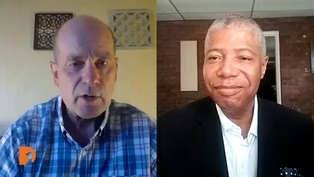
Who won, who lost in the 2022 Michigan Primary Election?
Video has Closed Captions
Clip: S6 Ep51 | 8m 21s | Nolan Finley and Greg Bowens discuss the 2022 Michigan primary election results. (8m 21s)
Providing Support for PBS.org
Learn Moreabout PBS online sponsorship
- News and Public Affairs

Top journalists deliver compelling original analysis of the hour's headlines.

- News and Public Affairs

FRONTLINE is investigative journalism that questions, explains and changes our world.












Support for PBS provided by:
One Detroit is a local public television program presented by Detroit PBS