
Michigan U.S. Senate race, AI for Mobility, Detroit Opera, Weekend events
Season 8 Episode 39 | 26m 46sVideo has Closed Captions
Michigan U.S. senate race, AI for Mobility Program, Detroit Opera and upcoming events.
Contributors Stephen Henderson, Nolan Finley and Zoe Clark weigh in on a tight Michigan senate race ahead of the 2024 election. Wayne State University’s AI for Mobility Program seeks to improve Detroit’s public transit system. Detroit Opera presents two new operas making their Detroit premiere. Plus, ways to celebrate Easter Sunday, the spring season and more on “One Detroit Weekend.”
Problems playing video? | Closed Captioning Feedback
Problems playing video? | Closed Captioning Feedback
One Detroit is a local public television program presented by Detroit PBS
Michigan U.S. Senate race, AI for Mobility, Detroit Opera, Weekend events
Season 8 Episode 39 | 26m 46sVideo has Closed Captions
Contributors Stephen Henderson, Nolan Finley and Zoe Clark weigh in on a tight Michigan senate race ahead of the 2024 election. Wayne State University’s AI for Mobility Program seeks to improve Detroit’s public transit system. Detroit Opera presents two new operas making their Detroit premiere. Plus, ways to celebrate Easter Sunday, the spring season and more on “One Detroit Weekend.”
Problems playing video? | Closed Captioning Feedback
How to Watch One Detroit
One Detroit is available to stream on pbs.org and the free PBS App, available on iPhone, Apple TV, Android TV, Android smartphones, Amazon Fire TV, Amazon Fire Tablet, Roku, Samsung Smart TV, and Vizio.
Providing Support for PBS.org
Learn Moreabout PBS online sponsorship- [Will] Coming up on "One Detroit."
We'll check in on the race to fill US Senator Debbie Stabenow's seat with ""One Detroit"" contributor Stephen Henderson, Zoe Clark, and Nolan Finley.
Plus, an artificial intelligence project that could improve the way Detroiters get around the city.
Also ahead, Detroit Opera's Artistic Director talks about the theater spring lineup.
And we'll give you some ideas on things you and your family can do over the Easter weekend.
It's all coming up next on "One Detroit".
- [Announcer] From Delta faucets to Behr paint, Masco Corporation is proud to deliver products that enhance the way consumers all over the world experience and enjoy their living spaces.
Masco, serving Michigan communities since 1929.
Support for this program is provided by the Cynthia and Edsel Ford Fund for Journalism at Detroit Public TV.
- [Announcer] The DTE Foundation is a proud sponsor of Detroit Public TV.
Among the state's largest foundations committed to Michigan-focused giving.
We support organizations that are doing exceptional work in our state.
Visit dtefoundation.com to learn more.
- [Announcer] Nissan Foundation and viewers like you.
(upbeat music) - [Will] Just ahead on "One Detroit," Wayne State University is working on a project using artificial intelligence that will improve mobility for Detroit bus riders.
Plus, Detroit Opera encourages visitors to the NFL draft to check out its cultural and architectural history.
And Cecelia Sharpe and Dave Wagner of 90.9 WRCJ have suggestions for how to spend the Easter weekend.
But first up, the race for the US Senate seat soon to be vacated by Michigan Democrat Debbie Stabenow is heating up.
The latest polls show former US representative Mike Rogers, a Republican endorsed by former president Donald Trump, is in a tight race with the Democratic frontrunner, US Representative Elissa Slotkin.
"One Detroit" contributors Stephen Henderson of "American Black Journal," Nolan Finley from the Detroit News, and Zoe Clark of Michigan Public weighed in on the contenders.
(upbeat music) - So Zoe Clark and Nolan Finley, among the other electoral treats that we have this year in Michigan, we've got a Senate race with an open Senate seat because Debbie Stabenow, who has been in the Senate since 2001, says she's not running again.
That's a rarity in and of itself.
It is gonna be a contested race, obviously, but within the Republican party, the primary is looking to be contested.
I'm gonna set it up this way.
Republicans have not won a Senate race in Michigan since 1994.
That's a long time, do they have any shot, do they have any shot here of doing it in a year where they got a lot of other problems on their plate?
Nolan, I'll start with you.
- Oh yeah, I think they have a shot.
I mean, a lot of this depends what happens with the top of the ticket.
I think we saw four years ago when John James ran against Gary Peters and lost a narrow race when Trump lost the state.
Those races in a presidential year particularly depend on the top of the ticket to pull them through.
And so if Trump does well in Michigan, I think he could pull Mike Rogers or Peter Meyer or whomever the nominee is across the finish line.
But if the presidential race doesn't go the Republicans' way, I don't think they can win the Senate.
- The other thing I'm fascinated too, to Nolan's point about top of the ticket, like that tends to be what we see.
We saw it in '22, right?
Not with any open Senate races,, but with Governor Gretchen Whitmer winning by double digits that ended up lifting along with some changing of redistricting and new maps for the first time in 40 years, Democrats to hold control.
But what I'm gonna be really interested about, and I would love to hear both of your thoughts about this, if we might see some tickets splitting.
We know that Michiganders sometimes vote Republican for one race, Democrats for the other.
And because we know right now that that top of the ticket aren't the most popular candidates, it's fair to say, I'm really curious if you may see some Republicans holding their noses and voting for establishment Republicans, let's say, and voting for Biden, but then saying, "You know what, I'm gonna vote for Mike Rogers instead."
And just trying to sort of somehow even this out.
- I think you might see independents doing that.
I think you'll definitely see independents doing that.
I don't see a whole lot of Republicans voting for Joe Biden.
It's not like it was four years ago.
I mean, they know Joe Biden now, and they've seen him.
I think the most likely place you'll see disenfranchised Republicans go at the top of the ticket is just to leave it blank.
So I do think independents may do that.
I doubt many Democrats will do that.
I don't think any Democrats will do that.
And I really don't see Republicans going that way.
- So I actually think Republicans are cursed when it comes to the Senate in Michigan.
If you think about all the things that have happened, all the opportunities they've had to win just one of those seats in the last 30 years.
We've seen this scenario before where you've got a Democrat who's not maybe terribly popular at the top of the ticket.
You had George W. Bush at the top of the ticket during a war, and it wouldn't pull somebody across the finish line.
There's something about the candidates, I think, that they choose to run in these races that turns people off.
And this year someone like Mike Rogers, who used to be a really respectable member of the delegation in Washington from Michigan, is now married to Donald Trump and his politics.
And I don't see how Republican voters or Democratic voters would separate him from the question of Trump, especially if Trump is on the ballot at the top of the ballot.
Someone like Peter Meyer would be a good compromise candidate.
That's somebody that you could get independents and maybe even some Democrats to vote for if they don't like Elissa Slotkin.
But he has almost no shot in the primary because the party's such a mess.
- No, and I think without Trump this year, I mean, if things trend like they are trending, he doesn't have a shot in either race, I think, I mean, all the polls look still at this point fairly good for Donald Trump in Michigan, and Peter Meyer would probably be a better candidate for Democrats, but I don't see Democrats leaving Elissa Slotkin.
So I don't know where you gain votes in in that equation.
I think if Mike Rogers runs his own race, the Trump support will help him.
And I don't know, I mean, people know him.
He's had a good reputation.
I don't think he's going to lose that many Republican voters.
Question is how many independents can you pick up and which way they lean in this election?
- Yeah, I mean, really what's fascinating is this Republican primary.
I mean, you were at a Baker's dozen, you had Nikki Snyder who just dropped out of the US Senate race to run for Congress.
And so, I mean, really what you're gonna see, if all of these folks get their names on the ballots, which we've seen as being an issue recently in recent history here in Michigan, there's just gonna be a plurality of whoever is going to win.
I mean, it would be shocking if one of these candidates within the Republican party actually wins 50 plus one in this primary.
And so what you're gonna see is smaller numbers.
And I think it would have been hard for a Mike Rogers and a Peter Meyer and a Sandy Pesnsler to split all of those votes in the primary, except for this news that I think took a number of folks by surprise, which was this early Donald Trump endorsement of Mike Rogers after Mike Rogers had said some things that were not super kind about the former president, and we know that the former president tends to hold a grudge.
I thought that was really interesting and could be what gets him through this primary into the general.
- Yeah, I mean, the Trump endorsement, I don't know if that helps or hurts in the primary.
It probably helps this time around.
I interviewed Mike Rogers when he said he was gonna run, and he had a hard time articulating some of the answers to questions about the election in 2020.
He wouldn't commit to the fact that Joe Biden had won.
He had a hard time articulating what we should think about January 6th.
I think these are issues that are gonna sink Republican candidates this fall.
I'm not sure what role Donald Trump plays in all of that, ultimately in the primary, but I do think that when you're talking about a general election, it's gonna be really tough to maintain voters' support and confidence when they can't be clear on things that are not debatable and that voters say are not debatable.
- I think state voters are gonna go to the polls this time, worried about immigration, worried about prices, worried about the drift in this country over the last four years and the lack of leadership under Democrats.
- The greatest job growth in the last 20 years.
- And still low participation in the workforce.
I mean, you can tell people all you want that they're doing great, but people, you look at what people are saying, you don't feel like they're doing great.
- What's your portfolio look like?
Mine's pretty good.
- I don't think it's a winning strategy, Steve, to tell voters, "Hey, you're not as bad off as you think you are."
I don't know that that's ever worked.
And that seems to be the Democratic strategy.
I mean, the issue that voters care about, I think Mike Rogers or Peter Meyer or even Sandy Pensler are going to speak very powerfully too.
I don't think they're gonna be looking back.
I mean, it may surprise you, it surprises me, it surprises most people.
I thought Donald Trump was done in 2021, but he's not.
And if you look at the poll and you look at his support, people have rightly or wrongly forgiven him his sins.
A lot of people have, and I think he's as competitive this election as he's ever been.
- Yeah, we'll see.
- Artificial intelligence continues to evolve, and here in Michigan, the technology could help transform public transit.
Wayne State University is working on an AI tool to improve the way Detroiters get around the city by making the bus system more reliable and efficient.
As part of "One Detroit's" Future of Work series, I spoke with a team behind the AI for Mobility project to find out how it would operate.
(upbeat music) Over the last few years, conversations around artificial intelligence or AI have grown.
From applications like ChatGPT writing just about anything you can think of to the recently showcased Sora that generates video from text, the uses for AI seem to grow daily, and that includes here in Michigan, in Detroit, at the Wayne State Computer Science Building, I spoke with professor of computer science Dr. Dongxiao Zhu whose goal is to use AI for social good.
Can you explain in, I guess, the simplest terms, what artificial intelligence is?
What are we talking about?
- Yeah, artificial intelligence is a sub-discipline of computer science.
So it's basically just help people, human beings, how to use computer to promote the productivity.
Artificial intelligence is artificial, not real, just to mimic some of the human actions like decision making.
But second is general intelligence, just behave, hopefully behave completely like a human.
- What are some of the AI applications that people have been using but may not realize it is indeed artificial intelligence?
- For example, you can use AI to schedule a meeting for you.
The companies can use the conversation agent to do the entry level customer service in the medical field so the AI can help to diagnosis and also prognosis.
Based on the images, the AI can automate the process to predict or whether there's a certain condition exist.
- Today, we hear mostly about the second generation of AI differentiated by its ability to think past simple yes or no decisions and complete tasks like summarizing entire books, generating creative works like images and video, or administrative paperwork based on what the user asks, which for today's workforce, can be both inspiring and frightening.
- Instead of being afraid of AI to take a job from the people, we should take it more positively, we should start thinking about how to use AI to help us, to promote the productivity and improving the outcomes.
- [Will] In response to a Civic Innovation Challenge award by the National Science Foundation and Department of Energy, Dr. Xhu and his team are developing an AI tool to improve public transit operations and options for Detroiters.
The efficiency and accessibility of public transit, sometimes referred to as mobility, plays a critical role in moving people around Detroit.
- So in this case, I mean, mobility is one of the primary interests from public, right?
So how to move freely and safely, right?
Especially for the people with disabilities.
- [Will] The AI tool would enable the Detroit Public Transit Service to accommodate writers' needs by adjusting bus routes more.
It would also improve the availability of on-demand rides known as microtransit and paratransit rides for people with disabilities more effectively.
The AI tool would use foot traffic data to see where most people need and use public transit combined with information through an app to make sure more buses and rides are available and on time.
Rafi Ibn Sultan on Dr. Xhu's team shows us how the AI tool would also improve rider's ability to navigate what's called the last mile, which is the distance a rider has to travel to their destination after they've been dropped off by creating a detailed map of sidewalks using aerial images from sources like Google.
- What if people, they are to have like disabilities?
So they need like a pedestrian networks, like where the sidewalks are, where the crosswalks are, how I can cross the street.
- [Will] When we contacted the Detroit Department of Transportation, they said it's too early to comment on potential AI solutions to current transit needs.
While the current app does show where buses are and gives estimated arrivals, it doesn't help them run on time or make other transit options more readily available.
- So the AI play a role here to determine when and where to deploy these resources to move the people to where they want to go.
- [Will] AI technology is still an emerging field with new developments and potential applications cropping up daily.
- Well, obviously it's exciting, like we're in the front seat of a car which is going to the future, right?
So we're actually working on something that is being developed like every day.
If you go in the research community, you'll say like 10 or 15 papers per day because everybody's working on it.
- [Will] AI-enhanced public transit would be a game changer that has the potential to push Detroit further into the future.
AI for mobility is just one area of Dr. Xhu's research, and it's still in the prototype stage, but overall, he's cautiously optimistic about the future.
- My optimistic estimate is next five years, we can fully realize the AGI, artificial general intelligence.
So that means AI can behave exactly like a human being in terms of any many things, not anything, may things.
- [Will] The spring season gets underway next month at Detroit Opera with a production of "Breaking the Waves" by composer Missy Mazzoli.
Then in May, "The Cunning Little Vixen," directed by Detroit Opera's Artistic Director Yuval Sharon takes the stage.
"One Detroit's" Sarah Zeintarski sat down with Sharon to talk about the upcoming shows and what makes Detroit Opera truly Detroit.
(upbeat music) (bright music) - How do you make Detroit Opera accessible to the community here in Detroit and Metro Detroit?
- I think we're trying to do a number of different things.
First of all, just a few years ago, we changed the name to Detroit Opera to really make sure everyone realizes how much pride we have being right here in the heart of downtown Detroit.
And I hope that signals to our public that we're all about Detroit and that we're all about the people that live in the Metro Detroit area, and that the operas that happen here, really one of my goals is to think, can we create productions here that you cannot really experience quite the same way anywhere else?
And so that's involved some world premiere productions, some new productions, and of course productions in various different venues around Detroit that I think really speak to a certain kind of character of what Detroit's about.
- What does the spring and summer look like for Detroit Opera?
- We have two other pieces on our main stage at the Detroit Opera House, both of which I'm really excited about.
One is, and they're both, you know, what I'm really excited about both of them is that they are firsts for Detroit Opera to be doing these pieces.
One of them is the first time we've ever done an opera on the main stage written by a woman named Missy Mazzoli, who is known as kind of the Mozart of her generation is what New York Magazine, I believe, called her with good reason.
She is an incredible composer, beautiful work that she's written called "Breaking the Waves," which is based on the Lars von Trier film and is actually an incredibly engaging and powerful story.
Pretty dark, it's not for the faint of heart, but it is an absolutely ravishing musical score that I think anyone that comes is gonna be completely captivated by.
So I'm really looking forward to that in April.
And I'm gonna be directing a piece called "The Cunning Little Vixen" in May, which after a piece that is so brooding and dark like ""Breaking the Waves," it's really nice to end the season with a comedy and one that is really good I think for the whole family.
It's a 90 minute piece called "The Cunning Little Vixen."
It is by the Czech composer Leos Janacek and it's based on a comic strip that he read in the newspaper.
And so for our production, we're taking that comic strip aspect really seriously.
There are screens that are up where the singers are basically gonna open portals in the screen, stick their head through the screen, and their bodies will be animated as the animals.
And we'll see the animals running all over the screen.
And the singers have to close these portals and kind of pop up in exactly the right spot to line up with their bodies.
But something really playful, I think really joyful.
Also, some of the most beautiful music I think that's been written for opera and the first time that we've ever performed either this opera or the composer.
And so for me sometimes people think opera is something that people think, I know everything about opera, it's Puccini, it's verity, it's et cetera.
But there is so much more to explore always with opera.
There's so many new directions that it's going and have gone, you know, that opera has gone that I am so excited to be exploring with Detroit audiences.
- Yeah, I love how you're taking these operas and making it like almost modern.
We were here for "Madame Butterfly."
How you took that opera and created this virtual reality space, it was incredible, really blew you away, but then you still had the music that was just so compelling and beautiful as always.
And then "Ainadamar."
- I loved "Ainadamar."
"The Fountain of Tears" was really one one of my favorites I think during my time here.
I mean really it's something that in the case of "Madame Butterfly," I do hope audiences realize it's like the music stays the same, but when the visual changes, you plug into this music in a totally different way.
I think for people that didn't know "Madame Butterfly," maybe they went home to study it or to listen to it on Spotify or Apple Music or however they like to listen to music, it hopefully piqued their interest in what was originally supposed to happen versus why did the director make these choices to take us into a virtual reality space, and what kind of illumination does that bring to a piece.
And so I've been really excited that we could offer that for every single piece that we do.
- So April 25th through 27th, the NFL draft is coming here, your next door neighbor, Ford Field.
So what is the Detroit Opera, do you have anything going on those dates?
- For people interested in architectural history, how that relates to culture, we definitely do tours of the building and it's really well worth the tour because the building itself is over a hundred years old and has gone through so many different lives.
And we have great Dawsons that can tell so many fantastic stories about the life of this theater, the Detroit Opera House.
And I think that that's something that I hope we can continue doing, which is give people one reason to keep exploring.
And I hope that as they come here, they'll discover their own reasons to come back, not just the opera, but everything else that Detroit I think has to offer.
(bright opera music) - [Will] Easter weekend is here.
And you'll find plenty of holiday-themed activities throughout Metro Detroit.
Plus, March Madness is taking over the city.
Cecelia Sharpe and Dave Wagner of 90.9 WRCJ have a rundown of events to check out in today's One Detroit Weekend.
- Hey Dave, I love being able to sit here with you and talk about the incredible events that the city has in store for us.
So what are you gonna start us off with, Dave?
- Oh, I've got some great stuff.
Starting Friday, the musical "Children of Eden" takes the main stage at the Baldwin Theater.
It's put on by stage crafters, and the production takes on the relationships of parents with their children, with the ultimate message being the hardest part of love is letting go - [Cecelia] Through March 31st is the always anticipated Ann Arbor film festival.
The event screens more than 180 films from over 20 countries in 40 different categories.
Be sure to check out this staple that's the oldest avant-garde and experimental film festival in North America.
- Oh yeah, that's been around since what, 1963?
- About as long as you've been around, right Dave?
- [Dave] That's funny.
- Well you know I love you Dave.
And on Saturday, get into the spring holiday spirit with Easter Jazz 24 with Incognito and Norman Brown at the Fisher Theater.
- [Dave] Some more Easter fun is taking place at the Leslie Science and Nature Center with the Spring Eggstravaganza Saturday from 10:00 AM to noon, kids can do a craft, take part in a scavenger egg hunt, and see just which animals in nature lay those eggs in the critter house.
- [Cecelia] Let's keep the spring theme going with Spring into Science, running through March 30th.
The hands-on activities include beehive keeping, exploring creepy invasive in the Great Lakes, checking out spring wildflowers, and much more.
- Opening your eyes to the magic of nature in the springtime really is a great way to spend the weekend, Cecilia.
And there's always so much more happening in and around Detroit.
So here's a few more events (upbeat music) - [Will] That'll do it for this week's "One Detroit."
Thanks for watching.
Head to the "One Detroit" website for all the stories we're working on, follow us on social media, and sign up for our weekly newsletter.
(upbeat music continues) - [Announcer] From Delta Faucets to Behr paint, Masco Corporation is proud to deliver products that enhance the way consumers all over the world experience and enjoy their living spaces.
Masco, serving Michigan communities since 1929.
Support for this program is provided by the Cynthia and Edsel Ford Fund for Fournalism at Detroit Public TV.
- [Announcer] The DTE Foundation is a proud sponsor of Detroit Public TV.
Among the state's largest foundations committed to Michigan-focused giving.
We support organizations that are doing exceptional work in our state.
Visit dtefoundation.com to learn more.
- [Announcer] Nissan Foundation, and viewers like you.
(upbeat music) (bright music)
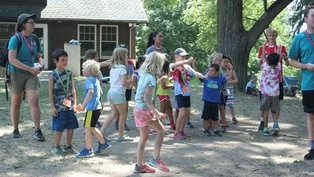
One Detroit Weekend: March 29, 2024
Video has Closed Captions
Clip: S8 Ep39 | 2m 11s | Celebrate Easter Sunday, the start of spring and more around metro Detroit this weekend. (2m 11s)
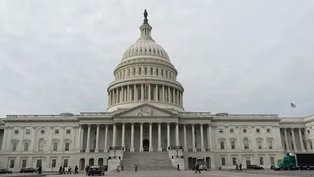
Republicans, Democrats vie for open Michigan senate seat
Video has Closed Captions
Clip: S8 Ep39 | 9m 10s | Republicans and Democrats in a tight race for Michigan’s open Senate seat. (9m 10s)
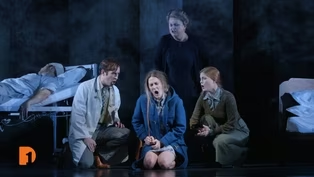
Two new operas close out Detroit Opera’s spring season
Video has Closed Captions
Clip: S8 Ep39 | 5m 9s | “Breaking the Waves,” “Cunning Little Vixen” closes out Detroit Opera’s spring season. (5m 9s)
Wayne State University creates AI for Mobility Project
Video has Closed Captions
Clip: S8 Ep39 | 5m 14s | Wayne State University seeks to improve Detroit’s public transit system with AI. (5m 14s)
Providing Support for PBS.org
Learn Moreabout PBS online sponsorship
- News and Public Affairs

Top journalists deliver compelling original analysis of the hour's headlines.

- News and Public Affairs

FRONTLINE is investigative journalism that questions, explains and changes our world.












Support for PBS provided by:
One Detroit is a local public television program presented by Detroit PBS